


Puppy

Encyclopedia
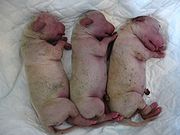
Juvenile (organism)
A juvenile is an individual organism that has not yet reached its adult form, sexual maturity or size. Juveniles sometimes look very different from the adult form, particularly in terms of their colour...
dog
Dog
The domestic dog is a domesticated form of the gray wolf, a member of the Canidae family of the order Carnivora. The term is used for both feral and pet varieties. The dog may have been the first animal to be domesticated, and has been the most widely kept working, hunting, and companion animal in...
. Some puppies may weigh 1 pound, while larger ones can weigh up to 15 pound. All healthy puppies grow quickly after birth. A puppy's coat color may change as the puppy grows older, as is commonly seen in breeds such as the Yorkshire Terrier
Yorkshire Terrier
The Yorkshire Terrier is a small dog breed of terrier type, developed in the 19th century in the county of Yorkshire, England to catch rats in clothing mills. The defining features of the breed are its size, to , and its silky blue and tan coat...
. In vernacular English, puppy refers specifically to dogs while pup may often be used for other mammals such as seals
Pinniped
Pinnipeds or fin-footed mammals are a widely distributed and diverse group of semiaquatic marine mammals comprising the families Odobenidae , Otariidae , and Phocidae .-Overview: Pinnipeds are typically sleek-bodied and barrel-shaped...
, giraffes, guinea pigs, or even rats
RATS
RATS may refer to:* RATS , Regression Analysis of Time Series, a statistical package* Rough Auditing Tool for Security, a computer program...
.
Development
Born after an average of 63 days of gestationGestation
Gestation is the carrying of an embryo or fetus inside a female viviparous animal. Mammals during pregnancy can have one or more gestations at the same time ....
, puppies emerge in an amnion
Amnion
The amnion is a membrane building the amniotic sac that surrounds and protects an embryo. It is developed in reptiles, birds, and mammals, which are hence called “Amniota”; but not in amphibians and fish , which are consequently termed “Anamniota”. The primary role of this is the protection of the...
that is bitten off and eaten by the mother dog. Puppies begin to nurse
Breastfeeding
Breastfeeding is the feeding of an infant or young child with breast milk directly from female human breasts rather than from a baby bottle or other container. Babies have a sucking reflex that enables them to suck and swallow milk. It is recommended that mothers breastfeed for six months or...
almost immediately. If the litter
Litter (animal)
A litter is the offspring at one birth of animals from the same mother and usually from one set of parents. The word is most often used for the offspring of mammals, but can be used for any animal that gives birth to multiple young. In comparison, a group of eggs and the offspring that hatch from...
exceeds six puppies, particularly if one or more are obvious runt
Runt
A runt is a smaller specimen in a group of animals, usually of offspring in a litter.Runt may also refer to:*Runt , a 1970 album by Todd Rundgren, originally credited to the band Runt...
s, human intervention in hand-feeding the stronger puppies is necessary to ensure that the runts get proper nourishment and attention from the mother. As they reach one month of age, puppies are gradually weaned
Weaning
Weaning is the process of gradually introducing a mammal infant, either human or animal, to what will be its adult diet and withdrawing the supply of its mother's milk.The process takes place only in mammals, as only mammals produce milk...
and begin
to eat solid food. The mother may regurgitate partially digested food for the puppies or might let them eat some of her solid food
to nurse, the mother dog usually refuses after this age, though she might let them occasionally nurse for comfort.
At first, puppies spend the large majority of their time sleeping and the rest feeding. They instinctively pile together into a heap, and become distressed if separated from physical contact with their littermates, by even a short distance.
Puppies are born with a fully functional sense of smell but can't open their eyes. During their first two weeks, a puppy's senses all develop rapidly. During this stage the nose is the primary sense organ used by puppies to find their mother's teats, and to locate their litter-mates, if they become separated by a short distance. Puppies open their eye
Eye
Eyes are organs that detect light and convert it into electro-chemical impulses in neurons. The simplest photoreceptors in conscious vision connect light to movement...
s about nine to eleven days following birth
Birth
Birth is the act or process of bearing or bringing forth offspring. The offspring is brought forth from the mother. The time of human birth is defined as the time at which the fetus comes out of the mother's womb into the world...
. At first, their retinas are poorly developed and their vision is poor. Puppies are not able to see as well as adult dogs. In addition, puppies' ears remain sealed until about thirteen to seventeen days after birth, after which they respond more actively to sounds. While between two to four weeks old, puppies usually begin to growl, bite, wag their tails, and bark.
Puppies develop very quickly during their first three months, particularly after their eyes and ears open and they are no longer completely dependent on their mother. Their coordination and strength improve, they spar
Sparring
Sparring is a form of training common to many martial arts. Although the precise form varies, it is essentially relatively 'free-form' fighting, with enough rules, customs, or agreements to make injuries unlikely...
with their litter-mates, and begin to explore the world outside the nest. They play wrestling, chase, dominance, and tug-of-war games.
Puppies are highly social animals and spend most of their waking hours interacting with either their mother or littermates.
It is important that puppies are socialized with humans, particularly between the ages of eight and twelve weeks, so as to encourage healthy interaction and develop the puppy's social skills around people. Puppies ideally should be exposed to as wide a variety of friendly people as possible during this period. Dogs that do not receive adequate socialization during this sensitive period may display fearful behavior around humans or other dogs as adults.
Docking and declawing
Some breeds traditionally have their tails cropped anywhere from slightly, partially to almost entirely. Some countries now ban cropping and docking for cosmetic purposes, while others have no such prohibitions. Some breeders also prefer to declaw the dogs to prevent future injuries caused by scratching, or in the case of dewclawDewclaw
A dewclaw is a vestigial digit on the foot of many mammals, birds, and reptiles . It commonly grows high on the leg so that in digitigrade species, when the animal is standing, it does not make contact with the ground...
s, ingrown and ripped off nails. Docking and declawing procedures are usually performed within the first few days after birth, by a veterinarian
Veterinarian
A veterinary physician, colloquially called a vet, shortened from veterinarian or veterinary surgeon , is a professional who treats disease, disorder and injury in animals....
, or by an experienced breeder. The practice of docking primarily began as a preventative measure for injury among dogs that worked in environments that led to a high incidence of tail injuries.
See also
- The Puppy ChannelThe Puppy ChannelThe Puppy Channel was a short-lived American cable television channel whose programming consisted entirely of video footage of puppies.The network was created in 1997 by retired advertising executive Dan FitzSimons. FitzSimons and his daughter Molly stated in a featured segment on This American...
- Sell a pupPig in a pokeThe idioms pig in a poke and sell a pup refer to a confidence trick originating in the Late Middle Ages, when meat was scarce, but cats and dogs were not...
, buy a pupPig in a pokeThe idioms pig in a poke and sell a pup refer to a confidence trick originating in the Late Middle Ages, when meat was scarce, but cats and dogs were not...
(idioms)