


Puente del Inca

Encyclopedia
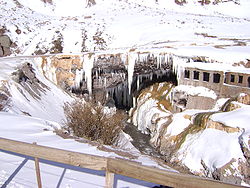
Natural arch
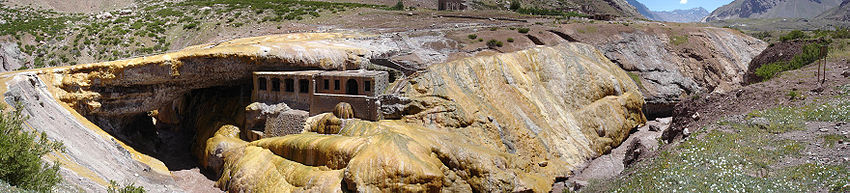
A natural arch or natural bridge is a natural geological formation where a rock arch forms, with an opening underneath. Most natural arches form as a narrow ridge, walled by cliffs, become narrower from erosion, with a softer rock stratum under the cliff-forming stratum gradually eroding out until...
that forms a bridge over the Vacas River, a tributary of the Mendoza River
Mendoza River
The Mendoza River is a river in the province of Mendoza, Argentina. It is formed in the Andes range between the Aconcagua and the Tupungato, by the confluence of the Vacas, the Cuevas and the Tupungato Rivers, the last being its major tributary....
. It is located in Mendoza Province
Mendoza Province
The Province of Mendoza is a province of Argentina, located in the western central part of the country in the Cuyo region. It borders to the north with San Juan, the south with La Pampa and Neuquén, the east with San Luis, and to the west with the republic of Chile; the international limit is...
, Argentina
Argentina
Argentina , officially the Argentine Republic , is the second largest country in South America by land area, after Brazil. It is constituted as a federation of 23 provinces and an autonomous city, Buenos Aires...
near Las Cuevas.
Puente del Inca is also the name of the nearby hot spring
Hot spring
A hot spring is a spring that is produced by the emergence of geothermally heated groundwater from the Earth's crust. There are geothermal hot springs in many locations all over the crust of the earth.-Definitions:...
s. Scientists speculate that interaction of extreme elements like ice and hot springs was involved in the origin of the formation. They suppose that in ancient times ice covered the river and acted as support for avalanches of snow, dust and rocks. So the dust over the ice over the river would have served as a path for the sulfurous water and petrified
Petrifaction
In geology, petrifaction, petrification or silicification is the process by which organic material is converted into stone by impregnation with silica. It is a rare form of fossilization...
the surface, so when the snow melted, the bridge remained by itself.
In March 1835, Charles Darwin
Charles Darwin
Charles Robert Darwin FRS was an English naturalist. He established that all species of life have descended over time from common ancestry, and proposed the scientific theory that this branching pattern of evolution resulted from a process that he called natural selection.He published his theory...
visited this natural marvel, and made some drawings of the bridge with great stalactites.
In the early twentieth century there was a big thermal resort and Spa
Destination spa
A destination spa is a short term residential/lodging facility with the primary purpose of providing individual services for spa-goers to develop healthy habits. Historically many such spas were developed at the location of natural hot springs or sources of mineral waters...
that used the hot springs to cure some illnesses (a spa still survives further down the river at Cacheuta
Cacheuta Spa
The Cacheuta Hot Springs are natural hot springs at Cacheuta on the Mendoza River in the foothills of the Andes....
). There was a train station that is still standing there, and tourists arrived by train to the resort. This was one of the last Argentine stations of the Transandine Railway before the train continued into Chile, traveling through a long tunnel under the Andes.
Climate
Situated at 2740 m (8,990 ft) above sea level, Puente del Inca has a cold semi-arid climate (BSk, according to the Köppen climate classificationKöppen climate classification
The Köppen climate classification is one of the most widely used climate classification systems. It was first published by Crimea German climatologist Wladimir Köppen in 1884, with several later modifications by Köppen himself, notably in 1918 and 1936...
), with moderate summers and snow
Snow
Snow is a form of precipitation within the Earth's atmosphere in the form of crystalline water ice, consisting of a multitude of snowflakes that fall from clouds. Since snow is composed of small ice particles, it is a granular material. It has an open and therefore soft structure, unless packed by...
y winters.