

Protosuchia

Encyclopedia
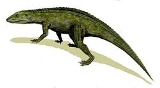
Protosuchia is a group of extinct Mesozoic crocodyliforms. They were small in size (~1 meter in length) and terrestrial
. In phylogenetic terms, Protosuchia is considered an informal group because it is a grade
of basal crocodyliforms, not a true clade
.
. However, two studies found a clade of Late Triassic
-Early Jurassic
animals:
Both of these studies also found a clade
more closely related to Hsisosuchus
and Mesoeucrocodylia
consisting of Late Jurassic
-Late Cretaceous
genera:
However, other possible protosuchians from the Late Cretaceous
of China
-Mongolia
, the Gobiosuchidae
(Gobiosuchus
and Zaraasuchus
), have been found to either intermediate between these two clades, or members of the Sichuanosuchus clade. There is also another family of Late Jurassic
-Late Cretaceous
genera, the Shartegosuchidae
(e.g. Kyasuchus
, Shartegosuchus
and Nominosuchus
).
Below is a cladogram
from Fiorelli and Calvo (2007). Protosuchians are marked by the green bracket.
Terrestrial animal
Terrestrial animals are animals that live predominantly or entirely on land , as compared with aquatic animals, which live predominantly or entirely in the water , or amphibians, which rely on a combination of aquatic and terrestrial habitats...
. In phylogenetic terms, Protosuchia is considered an informal group because it is a grade
Evolutionary grade
In alpha taxonomy, a grade refers to a taxon united by a level of morphological or physiological complexity. The term was coined by British biologist Julian Huxley, to contrast with clade, a strictly phylogenetic unit.-Definition:...
of basal crocodyliforms, not a true clade
Clade
A clade is a group consisting of a species and all its descendants. In the terms of biological systematics, a clade is a single "branch" on the "tree of life". The idea that such a "natural group" of organisms should be grouped together and given a taxonomic name is central to biological...
.
Classification
Recent phylogenetic analyses have not supported Protosuchia as a natural groupMonophyly
In common cladistic usage, a monophyletic group is a taxon which forms a clade, meaning that it contains all the descendants of the possibly hypothetical closest common ancestor of the members of the group. The term is synonymous with the uncommon term holophyly...
. However, two studies found a clade of Late Triassic
Late Triassic
The Late Triassic is in the geologic timescale the third and final of three epochs of the Triassic period. The corresponding series is known as the Upper Triassic. In the past it was sometimes called the Keuper, after a German lithostratigraphic group that has a roughly corresponding age...
-Early Jurassic
Early Jurassic
The Early Jurassic epoch is the earliest of three epochs of the Jurassic period...
animals:
- EdentosuchusEdentosuchusEdentosuchus is a genus of protosuchian crocodylomorph. It is known from fossils found in rocks of the Early Cretaceous-age Tugulu Group from the Junggar Basin, Xinjiang, China. Two partial skulls and several neck vertebrae are known to date...
- HemiprotosuchusHemiprotosuchusHemiprotosuchus is an extinct genus of protosuchid from the Norian stage of the Los Colorados Formation of South America. It was named by prolific Argentinian paleontologist José Bonaparte in 1969. The type species is H. leali.-External links:...
- OrthosuchusOrthosuchusOrthosuchus is an extinct genus of protosuchian crocodyliform that lived during the Early Jurassic....
- ProtosuchusProtosuchusProtosuchus is an extinct genus of carnivorous crocodylomorph from the Early Jurassic. The name Protosuchus means "first crocodile", and is among the earliest animals that resemble crocodilians...
Both of these studies also found a clade
Clade
A clade is a group consisting of a species and all its descendants. In the terms of biological systematics, a clade is a single "branch" on the "tree of life". The idea that such a "natural group" of organisms should be grouped together and given a taxonomic name is central to biological...
more closely related to Hsisosuchus
Hsisosuchus
Hsisosuchus is an extinct genus of crocodyliform from China. Currently there are three species within this genus. H. chungkingensis and H. chowi are from the Late Jurassic. H. dashanpuensis is from the Middle Jurassic....
and Mesoeucrocodylia
Mesoeucrocodylia
Mesoeucrocodylia is the name of the clade that includes Eusuchia and the paraphyletic group Mesosuchia. The group appeared during the Early Jurassic, and continues to the present day....
consisting of Late Jurassic
Late Jurassic
The Late Jurassic is the third epoch of the Jurassic Period, and it spans the geologic time from 161.2 ± 4.0 to 145.5 ± 4.0 million years ago , which is preserved in Upper Jurassic strata. In European lithostratigraphy, the name "Malm" indicates rocks of Late Jurassic age...
-Late Cretaceous
Late Cretaceous
The Late Cretaceous is the younger of two epochs into which the Cretaceous period is divided in the geologic timescale. Rock strata from this epoch form the Upper Cretaceous series...
genera:
- NeuquensuchusNeuquensuchusNeuquensuchus is an extinct genus of basal crocodyliform from the Santonian-age Upper Cretaceous Bajo de la Carpa Formation of Neuquén Province, Argentina. The known remains were discovered on the campus of Universidad Nacional del Comahue in the city of Neuquén. Neuquensuchus was named by Lucas...
- ShantungosuchusShantungosuchusShantungosuchus is an extinct genus of Cretaceous crocodyliform found in China. It includes three species: Shantungosuchus chuhsienensis, and S. brachycephalus, which were both described by Yang Zhongjian – usually referred to as "Young" – in 1961 and 1982, and S. hangjinensis, which...
- SichuanosuchusSichuanosuchusSichuanosuchus is an extinct genus of crocodylomorph from the Late Jurassic and possibly Early Cretaceous of China.-References:* Chinese Fossil Vertebrates by Spencer G. Lucas...
- ZosuchusZosuchusZosuchus is a genus of basal, Late Cretaceous crocodyliform from the Redbeds of Zos Canyon in the Gobi Desert of Mongolia. It was discovered by expeditions organized by the American Museum of Natural History, and described by palaeontologists Diego Pol and Mark Norell.The type species is Z...
However, other possible protosuchians from the Late Cretaceous
Late Cretaceous
The Late Cretaceous is the younger of two epochs into which the Cretaceous period is divided in the geologic timescale. Rock strata from this epoch form the Upper Cretaceous series...
of China
China
Chinese civilization may refer to:* China for more general discussion of the country.* Chinese culture* Greater China, the transnational community of ethnic Chinese.* History of China* Sinosphere, the area historically affected by Chinese culture...
-Mongolia
Mongolia
Mongolia is a landlocked country in East and Central Asia. It is bordered by Russia to the north and China to the south, east and west. Although Mongolia does not share a border with Kazakhstan, its western-most point is only from Kazakhstan's eastern tip. Ulan Bator, the capital and largest...
, the Gobiosuchidae
Gobiosuchidae
Gobiosuchidae is a family of Late Cretaceous crocodyliforms that lived in what is now the Gobi Desert in Mongolia.- Genera :The two genera currently classified within Gobiosuchidae are Gobiosuchus and Zaraasuchus.- Synapomorphies :...
(Gobiosuchus
Gobiosuchus
Gobiosuchus was a gobiosuchid crocodyliform described in 1972 by Polish palaeontologist Halszka Osmólska. It hails from the Late Cretaceous of Bayn Dzak , in the Gobi Desert of Mongolia....
and Zaraasuchus
Zaraasuchus
Zaraasuchus was a gobiosuchid crocodyliform described in 2004 by Diego Pol and Mark Norell. It was found in the Red Beds of Zos Canyon, in the Gobi Desert of Mongolia, thus making it Late Cretaceous in age....
), have been found to either intermediate between these two clades, or members of the Sichuanosuchus clade. There is also another family of Late Jurassic
Late Jurassic
The Late Jurassic is the third epoch of the Jurassic Period, and it spans the geologic time from 161.2 ± 4.0 to 145.5 ± 4.0 million years ago , which is preserved in Upper Jurassic strata. In European lithostratigraphy, the name "Malm" indicates rocks of Late Jurassic age...
-Late Cretaceous
Late Cretaceous
The Late Cretaceous is the younger of two epochs into which the Cretaceous period is divided in the geologic timescale. Rock strata from this epoch form the Upper Cretaceous series...
genera, the Shartegosuchidae
Shartegosuchidae
Shartegosuchidae is an extinct family of Late Jurassic and Early Cretaceous crocodylomorphs. The family is named after the Late Jurassic Shar Teeg Beds in southwestern Mongolia, from which most shartegosuchid remains have been found. Four genera are currently assigned to Shartegosuchidae:...
(e.g. Kyasuchus
Kyasuchus
Kyasuchus is an extinct genus of shartegosuchid crocodylomorph. Fossils have been found from the Ilek Formation outcropping in the Kemerovo Oblast of Russia, deposited during the Aptian and Albian stages of the Early Cretaceous...
, Shartegosuchus
Shartegosuchus
Shartegosuchus is a genus of protosuchian-grade crocodylomorph. It is known primarily from PIN 4174/2, the partial deformed skull and jaws of a juvenile. This specimen was discovered in ancient lake deposits of the Tithonian-age Upper Jurassic Tsagaantsav Formation, southwestern Mongolia. ...
and Nominosuchus
Nominosuchus
Nominosuchus is a genus of protosuchian-grade crocodylomorph. It is known from several specimens discovered in ancient lake deposits of the Tithonian-age Upper Jurassic Tsagaantsav Formation, southwestern Mongolia. The type specimen is PIN 4174/4, a partial skull. Nominosuchus was not...
).
Below is a cladogram
Cladogram
A cladogram is a diagram used in cladistics which shows ancestral relations between organisms, to represent the evolutionary tree of life. Although traditionally such cladograms were generated largely on the basis of morphological characters, DNA and RNA sequencing data and computational...
from Fiorelli and Calvo (2007). Protosuchians are marked by the green bracket.