

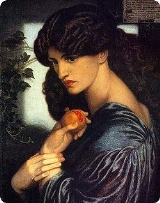
Proserpina

Overview
Proserpina or Proserpine (ˈ) is an ancient Roman goddess
whose story is the basis of a myth
of Springtime
. Her Greek
goddess' equivalent is Persephone
. The probable origin of her name comes from the Latin, "proserpere" or "to emerge," in respect to the growing of grain. Proserpina was subsumed by the cult of Libera
, an ancient fertility goddess
, wife of Liber
and is also considered a life–death–rebirth deity
.
She was the daughter of Ceres, goddess of agriculture and crops and Jupiter
, the god of sky and thunder.
Venus
, in order to bring love to Pluto
, sent her son Amor also known as Cupid
to hit Pluto with one of his arrows.
Goddess
A goddess is a female deity. In some cultures goddesses are associated with Earth, motherhood, love, and the household. In other cultures, goddesses also rule over war, death, and destruction as well as healing....
whose story is the basis of a myth
Mythology
The term mythology can refer either to the study of myths, or to a body or collection of myths. As examples, comparative mythology is the study of connections between myths from different cultures, whereas Greek mythology is the body of myths from ancient Greece...
of Springtime
Spring (season)
Spring is one of the four temperate seasons, the transition period between winter and summer. Spring and "springtime" refer to the season, and broadly to ideas of rebirth, renewal and regrowth. The specific definition of the exact timing of "spring" varies according to local climate, cultures and...
. Her Greek
Greek mythology
Greek mythology is the body of myths and legends belonging to the ancient Greeks, concerning their gods and heroes, the nature of the world, and the origins and significance of their own cult and ritual practices. They were a part of religion in ancient Greece...
goddess' equivalent is Persephone
Persephone
In Greek mythology, Persephone , also called Kore , is the daughter of Zeus and the harvest-goddess Demeter, and queen of the underworld; she was abducted by Hades, the god-king of the underworld....
. The probable origin of her name comes from the Latin, "proserpere" or "to emerge," in respect to the growing of grain. Proserpina was subsumed by the cult of Libera
Libera (mythology)
Libera is a fertility goddess in ancient Roman religion. Her origins are unknown; she may have been a fertility goddess of archaic or pre-Roman Magna Graecia. Her Latin name is the feminine form of Liber,...
, an ancient fertility goddess
Fertility goddess
A fertility deity is a god or goddess in mythology associated with fertility, pregnancy, and birth. In some cases these deities are directly associated with sex, and in others they simply embody related attributes...
, wife of Liber
Liber
In ancient Roman religion and mythology, Liber , also known as Liber Pater was a god of viticulture and wine, fertility and freedom. He was a patron deity of Rome's plebeians and was part of their Aventine Triad. His festival of Liberalia became associated with free speech and the rights...
and is also considered a life–death–rebirth deity
Life-death-rebirth deity
A dying god, also known as a dying-and-rising or resurrection deity, is a god who dies and is resurrected or reborn, in either a literal or symbolic sense. Male examples include the ancient Near Eastern and Greek deities Baal, Melqart, Adonis, Eshmun, Attis Tammuz, Asclepius, Orpheus, as well as...
.
She was the daughter of Ceres, goddess of agriculture and crops and Jupiter
Jupiter (mythology)
In ancient Roman religion and myth, Jupiter or Jove is the king of the gods, and the god of the sky and thunder. He is the equivalent of Zeus in the Greek pantheon....
, the god of sky and thunder.
Venus
Venus (mythology)
Venus is a Roman goddess principally associated with love, beauty, sex,sexual seduction and fertility, who played a key role in many Roman religious festivals and myths...
, in order to bring love to Pluto
Pluto (mythology)
In ancient Greek religion and myth, Pluto was a name for the ruler of the underworld; the god was also known as Hades, a name for the underworld itself...
, sent her son Amor also known as Cupid
Cupid
In Roman mythology, Cupid is the god of desire, affection and erotic love. He is the son of the goddess Venus and the god Mars. His Greek counterpart is Eros...
to hit Pluto with one of his arrows.
Unanswered Questions
