

Polylepis

Encyclopedia
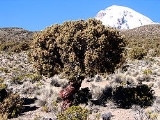
Polylepis is a genus containing about twenty species of shrubs or trees native to the mid- and high-elevation regions of the tropical Andes. This group is unique in the rose family in that it is predominantly wind-pollinated. They are usually gnarled in shape, but in certain areas some trees are 15-20 m tall and have 2 m-thick trunks. The foliage is evergreen, with dense small leaves, and often having large amounts of dead twigs hanging down from the underside of the canopy. The name Polylepis is, in fact, derived from the Greek words poly (many) plus letis (layers), referring to the shredding, multi-layered bark that is common to all species of the genus. The bark is thick and rough and densely layered for protection against low temperatures
Some species of Polylepis form woodlands growing well above normal tree line within grass and scrub associations at elevations over 5000 m; which makes Polylepis appear to be the highest natural occurring arborescent
angiosperm genus in the world.
is largely unknown, the analysis of Erickssonn et al. (2003) showed evidence of a close relationship between Polylepis and Acaena
, which shows tendencies towards having fused stipular sheaths, reddish, flaking-off bark, and axillary, somewhat pendant inflorescences, features otherwise only characteristic of Polylepis. There are several characteristics that are important taxonomically to distinguish between species of Polylepis, for example: 1) The amount of leaf congestion, 2) presence or absence of spurs and their size and vestiture, 3) presence or absence and type of trichomes, (4) size, shape, thickness and vestiture of leaflets. The most important taxonomic character, however, is the leaflets.
Studies suggest that repeated fragmentation and reconnection of paramo
vegetation, caused by the Pleistocene
climatic fluctuations, had a strong influence on the evolution and speed of speciation in the genus Polylepis as well as the paramo
biota as a whole.
There is much debate on whether Polylepis was forced to exhibit such extreme elevation habitats due to habitat destruction by human interference. Physiological tolerances for growth at these elevations are subject to considerable debate among scientists, but evidence indicates that even before severe decimation by man, high elevation trees were limited in their distribution by the presence of specialized microhabitats. Due to the harsh environment in which many species of Polylepis grow the growth of the tree’s stems and branches are generally contorted. This abnormal growth is often associated with windy, cold or arid habitats. The climate of the South American Andes changes drastically throughout the region creating lots of microhabitats. Overall, the climate consists of short southern summers when temperatures are warm and rainfall is high and long winters when temperatures are low and rainfall is limited. The temperature and amount of rainfall also depend on which side of the mountain (eastern or western side), elevation and latitude.
: The bark of Polylepis consists of numerous layers of thin, dark red exfoliating sheets. In some cases, the layered bark can be more than an inch thick. A majority of the larger branches have similar shredding bark. It would seem that the bark serves as insulation from both the nightly frosts and the intense daytime irradiation. The thick bark of Polylepis also serves an important function as protection against fire and isolation against nocturnal frosts. It is thought to originally have been a protection against epiphytic mosses, whose thick masses may damage trees by adding weight to the branches and providing a suitable environment for fungi which attack the trees.
Branching Pattern and Leaf Arrangement: Polylepis trees tend to have twisted, crooked stems and branches with repeated sympodial
branching. Contorted growth is often associated with windy, cold, or arid habitats. The leaves are generally congested along the branch tips often at the end of long, naked branch segments.
Stipule
Sheath: Each leaf has a pair of stipules fused around the branch forming a sheath. The crowding of the leaves results in a pattern of stacked, inverted cones due to the overlapping of the stipule sheaths. On the top of the sheaths on either side of the petiole there are often projections, or spurs. The presence or absence of these spurs and their size are important taxonomic characteristics.
Leaves and Leaflets: All species of Polylepis have compound, imparipinnate leaves, but the number of pairs of leaflets varies within and between species. The arrangement of the leaflets and the position from the terminal leaflet of the largest pair of leaflets determine the shape of the leaf. The outline of the leaf is usually rhombic in species with one pair of leaflets. Depending on the position of the largest pair, the leaf can be trullate to obtrullate in taxa with more than one leaflet pair.
Leaf Anatomy: The leaves of all species are built on a dorsiventral
arrangement of cells, with the epidermis
and palisade
layer on the adaxial surface and the spongy tissue on the abaxial surface.
of Polylepis can be described as monads, isopolar, and more or less spheroidal to slightly oblate in shape. They have both an elongated and rounded aperture and the limits of the endoaperture (the inner openings of compound the aperture) are obscure. The elongated part of the aperture is completely covered by a pontoperculum
The fruits of Polylepis are essentially achenes composed of the floral cup fused to the ovary. Fruits of all species are indehiscent (they do not open at maturity) and one seeded. The surface of the fruit of different species has ridges, knobs, spines or wings. There are no definite sites for the placement of these different types of protrusions that appear irregularly over the surface. The type of protrusion, wings verses spines, or knobs versus wings, is useful for distinguishing between species.
The flowers of all species of the genus are born on inflorescences. In most cases the inflorescences are long enough to hang like a pendant, but in the westernmost populations of P. tomentella and in at least one population of P. pepei, the inflorescence is so reduced that it remains almost hidden in the leaf axil. In the species with pendant inflorescences, the flowers are born regularly along the rachis or clustered toward the terminal end. The flowers themselves are reduced and have many features associated with wind pollination. These include: the absence of petals, green rather than colored sepals, an absence of scent or nectar, numerous anthers with long filaments, abundant, dry pollen, a large, spreading, fine fringed stigma, compounded pinnate leaves and the growth of trees in strands.
The fruits of all species must be wind dispersed because members of the genus are trees and are thus too tall for animals (presumably mammals) to brush against on the ground. However, the elaboration of spines on the fruits of many taxa would argue for animal dispersal although wind dispersal undoubtedly predominates in P. australis. Numerous birds forage or live in Polylepis trees and it is possible that they disperse fruits caught in their feathers.
changes. In midday, the temperatures may reach somewhere around 10-12° C (or higher). This causes the soil lower than the top 30 cms to maintain a constant temperature of about 2-5 ° C (or lower) all year. Thus plants must stay active throughout the year and do not become dormant. Given these harsh circumstances, the growth of trees in such areas should be impossible. The reasons for Polylepis’ ability to inhabit such conditions have been studied by many. Carl Troll, for example, considered Polylepis to be a distinct type of vegetation and he claimed one of the reasons for their survival is the presence of microclimatic phenomena such as the formation of cloud layers on slopes and along low drainage areas, prevented nighttime freezes and producing what he called “lower elevation” conditions. Another study was done by Hoch and Korner which provided that Polylepis has slow growth making it a weak competitor. Therefore, if the temperatures become warmer and more humid, Polylepis tends to lose out to the species that are more vigorous.
To find out more about this project, visit the website
and habitats for endangered animals. In some countries, conservation
and reforestation
measures are underway.
Some species of Polylepis form woodlands growing well above normal tree line within grass and scrub associations at elevations over 5000 m; which makes Polylepis appear to be the highest natural occurring arborescent
Arborescent
Arborescent is a term used by the French thinkers Deleuze and Guattari to characterize thinking marked by insistence on totalizing principles, binarism and dualism...
angiosperm genus in the world.
Classification/Taxonomy
The genus Polylepis is very complicated taxonomically. It contains about twenty species that are distributed across the Andes. It is in the family Rosaceae, commonly known as the roses. The family belongs to the tribe Sanguisorbeae, which mainly comprises of herbs and small shrubs. Although the relationship of Polylepis to other genera of SanguisorbeaeSanguisorbeae
Sanguisorbeae is a tribe of the rose family, Rosaceae. It contains 16 genera in two subtribes, Agrimoniinae and Sanguisorbinae.-References:*Eriksson, Torsten; Malin S. Hibbs, Anne D. Yoder, Charles F. Delwiche, Michael J. Donoghue...
is largely unknown, the analysis of Erickssonn et al. (2003) showed evidence of a close relationship between Polylepis and Acaena
Acaena
Acaena is a genus of about one hundred species of perennial herbs and subshrubs in the Rosaceae, native mainly to the Southern Hemisphere, notably New Zealand, Australia and South America, but with a few species extending into the Northern Hemisphere, north to Hawaii and California Acaena is a...
, which shows tendencies towards having fused stipular sheaths, reddish, flaking-off bark, and axillary, somewhat pendant inflorescences, features otherwise only characteristic of Polylepis. There are several characteristics that are important taxonomically to distinguish between species of Polylepis, for example: 1) The amount of leaf congestion, 2) presence or absence of spurs and their size and vestiture, 3) presence or absence and type of trichomes, (4) size, shape, thickness and vestiture of leaflets. The most important taxonomic character, however, is the leaflets.
Studies suggest that repeated fragmentation and reconnection of paramo
Páramo
The term páramo can refer to a variety of ecosystems. Some ecologists describe the páramo broadly as “all high, tropical, montane vegetation above the continuous timberline”. A more narrow term classifies the páramo according to its regional placement - specifically located in “the northern Andes...
vegetation, caused by the Pleistocene
Pleistocene
The Pleistocene is the epoch from 2,588,000 to 11,700 years BP that spans the world's recent period of repeated glaciations. The name pleistocene is derived from the Greek and ....
climatic fluctuations, had a strong influence on the evolution and speed of speciation in the genus Polylepis as well as the paramo
Páramo
The term páramo can refer to a variety of ecosystems. Some ecologists describe the páramo broadly as “all high, tropical, montane vegetation above the continuous timberline”. A more narrow term classifies the páramo according to its regional placement - specifically located in “the northern Andes...
biota as a whole.
Habitat and Distribution
Tree species in the genus Polylepis are confined to the high tropical South American Andes Mountains, with the most abundant concentrations of Polylepis ranging from northern Venezuela to northern Chile and adjacent Argentina. One known group of extra-tropical populations of Polylepis is distributed in the mountains of Northwestern Argentina. Most species of Polylepis grow best at high elevations between 3500 to 5000 meters. However, there are occurrences of species at altitudes as low as 1800 meters. These low altitude species are mixed with montane forest which indicates that components of the genus could have been present in western South America during the Miocene Period or even earlier. It is extremely rare for tree species to live at such altitudes, making Polylepis one of the highest natural occurring trees along with the conifers of the Himalayan Mountains. Polylepis rosaceous grows as shrubby trees on steep, rocky slopes above cloud forest. Polylepis tomentella is one that reaches 4,800 m; the highest elevation of tree growth in the world.There is much debate on whether Polylepis was forced to exhibit such extreme elevation habitats due to habitat destruction by human interference. Physiological tolerances for growth at these elevations are subject to considerable debate among scientists, but evidence indicates that even before severe decimation by man, high elevation trees were limited in their distribution by the presence of specialized microhabitats. Due to the harsh environment in which many species of Polylepis grow the growth of the tree’s stems and branches are generally contorted. This abnormal growth is often associated with windy, cold or arid habitats. The climate of the South American Andes changes drastically throughout the region creating lots of microhabitats. Overall, the climate consists of short southern summers when temperatures are warm and rainfall is high and long winters when temperatures are low and rainfall is limited. The temperature and amount of rainfall also depend on which side of the mountain (eastern or western side), elevation and latitude.
Morphological Characteristics
BarkBark
Bark is the outermost layers of stems and roots of woody plants. Plants with bark include trees, woody vines and shrubs. Bark refers to all the tissues outside of the vascular cambium and is a nontechnical term. It overlays the wood and consists of the inner bark and the outer bark. The inner...
: The bark of Polylepis consists of numerous layers of thin, dark red exfoliating sheets. In some cases, the layered bark can be more than an inch thick. A majority of the larger branches have similar shredding bark. It would seem that the bark serves as insulation from both the nightly frosts and the intense daytime irradiation. The thick bark of Polylepis also serves an important function as protection against fire and isolation against nocturnal frosts. It is thought to originally have been a protection against epiphytic mosses, whose thick masses may damage trees by adding weight to the branches and providing a suitable environment for fungi which attack the trees.
Branching Pattern and Leaf Arrangement: Polylepis trees tend to have twisted, crooked stems and branches with repeated sympodial
Sympodial
Sympodial means "with conjoined feet", and in biology is often used to refer to the outward morphology or mode of growth of organisms.-In botany:...
branching. Contorted growth is often associated with windy, cold, or arid habitats. The leaves are generally congested along the branch tips often at the end of long, naked branch segments.
Stipule
Stipule
In botany, stipule is a term coined by Linnaeus which refers to outgrowths borne on either side of the base of a leafstalk...
Sheath: Each leaf has a pair of stipules fused around the branch forming a sheath. The crowding of the leaves results in a pattern of stacked, inverted cones due to the overlapping of the stipule sheaths. On the top of the sheaths on either side of the petiole there are often projections, or spurs. The presence or absence of these spurs and their size are important taxonomic characteristics.
Leaves and Leaflets: All species of Polylepis have compound, imparipinnate leaves, but the number of pairs of leaflets varies within and between species. The arrangement of the leaflets and the position from the terminal leaflet of the largest pair of leaflets determine the shape of the leaf. The outline of the leaf is usually rhombic in species with one pair of leaflets. Depending on the position of the largest pair, the leaf can be trullate to obtrullate in taxa with more than one leaflet pair.
Leaf Anatomy: The leaves of all species are built on a dorsiventral
Dorsiventral
Dorsiventral is a term used to describe an organ which has two surfaces differing from each other in appearance and structure, as an ordinary leaf. In biology, this term also refers to that which extends from a dorsal to a ventral surface....
arrangement of cells, with the epidermis
Epidermis
Epidermis may refer to:* Epidermis , in plants, the outermost layer of cells covering the leaves and young parts of a plant* Epidermis , the outermost layer of the skin of a human...
and palisade
Palisade
A palisade is a steel or wooden fence or wall of variable height, usually used as a defensive structure.- Typical construction :Typical construction consisted of small or mid sized tree trunks aligned vertically, with no spacing in between. The trunks were sharpened or pointed at the top, and were...
layer on the adaxial surface and the spongy tissue on the abaxial surface.
Reproduction
The pollenPollen
Pollen is a fine to coarse powder containing the microgametophytes of seed plants, which produce the male gametes . Pollen grains have a hard coat that protects the sperm cells during the process of their movement from the stamens to the pistil of flowering plants or from the male cone to the...
of Polylepis can be described as monads, isopolar, and more or less spheroidal to slightly oblate in shape. They have both an elongated and rounded aperture and the limits of the endoaperture (the inner openings of compound the aperture) are obscure. The elongated part of the aperture is completely covered by a pontoperculum
The fruits of Polylepis are essentially achenes composed of the floral cup fused to the ovary. Fruits of all species are indehiscent (they do not open at maturity) and one seeded. The surface of the fruit of different species has ridges, knobs, spines or wings. There are no definite sites for the placement of these different types of protrusions that appear irregularly over the surface. The type of protrusion, wings verses spines, or knobs versus wings, is useful for distinguishing between species.
The flowers of all species of the genus are born on inflorescences. In most cases the inflorescences are long enough to hang like a pendant, but in the westernmost populations of P. tomentella and in at least one population of P. pepei, the inflorescence is so reduced that it remains almost hidden in the leaf axil. In the species with pendant inflorescences, the flowers are born regularly along the rachis or clustered toward the terminal end. The flowers themselves are reduced and have many features associated with wind pollination. These include: the absence of petals, green rather than colored sepals, an absence of scent or nectar, numerous anthers with long filaments, abundant, dry pollen, a large, spreading, fine fringed stigma, compounded pinnate leaves and the growth of trees in strands.
Pollination/Dispersal
Wind-pollination was a useful and evolutionary event in the adaption to the highlands, where insects are much scarcer than in warmer climates. By relying on wind for pollination, species distribution and phylogeny reconstruction have different patterns than insect-pollinated genus. Wind pollination allows genetic information to cover large distances and hurdle reproductive barriers.The fruits of all species must be wind dispersed because members of the genus are trees and are thus too tall for animals (presumably mammals) to brush against on the ground. However, the elaboration of spines on the fruits of many taxa would argue for animal dispersal although wind dispersal undoubtedly predominates in P. australis. Numerous birds forage or live in Polylepis trees and it is possible that they disperse fruits caught in their feathers.
Ecology
Mountain forest ecosystems have drastically changed due to human disruption such as cutting, burning and grazing, which causes fragmentation of the forest landscape. Polylepis contains some very unique forms of autoecological (population ecology) and synecological relationships. Since they are located at high altitudes, they are equipped with specializations that help them withstand the harsh conditions. They are semiarid with an mean annual rainfall average between 200 and 500 mm. Tropical habitats found above 3600 m are subject to extreme diurnalDiurnal
Diurnal may refer to:* Diurnal cycle, any pattern that recurs daily** Diurnality, the behavior of animals and plants that are active in the daytime* Diurnal motion, the apparent motion of stars around the Earth...
changes. In midday, the temperatures may reach somewhere around 10-12° C (or higher). This causes the soil lower than the top 30 cms to maintain a constant temperature of about 2-5 ° C (or lower) all year. Thus plants must stay active throughout the year and do not become dormant. Given these harsh circumstances, the growth of trees in such areas should be impossible. The reasons for Polylepis’ ability to inhabit such conditions have been studied by many. Carl Troll, for example, considered Polylepis to be a distinct type of vegetation and he claimed one of the reasons for their survival is the presence of microclimatic phenomena such as the formation of cloud layers on slopes and along low drainage areas, prevented nighttime freezes and producing what he called “lower elevation” conditions. Another study was done by Hoch and Korner which provided that Polylepis has slow growth making it a weak competitor. Therefore, if the temperatures become warmer and more humid, Polylepis tends to lose out to the species that are more vigorous.
Polylepis Conservation in South Conchucos
In 2005 a conservation project began promoted by the Department of Environment, the Mountain Institute and had the management support of the Ancash Association and International Conservation (IC). The project's direct environmental outcome was the restoration and conservation of the polylepis forests, which contributed to the development of a forest corridor linking Conchucos valley between the Huascaran National Park and the Huayhuash Reserve in the Ancash Department. In respect to conservation of biodiversity as a component of sustainable development, this project represented a model of international environmental and social corporate responsibility for the mining sector in Peru and the world .To find out more about this project, visit the website
Conservation issues
Polylepis forests exist primarily as small, widely isolated fragments, which are being rapidly depleted by rural communities. Remaining Polylepis forests are used for firewood and building material and provide protection against erosionErosion
Erosion is when materials are removed from the surface and changed into something else. It only works by hydraulic actions and transport of solids in the natural environment, and leads to the deposition of these materials elsewhere...
and habitats for endangered animals. In some countries, conservation
Conservation ethic
Conservation is an ethic of resource use, allocation, and protection. Its primary focus is upon maintaining the health of the natural world: its, fisheries, habitats, and biological diversity. Secondary focus is on materials conservation and energy conservation, which are seen as important to...
and reforestation
Reforestation
Reforestation is the natural or intentional restocking of existing forests and woodlands that have been depleted, usually through deforestation....
measures are underway.
Human Use
Since Polylepis inhabits extremely high elevations, it has played an important role in the culture of various Andean Indian groups by providing building material and firewood. Also, the woodlands themselves constitute a distinctive habitat for other organisms allowing for the creation of endemic fauna in the future. The trees are also used as decoration; planted in front of buildings and houses. As a result of people expanding their reach, Polylepis have been subjected to harvest for firewood, the clearing of woodlands for pastureland and the destruction of seedlings by domesticated animals. Few trees have been found growing on level ground and are subsequently located on “inaccessible” slopes.Species include
- Polylepis australisPolylepis australisPolylepis australis, also known locally as Tabaquillo or Queñoa is a tree endemic of central Argentina, member of the family Rosaceae. The genus Polylepis originated in the eastern South America, Andean forests . The plant has small, pinnate leaves, 7–10 cm long, normally composed of five or...
- Polylepis besseri
- Polylepis canoi
- Polylepis crista-galliPolylepis crista-galliPolylepis crista-galli is a species of plant in the Rosaceae family. It is endemic to Bolivia. It is threatened by habitat loss.-Source:* World Conservation Monitoring Centre 1998. . Downloaded on 23 August 2007....
- Polylepis flavipila
- Polylepis hieronymiPolylepis hieronymiPolylepis hieronymi is a species of plant in the Rosaceae family. It is found in Argentina and Bolivia. It is threatened by habitat loss.-Source:* World Conservation Monitoring Centre 1998. . Downloaded on 23 August 2007....
- Polylepis incanaPolylepis incanaPolylepis incana is a species of plant in the Rosaceae family. It is found in Ecuador, Peru, and possibly Colombia. It is threatened by habitat loss.-Source:* World Conservation Monitoring Centre 1998. . Downloaded on 23 August 2007....
- Polylepis incarum
- Polylepis lanata
- Polylepis lanuginosaPolylepis lanuginosaPolylepis lanuginosa is a species of plant in the Rosaceae family. It is endemic to Ecuador.-Source:* Romoleroux, K. & Pitman, N. 2004. . Downloaded on 23 August 2007....
- Polylepis microphyllaPolylepis microphyllaPolylepis microphylla is a species of plant in the Rosaceae family. It is endemic to Ecuador.-Source:* Romoleroux, K. & Pitman, N. 2004. . Downloaded on 23 August 2007....
- Polylepis multijugaPolylepis multijugaPolylepis multijuga is a species of plant in the Rosaceae family. It is endemic to Peru. It is threatened by habitat loss.-Source:* World Conservation Monitoring Centre 1998. . Downloaded on 23 August 2007....
- Polylepis neglectaPolylepis neglectaPolylepis neglecta is a species of plant in the Rosaceae family. It is endemic to Bolivia. It is threatened by habitat loss.-Source:* World Conservation Monitoring Centre 1998. . Downloaded on 23 August 2007....
- Polylepis pacensis
- Polylepis pautaPolylepis pautaPolylepis pauta is a species of plant in the Rosaceae family. It is found in Ecuador and Peru. It is threatened by habitat loss.-Source:* World Conservation Monitoring Centre 1998. . Downloaded on 23 August 2007....
- Polylepis pepeiPolylepis pepeiPolylepis pepei is a species of plant in the Rosaceae family. It is found in Bolivia and Peru. It is threatened by habitat loss.-Source:* World Conservation Monitoring Centre 1998. . Downloaded on 23 August 2007....
- Polylepis quadrijuga
- Polylepis racemosaPolylepis racemosaPolylepis racemosa is a species of plant in the Rosaceae family. It is endemic to Peru, Bolivia, and Ecuador. It is threatened by habitat loss.-Source:* World Conservation Monitoring Centre 1998. . Downloaded on 23 August 2007....
- Polylepis reticulataPolylepis reticulataPolylepis reticulata is a species of plant in the Rosaceae family. It is endemic to Ecuador.-Source:* Romoleroux, K. & Pitman, N. 2004. . Downloaded on 23 August 2007....
- Polylepis rugulosaPolylepis rugulosaPolylepis rugulosa is a species of plant in the Rosaceae family. It is primarily found in the Andes region of South America in Argentina, Bolivia, Chile and Peru. It is currently threatened by habitat loss....
- Polylepis sericea
- Polylepis subsericansPolylepis subsericansPolylepis subsericans is a species of plant in the Rosaceae family. It is endemic to Peru. It is threatened by habitat loss.-Source:* World Conservation Monitoring Centre 1998. . Downloaded on 23 August 2007....
- Polylepis subtusalbida
- Polylepis tarapacanaPolylepis tarapacanaPolylepis tarapacana, known in its native habitat by the Spanish common name Queñoa De Altura , is a short tree or shrub which is found in small, scattered groupings along the mountainous borders of Bolivia, Chile, and Peru , growing in soil formed by volcanos...
- Polylepis triacontandra
- Polylepis tomentella
- Polylepis weberbaueriPolylepis weberbaueriPolylepis weberbaueri is a species of plant in the Rosaceae family. It is found in Ecuador and Peru. It is threatened by habitat loss.-Source:* World Conservation Monitoring Centre 1998. . Downloaded on 23 August 2007....