


Polybolos

Encyclopedia
Polybolos was an ancient Greek
repeating ballista
reputedly invented by Dionysius of Alexandria, a 3rd century BC Greek
engineer at the Rhodes arsenal and used in antiquity
. Philo of Byzantium
encountered and described the polybolos, a catapult
that like a modern machine gun
could fire again and again without a need to reload. Philo left a detailed description of the gear
s that powered its chain drive
, the oldest known application of such a mechanism, and that placed bolt
after bolt into its firing slot.
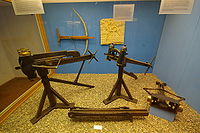 The polybolos would have differed from an ordinary ballista in that it had a wooden magazine over the mensa (the cradle that holds the bolt prior to firing) capable of holding several dozen bolts. The mechanism is unique in that it is driven by a flat-link chain
connected to a windlass
; the flat-link chain is an invention more often attributed to Leonardo da Vinci
.
When loading a new bolt, the windlass is rotated counter-clockwise with the trigger claw raised; this drives the mensa forward towards the bow string, where a metal lug pushes the trigger under the trigger claw, which is closed over the string.
Once the string is locked into the trigger mechanism, the windlass is then rotated clockwise, drawing the mensa back, drawing the bow string with it.
A round wooden pole in the bottom of the magazine is rotated down toward the mensa as it is drawn to the back of the polybolos, dropping a single bolt into the tray, ready to be fired. As the mensa is pulled farther back, it meets another lug like the one that locked the string into position, this one pushes the trigger and automatically fires the polybolos, and the process is repeated. The repetition provides the weapon's name, in Greek
"πολυβόλος", "throwing many missiles", from "πολύς" (polys), "multiple, many" and -βόλος - -bolos "thrower", in turn from "βάλλω" (ballo), "to throw, to hurl", literally a repeating weapon.
In 2010 a reconstruction was built by the crew of MythBusters
, who concluded that it was a possible weapon.
Ancient Greece
Ancient Greece is a civilization belonging to a period of Greek history that lasted from the Archaic period of the 8th to 6th centuries BC to the end of antiquity. Immediately following this period was the beginning of the Early Middle Ages and the Byzantine era. Included in Ancient Greece is the...
repeating ballista
Ballista
The ballista , plural ballistae, was an ancient missile weapon which launched a large projectile at a distant target....
reputedly invented by Dionysius of Alexandria, a 3rd century BC Greek
Greeks
The Greeks, also known as the Hellenes , are a nation and ethnic group native to Greece, Cyprus and neighboring regions. They also form a significant diaspora, with Greek communities established around the world....
engineer at the Rhodes arsenal and used in antiquity
Classical antiquity
Classical antiquity is a broad term for a long period of cultural history centered on the Mediterranean Sea, comprising the interlocking civilizations of ancient Greece and ancient Rome, collectively known as the Greco-Roman world...
. Philo of Byzantium
Philo of Byzantium
Philo of Byzantium , also known as Philo Mechanicus, was a Greek engineer and writer on mechanics, who lived during the latter half of the 3rd century BC...
encountered and described the polybolos, a catapult
Catapult
A catapult is a device used to throw or hurl a projectile a great distance without the aid of explosive devices—particularly various types of ancient and medieval siege engines. Although the catapult has been used since ancient times, it has proven to be one of the most effective mechanisms during...
that like a modern machine gun
Machine gun
A machine gun is a fully automatic mounted or portable firearm, usually designed to fire rounds in quick succession from an ammunition belt or large-capacity magazine, typically at a rate of several hundred rounds per minute....
could fire again and again without a need to reload. Philo left a detailed description of the gear
Gear
A gear is a rotating machine part having cut teeth, or cogs, which mesh with another toothed part in order to transmit torque. Two or more gears working in tandem are called a transmission and can produce a mechanical advantage through a gear ratio and thus may be considered a simple machine....
s that powered its chain drive
Chain drive
Chain drive is a way of transmitting mechanical power from one place to another. It is often used to convey power to the wheels of a vehicle, particularly bicycles and motorcycles...
, the oldest known application of such a mechanism, and that placed bolt
Quarrel
A quarrel or bolt is the term for the ammunition used in a crossbow. The name "quarrel" is derived from the French carré, "square", referring to the fact that they typically have square heads. Although their length varies, they are typically shorter than traditional arrows.Bolts and arrows have...
after bolt into its firing slot.
Mechanism
Flat chain
Flat chain is a form of chain used chiefly in agricultural machinery. Early machinery made extensive use of flat chain. It has been gradually replaced in most applications by roller chain, which is quieter, lasts longer, and requires less frequent retensioning.Modern flat chain is made from...
connected to a windlass
Windlass
The windlass is an apparatus for moving heavy weights. Typically, a windlass consists of a horizontal cylinder , which is rotated by the turn of a crank or belt...
; the flat-link chain is an invention more often attributed to Leonardo da Vinci
Leonardo da Vinci
Leonardo di ser Piero da Vinci was an Italian Renaissance polymath: painter, sculptor, architect, musician, scientist, mathematician, engineer, inventor, anatomist, geologist, cartographer, botanist and writer whose genius, perhaps more than that of any other figure, epitomized the Renaissance...
.
When loading a new bolt, the windlass is rotated counter-clockwise with the trigger claw raised; this drives the mensa forward towards the bow string, where a metal lug pushes the trigger under the trigger claw, which is closed over the string.
Once the string is locked into the trigger mechanism, the windlass is then rotated clockwise, drawing the mensa back, drawing the bow string with it.
A round wooden pole in the bottom of the magazine is rotated down toward the mensa as it is drawn to the back of the polybolos, dropping a single bolt into the tray, ready to be fired. As the mensa is pulled farther back, it meets another lug like the one that locked the string into position, this one pushes the trigger and automatically fires the polybolos, and the process is repeated. The repetition provides the weapon's name, in Greek
Greek language
Greek is an independent branch of the Indo-European family of languages. Native to the southern Balkans, it has the longest documented history of any Indo-European language, spanning 34 centuries of written records. Its writing system has been the Greek alphabet for the majority of its history;...
"πολυβόλος", "throwing many missiles", from "πολύς" (polys), "multiple, many" and -βόλος - -bolos "thrower", in turn from "βάλλω" (ballo), "to throw, to hurl", literally a repeating weapon.
In 2010 a reconstruction was built by the crew of MythBusters
MythBusters
MythBusters is a science entertainment TV program created and produced by Beyond Television Productions for the Discovery Channel. The series is screened by numerous international broadcasters, including Discovery Channel Australia, Discovery Channel Latin America, Discovery Channel Canada, Quest...
, who concluded that it was a possible weapon.