

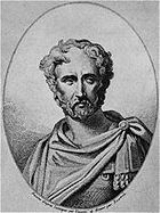
Pliny the Elder
Topics
Pliny the Elder

Quotations
Gaius Plinius Secundus better known as Pliny the Elder, was an ancient author and natural philosopher of some importance who wrote Naturalis Historia.
Sourced
- Fortune favours the brave…
- Attributed by Pliny the Younger to his uncle during the eruption of Mount Vesuvius in which the Elder died
- Quoted in
-
- Commonly quoted as "Fortune favours the bold."
Naturalis Historia
- In comparing various authors with one another, I have discovered that some of the gravest and latest writers have transcribed, word for word, from former works, without making acknowledgment.
- Book I, Dedication, sec. 22
- The only certainty is that nothing is certain.
- Book II, sec. 7
- It is far from easy to determine whether she [Nature] has proved to man a kind parent or a merciless stepmother.
- Book VII, sec. 1
- Man alone at the very moment of his birth, cast naked upon the naked earth, does she [Nature] abandon to cries and lamentations.
- Book VII, sec. 2
- To laugh, if but for an instant only, has never been granted to man before the fortieth day from his birth, and then it is looked upon as a miracle of precocity.
- Book VII, sec. 2
- Man is the only one that knows nothing, that can learn nothing without being taught. He can neither speak nor walk nor eat, and in short he can do nothing at the prompting of nature only, but weep.
- Book VII, sec. 4
- With man, most of his misfortunes are occasioned by man.
- Book VII, sec. 5
- Indeed, what is there that does not appear marvelous when it comes to our knowledge for the first time? How many things, too, are looked upon as quite impossible until they have actually been effected?
- Book VII, sec. 6
- The human features and countenance, although composed of but some ten parts or little more, are so fashioned that among so many thousands of men there are no two in existence who cannot be distinguished from one another.
- Book VII, sec. 8
- It has been observed that the height of a man from the crown of the head to the sole of the foot is equal to the distance between the tips of the middle fingers of the two hands when extended in a straight line.
- Book VII, sec. 77
- When a building is about to fall down, all the mice desert it.
- Book VIII, sec. 103
- The best plan is to profit by the folly of others.
- Book XVIII, sec. 31
- Cum grano salis.
- Translation: With a grain of salt.
- Book XXIII, sec. 8
Unsourced
- True glory consists in doing what deserves to be written; in writing what deserves to be read.
-