
All Topics  
Piranha

 
Piranha

   Email Print
   Bookmark   Link


Piranha


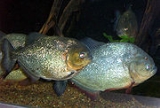
A piranha or piraña (or ) is a member of a family of omnivorous freshwater
Freshwater

Freshwater is a word that refers to bodies of water such as ponds, lakes, rivers and streams containing low concentrations of dissolved salts and other total dissolved solids....
 fish
Fish

A fish is any marine biology vertebrate animal that is typically ectothermic , covered with scale , and equipped with two sets of paired fins and several unpaired fins....
 which live in South American river
River

A river is a natural stream of water, usually freshwater, flowing toward an ocean, a lake, or another stream. In some cases a river flows into the ground or dries up completely before reaching another body of water....
s. In Venezuela
Venezuela

Venezuela , officially the Bolivarian Republic of Venezuela , is a country on the northern coast of South America.The country comprises a continental mainland and numerous islands located off the Venezuelan coastline in the Caribbean Sea....
n rivers they are called caribes. They are known for their sharp teeth
Tooth

Teeth are small whitish structures found in the jaws of many vertebrates that are used to tear, scrape, and chew food. Some animals, particularly carnivores, also use teeth for hunting or defense....
 and a voracious appetite for meat
Meat

In modern English usage, meat most often refers to animal biological tissue used as food, mostly skeletal muscle and associated fat, but it may also refer to offal, including livers, skin, brains, bone marrow, kidneys, in some countries lungs, and a variety of other internal organs as well as blood....
, although they do not kill prey; they are scavengers.

name piranha may come from a hybrid language
Language

A language is a form of symbol communication in which elements are combined to represents something other than themselves. Language can also refer to the use of such systems as a general phenomenon....
 composed of Tupi-Guarani languages; it may be a compound word made of the components pirá, meaning 'fish', and sanha or ranha, meaning 'tooth
Tooth

Teeth are small whitish structures found in the jaws of many vertebrates that are used to tear, scrape, and chew food. Some animals, particularly carnivores, also use teeth for hunting or defense....
'.


Discussion
Ask a question about 'Piranha'
Start a new discussion about 'Piranha'
Answer questions from other users
Full Discussion Forum


Recent Posts


Encyclopedia


A piranha or piraña (or ) is a member of a family of omnivorous freshwater
Freshwater

Freshwater is a word that refers to bodies of water such as ponds, lakes, rivers and streams containing low concentrations of dissolved salts and other total dissolved solids....
 fish
Fish

A fish is any marine biology vertebrate animal that is typically ectothermic , covered with scale , and equipped with two sets of paired fins and several unpaired fins....
 which live in South American river
River

A river is a natural stream of water, usually freshwater, flowing toward an ocean, a lake, or another stream. In some cases a river flows into the ground or dries up completely before reaching another body of water....
s. In Venezuela
Venezuela

Venezuela , officially the Bolivarian Republic of Venezuela , is a country on the northern coast of South America.The country comprises a continental mainland and numerous islands located off the Venezuelan coastline in the Caribbean Sea....
n rivers they are called caribes. They are known for their sharp teeth
Tooth

Teeth are small whitish structures found in the jaws of many vertebrates that are used to tear, scrape, and chew food. Some animals, particularly carnivores, also use teeth for hunting or defense....
 and a voracious appetite for meat
Meat

In modern English usage, meat most often refers to animal biological tissue used as food, mostly skeletal muscle and associated fat, but it may also refer to offal, including livers, skin, brains, bone marrow, kidneys, in some countries lungs, and a variety of other internal organs as well as blood....
, although they do not kill prey; they are scavengers.

Etymology

The name piranha may come from a hybrid language
Language

A language is a form of symbol communication in which elements are combined to represents something other than themselves. Language can also refer to the use of such systems as a general phenomenon....
 composed of Tupi-Guarani languages; it may be a compound word made of the components pirá, meaning 'fish', and sanha or ranha, meaning 'tooth
Tooth

Teeth are small whitish structures found in the jaws of many vertebrates that are used to tear, scrape, and chew food. Some animals, particularly carnivores, also use teeth for hunting or defense....
'. In Tupi, inalienably possessed
Possession (linguistics)

Possession, in the context of linguistics, is an asymmetric relationship between two constituents, the referent of one of which possession the referent of the other....
 nouns take the prefix t-, s-, or r- depending on the possessor, or zero in combination; thus pirá + anha. Alternatively, it may come from Tupi pirá (fish) and ánha (devil).

Taxonomy

Piranhas belong to the family
Family (biology)

In biological classification, family is a taxonomic rank. Exact details of formal nomenclature depend on the Nomenclature Codes which applies....
 of Serrasalmidae, which also includes closely related herbivorous fish including pacu
Pacú

Pacu or pac? may refer to any of several South American fishes, including:*Piaractus mesopotamicus *Tambaqui Pacu may also refer to:...
s. Traditionally, only the four genera Pristobrycon
Pristobrycon

Pristobrycon is a genus of piranhas.Pristobrycon contains five species. However, this genus is not monophyly. No single morphological feature has been found that completely diagnoses this genus....
, Pygocentrus
Pygocentrus

Pygocentrus is a genus of the piranha family Characidae. All are native to tropical South America. It is mainly located in the Amazon, San Francisco and Orinoco rivers....
, Pygopristis and Serrasalmus
Serrasalmus

The genus Serrasalmus consists of several species of piranhas in family Serrasalminae of the family Characidae. They are collectively known as pirambebas; the "typical" piranhas like the Piraya Piranha are nowadays placed in Pygocentrus....
 are considered to be true piranhas, due to their specialized teeth. However, a recent analysis showed that, if the piranha group is to be monophyletic
Monophyly

In common cladistic usage, a monophyletic group is a clade, consisting of an ancestor and all its descendants. The term is synonymous with the uncommon term holophyly....
, it should be restricted to Serrasalmus, Pygocentrus and part of Pristobrycon, or expanded to include these taxa plus Pygopristis, Catoprion, and Pristobrycon striolatus. Pygopristis was found to be more closely related to Catoprion than the other three piranha genera.

The total number of piranha species is unknown and new species continue to be described. In 1988, it was stated that fewer than a half of the approximately 60 nominal species of piranhas at the time were valid. More recently (in 2003), one author recognized a total of 38 or 39 species, although the validity of some taxa remains questionable. ]]

Distribution

Piranhas are found only in the Amazon
Amazon River

The Amazon River of South America is the list of rivers by length in the world by volume, with a total river flow greater than the next top eight largest rivers combined....
 basin, in the Orinoco
Orinoco

The Orinoco is one of the longest rivers in South America at 2,140 km, . Its drainage basin, sometimes called the Orinoquia covers 880,000 km?, 76.3% in Venezuela with the rest in Colombia....
, in rivers of the Guyana
Guyana

Guyana , officially the Co-operative Republic of Guyana and previously known as British Guiana, is the only state of the Commonwealth of Nations on mainland South America....
s, in the Paraguay
Paraguay River

The Paraguay River is a major river in south central South America, running through Brazil and Paraguay and running close to the border between Brazil and Bolivia as well as being the border between Paraguay and Argentina....
-Paraná
Paraná River

This article is about the second-longest river in South America: For the shorter river in Goi?s, central Brazil, see Paran? RiverThe Paran? River is a river in south central South America, running through Brazil, Paraguay and Argentina over a course of some 2,570 kilometers ....
, and in the São Francisco River
São Francisco River

The S?o Francisco River is a river in Brazil with a length of 3,160 kilometres. It is the fourth largest river system in South before turning east to form the border between the state of Bahia and the states of Pernambuco and Alagoas before entering the Atlantic Ocean between the states of Alagoas and Sergipe....
 systems; some species of piranha have broad geographic ranges, occurring in more than one of the major basins mentioned above, whereas others appear to have more limited distributions.

However, piranha (inevitably former aquarium
Aquarium

An aquarium is a vivarium consisting of at least one transparent side in which water-dwelling plants or animals are kept. fishkeeping use aquaria to keep fish, invertebrates, amphibians, marine mammals, turtles, and aquatic plants....
-dwellers) have been introduced
Introduced species

A species is defined as introduced in a certain geographical area, if that area is outside the species' indigenous distributional range, and the species has arrived there by human activity....
 into parts of the United States, even being occasionally found in the Potomac River
Potomac River

The Potomac River flows into the Chesapeake Bay, located along the mid-Atlantic Ocean coast of the United States. The river is approximately 383 statute miles long, with a Drainage basin of about 14,700 square miles ....
, although they typically do not survive the cold winters of that region. In 2007, a piranha was caught by a fisherman in the Catawba River
Catawba River

The Catawba River is a tributary of the Wateree River in the U.S. states of North Carolina and South Carolina. The river is approximately 220 miles long....
 in North Carolina
North Carolina

North Carolina is a U.S. state located on the Atlantic Seaboard in the southeastern United States. The state borders South Carolina and Georgia to the south, Tennessee to the west and Virginia to the north....
; this was the first known case in North Carolina and possibly also the first in the region. Piranha have also been discovered in the Kaptai Lake
Kaptai Lake

Kaptai Lake is a man-made lake in south-eastern Bangladesh. It is located in the Kaptai Upazila of Rangamati District of Chittagong Division. The lake was created as a result of building the Kaptai Dam on the Karnaphuli River, as part of the Karnaphuli Hydro-electric project....
 in south-east Bangladesh
Bangladesh

, officially the People's Republic of Bangladesh is a country in South Asia. It is bordered by India on all sides except for a small border with Burma to the far southeast and by the Bay of Bengal to the south....
. Research is being carried out to establish how piranha have moved to such distant corners of the world from their original habitat. It is anticipated that rogue exotic fish traders have released them in the lake to avoid being caught by anti-poaching forces.

Description

Piranhas are normally about 15 to 25 cm long (6 to 10 inches), although reportedly individuals have been found up to 43 cm (18.0 inches) in length.

Serrasalmus, Pristobrycon, Pygocentrus and Pygopristis are most easily recognized by their unique dentition. All piranhas have a single row of sharp teeth in both jaws; the teeth are tightly packed and interlocking (via small cusps
Cusp (dentistry)

A cusp is an Commonly used terms of relationship and comparison in dentistry or Commonly used terms of relationship and comparison in dentistry eminence on a tooth....
) and used for rapid puncture and shearing. Individual teeth are typically broadly triangular, pointed and blade-like (flat in profile). There is minor variation in the number of cusps; in most species, the teeth are tricuspid with a larger middle cusp which makes the individual teeth appear markedly triangular. The exception is Pygopristis, which has pentacuspid teeth and a middle cusp usually only slightly larger than the other cusps. In the scale-eating Catoprion, the shape of their teeth is markedly different and the premaxilla
Premaxilla

The incisive bone is the portion of the maxilla adjacent to the incisors.The term premaxilla can also be used to refer to the incisive bone....
ry teeth are in two rows, as in most other serrasalmines.

Ecology

Ecologically, piranhas are important components of their native environments. Although largely restricted to lowland drainages, these fish are widespread and inhabit diverse habitats within both lotic and lentic environments. Some piranha species are abundant locally, and multiple species often occur together. As both predators and scavenger
Scavenger

Scavenging, or necrophagy, is a carnivorous feeding behaviour in which a predator consumes corpses or carrion that were not killed to be eaten by the predator or others of its species....
s, piranhas influence the local distribution and composition of fish assemblages. Certain piranha species consume large quantities of seeds, but unlike the related Colossoma and Piaractus, herbivorous piranhas thoroughly masticate and entirely devour all seeds eaten and consequently do not function as dispersers.

The piranha is all-too-frequently portrayed as a vicious species of fish hunting in large schools. This conception was created from the belief that piranhas created schools for hunting purposes. Recent research, however, suggests that this is actually used as a defense mechanism against the piranha's natural predators (such as river dolphin
River dolphin

River dolphins are four living species of dolphin which reside in freshwater rivers and estuaries. They are classed in the Platanistoidea superfamily of cetaceans....
s, caimans and gigantic arapaima
Arapaima

The arapaima, pirarucu, or paiche is a South American tropical fresh water fish. It is one of the largest fresh water fish in the world....
).

Research on the species Serrasalmus aff. brandtii and Pygocentrus nattereri in Viana Lake, which is formed during the wet season when the Rio Pindare (a tributary of the Rio Mearim) floods, has shown that these species eat vegetable matter at some stages in their life; they are not strictly carnivorous fish.

Relationship to people

Locals often use piranha teeth to make tools and weapons. Piranha are also a popular food, although if an individual piranha is caught on a hook or line, it may be attacked by other (free) piranhas.

Piranha are commonly consumed by subsistence fishermen and often sold for food in local markets. In recent decades, dried specimens have been marketed as tourist souvenir
Souvenir

A souvenir , memento or keepsake is an object a traveler brings home for the memory associated with it. Souvenirs include clothing such as T-shirts or hats, postcards, refrigerator magnets, miniature figures, household items such as mugs and Bowl , ashtrays, egg timers, spoons, notebook, and many others....
s. Piranhas occasionally bite and sometimes injure bathers and swimmers, but truly serious attacks are rare and the threat to humans has been largely exaggerated. For example, in the James Bond film You Only Live Twice
You Only Live Twice (film)

You Only Live Twice is the fifth spy film in the James Bond James Bond , and the fifth to star Sean Connery as the fictional character Secret Intelligence Service agent James Bond ....
, the villain has a pool of piranha fish which can strip a human body to the bone. A piranha bite is sometimes considered more an act of carelessness than that of misfortune, but piranhas are a considerable nuisance to commercial and sport fishers because they steal bait
Bait

Bait usually refers to:* Bait , bait as a luring substance, or* Fishing bait, bait used for fishing.Bait may also refer to one of the following:...
, mutilate catch, damage nets and other gear and may bite when handled.

Several piranha species appear in the aquarium
Aquarium

An aquarium is a vivarium consisting of at least one transparent side in which water-dwelling plants or animals are kept. fishkeeping use aquaria to keep fish, invertebrates, amphibians, marine mammals, turtles, and aquatic plants....
 trade. Piranhas can be bought as pets in some areas, but they are illegal in much of the United States including Alabama, Alaska, Arizona, Arkansas, California, Colorado, Florida, Georgia, Hawaii, Kentucky, Louisiana, Maine, Massachusetts, Mississippi, Nevada, New Mexico, New York, North Carolina, Oklahoma, South Carolina, Texas, Utah, Virginia and Washington.

The most common aquarium piranha is the Pygocentrus nattereri, or the red-bellied piranha. Piranhas can be bought fully grown or as babies, often no larger than a thumbnail. It is important to keep Pygocentrus piranhas alone or in groups of four or more, not in pairs, since aggression among them is common and is distributed more widely when kept in larger groups, not allowing the weaker fish to survive. It is not rare to find individuals with one eye missing due to a previous attack. If underfed, piranhas are likely to become cannibalistic on others in their group.

Some say the human-ripping piranha legend started with Teddy Roosevelt — and a setup by the Brazilians. To guarantee a good show for the adventure-loving Roosevelt, local fishermen blocked off a portion of an Amazon river with nets and dumped hordes of starving piranhas into it when the U.S. president explored the region on a hunting trip. Then they sliced up a cow and tossed it in the river, setting off a wild feeding frenzy, producing the now-fabled instant skeleton effect. Roosevelt declared the fish evil, and the media traveling with him spread the tale around the world. Hollywood would later emblazon the image for posterity.

External links

  • Eric J. Lyman: , Houston Chronicle, July 17, 1998