

Pipefish

Encyclopedia
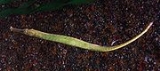
Pipefishes or pipe-fishes (Syngnathinae) are a subfamily of small fish
es, which, together with the seahorse
s, form the family Syngnathidae
.
s. The name is derived from the peculiar form of their snout
, which is like a long tube, ending in a narrow and small mouth which opens upwards and is toothless. The body and tail are long, thin, and snake
-like. They have a highly modified skeleton
formed into armored plating. This dermal skeleton has several longitudinal ridges, so that a vertical section through the body looks angular, not round or oval as in the majority of other fishes.
A dorsal fin
is always present, and is the principal (in some species, the only) organ of locomotion
. The ventral fins are constantly absent, and the other fins may or may not be developed. The gill
openings are extremely small and placed near the upper posterior angle of the gill cover.
Many are very weak swimmers in open water, moving slowly by means of rapid movements of the dorsal fin. Some species of pipefish have tails that are prehensile, as in seahorse
s. The majority of pipefishes have some form of a caudal fin (unlike seahorses), which can be used for locomotion. See fish anatomy
for fin descriptions. There are species of pipefish with more developed caudal fins, such as the group collectively known as flagtail pipefish, which are quite strong swimmers.
dwellers; only a few are freshwater
species. Pipefishes are abundant on coasts of the tropical and temperate zones. Most species of pipefish are usually 35–40 cm in length and generally inhabit sheltered areas in coral reef
s, seagrass
beds and sandy lagoon
s. There are approximately 200 species of pipefish.
. Courtship
tends to be elaborately choreographed displays between the males and females. Pair bonding varies wildly between different species of pipefish. While some are monogamous or seasonally monogamous, others are not.
Male pipefishes have a specially developed area to carry eggs, which are deposited by the female. In some species this is just a patch of spongy skin that the eggs adhere to until hatching. Other species have a partial or even fully developed pouch to carry the eggs. The location of the brood patch or pouch can be along the entire underside of the pipefish or just at the base of the tail, as with seahorses. Many species exhibit polyandry
, a breeding system in which one female mates with two or more males. This tends to occur with greater frequency in internal brooding species of pipefishes than with external brooding species.
Young are born freeswimming with relatively little or no yolk sac, and begin feeding immediately. From the time they hatch they are independent of their parents, who at that time may choose to view them as food. Some fry have short larval stages and live as plankton for a short while. Others are fully developed but miniature versions of their parents, assuming the same behaviors as their parents immediately.
Fish
Fish are a paraphyletic group of organisms that consist of all gill-bearing aquatic vertebrate animals that lack limbs with digits. Included in this definition are the living hagfish, lampreys, and cartilaginous and bony fish, as well as various extinct related groups...
es, which, together with the seahorse
Seahorse
Seahorses compose the fish genus Hippocampus within the family Syngnathidae, in order Syngnathiformes. Syngnathidae also includes the pipefishes. "Hippocampus" comes from the Ancient Greek hippos meaning "horse" and kampos meaning “sea monster”.There are nearly 50 species of seahorse...
s, form the family Syngnathidae
Syngnathidae
Syngnathidae is a family of fish which includes the seahorses, the pipefishes, and the weedy and leafy sea dragons. The name is derived from Greek, meaning "fused jaw" - syn meaning fused or together, and gnathus meaning jaws. This fused jaw trait is something the entire family has in common...
.
Anatomy
Pipefish look like straight-bodied seahorses with tiny mouthMouth
The mouth is the first portion of the alimentary canal that receives food andsaliva. The oral mucosa is the mucous membrane epithelium lining the inside of the mouth....
s. The name is derived from the peculiar form of their snout
Snout
The snout, or muzzle, is the protruding portion of an animal's face, consisting of its nose, mouth, and jaw.-Terminology:The term "muzzle", used as a noun, can be ambiguous...
, which is like a long tube, ending in a narrow and small mouth which opens upwards and is toothless. The body and tail are long, thin, and snake
Snake
Snakes are elongate, legless, carnivorous reptiles of the suborder Serpentes that can be distinguished from legless lizards by their lack of eyelids and external ears. Like all squamates, snakes are ectothermic, amniote vertebrates covered in overlapping scales...
-like. They have a highly modified skeleton
Skeleton
The skeleton is the body part that forms the supporting structure of an organism. There are two different skeletal types: the exoskeleton, which is the stable outer shell of an organism, and the endoskeleton, which forms the support structure inside the body.In a figurative sense, skeleton can...
formed into armored plating. This dermal skeleton has several longitudinal ridges, so that a vertical section through the body looks angular, not round or oval as in the majority of other fishes.
A dorsal fin
Dorsal fin
A dorsal fin is a fin located on the backs of various unrelated marine and freshwater vertebrates, including most fishes, marine mammals , and the ichthyosaurs...
is always present, and is the principal (in some species, the only) organ of locomotion
Animal locomotion
Animal locomotion, which is the act of self-propulsion by an animal, has many manifestations, including running, swimming, jumping and flying. Animals move for a variety of reasons, such as to find food, a mate, or a suitable microhabitat, and to escape predators...
. The ventral fins are constantly absent, and the other fins may or may not be developed. The gill
Gill
A gill is a respiratory organ found in many aquatic organisms that extracts dissolved oxygen from water, afterward excreting carbon dioxide. The gills of some species such as hermit crabs have adapted to allow respiration on land provided they are kept moist...
openings are extremely small and placed near the upper posterior angle of the gill cover.
Many are very weak swimmers in open water, moving slowly by means of rapid movements of the dorsal fin. Some species of pipefish have tails that are prehensile, as in seahorse
Seahorse
Seahorses compose the fish genus Hippocampus within the family Syngnathidae, in order Syngnathiformes. Syngnathidae also includes the pipefishes. "Hippocampus" comes from the Ancient Greek hippos meaning "horse" and kampos meaning “sea monster”.There are nearly 50 species of seahorse...
s. The majority of pipefishes have some form of a caudal fin (unlike seahorses), which can be used for locomotion. See fish anatomy
Fish anatomy
Fish anatomy is primarily governed by the physical characteristics of water, which is much denser than air, holds a relatively small amount of dissolved oxygen, and absorbs more light than air does.- Body :...
for fin descriptions. There are species of pipefish with more developed caudal fins, such as the group collectively known as flagtail pipefish, which are quite strong swimmers.
Habitat and distribution
Most pipefish are marineMarine (ocean)
Marine is an umbrella term. As an adjective it is usually applicable to things relating to the sea or ocean, such as marine biology, marine ecology and marine geology...
dwellers; only a few are freshwater
Freshwater
Fresh water is naturally occurring water on the Earth's surface in ice sheets, ice caps, glaciers, bogs, ponds, lakes, rivers and streams, and underground as groundwater in aquifers and underground streams. Fresh water is generally characterized by having low concentrations of dissolved salts and...
species. Pipefishes are abundant on coasts of the tropical and temperate zones. Most species of pipefish are usually 35–40 cm in length and generally inhabit sheltered areas in coral reef
Coral reef
Coral reefs are underwater structures made from calcium carbonate secreted by corals. Coral reefs are colonies of tiny living animals found in marine waters that contain few nutrients. Most coral reefs are built from stony corals, which in turn consist of polyps that cluster in groups. The polyps...
s, seagrass
Seagrass
Seagrasses are flowering plants from one of four plant families , all in the order Alismatales , which grow in marine, fully saline environments.-Ecology:...
beds and sandy lagoon
Lagoon
A lagoon is a body of shallow sea water or brackish water separated from the sea by some form of barrier. The EU's habitat directive defines lagoons as "expanses of shallow coastal salt water, of varying salinity or water volume, wholly or partially separated from the sea by sand banks or shingle,...
s. There are approximately 200 species of pipefish.
Reproduction
Pipefishes, like their seahorse relatives, leave most of the parenting duties to the maleMale
Male refers to the biological sex of an organism, or part of an organism, which produces small mobile gametes, called spermatozoa. Each spermatozoon can fuse with a larger female gamete or ovum, in the process of fertilization...
. Courtship
Courtship
Courtship is the period in a couple's relationship which precedes their engagement and marriage, or establishment of an agreed relationship of a more enduring kind. In courtship, a couple get to know each other and decide if there will be an engagement or other such agreement...
tends to be elaborately choreographed displays between the males and females. Pair bonding varies wildly between different species of pipefish. While some are monogamous or seasonally monogamous, others are not.
Male pipefishes have a specially developed area to carry eggs, which are deposited by the female. In some species this is just a patch of spongy skin that the eggs adhere to until hatching. Other species have a partial or even fully developed pouch to carry the eggs. The location of the brood patch or pouch can be along the entire underside of the pipefish or just at the base of the tail, as with seahorses. Many species exhibit polyandry
Polyandry
Polyandry refers to a form of marriage in which a woman has two or more husbands at the same time. The form of polyandry in which a woman is married to two or more brothers is known as "fraternal polyandry", and it is believed by many anthropologists to be the most frequently encountered...
, a breeding system in which one female mates with two or more males. This tends to occur with greater frequency in internal brooding species of pipefishes than with external brooding species.
Young are born freeswimming with relatively little or no yolk sac, and begin feeding immediately. From the time they hatch they are independent of their parents, who at that time may choose to view them as food. Some fry have short larval stages and live as plankton for a short while. Others are fully developed but miniature versions of their parents, assuming the same behaviors as their parents immediately.
Genera
- Subfamily Syngnathinae (pipefishes)
- Genus Acentronura Kaup, 1853
- Genus Amphelikturus
- Genus Anarchopterus Hubbs, 1935
- Genus Apterygocampus Weber, 1913
- Genus Bhanotia Hora, 1926
- Genus Bryx Herald, 1940
- Genus Bulbonaricus Herald in Schultz, Herald, Lachner, Welander and Woods, 1953
- Genus Campichthys Whitley, 1931
- Genus Choeroichthys Kaup, 1856
- Genus CorythoichthysCorythoichthysCorythoichthys is a genus of pipefishes of the family Syngnathidae.- Species :* Brown-banded pipefish, Corythoichthys amplexus Dawson & Randall, 1975* Corythoichthys benedetto Allen & Erdmann, 2008...
Kaup, 1853 - Genus Cosmocampus Dawson, 1979
- Genus Doryichthys Kaup, 1853
- Genus DoryrhamphusDoryrhamphusDoryrhamphus and Dunckerocampus, popularly known as flagtail pipefish, are two genera of fishes in the Syngnathidae family. They are found in warm, relatively shallow waters of the Indo-Pacific, with a single species, D. paulus, in the eastern Pacific...
Kaup, 1856 - Genus Dunckerocampus Whitley, 1933
- Genus Enneacampus Dawson, 1981
- Genus Entelurus Duméril, 1870
- Genus Festucalex Whitley, 1931
- Genus Filicampus Whitley, 1948
- Genus Halicampus Kaup, 1856
- Genus Haliichthys Gray, 1859
- Genus Heraldia Paxton, 1975
- Genus Hippichthys Bleeker, 1849—river pipefishes
- Genus Hypselognathus Whitley, 1948
- Genus Ichthyocampus Kaup, 1853
- Genus IdiotropiscisIdiotropiscisIdiotropiscis is a genus of fish in the Syngnathidae family.It contains the following species:* southern little pipehorse...
- Genus Kaupus Whitley, 1951
- Genus Kimblaeus Dawson, 1980
- Genus Kyonemichthys
- Genus Leptoichthys Kaup, 1853
- Genus LeptonotusLeptonotusLeptonotus is a genus of pipefishes of the family Syngnathidae.- Species :* Genus Leptonotus** Deep-bodied pipefish, Leptonotus blainvilleanus ** Pipefish, Leptonotus elevatus...
Kaup, 1853 - Genus Lissocampus Waite and Hale, 1921
- Genus Maroubra Whitley, 1948
- Genus Micrognathus Duncker, 1912
- Genus MicrophisMicrophisMicrophis is a genus of fish in the Syngnathidae family.It contains the following species:* Microphis argulus* slender pipefish * spinach pipefish...
Kaup, 1853—freshwater pipefishes - Genus Minyichthys Herald and Randall, 1972
- Genus Mitotichthys Whitley, 1948
- Genus Nannocampus Günther, 1870
- Genus NerophisNerophisNerophis is a genus of pipefishes. Consists of three species:* Nerophis lumbriciformis - Worm pipefish* Nerophis maculatus Rafinesque, 1810 - Spotted pipefish* Nerophis ophidion - Straightnose pipefish...
Rafinesque, 1810 - Genus Notiocampus Dawson, 1979
- Genus Penetopteryx Lunel, 1881
- Genus Phoxocampus Dawson, 1977
- Genus Phycodurus Gill, 1896
- Genus Phyllopteryx Swainson, 1839
- Genus Pseudophallus Herald, 1940—fluvial pipefishes
- Genus Pugnaso Whitley, 1948
- Genus Siokunichthys Herald in Schultz, Herald, Lachner, Welander and Woods, 1953
- Genus SolegnathusSolegnathusSolegnathus is a genus of pipefish belonging to the family Syngnathidae. They are found in temperate and tropical seas worldwide.- Species :* Solegnathus dunckeri Whitley, 1927* Hardwicke's pipefish, Solegnathus hardwickii...
Swainson, 1839 - Genus StigmatoporaStigmatoporaStigmatopora is a genus of pipefish of the family Syngnathidae. It has four described species.-Species in the genus Stigmatopora:* Spotted pipefish, Stigmatopora argus...
Kaup, 1853 - Genus Stipecampus Whitley, 1948
- Genus SyngnathoidesSyngnathoidesSyngnathoides is a genus of fish in the Syngnathidae family.It contains the following species:* alligator pipefish...
Bleeker, 1851 - Genus Syngnathus Linnaeus, 1758—seaweed pipefishes
- Genus Trachyrhamphus Kaup, 1853
- Genus Urocampus Günther, 1870
- Genus Vanacampus Whitley, 1951