


Phyllite

Encyclopedia
Foliation (geology)
Foliation is any penetrative planar fabric present in rocks. Foliation is common to rocks affected by regional metamorphic compression typical of orogenic belts. Rocks exhibiting foliation include the standard sequence formed by the prograde metamorphism of mudrocks; slate, phyllite, schist and...
metamorphic rock
Metamorphic rock
Metamorphic rock is the transformation of an existing rock type, the protolith, in a process called metamorphism, which means "change in form". The protolith is subjected to heat and pressure causing profound physical and/or chemical change...
primarily composed of quartz
Quartz
Quartz is the second-most-abundant mineral in the Earth's continental crust, after feldspar. It is made up of a continuous framework of SiO4 silicon–oxygen tetrahedra, with each oxygen being shared between two tetrahedra, giving an overall formula SiO2. There are many different varieties of quartz,...
, sericite
Sericite
Sericite is a fine grained mica, similar to muscovite, illite, or paragonite. Sericite is a common alteration mineral of orthoclase or plagioclase feldspars in areas that have been subjected to hydrothermal alteration typically associated with copper, tin, or other hydrothermal ore deposits...
mica
Mica
The mica group of sheet silicate minerals includes several closely related materials having highly perfect basal cleavage. All are monoclinic, with a tendency towards pseudohexagonal crystals, and are similar in chemical composition...
, and chlorite
Chlorite group
The chlorites are a group of phyllosilicate minerals. Chlorites can be described by the following four endmembers based on their chemistry via substitution of the following four elements in the silicate lattice; Mg, Fe, Ni, and Mn....
; the rock represents a gradation in the degree of metamorphism
Metamorphism
Metamorphism is the solid-state recrystallization of pre-existing rocks due to changes in physical and chemical conditions, primarily heat, pressure, and the introduction of chemically active fluids. Mineralogical, chemical and crystallographic changes can occur during this process...
between slate
Slate
Slate is a fine-grained, foliated, homogeneous metamorphic rock derived from an original shale-type sedimentary rock composed of clay or volcanic ash through low-grade regional metamorphism. The result is a foliated rock in which the foliation may not correspond to the original sedimentary layering...
and mica
Mica
The mica group of sheet silicate minerals includes several closely related materials having highly perfect basal cleavage. All are monoclinic, with a tendency towards pseudohexagonal crystals, and are similar in chemical composition...
schist
Schist
The schists constitute a group of medium-grade metamorphic rocks, chiefly notable for the preponderance of lamellar minerals such as micas, chlorite, talc, hornblende, graphite, and others. Quartz often occurs in drawn-out grains to such an extent that a particular form called quartz schist is...
. Minute crystals of graphite
Graphite
The mineral graphite is one of the allotropes of carbon. It was named by Abraham Gottlob Werner in 1789 from the Ancient Greek γράφω , "to draw/write", for its use in pencils, where it is commonly called lead . Unlike diamond , graphite is an electrical conductor, a semimetal...
, sericite, or chlorite impart a silky, sometimes golden sheen to the surfaces of cleavage
Cleavage (geology)
This article is about rock cleavage, for cleavage in minerals see Cleavage Cleavage, in structural geology and petrology, describes a type of planar rock feature that develops as a result of deformation and metamorphism. The degree of deformation and metamorphism along with rock type determines the...
(or schistosity). Phyllite is formed from the continued metamorphism of slate.
The protolith
Protolith
Protolith refers to the precursor lithology of a metamorphic rock.For example, the protolith of a slate is a shale or mudstone. Metamorphic rocks can be derived from any other rock and thus have a wide variety of protoliths. Identifying a protolith is a major aim of metamorphic geology.Sedimentary...
(or parent rock) for a phyllite is a shale
Shale
Shale is a fine-grained, clastic sedimentary rock composed of mud that is a mix of flakes of clay minerals and tiny fragments of other minerals, especially quartz and calcite. The ratio of clay to other minerals is variable. Shale is characterized by breaks along thin laminae or parallel layering...
or pelite
Pelite
Pelite is old and currently not widely used field terminology for a clayey fine-grained clastic sediment or sedimentary rock, i.e. mud or mudstone. It is equivalent to the Latin-derived term lutite. More commonly, metamorphic geologists currently use pelite for a metamorphosed fine-grained...
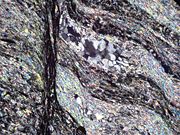
. Its constituent platy minerals are larger than those in slate but are not visible with the naked eye. Phyllites are said to have a "phyllitic texture" and are usually classified as having a low grade in the regional metamorphic facies
Metamorphic facies
The metamorphic facies are groups of mineral compositions in metamorphic rocks, that are typical for a certain field in pressure-temperature space...
.
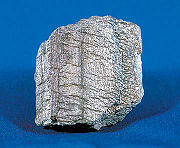
Phyllite has a good fissility (a tendency to split into sheets) and will form under low grade metamorphic conditions. Phyllites are usually black to gray or light greenish gray in color. The foliation is commonly crinkled or wavy in appearance.
Phyllite is commonly found in the Dalradian
Dalradian
Dalradian in geology describes a series of metamorphic rocks, typically developed in the high ground which lies southeast of the Great Glen of Scotland...
metasediments of northwest Arran
Isle of Arran
Arran or the Isle of Arran is the largest island in the Firth of Clyde, Scotland, and with an area of is the seventh largest Scottish island. It is in the unitary council area of North Ayrshire and the 2001 census had a resident population of 5,058...
.