

Phellodendron

Encyclopedia
Phellodendron or Cork-tree, is a genus of deciduous
trees in the family Rutaceae
, native to east and northeast Asia
. It has leathery, pinnate leaves
and yellow, clumped flower
s. The name refers to the thick and corky bark
of some (but not all) species in the genus.
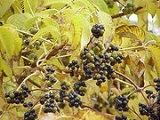
, Phellodendron is a tree for all seasons. In spring it has yellow flowers, in summer it provides foliage and shade, in fall the leaves turn bright yellow and the textured bark and winding branches add interest in the winter. The female bears black drupe
s that attract bird
s and other wildlife
through the late fall and winter.
The Cork-tree is resistant to drought and insect
s, and it can thrive in a variety of soil
s. It is hardy to zone 4 and it is easy to maintain, sometimes to the point of being invasive
. One drawback is that the drupes fall and scatter, which may be undesirable on a formal lawn
.
The bark in some species is thick, resembling that of the Cork Oak
, but is not thick enough for commercial cork
production. It has been used to produce a yellow dye
.
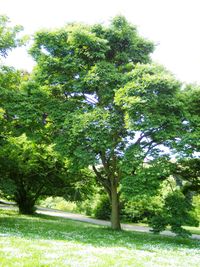 One species, Amur cork tree, Phellodendron amurense (Chinese: 黄柏; pinyin: huáng bǎi
; or 黄檗; pinyin: huáng bò; Russian: Бархат амурский "Barkhat Amurskiy", also бархатное дерево, пробковое дерево), is one of the 50 fundamental herbs used in traditional Chinese medicine
. Recently, Phellodendron has also attracted scientific attention because of the phytochemicals it produces:
The phytochemical descriptions are included for informational purposes only and not for treatment purposes. The research at this stage is very preliminary. Traditionally, the bark
is the principal part of the plant used medicinally, although oil from the fruit
is also used. The species grows in Northern China
, and in the Khabarovsk
and Primorskiy regions of Russia
.
Already identified as a significant forest invader in the mid-Atlantic region, Phellodendron amurense is an emerging species of concern in New England, and is identified as invasive or having invasive tendencies by state and private conservation authorities. Because the fruit is plentiful and high in sugars, Amur cork-tree attracts birds and mammals which help disperse its seeds. Because of its phytochemical profile and because the seedlings grow thickly, Phellodendron can out-compete other species. By suppressing reproduction of native hardwoods, Amur cork-tree can come to dominate native forests under favorable conditions. As a relatively new species of concern, its invasion biology and response to control is not well understood.
Deciduous
Deciduous means "falling off at maturity" or "tending to fall off", and is typically used in reference to trees or shrubs that lose their leaves seasonally, and to the shedding of other plant structures such as petals after flowering or fruit when ripe...
trees in the family Rutaceae
Rutaceae
Rutaceae, commonly known as the rue or citrus family, is a family of flowering plants, usually placed in the order Sapindales.Species of the family generally have flowers that divide into four or five parts, usually with strong scents...
, native to east and northeast Asia
Asia
Asia is the world's largest and most populous continent, located primarily in the eastern and northern hemispheres. It covers 8.7% of the Earth's total surface area and with approximately 3.879 billion people, it hosts 60% of the world's current human population...
. It has leathery, pinnate leaves
Leaf
A leaf is an organ of a vascular plant, as defined in botanical terms, and in particular in plant morphology. Foliage is a mass noun that refers to leaves as a feature of plants....
and yellow, clumped flower
Flower
A flower, sometimes known as a bloom or blossom, is the reproductive structure found in flowering plants . The biological function of a flower is to effect reproduction, usually by providing a mechanism for the union of sperm with eggs...
s. The name refers to the thick and corky bark
Bark
Bark is the outermost layers of stems and roots of woody plants. Plants with bark include trees, woody vines and shrubs. Bark refers to all the tissues outside of the vascular cambium and is a nontechnical term. It overlays the wood and consists of the inner bark and the outer bark. The inner...
of some (but not all) species in the genus.
Cultivation and uses
As an ornamental plantOrnamental plant
Ornamental plants are plants that are grown for decorative purposes in gardens and landscape design projects, as house plants, for cut flowers and specimen display...
, Phellodendron is a tree for all seasons. In spring it has yellow flowers, in summer it provides foliage and shade, in fall the leaves turn bright yellow and the textured bark and winding branches add interest in the winter. The female bears black drupe
Drupe
In botany, a drupe is a fruit in which an outer fleshy part surrounds a shell of hardened endocarp with a seed inside. These fruits develop from a single carpel, and mostly from flowers with superior ovaries...
s that attract bird
Bird
Birds are feathered, winged, bipedal, endothermic , egg-laying, vertebrate animals. Around 10,000 living species and 188 families makes them the most speciose class of tetrapod vertebrates. They inhabit ecosystems across the globe, from the Arctic to the Antarctic. Extant birds range in size from...
s and other wildlife
Wildlife
Wildlife includes all non-domesticated plants, animals and other organisms. Domesticating wild plant and animal species for human benefit has occurred many times all over the planet, and has a major impact on the environment, both positive and negative....
through the late fall and winter.
The Cork-tree is resistant to drought and insect
Insect
Insects are a class of living creatures within the arthropods that have a chitinous exoskeleton, a three-part body , three pairs of jointed legs, compound eyes, and two antennae...
s, and it can thrive in a variety of soil
Soil
Soil is a natural body consisting of layers of mineral constituents of variable thicknesses, which differ from the parent materials in their morphological, physical, chemical, and mineralogical characteristics...
s. It is hardy to zone 4 and it is easy to maintain, sometimes to the point of being invasive
Invasive species
"Invasive species", or invasive exotics, is a nomenclature term and categorization phrase used for flora and fauna, and for specific restoration-preservation processes in native habitats, with several definitions....
. One drawback is that the drupes fall and scatter, which may be undesirable on a formal lawn
Lawn
A lawn is an area of aesthetic and recreational land planted with grasses or other durable plants, which usually are maintained at a low and consistent height. Low ornamental meadows in natural landscaping styles are a contemporary option of a lawn...
.
The bark in some species is thick, resembling that of the Cork Oak
Cork Oak
Quercus suber, commonly called the Cork Oak, is a medium-sized, evergreen oak tree in the section Quercus sect. Cerris. It is the primary source of cork for wine bottle stoppers and other uses, such as cork flooring. It is native to southwest Europe and northwest Africa.It grows to up to 20 m,...
, but is not thick enough for commercial cork
Cork (material)
Cork is an impermeable, buoyant material, a prime-subset of bark tissue that is harvested for commercial use primarily from Quercus suber , which is endemic to southwest Europe and northwest Africa...
production. It has been used to produce a yellow dye
Dye
A dye is a colored substance that has an affinity to the substrate to which it is being applied. The dye is generally applied in an aqueous solution, and requires a mordant to improve the fastness of the dye on the fiber....
.
Huáng bǎi
Huáng bǎi or huáng bò is one of the fifty fundamental herbs of traditional Chinese medicine. Known also as Cortex Phellodendri, it is the bark of one of two species of Phellodendron tree: Phellodendron amurense or Phellodendron chinense.]- Cultivation :For Phellodendron amurense Huáng bǎi (黄栢 or...
; or 黄檗; pinyin: huáng bò; Russian: Бархат амурский "Barkhat Amurskiy", also бархатное дерево, пробковое дерево), is one of the 50 fundamental herbs used in traditional Chinese medicine
Traditional Chinese medicine
Traditional Chinese Medicine refers to a broad range of medicine practices sharing common theoretical concepts which have been developed in China and are based on a tradition of more than 2,000 years, including various forms of herbal medicine, acupuncture, massage , exercise , and dietary therapy...
. Recently, Phellodendron has also attracted scientific attention because of the phytochemicals it produces:
- BerberineBerberineBerberine is a quaternary ammonium salt from the protoberberine group of isoquinoline alkaloids. It is found in such plants as Berberis Berberine is a quaternary ammonium salt from the protoberberine group of isoquinoline alkaloids. It is found in such plants as Berberis Berberine is a quaternary...
has antibacterial and anti-fungal properties - JatrorrhizineJatrorrhizineJatrorrhizine is a protoberberine alkaloid isolated from Enantia chlorantha and other species. Synonyms that may be encountered include jateorrhizine, neprotin, jatrochizine, jatrorhizine, or yatrorizine. It has been reported to have antiinflammatory effect, and to improve blood flow and mitotic...
may be anti-mutagenic - PhellodendrinePhellodendrinePhellodendrine is an alkaloid native to phellodendron amurense....
has promise as an immune suppressant - PalmatinePalmatinePalmatine is a protoberberine alkaloid found in several plants including Phellodendron amurense, Rhizoma coptidis/Coptis Chinensis and Corydalis yanhusuo.It is the major component of the protoberberine extract from Enantia chlorantha....
may be a vasodilator
The phytochemical descriptions are included for informational purposes only and not for treatment purposes. The research at this stage is very preliminary. Traditionally, the bark
Bark
Bark is the outermost layers of stems and roots of woody plants. Plants with bark include trees, woody vines and shrubs. Bark refers to all the tissues outside of the vascular cambium and is a nontechnical term. It overlays the wood and consists of the inner bark and the outer bark. The inner...
is the principal part of the plant used medicinally, although oil from the fruit
Amur cork tree fruit oil
Amur cork tree fruit oil is a pressed oil extracted from the fruit of Phellodendron amurense, the Amur Cork Tree. The bark of the tree is an important herbal medicine in China. The oil has insecticidal properties similar to pyrethrum...
is also used. The species grows in Northern China
China
Chinese civilization may refer to:* China for more general discussion of the country.* Chinese culture* Greater China, the transnational community of ethnic Chinese.* History of China* Sinosphere, the area historically affected by Chinese culture...
, and in the Khabarovsk
Khabarovsk
Khabarovsk is the largest city and the administrative center of Khabarovsk Krai, Russia. It is located some from the Chinese border. It is the second largest city in the Russian Far East, after Vladivostok. The city became the administrative center of the Far Eastern Federal District of Russia...
and Primorskiy regions of Russia
Russia
Russia or , officially known as both Russia and the Russian Federation , is a country in northern Eurasia. It is a federal semi-presidential republic, comprising 83 federal subjects...
.
Already identified as a significant forest invader in the mid-Atlantic region, Phellodendron amurense is an emerging species of concern in New England, and is identified as invasive or having invasive tendencies by state and private conservation authorities. Because the fruit is plentiful and high in sugars, Amur cork-tree attracts birds and mammals which help disperse its seeds. Because of its phytochemical profile and because the seedlings grow thickly, Phellodendron can out-compete other species. By suppressing reproduction of native hardwoods, Amur cork-tree can come to dominate native forests under favorable conditions. As a relatively new species of concern, its invasion biology and response to control is not well understood.