


Pei Wenzhong

Encyclopedia
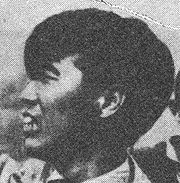
Pei Wenzhong was a Chinese
China
Chinese civilization may refer to:* China for more general discussion of the country.* Chinese culture* Greater China, the transnational community of ethnic Chinese.* History of China* Sinosphere, the area historically affected by Chinese culture...
paleontologist, archaeologist and anthropologist. Professor Pei is considered the founding father of Chinese anthropology.
He graduated from the Peking University
Peking University
Peking University , colloquially known in Chinese as Beida , is a major research university located in Beijing, China, and a member of the C9 League. It is the first established modern national university of China. It was founded as Imperial University of Peking in 1898 as a replacement of the...
in 1928 and went to work for the Cenozoic Research Laboratory
Cenozoic Research Laboratory
The Cenozoic Research Laboratory of the Geological Survey of China was established at the Peking Union Medical College in 1928 by Canadian paleoanthropologist Davidson Black and Chinese geologists Ding Wenjing and Weng Wenhao for the research and appraisal of Peking Man fossils unearthed at...
of the Geological Survey of China
Geological Survey of China
The Geological Survey of China is a government-owned, not-for-profit, Chinese organization researching China's mineral resources. It is the largest Geoscience agency in China since being reconstructed in 1999.-History:...
joining the excavations of Peking Man
Peking Man
Peking Man , Homo erectus pekinensis, is an example of Homo erectus. A group of fossil specimens was discovered in 1923-27 during excavations at Zhoukoudian near Beijing , China...
Site in Zhoukoudian
Zhoukoudian
Zhoukoudian or Choukoutien is a cave system in Beijing, China. It has yielded many archaeological discoveries, including one of the first specimens of Homo erectus, dubbed Peking Man, and a fine assemblage of bones of the gigantic hyena Pachycrocuta brevirostris...
, where he was named the field director of the excavations in the following year
1929 in archaeology
The year 1929 in archaeology involved some significant events.-Explorations:* Expedition under Neil Merton Judd to collect dendrochronological specimens to date habitation of Chaco Canyon....
. The work at Zhoukoudian was done in rough conditions: for example, the scientists had to ride to there on mules. The first skullcap was dug out by Pei "working in a 40-meter crevasse in frigid weather with a hammer in one hand and a candle in the other.", on December 2, 1929, at 4 pm.
From 1933 to 1934, he supervised the excavation of the Upper Cave site and was director of Zhoukoudian Office of the Cenozoic Research Laboratory of the Geological Survey of China. He left the excavation in 1935 to get a degree from the University of Paris
University of Paris
The University of Paris was a university located in Paris, France and one of the earliest to be established in Europe. It was founded in the mid 12th century, and officially recognized as a university probably between 1160 and 1250...
and was succeeded by Professor Jia Lanpo
Jia Lanpo
Jia Lanpo was a Chinese prehistorian. Professor Jia was one of the founders of Chinese anthropology.He graduated from the Huiwen Academy in 1929 and went on to work as a trainee at the Cenozoic Research Laboratory of the Geological Survey of China...
). He returned to the excavation in 1937 shortly before they ceased.
Since Zhoukoudian, Professor Pei worked at many other sites, for example Djalainor or Kansu. In 1955 he was elected to the Chinese Academy of Sciences
Chinese Academy of Sciences
The Chinese Academy of Sciences , formerly known as Academia Sinica, is the national academy for the natural sciences of the People's Republic of China. It is an institution of the State Council of China. It is headquartered in Beijing, with institutes all over the People's Republic of China...
, became the first Chairman of Chinese Association of Natural Science Museums, and the second director of Beijing Museum of Natural History. Until his death, he worked at the Institute of Vertebrate Paleontology and Paleoanthropology of the Chinese Academy of Sciences. He also wrote several books, including the first on Chinese prehistory
Prehistory
Prehistory is the span of time before recorded history. Prehistory can refer to the period of human existence before the availability of those written records with which recorded history begins. More broadly, it refers to all the time preceding human existence and the invention of writing...
written in Chinese
Chinese language
The Chinese language is a language or language family consisting of varieties which are mutually intelligible to varying degrees. Originally the indigenous languages spoken by the Han Chinese in China, it forms one of the branches of Sino-Tibetan family of languages...
.
His cremated remains are buried at Zhoukoudian besides those of his colleagues Yang Zhongjian
Yang Zhongjian
Yang Zhongjian , courtesy name Keqiang , also known as C.C. Young, was one of China's foremost paleontologists. He has been called the 'Father of Chinese vertebrate paleontology'...
and Jia Lanpo
Jia Lanpo
Jia Lanpo was a Chinese prehistorian. Professor Jia was one of the founders of Chinese anthropology.He graduated from the Huiwen Academy in 1929 and went on to work as a trainee at the Cenozoic Research Laboratory of the Geological Survey of China...
.