
All Topics  
Panzerschreck


   Email Print
   Bookmark   Link


Panzerschreck


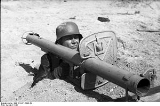
Panzerschreck was the popular name for the Raketenpanzerbüchse ('rocket tank rifle', abbreviated to RPzB), an 88 mm calibre reusable anti-tank
Anti-tank warfare

Anti-tank refers to any method of combating military armored fighting vehicles, notably tanks. The most common anti-tank systems include artillery with a high muzzle velocity, missiles , various autocannons firing penetrating ammunition, and anti-tank mines....
 rocket launcher developed by the Germans
Nazi Germany

Nazi Germany and the Third Reich are the colloquial English names for Germany under the regime of Adolf Hitler and the Nazi Party , which established a Totalitarianism dictatorship that existed from 1933 to 1945....
 in World War II
World War II

World War II, or the Second World War , was a global military conflict which involved a Participants in World War II, including all of the great powers, organised into two opposing military alliances: the Allies of World War II and the Axis powers....
. Another popular nickname was Ofenrohr ("stove pipe").

It was given to infantry
Infantry

Infantry are soldiers who are primarily trained for the role of fighting on foot. A soldier in the infantry is known as an infantryman. Infantry units have more physically demanding training than other branches of armies, and place a greater emphasis on fitness, physical strength and aggression....
 to bolster their anti-tank capability. The weapon was shoulder-launched and fired a rocket-propelled, fin-stabilized grenade with a shaped charge
Shaped charge

A shaped charge is an explosive charge shaped to focus the effect of the explosive's energy. Various types are used to cut and form metal, initiate nuclear weapons, and penetrate armour....
 warhead
Warhead

Typically, a warhead is the explosive material and detonator that is delivered by a missile, rocket, or torpedo....
.


Discussion
Ask a question about 'Panzerschreck'
Start a new discussion about 'Panzerschreck'
Answer questions from other users
Full Discussion Forum


Encyclopedia


Panzerschreck was the popular name for the Raketenpanzerbüchse ('rocket tank rifle', abbreviated to RPzB), an 88 mm calibre reusable anti-tank
Anti-tank warfare

Anti-tank refers to any method of combating military armored fighting vehicles, notably tanks. The most common anti-tank systems include artillery with a high muzzle velocity, missiles , various autocannons firing penetrating ammunition, and anti-tank mines....
 rocket launcher developed by the Germans
Nazi Germany

Nazi Germany and the Third Reich are the colloquial English names for Germany under the regime of Adolf Hitler and the Nazi Party , which established a Totalitarianism dictatorship that existed from 1933 to 1945....
 in World War II
World War II

World War II, or the Second World War , was a global military conflict which involved a Participants in World War II, including all of the great powers, organised into two opposing military alliances: the Allies of World War II and the Axis powers....
. Another popular nickname was Ofenrohr ("stove pipe").

It was given to infantry
Infantry

Infantry are soldiers who are primarily trained for the role of fighting on foot. A soldier in the infantry is known as an infantryman. Infantry units have more physically demanding training than other branches of armies, and place a greater emphasis on fitness, physical strength and aggression....
 to bolster their anti-tank capability. The weapon was shoulder-launched and fired a rocket-propelled, fin-stabilized grenade with a shaped charge
Shaped charge

A shaped charge is an explosive charge shaped to focus the effect of the explosive's energy. Various types are used to cut and form metal, initiate nuclear weapons, and penetrate armour....
 warhead
Warhead

Typically, a warhead is the explosive material and detonator that is delivered by a missile, rocket, or torpedo....
. It was made in much smaller numbers than the highly successful Panzerfaust
Panzerfaust

The Panzerfaust was an inexpensive, recoilless Nazi Germany anti-tank weapon of World War II. It consisted of a small, disposable preloaded launch tube firing a high explosive anti-tank warhead, operated by a single soldier....
, which was a disposable recoilless rifle
Recoilless rifle

A recoilless gun or recoilless rifle is a lightweight form of weapon that allows the firing of a heavier projectile than would be practical with a recoiling weapon....
 firing an anti-tank warhead.

History


In 1941, when the Germans encountered the new Soviet tank designs such as the T-34
T-34

The T-34 was a Soviet Union Tank classification produced from 1940 to 1958. It is widely regarded as having been the world's best tank when the Soviet Union became involved in World War II, and although its armoured fighting vehicle and armament were surpassed by later tanks of the era, it has been often credited as the war's most effective,...
, they quickly discovered the effectiveness of the HEAT
Heat

In physics and thermodynamics, heat is any transfer of energy from one body or thermodynamic system to another due to a difference in temperature....
 round which many of their early tanks such as the Panzer IV
Panzer IV

The Panzerkampfwagen IV , commonly known as the Panzer IV, was a medium tank developed in Nazi Germany in the late 1930s and used extensively during the World War II....
 were equipped with against this new threat. The need of a more effective infantry anti-tank weapon than the Panzerbüchsen anti-tank rifle
Anti-tank rifle

An anti-tank rifle is a rifle designed to penetrate the vehicle armour of vehicles, particularly tanks. The usefulness of rifles for this purpose ran from the introduction of tanks into the Second World War, when they were rendered almost entirely obsolete....
s was paramount for the German army. Development for such a weapon which used the HEAT principle quickly ensued. The first development was a converted anti-tank grenade launcher version of the P.z.b 39 anti-tank rifle called the G.z.b 39. Development created the Faustpatrone
Faustpatrone

File:Bundesarchiv Bild 101I-672-7634-13, Russland, Luftwaffensoldat mit Panzerabwehrwaffe.jpgThe Faustpatrone was a Nazi Germany anti-tank weapon of early World War II and a forerunner of the later Panzerfaust....
 and later the Panzerfaust which were highly effective against Allied armor but lacked the range and multi-purpose nature of the M1A1 "Bazooka"
Bazooka

A bazooka is one of a series of anti-armor and anti-bunker, man-portable rocket launchers that became famous during World War II. Technically named as the M9 Anti-tank Rocket Launcher, it was also called "stovepipe" and used to deliver high explosives into machine gun nests and hardened bunkers in all WWII theaters....
. Later in the fighting in Africa, German troops captured many Allied bazooka
Bazooka

A bazooka is one of a series of anti-armor and anti-bunker, man-portable rocket launchers that became famous during World War II. Technically named as the M9 Anti-tank Rocket Launcher, it was also called "stovepipe" and used to deliver high explosives into machine gun nests and hardened bunkers in all WWII theaters....
 in the North Africa
North African campaign

During World War II, the North African Campaign took place in North Africa from 10 June 1940 to 16 May 1943. It included campaigns fought in the Libya and Egypt deserts and in Morocco and Algeria and Tunisia ....
 as well as some lend-lease versions on the Eastern front
Eastern Front (World War II)

The Eastern Front of World War II was a Theatre between the German Reich and the Soviet Union which encompassed Central Europe and eastern Europe from 22 June 1941 to 9 May 1945....
. The German army quickly assimilated an improved German version of the M1A1 Bazooka, the Raketen-Panzerbüchse, which had double the penetrative performance and used a bigger 88 mm round. Although this was a much heavier round than its Allied counter part, it proved itself against Allied armor on all fronts, earning the nickname "tank terror".

The first model was the RPzB- 43 which was 164 cm long and weighed about 9.25 kg when empty. Operators of the RPzB 43 had to wear a protective poncho and a gas mask without a filter to protect them from the heat of the backblast when the weapon was fired. In October 1943, it was succeeded by the RPzB 54 which was fitted with a blast shield to protect the operator. This was heavier and weighed 11 kg empty. This was followed by the RPzB-54/1 with an improved rocket, shorter barrel and a range increased to about 180 meters.

Firing the RPzB generated a lot of smoke both in front and behind the weapon. Because of the weapon's tube and the smoke, the German troops nicknamed it the Ofenrohr ("Stove Pipe"). This also meant that Panzerschreck teams were revealed once they fired, making them targets and, therefore, required them to shift positions. This type of system also made it problematic to fire the weapon from inside closed spaces (such as bunkers or houses), filling the room with toxic smoke and revealing the firing location immediately. This was in contrast to the British PIAT
PIAT

The Projector, Infantry, Anti Tank , was one of the earlier anti-tank weapons using a HEAT projectile. It was developed by the United Kingdom starting in 1941, reaching the field in time for the Operation Husky in 1943....
's cumbersome, but non-smoking system, or the Panzerfaust
Panzerfaust

The Panzerfaust was an inexpensive, recoilless Nazi Germany anti-tank weapon of World War II. It consisted of a small, disposable preloaded launch tube firing a high explosive anti-tank warhead, operated by a single soldier....
s short burst launch system.

The Panzerschreck was an effective weapon. Allied bazookas had problems with new up-armored German armor present on German tanks, most notably the Tiger tank
Tiger tank

The name Tiger was given to two German tanks of the Second World War:*Tiger I, Panzerkampfwagen VI Tiger I*Tiger II, Panzerkampfwagen VI Ausf....
 and the Panther tank
Panther tank

The Panther was a tank fielded by Germany in World War II that served from mid-1943 to the end of the European war in 1945. It was intended as a counter to the T-34, and to replace the Panzer IV and Panzer III, though it served along with them and the heavy tanks until the end of the war....
. By comparison the Panzerschreck rocket could penetrate over 200 mm of armor, which was not found on any Allied designs, but paid for this extra hitting power with extra weight. The rocket projectile weighed 3.3 kg (7.25 lb). One direct hit was usually enough to destroy any Allied
Allies

In general, allies are people, groups or nations that have joined together in an association for mutual benefit or to achieve some common purpose....
 armored vehicle. When handled by well-trained crews, this weapon became the bane of Allied armored units, who frequently attempted to add improvised protection to their tanks, e.g. sandbags, spare track units, logs and so on. Most of this make-shift protection had little actual effect.

Triple Panzerschrecks were mounted on some SdKfz 251
SdKfz 251

The Sd.Kfz. 251 half-track was an armored fighting vehicle designed and first built by Nazi Germany's Hanomag company during World War II. They were produced throughout the war....
s, Volkswagen Kübelwagen
Volkswagen Kübelwagen

The Volkswagen K?belwagen was a military vehicle designed by Ferdinand Porsche and built by Volkswagen during World War II for use by the Nazi Germany military ....
s and captured Universal Carrier
Universal Carrier

The Universal Carrier, also known as a Bren Carrier and Scout Carrier, is a common name describing a family of light caterpillar track vehicles built by Vickers-Armstrong....
s.

See also

  • Shoulder-launched missile weapon
    Shoulder-launched missile weapon

    A shoulder-launched missile weapon is a weapon that fires a projectile at a targeting , yet is small enough to be carried by a single person, and fired while held on one's shoulder....
  • List of common World War II infantry weapons
    List of common World War II infantry weapons

    This page lists the common infantry weapons used by the various armies engaged in World War II....


External links