

Pak Protector

Encyclopedia
Larry Niven
Laurence van Cott Niven / ˈlæri ˈnɪvən/ is an American science fiction author. His best-known work is Ringworld , which received Hugo, Locus, Ditmar, and Nebula awards. His work is primarily hard science fiction, using big science concepts and theoretical physics...
's Known Space
Known Space
Known Space is the fictional setting of some dozen science fiction novels and several collections of short stories written by author Larry Niven. It has also in part been used as a shared universe in the Man-Kzin Wars spin-off anthologies sub-series....
universe. The Pak first appeared in "The Adults," which appeared in Galaxy in 1967; this story was expanded into the novel Protector
Protector (novel)
Protector is a 1973 science fiction novel by Larry Niven, set in his Known Space universe. It was nominated for the Hugo in 1974, and placed fourth in the annual Locus poll for that year....
by Larry Niven (1973). The Pak also appear in several of Niven's later novels, notably those set in the Ringworld
Ringworld
Ringworld is a Hugo, Nebula, and Locus award-winning 1970 science fiction novel by Larry Niven, set in his Known Space universe and considered a classic of science fiction literature. It is followed by three sequels, and preceded by four prequels, and ties into numerous other books set in Known Space...
.
Destroyer of Worlds
Destroyer of Worlds (novel)
Destroyer of Worlds is a novel set in the Known Space series, by Larry Niven and Edward M. Lerner. It is a sequel to their previous novels, Fleet of Worlds and Juggler of Worlds...
depicts a confrontation between the Pak and the Puppeteers.
Narrative purpose
Niven has written that he invented the Protectors as a thought experiment to explain the common effects of aging on humans and to create a fictional evolutionary explanation for humans' long lives after females have passed reproductive age. Accordingly, most of the positive attributes of Protectors are based on negative human aging effects: sore joints, poor circulation, wrinkled skin, lack of sex drive, and tooth loss are all turned to advantage during the shift from Breeder to Protector.The Pak species
In Protector, we learn that humans are descended from the Pak. Pak Children and Breeders appear in Earth's fossil record as Homo habilisHomo habilis
Homo habilis is a species of the genus Homo, which lived from approximately at the beginning of the Pleistocene period. The discovery and description of this species is credited to both Mary and Louis Leakey, who found fossils in Tanzania, East Africa, between 1962 and 1964. Homo habilis Homo...
; the few Pak Protectors to make it to Earth apparently are not found in the fossil record.
The Pak species goes through three stages of development: Child, Breeder and Protector.
Pak Child is analogous to a human child: sexually immature and dependent upon adults for survival.
Pak Breeder is analogous to a human adult: sexually mature, self-sufficient (in later writings) and provides immediate care for the children. To the Pak, the Breeder stage, though capable of space travel, is not deemed fully sentient; Breeders, to a large extent, rely on Protectors for long-term survival. Earlier Niven stories
Ringworld
Ringworld is a Hugo, Nebula, and Locus award-winning 1970 science fiction novel by Larry Niven, set in his Known Space universe and considered a classic of science fiction literature. It is followed by three sequels, and preceded by four prequels, and ties into numerous other books set in Known Space...
describe the breeder as "just intelligent enough to swing a club or throw a stone."
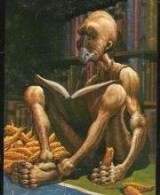
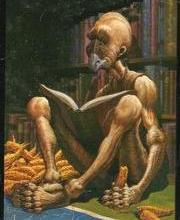
Pak Protector is not analogous to any human form. It is described as a 'fighting machine,' with armor-like skin, super-human strength and super-human intelligence. Niven's stories which focus on the Pak mostly concentrate on the unique Protector-stage.
Niven explained the evolution of the Pak as resulting from high radiation levels on their home world near the core of the Galaxy
Galaxy
A galaxy is a massive, gravitationally bound system that consists of stars and stellar remnants, an interstellar medium of gas and dust, and an important but poorly understood component tentatively dubbed dark matter. The word galaxy is derived from the Greek galaxias , literally "milky", a...
. The high radiation near the star-dense core caused severe mutations that can destabilize the evolutionary process. As a result, the Pak evolved a mechanism to eliminate dangerous mutations from the population. That mechanism is the protector stage.
Protectors are highly sensitive to the smell of their close relatives and 'weed out' those that smell wrong, which may indicate a potentially dangerous mutation. This weeding also suppressed positive mutations, essentially halting Pak evolution. Protectors are fully sentient, and are far more intelligent than ordinary humans. However, this superior intelligence only serves a Pak Protector's instincts to protect its bloodline at any costs.
The change from Breeder to Protector is the result of a peramorphic
Peramorphosis
In developmental biology, peramorphosis is a phylogenetic change in which individuals of a species mature past adulthood and take on hitherto unseen traits...
transformation brought about by the plant known as Tree-of-Life
Tree-of-Life
The Tree-of-Life is a fictional plant in Larry Niven's Known Space universe, for which all Hominids have a built-in genetic craving...
. As humans (and all primates) are descended from the Pak, Tree-of-Life can create a Protector-stage human.
Tree-of-Life
Tree-of-LifeTree-of-Life
The Tree-of-Life is a fictional plant in Larry Niven's Known Space universe, for which all Hominids have a built-in genetic craving...
is the mechanism by which a Breeder becomes a Protector. The term originally is used to refer to a specific plant which, when consumed, triggers the transformation. The term "Tree-of-Life virus" is used to describe the symbiotic
Symbiosis
Symbiosis is close and often long-term interaction between different biological species. In 1877 Bennett used the word symbiosis to describe the mutualistic relationship in lichens...
virus which actually governs the transition.
Niven took the name Tree-of-Life from the Book of Genesis; specifically to the fruit of the "Tree of Life" that could make Adam and Eve immortal (Genesis 3:22-24), which is quoted as the foreword to the novel Protector
Protector (novel)
Protector is a 1973 science fiction novel by Larry Niven, set in his Known Space universe. It was nominated for the Hugo in 1974, and placed fourth in the annual Locus poll for that year....
, and also mentioned by Brennan within the novel.
Tree-of-Life (the plant) is a bush native to the Pak homeworld. When a Breeder reaches the proper age (early 40s for humans), the smell of the root becomes irresistible; the Breeder gorges on the Tree-of-Life root, infecting itself with the Tree-of-Life virus and transforming into a Protector. The age window for the metamorphosis is relatively narrow (between 42 and 50 Earth years). Tree-of-Life is common on the Pak world, so there is almost no risk of a Breeder living past this window without being exposed to the roots. Humans who are beyond the metamorphosis window still find the smell of the root irresistible, but die in what appears to be a failed transition.
The transition from Breeder to Protector involves reconfiguration of the anatomy. Skin thickens, becoming similar to leather armor, strong enough to turn a copper knife. Joints swell until the creature becomes "a parody of the human form done in cantaloupe
Cantaloupe
"Rockmelon" redirects here, for the band see Rockmelons. See also Cantaloupe .Cantaloupe refers to a variety of Cucumis melo, a species in the family Cucurbitaceae which includes nearly all melons and squashes. Cantaloupes range in size from...
s and coconut
Coconut
The coconut palm, Cocos nucifera, is a member of the family Arecaceae . It is the only accepted species in the genus Cocos. The term coconut can refer to the entire coconut palm, the seed, or the fruit, which is not a botanical nut. The spelling cocoanut is an old-fashioned form of the word...
s". This increases leverage available to muscles by increasing the force of the moment arm
Moment (physics)
In physics, the term moment can refer to many different concepts:*Moment of force is the tendency of a force to twist or rotate an object; see the article torque for details. This is an important, basic concept in engineering and physics. A moment is valued mathematically as the product of the...
, the result being that a protector can lift ten times its own weight. Genitalia vanish, and a second two-chambered heart forms in the groin at the fusion of the femoral vein
Femoral vein
In the human body, the femoral vein is a blood vessel that accompanies the femoral artery in the femoral sheath. It begins at the adductor canal and is a continuation of the popliteal vein...
s. The arms lengthen. Fingernails turn into retractable claws. Teeth fall out and the lips and gums fuse, the mouth forming a horny beak (flat in protectors transformed from humans, non-flat in protectors transformed from Pak). All the breeder's hair falls out and the head acquires a bony ridge to protect the newly-expanded cranium
Skull
The skull is a bony structure in the head of many animals that supports the structures of the face and forms a cavity for the brain.The skull is composed of two parts: the cranium and the mandible. A skull without a mandible is only a cranium. Animals that have skulls are called craniates...
. The expanded skull allows the brain to grow to an enormous size; the resulting mind, even starting from something as "unintelligent" as a chimpanzee, becomes far more intelligent than a typical human. Pak Protectors also acquire an extended lifespan, and can live tens of thousands of Earth years (a common element in Niven's stories).
Once the transformation is complete, a Pak Protector must periodically consume more Tree-of-Life root to maintain the virus in its body. Without the virus, a Protector will weaken and die as his DNA is degraded; the virus supplies replacement DNA.
The Tree-of-Life crop on Earth failed due to there being insufficient thallium oxide
Thallium oxide
Thallium oxide is the inorganic compound of thallium and oxygen with the formula Tl2O in which thallium is in its +1 oxidation state. It is black and produces a basic yellow solution of thallium hydroxide when dissolved in water. It is formed by heating solid TlOH or Tl2CO3 in the absence of air....
in the Earth's soil; the plants grew but didn't support the virus. As a result, the Protectors that led the colony to Earth died of starvation when their store of roots ran out.
Protector behavior
Pak Protectors have an innate need to look after (or protect, hence the name) close relatives of their family. When a Pak Protector has no bloodline to protect, it usually stops eating and starves; some childless Protectors can adopt the entire Pak race as their family.Niven states that Protectors on the crowded Pak homeworld would constantly war against each other to gain advantage for their family and that alliances would last only until one ally sees advantage in betrayal. Human Protectors, and those on the Ringworld, seem to be less warlike and better able to work for the betterment of the entire species (or all of the Ringworld hominids) rather than just their bloodline.
Protectors typically die from starvation (from lack of will to live, e.g. if the Protector's bloodline has died out) or violence. Although Protectors have a vastly extended lifetime, it is not infinite; during the original half million year journey to Earth some protector colonists did die from old age.
Because of their enormous intelligence and instinctive need to protect their family (or their species, etc), Protectors are efficient, ruthless and quite amoral. It is observed several times that this intelligence combined with instinct also compels action so completely that Protectors often have little "free will". Niven uses this trait as a plot device several times as characters set up circumstances where Protector characters will react in a specific manner. In Protector, Jack Brennan (a human turned into a Protector) commits genocide
Genocide
Genocide is defined as "the deliberate and systematic destruction, in whole or in part, of an ethnic, racial, religious, or national group", though what constitutes enough of a "part" to qualify as genocide has been subject to much debate by legal scholars...
by exterminating the Martian
Martian
As an adjective, the term martian is used to describe anything pertaining to the planet Mars.However, a Martian is more usually a hypothetical or fictional native inhabitant of the planet Mars. Historically, life on Mars has often been hypothesized, although there is currently no solid evidence of...
race ("Aliens were dangerous, or might be, and Pak were not interested in anything but Pak") and also releases a genetically modified Tree-of-Life virus on the colony world Home, turning everyone middle aged into a Protector (and killing all other humans on the planet) in order to create an army of childless Protectors with which to fight the invading Pak fleet. It was also indicated in Protector that humans that have turned into protectors may be more intelligent than their Pak counterparts.
Niven explains much of Protector behavior in his Future History, by revealing in Ringworld's Children
Ringworld's Children
Ringworld's Children is a 2004 science fiction novel by Larry Niven, the fourth in the Ringworld series set in the Known Space universe. It describes the continuing adventures of Louis Wu and companions on Ringworld.-Plot summary:...
that the ARM may be run by at least one Protector and that Boosterspice (which dramatically prolongs human lifespan) is derived from Tree-of-Life.
The Pak and Humanity
In Protector, Niven explains that humans (and all of Earth's primates) are descended from a colony of Pak breeders that were stranded on Earth 2.5 million years ago. The protectors that built the colony ship died when their Tree-of-Life crops failed. The original Pak Breeder population (known to us as Homo habilisHomo habilis
Homo habilis is a species of the genus Homo, which lived from approximately at the beginning of the Pleistocene period. The discovery and description of this species is credited to both Mary and Louis Leakey, who found fossils in Tanzania, East Africa, between 1962 and 1964. Homo habilis Homo...
) bred and mutated wildly, evolving into modern humans as well as all other Earth primates. All Terran primates would transform into the Protector stage if exposed to Tree-of-Life root (or, more accurately, the symbiotic virus it contains).
In The Ringworld Engineers, the characters find evidence that the Ringworld
Ringworld
Ringworld is a Hugo, Nebula, and Locus award-winning 1970 science fiction novel by Larry Niven, set in his Known Space universe and considered a classic of science fiction literature. It is followed by three sequels, and preceded by four prequels, and ties into numerous other books set in Known Space...
was built by Pak Protectors (confirmed by the statements of a character in Ringworld's Children who claims to be one of the original builders) and populated by Pak breeders. The Pak Protectors dwindled in numbers until they were no longer able to maintain the genetic purity of the breeder forms and the breeders eventually evolved into all the other hominids of the Ringworld
Hominids of the Ringworld
The Hominids of the Ringworld, like the humans of Larry Niven's other works about the Known Space fictional universe, are descendants of the species called the Pak, whose "breeder" stage resembled Homo habilis, and who utilize a symbiotic virus to then develop into a hyper-intelligent Protector...
that one sees in Larry Niven's novels.
See also
- ProtectorProtector (novel)Protector is a 1973 science fiction novel by Larry Niven, set in his Known Space universe. It was nominated for the Hugo in 1974, and placed fourth in the annual Locus poll for that year....
- RingworldRingworldRingworld is a Hugo, Nebula, and Locus award-winning 1970 science fiction novel by Larry Niven, set in his Known Space universe and considered a classic of science fiction literature. It is followed by three sequels, and preceded by four prequels, and ties into numerous other books set in Known Space...
- The Ringworld EngineersThe Ringworld EngineersThe Ringworld Engineers is a 1980 science fiction novel by Larry Niven. It is the first sequel to Niven's award-winning Ringworld and was nominated for both the Hugo and Locus Awards in 1981.-Origin:...
- The Ringworld ThroneThe Ringworld ThroneThe Ringworld Throne is a novel by Larry Niven, first published in 1996. It is the direct sequel to his previous work The Ringworld Engineers...
- Ringworld's ChildrenRingworld's ChildrenRingworld's Children is a 2004 science fiction novel by Larry Niven, the fourth in the Ringworld series set in the Known Space universe. It describes the continuing adventures of Louis Wu and companions on Ringworld.-Plot summary:...
- Man-Kzin Wars XI