
|
|
|
|
Painted Turtle
|
| |
|
| |
- "Painted Turtle" is also the name of an imprint of Wayne State University Press.
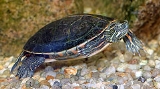
The Painted Turtle (Chrysemys picta) is a reptile that is common in southern Canada, the United States, and northern Mexico and is related to other water turtles such as sliders and cooters. This turtle lives in ponds, lakes, marshes, and in slow-moving rivers that have soft, muddy bottoms. The maximum carapace size, or shell length, for painted turtles is , or 25 cm.

Discussion
Ask a question about 'Painted Turtle'
Start a new discussion about 'Painted Turtle'
Answer questions from other users
|
Recent Posts

Encyclopedia
- "Painted Turtle" is also the name of an imprint of Wayne State University Press.
The Painted Turtle (Chrysemys picta) is a reptile that is common in southern Canada, the United States, and northern Mexico and is related to other water turtles such as sliders and cooters. This turtle lives in ponds, lakes, marshes, and in slow-moving rivers that have soft, muddy bottoms. The maximum carapace size, or shell length, for painted turtles is , or 25 cm. Its shell is used to protect it from its predators.
The skin of an adult Painted Turtle's head, neck, feet and tail, and the carapace-edge (marginal) scutes have a beautiful red and yellow striped design that conveys the idea of having been hand-painted. The plastron, depending on the subspecies, can be entirely yellowish or yellowish-orange, mostly yellowish with a dark pattern in the center, or may have a bold, elaborate pattern of yellow, orange, red and dark gray. The background skin tone of the painted turtle varies from olive green to solid black. The Painted turtle is the only species in the genus Chrysemys. It comprises 4 sub-species: the Eastern, Southern, Midland, and Western Painted Turtle.
The Western Painted Turtle (C. p. bellii), is the official reptile of the U.S. state of Colorado.
Reproduction
Mating begins shortly after the turtles have emerged from hibernation when the water temperature is still low. Mating may also occur in the fall. The breeding season typically lasts from late spring to early summer. Males begin to breed when they reach maturity, usually at 70-95 mm plastron length when they are three to five years old. Females take longer to mature (4-5 years) and are larger at maturity. The courtship ritual of adult painted turtles is a rare and beautiful sight, rarely seen in the wild. Possessing a broader, thicker tail and a smaller (about 80 percent the size of an adult female of the same age), more elongated body shape, the male painted turtle swims to face the female nose-to-nose, prior to fertilizing her ova, and uses his comparatively hugely over-sized front claws to tickle the cheeks of the female rapidly up-and-down in a vibratory manner, in about one-second bursts, with the "palms" of the forefeet facing outward. Different subspecies of painted turtle can and do interbreed - the offspring exhibit an intergradation of the characteristics of the parent races.
Painted turtles are amniotes which requires females to nest on land. Females prefer soft, sandy soil with good exposure to the sun for their nest site.
Nests are dug with the turtle's hind feet, usually within 200 meters of water. The nest is no deeper than 10 to 12 centimeters. The females will lay 4 to 15 oval, soft shelled eggs, in a flask-shaped hole. The eggs are elliptical, white to off-white and are mostly smooth with slight pits. Female turtles may lay up to five clutches of eggs per season although typically, they will lay only one or two clutches. Once the eggs are laid the mother will cover the hole with dirt or sand and leave the nest unattended. Painted turtle eggs hatch 72 to 80 days after they are laid. Once the young hatch and dig out of the nest, they are immediately independent.
Behavior
Painted turtles are most active from May to October in the Northeastern United States. Instances of local flooding following heavy rainfall in warm months, will sometimes force these turtles to temporarily take to the land for a day or two, migrating between habitats and taking risks crossing roads. It is then that a specimen can be captured with relative ease. During the winter, painted turtles hibernate by burying themselves deep in the mud beneath streams and ponds. The mud insulates the turtle, which helps prevent freezing during the harsh winter months. The turtle may submerge itself in up to .9 meters (3 ft) of mud under less than 1.8 meters (6 ft) of water. Painted turtles can survive without oxygen at 3° Celsius (37.4°F) for up to five months, longer than any other known air-breathing vertebrate. In order to survive during hibernation, the turtle must prevent lactic acid from building up in its body. The turtle accomplishes this by slowing its metabolic rate, which in turn lowers the rate of lactic acid production. It then uses magnesium and calcium stored in its shell to buffer and neutralize lactic acid. Northern populations of painted turtle may remain dormant for four to six months. More southerly populations may become active during warm periods. When emerging from a dormant period, most turtles will not begin to eat again until the water temperature has reached approximately 15.5° Celsius (60°F).
The painted turtle spends the majority of its time in the water, but it can often be seen, by an extremely quiet, stealthy observer, lying in the sun on floating logs or on rocks by the shore. This behavior is called basking. Some turtles bask simply by floating at the surface of the water with only the tip of their nose breaking the surface. Adult painted turtles are very shy and are not easily captured. Painted turtles bask because they cannot generate heat or regulate their own body temperature. Instead, they rely on heat from the sun to raise and maintain their body temperature at a level high enough for food in their stomachs to digest efficiently; about 65°F minimum. Basking episodes generally last for two hours at a time. Painted turtles are omnivorous, taking insects, worms, tadpoles, small fish and crustaceans as well as carrion, in addition to duckweed and other aquatic vegetation. Like almost all semi-aquatic turtles, painted turtles cannot and will not ingest food unless their mouths are fully underwater.
Housing Aquariums used to house a painted turtle should be sized at at least 40 gallons per adult, but a 20 gallon, or 30 gallon breeder tank is great for babies, or hatchlings. They must have an accessible land area (commercially made turtle ramps are available at most pet stores) to bask on and to completely dry out on. The tank should be cleaned at least a couple of times a month and right size filtration system should be purchased and kept clean and well-supplied with filter media. A UVA/UVB light is critical to the health of basking turtles. Turtles require heat and sunlight (either natural or artificial) to properly digest food and develop their shells and beaks. Fluorescent UVA/UVB lamps are not suitable for turtles. Turtles in cooler times of year need some heat in addition to the UV light, but a UV light will provide enough heat if the water is 60 F. Exposure to sunlight or artificial heat sources must not be arranged carelessly since overheating can kill a turtle within minutes. Always provide a sufficient amount of clean, shaded cooler water to which the turtle can retreat. Keep a turtle habitat fitted with an effective barrier such as a firmly-attached, 1/2-inch wire mesh cover with a sturdy frame which your baby or young child, cat or dog cannot dislodge.
Temperature
Water should be heated to 78º-80ºF and the basking area should have a surface temperature of 86º-88ºF.
Predators
Painted turtles are vulnerable to predation throughout their development and into adulthood. Many animals such as raccoons, several types of squirrels, chipmunk, woodchucks, skunk, badger, foxes, fish crows, garter snakes, deer, ants, beavers, and humans will prey on turtle nests. Newly hatched turtles are eaten by rats, muskrat, mink, raccoons, snapping turtles, snakes, bullfrogs, large fish and herons. Adult turtles are preyed upon by alligators, snapping turtles, raccoons, bald eagles, osprey, and red shouldered hawks. Humans pose many threats to painted turtles through habitat destruction, the use of pesticides, vehicles on roadways, intentional killing by anglers, and through improper care while kept as pets. When a painted turtle feels threatened, it may kick and scratch, bite and urinate. Painted turtles that have avoided predators and disease have been known to live longer than thirty years in the wild.
Global Warming Affects on Painted Turtle
Scientists researching around the Mississippi River and other U.S. areas say that turtles (including painted turtles) have changed their nesting dates because of global warming. Iowa State University Professor Fred Janzen stated he accumulated research data going back decades tracking turtles' habits to figured out when they lay eggs and make their nests. '"What we found was that in the late 1980s, painted turtles started nesting in early June (but) now it is on the order of 10 days or more earlier," said Janzen. "These behaviors are showing how the plasticity of the species is helping them survive, but we are wondering what the limit is to their ability to adapt."' This behavior has been an immediate effect of global warming on the painted turtle.
Subspecies Identification and Range Eastern Painted Turtle (C. p. picta)
- 4 1/2" - 6"
- Scutes of carapace in straight rows
- Front edges of large scutes form bands across carapace (aligned)
- Two bright yellow spots on each side of the head
- Plain yellow or yellow-orange plastron may have one or two small dark spots.
- Range: Nova Scotia to Georgia. Intergrading with Midland in much of the Northeast
Midland Painted Turtle (C. p. marginata)
- 4 1/2" - 5 1/2"
- Large, alternating (staggered) carapace scutes
- Vaguely oval or narrow elongated medium-to-dark gray plastral blotch centered on the mid-line, remainder of plastron yellow or yellow-orange
- Range: Southern Quebec and Southern Ontario to Tennessee. Northwest Georgia and extreme Northeastern Alabama
Southern Painted Turtle (C. p. dorsalis)
- 4" - 5"
- Single broad orange or red stripe on back, occasionally yellow or whitish in color
- Alternating (staggered) carapace scutes
- Plain yellow plastron which may have one or two tiny black spots
- Range: Southern Illinois to the Gulf of Mexico. Southwest Alabama to Southeastern Oklahoma. Isolated colony in central Texas
Western Painted Turtle (C. p. bellii)
- 3 1/2" - 7"
- State Reptile of Colorado
- Netlike pattern on carapace
- Alternating (staggered) carapace scutes
- Distinctive gaudy, red, orange and dark gray branched pattern on otherwise-yellowish plastron much larger than the plastral pattern in Midland.
- Range: Southwestern Ontario and Southern Missouri to the Pacific Northwest
External links
- Species account from the Iowa Reptile and Amphibian Field Guide
- at Animal Diversity Web
- Tennessee Aquarium has an excellent habitat containing many Southern Painted Turtles.
|
| |
|
|