
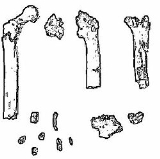
Orrorin tugenensis is considered to be the second-oldest (after Sahelanthropus) known hominin ancestor that is possibly related to modern
humanHumans are the only living species in the Homo genus...
s, and it is the only species classified in genus
Orrorin. Orrorin is significant because it can be an early bipedal hominin.
The name was given by the discoverers who found Orrorin
fossilFossils are the preserved remains or traces of animals , plants, and other organisms from the remote past...
s in the
Tugen HillsThe Tugen Hills are series of hills in Baringo District, Kenya.The Tugen Hills represent one of the few areas in Africa preserving a succession of deposits from the period of between 14 and 4 million years ago, making them an important location for the study of human evolution...
of
KenyaKenya , officially known as the Republic of Kenya, is a country in East Africa that lies on the equator, with the Indian Ocean to its south-east...
in 2000.
By analysing
radiometricRadiometric dating is a technique used to date materials such as rocks, usually based on a comparison between the observed abundance of a naturally occurring radioactive isotope and its decay products, using known decay rates...
decay (K–Ar dating),
paleomagnetismPaleomagnetism is the study of the record of the Earth's magnetic field in rocks. Certain minerals in rocks lock-in a record of the direction and intensity of the magnetic field when they form. This record provides information on the past behavior of Earth's magnetic field and the past location of...
, and
biochronologyBiochronology is the dating of biological events using biostratigraphic or palaeontological methods.-External links:* * *...
the age of the specimen have been estimated to (average: ). At present, 20 fossils have been found at four sites in the Lukeino Formation: of these, the fossils at Cheboit and Aragai are the oldest , while those in Kapsomin and Kapcheberek are found in the upper levels of the formation .
Fossils
The 20 specimen found this far include: the posterior part of
mandibleThe mandible pronunciation or inferior maxillary bone forms the lower jaw and holds the lower teeth in place...
in two pieces; a
symphysisA symphysis is a fibrocartilaginous fusion between two bones. It is a type of cartilaginous joint, specifically a secondary cartilaginous joint.1.A symphysis is an amphiarthrosis, a slightly movable joint.2.A growing together of parts or structures...
and several isolated teeth; three fragments of
femurThe femur , or thigh bone, is the most proximal bone of the leg in tetrapod vertebrates capable of walking or jumping, such as most land mammals, birds, many reptiles such as lizards, and amphibians such as frogs. In vertebrates with four legs such as dogs and horses, the femur is found only in...
s; a partial
humerusThe humerus is a long bone in the arm or forelimb that runs from the shoulder to the elbow....
; a proximal
phalanxIn anatomy, phalanx bones are those that form the fingers and toes. In primates such as humans and monkeys, the thumb and big toe have two phalanges, while the other fingers and toes consist of three. Phalanges are classified as long bones.The phalanges do not have individual names...
; and a distal thumb phalanx.
Orrorin had small teeth relative its body size. Its dentition differs from that found in
AustralopithecusAustralopithecus is a genus of hominids that is now extinct. From the evidence gathered by palaeontologists and archaeologists, it appears that the Australopithecus genus evolved in eastern Africa around 4 million years ago before spreading throughout the continent and eventually becoming extinct...
in that its cheek teeth are smaller and less elongated mesiodistally; and from
ArdipithecusArdipithecus is a very early hominin genus. Two species are described in the literature: A. ramidus, which lived about 4.4 million years ago during the early Pliocene, and A. kadabba, dated to approximately 5.6 million years ago ....
in that its
enamelTooth enamel, along with dentin, cementum, and dental pulp is one of the four major tissues that make up the tooth in vertebrates. It is the hardest and most highly mineralized substance in the human body. Tooth enamel is also found in the dermal denticles of sharks...
is thicker. The dentition differs from both these species in the presence of mesial groove on the upper canines. The
caninesIn mammalian oral anatomy, the canine teeth, also called cuspids, dogteeth, fangs, or eye teeth, are relatively long, pointed teeth...
are ape-like but reduced, like those found in Miocene apes and female chimpanzees. Orrorin had small post-canines and was
microdontMicrodontia is a condition in which teeth appear smaller than normal. In the generalized form, all teeth are involved. In the localized form, only a few teeth are involved. The most common teeth affected are the upper lateral incisors and third molars...
like modern humans, whereas Australopithecus was
megadontPost-canine megadontia is a great enlargement of the molars and premolars which is found in early hominid ancestors such as Paranthropus aethiopicus. It is considered to be evidence for vegetarianism, as the robust size would result from the eating of tough, hard shelled food such as seeds and nuts....
.
In the femur, the
headThe femur head is the highest part of the thigh bone . It is supported by the neck of the femur.The head is globular and forms rather more than a hemisphere, is directed upward, medialward, and a little forward, the greater part of its convexity being above and in front.Its surface is smooth,...
is spherical and rotated anteriorly; the
neckThe femur neck or neck of the femur is a flattened pyramidal process of bone, connecting the femoral head with the femoral shaft, and forming with the latter a wide angle opening medialward.- Angle of inclination :...
is elongated and oval in section; and the
lesser trochanterThe lesser trochanter of the femur is a conical eminence, which varies in size in different subjects-Anatomy:It projects from the lower and back part of the base of the femur neck.From its apex three well-marked borders extend:...
protrudes medially. While this suggest that Orrorin was bipedal, the rest of the postcranium indicates it climbed trees. while the proximal phalanx is curved, the distal
pollicalThe thumb is the first digit of the hand. When a person is standing in the medical anatomical position , the thumb is the lateral-most digit...
phalanx is of human proportions and have thus been associated with toolmaking, but should probably be associated with grasping abilities useful for tree-climbing in this context.
After the fossils were found in 2000, they were held at the Kipsaraman village community museum, but the museum was subsequently closed. Since then, according to the Community Museums of Kenya chairman Eustace Kitonga, the fossils are stored at a secret bank vault in Nairobi.
Classification
If Orrorin proves to be a direct human ancestor, then
australopithecineThe term australopithecine refers generally to any species in the related genera Australopithecus or Paranthropus. These species occurred in the Plio-Pleistocene era, and were bipedal and dentally similar to humans, but with a brain size not much larger than modern apes, lacking the...
s such as
Australopithecus afarensisAustralopithecus afarensis is an extinct hominid that lived between 3.9 and 2.9 million years ago. A. afarensis was slenderly built, like the younger Australopithecus africanus. It is thought that A...
("Lucy") may be considered a side branch of the hominid family tree: Orrorin is both earlier, by almost 3 million years, and more similar to modern humans than is A. afarensis. The main similarity is that the Orrorin femur is morphologically closer to that of H. sapiens than is Lucy's; there is, however, some debate over this point.
Other fossils (leaves and many mammals) found in the Lukeino Formation show that Orrorin lived in dry evergreen forest environment, not the
savannaA savanna, or savannah, is a grassland ecosystem characterized by the trees being sufficiently small or widely spaced so that the canopy does not close. The open canopy allows sufficient light to reach the ground to support an unbroken herbaceous layer consisting primarily of C4 grasses.Some...
assumed by many theories of
human evolutionHuman evolution refers to the evolutionary history of the genus Homo, including the emergence of Homo sapiens as a distinct species and as a unique category of hominids and mammals...
.
Discovery
The team that found these fossils in 2000 was led by Brigitte Senut and
Martin PickfordMartin Pickford is an English paleontologist born in Wiltshire in 1943, 4th child of Austin Joseph Pickford and Eleanor Margery Pickford née Holman. The family moved to Kenya in 1946...
from the
Muséum national d'histoire naturelleThe Muséum national d'Histoire naturelle is the National Museum of Natural History in Paris, France.- History :The museum was formally founded on 10 June 1793, during the French Revolution...
. The discoverers conclude that Orrorin is a hominin on the basis of its bipedal locomotion and dental anatomy; based on this, they date the split between hominins and African great apes to at least 7 million years ago, in the
MessinianThe Messinian is in the geologic timescale the last age or uppermost stage of the Miocene. It spans the time between 7.246 ± 0.005 Ma and 5.332 ± 0.005 Ma...
. This date is markedly different from those derived using the
molecular clockThe molecular clock is a technique in molecular evolution that uses fossil constraints and rates of molecular change to deduce the time in geologic history when two species or other taxa diverged. It is used to estimate the time of occurrence of events called speciation or radiation...
approach, but has found general acceptance among paleoanthropologists.
External links