

Optical cavity

Encyclopedia
An optical cavity or optical resonator is an arrangement of mirror
s that forms a standing wave
cavity resonator for light waves. Optical cavities are a major component of laser
s, surrounding the gain medium and providing feedback
of the laser light. They are also used in optical parametric oscillator
s and some interferometers. Light confined in the cavity reflect multiple times producing standing wave
s for certain resonance frequencies
. The standing wave patterns produced are called modes; longitudinal mode
s differ only in frequency while transverse mode
s differ for different frequencies and have different intensity patterns across the cross section of the beam.
Different resonator types are distinguished by the focal lengths of the two mirrors and the distance between them. (Flat mirrors are not often used because of the difficulty of aligning them to the needed precision.) The geometry (resonator type) must be chosen so that the beam remains stable (that the size of the beam does not continually grow with multiple reflections. Resonator types are also designed to meet other criteria such as minimum beam waist or having no focal point (and therefore intense light at that point) inside the cavity.
Optical cavities are designed to have a large Q factor
; a beam will reflect a very large number of times with little attenuation
. Therefore the frequency line width of the beam is very small indeed compared to the frequency of the laser.
 Light confined in a resonator will reflect multiple times from the mirrors, and due to the effects of interference, only certain patterns and frequencies
of radiation will be sustained by the resonator, with the others being suppressed by destructive interference. In general, radiation patterns which are reproduced on every round-trip of the light through the resonator are the most stable, and these are the eigenmodes, known as the modes, of the resonator.
Resonator modes can be divided into two types: longitudinal mode
s, which differ in frequency from each other; and transverse mode
s, which may differ in both frequency and the intensity
pattern of the light. The basic, or fundamental transverse mode of a resonator is a Gaussian beam
.
lasers and semiconductor lasers. In these cases, rather than using separate mirrors, a reflective optical coating
may be directly applied to the laser medium itself. The plane-parallel resonator is also the basis of the Fabry–Pérot interferometer.
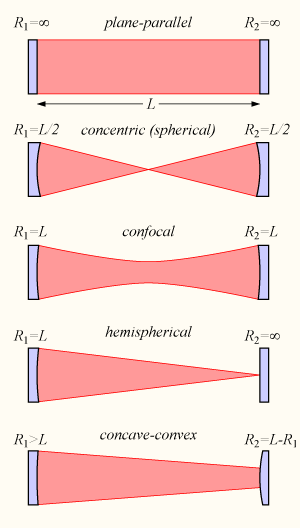
For a resonator with two mirrors with radii of curvature R1 and R2, there are a number of common cavity configurations. If the two curvatures are equal to half the cavity length (R1 = R2 = L / 2), a concentric or spherical resonator results. This type of cavity produces a diffraction
-limited beam waist in the centre of the cavity, with large beam diameters at the mirrors, filling the whole mirror aperture. Similar to this is the hemispherical cavity, with one plane mirror and one mirror of curvature equal to the cavity length.
A common and important design is the confocal resonator, with equal curvature mirrors equal to the cavity length (R1 = R2 = L). This design produces the smallest possible beam diameter at the cavity mirrors for a given cavity length, and is often used in lasers where the purity of the transverse mode pattern is important.
A concave-convex cavity has one convex mirror with a negative radius of curvature. This design produces no intracavity focus of the beam, and is thus useful in very high-power lasers where the intensity of the intracavity light might be damaging to the intracavity medium if brought to a focus.
microdroplets (20–40 micrometers in radius) doped with rhodamine 6G
dye
. This type of optical cavity exhibits optical resonances when the size of the sphere or the optical wavelength
or the refractive index
is varied. The resonance is known as morphology-dependent resonance
.
 Only certain ranges of values for R1, R2, and L produce stable resonators in which periodic refocussing of the intracavity beam is produced. If the cavity is unstable, the beam size will grow without limit, eventually growing larger than the size of the cavity mirrors and being lost. By using methods such as ray transfer matrix analysis
, it is possible to calculate a stability criterion:
Values which satisfy the inequality correspond to stable resonators.
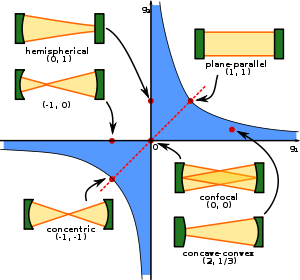
The stability can be shown graphically by defining a stability parameter, g for each mirror: ,
,
and plotting g1 against g2 as shown. Areas bounded by the line g1 g2 = 1 and the axes are stable. Cavities at points exactly on the line are marginally stable; small variations in cavity length can cause the resonator to become unstable, and so lasers using these cavities are in practice often operated just inside the stability line.
A simple geometric statement describes the regions of stability: A cavity is stable if the line segments between the mirrors and their centers of curvature overlap, but one does not lie entirely within the other.
In the confocal cavity a ray, which is deviated from its original direction in the middle between the of the cavity, is maximally (compared to other cavities) displaced on the return to the middle. This prevents amplified spontaneous emission
and is important for a good beam quality and high power amplifiers. In wave optics this is expressed by the eigenvalue degeneration of the modes. On every turn to the left, the 0,0 mode and the 1,0 mode are 90° out of phase, but on the turn back, they are 180° out of phase . Interference of the modes then leads to a displacement.
between the mirrors. Optical elements such as lenses placed in the cavity alter the stability and mode size. In addition, for most gain media, thermal and other inhomogeneities create a variable lensing effect in the medium, which must be considered in the design of the laser resonator.
Practical laser resonators may contain more than two mirrors; three- and four-mirror arrangements are common, producing a "folded cavity". Commonly, a pair of curved mirrors form one or more confocal sections, with the rest of the cavity being quasi-collimated and using plane mirrors. The shape of the laser beam depends on the type of resonator: The beam produced by stable, paraxial resonators can be well modeled by a Gaussian beam
. In special cases the beam can be described as a single transverse mode and the spatial properties can be well described by the Gaussian beam, itself. More generally, this beam may be described as a superposition of transverse modes. Accurate description of such a beam involves expansion over some complete, orthogonal set of functions (over two-dimensions) such as Hermite polynomials
or the Ince polynomials. Unstable laser resonators on the other hand, have been shown to produce fractal shaped beams.
Some intracavity elements are usually placed at a beam waist between folded sections. Examples include acousto-optic modulator
s for cavity dumping and vacuum
spatial filter
s for transverse mode
control. For some low power lasers, the laser gain medium itself may be positioned at a beam waist. Other elements, such as filter
s, prisms
and diffraction grating
s often need large quasi-collimated beams.
These designs allow compensation of the cavity beam's astigmatism
, which is produced by Brewster-cut
elements in the cavity. A 'Z'-shaped arrangement of the cavity also compensates for coma
while the 'delta' or 'X'-shaped cavity does not.
Out of plane resonators lead to rotation of the beam profile and more stability. The heat generated in the gain medium leads to frequency drift of the cavity, therefore the frequency can be actively stabilized by locking it to unpowered cavity. Similarly the pointing stability of a laser may still be improved by spatial filtering by an optical fibre.
The rotation of the beam inside the cavity alters the polarization state of the beam. To compensate for this, a single pass delay line is also needed, made of either a three or two mirrors in a 3d respective 2d retro-reflection configuration on top of a linear stage. To adjust for beam divergence a second car on the linear stage with two lenses can be used. The two lenses act as a telescope producing a flat phase front of a Gaussian beam
on a virtual end mirror.
Mirror
A mirror is an object that reflects light or sound in a way that preserves much of its original quality prior to its contact with the mirror. Some mirrors also filter out some wavelengths, while preserving other wavelengths in the reflection...
s that forms a standing wave
Standing wave
In physics, a standing wave – also known as a stationary wave – is a wave that remains in a constant position.This phenomenon can occur because the medium is moving in the opposite direction to the wave, or it can arise in a stationary medium as a result of interference between two waves traveling...
cavity resonator for light waves. Optical cavities are a major component of laser
Laser
A laser is a device that emits light through a process of optical amplification based on the stimulated emission of photons. The term "laser" originated as an acronym for Light Amplification by Stimulated Emission of Radiation...
s, surrounding the gain medium and providing feedback
Feedback
Feedback describes the situation when output from an event or phenomenon in the past will influence an occurrence or occurrences of the same Feedback describes the situation when output from (or information about the result of) an event or phenomenon in the past will influence an occurrence or...
of the laser light. They are also used in optical parametric oscillator
Optical parametric oscillator
An optical parametric oscillator is a parametric oscillator which oscillates at optical frequencies. It converts an input laser wave into two output waves of lower frequency by means of second order nonlinear optical interaction. The sum of the output waves frequencies is equal to the input wave...
s and some interferometers. Light confined in the cavity reflect multiple times producing standing wave
Standing wave
In physics, a standing wave – also known as a stationary wave – is a wave that remains in a constant position.This phenomenon can occur because the medium is moving in the opposite direction to the wave, or it can arise in a stationary medium as a result of interference between two waves traveling...
s for certain resonance frequencies
Resonance
In physics, resonance is the tendency of a system to oscillate at a greater amplitude at some frequencies than at others. These are known as the system's resonant frequencies...
. The standing wave patterns produced are called modes; longitudinal mode
Longitudinal mode
For the longitudinal mode of conduction of electric currents, see Common modeA longitudinal mode of a resonant cavity is a particular standing wave pattern formed by waves confined in the cavity. The longitudinal modes correspond to the wavelengths of the wave which are reinforced by constructive...
s differ only in frequency while transverse mode
Transverse mode
A transverse mode of a beam of electromagnetic radiation is a particular electromagnetic field pattern of radiation measured in a plane perpendicular to the propagation direction of the beam...
s differ for different frequencies and have different intensity patterns across the cross section of the beam.
Different resonator types are distinguished by the focal lengths of the two mirrors and the distance between them. (Flat mirrors are not often used because of the difficulty of aligning them to the needed precision.) The geometry (resonator type) must be chosen so that the beam remains stable (that the size of the beam does not continually grow with multiple reflections. Resonator types are also designed to meet other criteria such as minimum beam waist or having no focal point (and therefore intense light at that point) inside the cavity.
Optical cavities are designed to have a large Q factor
Q factor
In physics and engineering the quality factor or Q factor is a dimensionless parameter that describes how under-damped an oscillator or resonator is, or equivalently, characterizes a resonator's bandwidth relative to its center frequency....
; a beam will reflect a very large number of times with little attenuation
Attenuation
In physics, attenuation is the gradual loss in intensity of any kind of flux through a medium. For instance, sunlight is attenuated by dark glasses, X-rays are attenuated by lead, and light and sound are attenuated by water.In electrical engineering and telecommunications, attenuation affects the...
. Therefore the frequency line width of the beam is very small indeed compared to the frequency of the laser.
Resonator modes
Frequency
Frequency is the number of occurrences of a repeating event per unit time. It is also referred to as temporal frequency.The period is the duration of one cycle in a repeating event, so the period is the reciprocal of the frequency...
of radiation will be sustained by the resonator, with the others being suppressed by destructive interference. In general, radiation patterns which are reproduced on every round-trip of the light through the resonator are the most stable, and these are the eigenmodes, known as the modes, of the resonator.
Resonator modes can be divided into two types: longitudinal mode
Longitudinal mode
For the longitudinal mode of conduction of electric currents, see Common modeA longitudinal mode of a resonant cavity is a particular standing wave pattern formed by waves confined in the cavity. The longitudinal modes correspond to the wavelengths of the wave which are reinforced by constructive...
s, which differ in frequency from each other; and transverse mode
Transverse mode
A transverse mode of a beam of electromagnetic radiation is a particular electromagnetic field pattern of radiation measured in a plane perpendicular to the propagation direction of the beam...
s, which may differ in both frequency and the intensity
Intensity (physics)
In physics, intensity is a measure of the energy flux, averaged over the period of the wave. The word "intensity" here is not synonymous with "strength", "amplitude", or "level", as it sometimes is in colloquial speech...
pattern of the light. The basic, or fundamental transverse mode of a resonator is a Gaussian beam
Gaussian beam
In optics, a Gaussian beam is a beam of electromagnetic radiation whose transverse electric field and intensity distributions are well approximated by Gaussian functions. Many lasers emit beams that approximate a Gaussian profile, in which case the laser is said to be operating on the fundamental...
.
Resonator types
The most common types of optical cavities consist of two facing plane (flat) or spherical mirrors. The simplest of these is the plane-parallel or Fabry–Pérot cavity, consisting of two opposing flat mirrors. While simple, this arrangement is rarely used in large-scale lasers due the difficulty of alignment; the mirrors must be aligned parallel within a few seconds of arc, or "walkoff" of the intracavity beam will result in it spilling out of the sides of the cavity. However, this problem is much reduced for very short cavities with a small mirror separation distance (L < 1 cm). Plane-parallel resonators are therefore commonly used in microchip and microcavityOptical microcavity
An optical microcavity is a structure formed by reflecting faces on the two sides of a spacer layer or optical medium. The name microcavity stems from the fact that it is often only a few micrometers thick, the spacer layer sometimes even in the nanometer range...
lasers and semiconductor lasers. In these cases, rather than using separate mirrors, a reflective optical coating
Optical coating
An optical coating is one or more thin layers of material deposited on an optical component such as a lens or mirror, which alters the way in which the optic reflects and transmits light. One type of optical coating is an antireflection coating, which reduces unwanted reflections from surfaces, and...
may be directly applied to the laser medium itself. The plane-parallel resonator is also the basis of the Fabry–Pérot interferometer.
For a resonator with two mirrors with radii of curvature R1 and R2, there are a number of common cavity configurations. If the two curvatures are equal to half the cavity length (R1 = R2 = L / 2), a concentric or spherical resonator results. This type of cavity produces a diffraction
Diffraction
Diffraction refers to various phenomena which occur when a wave encounters an obstacle. Italian scientist Francesco Maria Grimaldi coined the word "diffraction" and was the first to record accurate observations of the phenomenon in 1665...
-limited beam waist in the centre of the cavity, with large beam diameters at the mirrors, filling the whole mirror aperture. Similar to this is the hemispherical cavity, with one plane mirror and one mirror of curvature equal to the cavity length.
A common and important design is the confocal resonator, with equal curvature mirrors equal to the cavity length (R1 = R2 = L). This design produces the smallest possible beam diameter at the cavity mirrors for a given cavity length, and is often used in lasers where the purity of the transverse mode pattern is important.
A concave-convex cavity has one convex mirror with a negative radius of curvature. This design produces no intracavity focus of the beam, and is thus useful in very high-power lasers where the intensity of the intracavity light might be damaging to the intracavity medium if brought to a focus.
Spherical cavity
A transparent dielectric sphere, such as a liquid droplet, also forms an interesting optical cavity. Richard K. Chang et al. have demonstrated, in 1986, lasing by using ethanolEthanol
Ethanol, also called ethyl alcohol, pure alcohol, grain alcohol, or drinking alcohol, is a volatile, flammable, colorless liquid. It is a psychoactive drug and one of the oldest recreational drugs. Best known as the type of alcohol found in alcoholic beverages, it is also used in thermometers, as a...
microdroplets (20–40 micrometers in radius) doped with rhodamine 6G
Rhodamine 6G
Rhodamine 6G is a chemical compound and a dye. It is often used as a tracer dye within water to determine the rate and direction of flow and transport. Rhodamine dyes fluoresce and can thus be detected easily and inexpensively with instruments called fluorometers...
dye
Dye
A dye is a colored substance that has an affinity to the substrate to which it is being applied. The dye is generally applied in an aqueous solution, and requires a mordant to improve the fastness of the dye on the fiber....
. This type of optical cavity exhibits optical resonances when the size of the sphere or the optical wavelength
Wavelength
In physics, the wavelength of a sinusoidal wave is the spatial period of the wave—the distance over which the wave's shape repeats.It is usually determined by considering the distance between consecutive corresponding points of the same phase, such as crests, troughs, or zero crossings, and is a...
or the refractive index
Refractive index
In optics the refractive index or index of refraction of a substance or medium is a measure of the speed of light in that medium. It is expressed as a ratio of the speed of light in vacuum relative to that in the considered medium....
is varied. The resonance is known as morphology-dependent resonance
Morphology-dependent resonance
Resonances found in certain types of optical cavity that are cylindrical, spherical, and ellipsoidal in shape. Conditions under which the resonances occur dependent on shape as well as refractive index of material within the optical cavity, and normally characterized by two integers, namely, order...
.
Stability
Ray transfer matrix analysis
Ray transfer matrix analysis is a type of ray tracing technique used in the design of some optical systems, particularly lasers...
, it is possible to calculate a stability criterion:
Values which satisfy the inequality correspond to stable resonators.
The stability can be shown graphically by defining a stability parameter, g for each mirror:
,and plotting g1 against g2 as shown. Areas bounded by the line g1 g2 = 1 and the axes are stable. Cavities at points exactly on the line are marginally stable; small variations in cavity length can cause the resonator to become unstable, and so lasers using these cavities are in practice often operated just inside the stability line.
A simple geometric statement describes the regions of stability: A cavity is stable if the line segments between the mirrors and their centers of curvature overlap, but one does not lie entirely within the other.
In the confocal cavity a ray, which is deviated from its original direction in the middle between the of the cavity, is maximally (compared to other cavities) displaced on the return to the middle. This prevents amplified spontaneous emission
Amplified spontaneous emission
Amplified spontaneous emission or superluminescence is light, produced by spontaneous emission, that has been optically amplified by the process of stimulated emission in a gain medium. It is inherent in the field of random lasers....
and is important for a good beam quality and high power amplifiers. In wave optics this is expressed by the eigenvalue degeneration of the modes. On every turn to the left, the 0,0 mode and the 1,0 mode are 90° out of phase, but on the turn back, they are 180° out of phase . Interference of the modes then leads to a displacement.
Practical resonators
If the optical cavity is not empty (e.g., a laser cavity which contains the gain medium), the value of L used is not the physical mirror separation, but the optical path lengthOptical path length
In optics, optical path length or optical distance is the product of the geometric length of the path light follows through the system, and the index of refraction of the medium through which it propagates. A difference in optical path length between two paths is often called the optical path...
between the mirrors. Optical elements such as lenses placed in the cavity alter the stability and mode size. In addition, for most gain media, thermal and other inhomogeneities create a variable lensing effect in the medium, which must be considered in the design of the laser resonator.
Practical laser resonators may contain more than two mirrors; three- and four-mirror arrangements are common, producing a "folded cavity". Commonly, a pair of curved mirrors form one or more confocal sections, with the rest of the cavity being quasi-collimated and using plane mirrors. The shape of the laser beam depends on the type of resonator: The beam produced by stable, paraxial resonators can be well modeled by a Gaussian beam
Gaussian beam
In optics, a Gaussian beam is a beam of electromagnetic radiation whose transverse electric field and intensity distributions are well approximated by Gaussian functions. Many lasers emit beams that approximate a Gaussian profile, in which case the laser is said to be operating on the fundamental...
. In special cases the beam can be described as a single transverse mode and the spatial properties can be well described by the Gaussian beam, itself. More generally, this beam may be described as a superposition of transverse modes. Accurate description of such a beam involves expansion over some complete, orthogonal set of functions (over two-dimensions) such as Hermite polynomials
Hermite polynomials
In mathematics, the Hermite polynomials are a classical orthogonal polynomial sequence that arise in probability, such as the Edgeworth series; in combinatorics, as an example of an Appell sequence, obeying the umbral calculus; in numerical analysis as Gaussian quadrature; and in physics, where...
or the Ince polynomials. Unstable laser resonators on the other hand, have been shown to produce fractal shaped beams.
Some intracavity elements are usually placed at a beam waist between folded sections. Examples include acousto-optic modulator
Acousto-optic modulator
An acousto-optic modulator , also called a Bragg cell, uses the acousto-optic effect to diffract and shift the frequency of light using sound waves . They are used in lasers for Q-switching, telecommunications for signal modulation, and in spectroscopy for frequency control. A piezoelectric...
s for cavity dumping and vacuum
Vacuum
In everyday usage, vacuum is a volume of space that is essentially empty of matter, such that its gaseous pressure is much less than atmospheric pressure. The word comes from the Latin term for "empty". A perfect vacuum would be one with no particles in it at all, which is impossible to achieve in...
spatial filter
Spatial filter
A spatial filter is an optical device which uses the principles of Fourier optics to alter the structure of a beam of coherent light or other electromagnetic radiation. Spatial filtering is commonly used to "clean up" the output of lasers, removing aberrations in the beam due to imperfect, dirty,...
s for transverse mode
Transverse mode
A transverse mode of a beam of electromagnetic radiation is a particular electromagnetic field pattern of radiation measured in a plane perpendicular to the propagation direction of the beam...
control. For some low power lasers, the laser gain medium itself may be positioned at a beam waist. Other elements, such as filter
Filter (optics)
Optical filters are devices which selectively transmit light of different wavelengths, usually implemented as plane glass or plastic devices in the optical path which are either dyed in the mass or have interference coatings....
s, prisms
Prism (optics)
In optics, a prism is a transparent optical element with flat, polished surfaces that refract light. The exact angles between the surfaces depend on the application. The traditional geometrical shape is that of a triangular prism with a triangular base and rectangular sides, and in colloquial use...
and diffraction grating
Diffraction grating
In optics, a diffraction grating is an optical component with a periodic structure, which splits and diffracts light into several beams travelling in different directions. The directions of these beams depend on the spacing of the grating and the wavelength of the light so that the grating acts as...
s often need large quasi-collimated beams.
These designs allow compensation of the cavity beam's astigmatism
Aberration in optical systems
Aberrations are departures of the performance of an optical system from the predictions of paraxial optics. Aberration leads to blurring of the image produced by an image-forming optical system. It occurs when light from one point of an object after transmission through the system does not converge...
, which is produced by Brewster-cut
Brewster's angle
Brewster's angle is an angle of incidence at which light with a particular polarization is perfectly transmitted through a transparent dielectric surface, with no reflection. When unpolarized light is incident at this angle, the light that is reflected from the surface is therefore perfectly...
elements in the cavity. A 'Z'-shaped arrangement of the cavity also compensates for coma
Coma (optics)
In optics , the coma in an optical system refers to aberration inherent to certain optical designs or due to imperfection in the lens or other components which results in off-axis point sources such as stars appearing distorted, appearing to have a tail like a comet...
while the 'delta' or 'X'-shaped cavity does not.
Out of plane resonators lead to rotation of the beam profile and more stability. The heat generated in the gain medium leads to frequency drift of the cavity, therefore the frequency can be actively stabilized by locking it to unpowered cavity. Similarly the pointing stability of a laser may still be improved by spatial filtering by an optical fibre.
Optical delay lines
Optical cavities can also be used as multipass optical delay lines, folding a light beam so that a long path-length may be achieved in a small space. A plane-parallel cavity with flat mirrors produces a flat zigzag light path, but as discussed above, these designs are very sensitive to mechanical disturbances and walk-off. When curved mirrors are used in a nearly confocal configuration, the beam travels on a circular zigzag path. The latter is called a Herriott-type delay line. A fixed insertion mirror is placed off-axis near one of the curved mirrors, and a mobile pickup mirror is similarly placed near the other curved mirror. A flat linear stage with one pickup mirror is used in case of flat mirrors and a rotational stage with two mirrors is used for the Herriott-type delay line.The rotation of the beam inside the cavity alters the polarization state of the beam. To compensate for this, a single pass delay line is also needed, made of either a three or two mirrors in a 3d respective 2d retro-reflection configuration on top of a linear stage. To adjust for beam divergence a second car on the linear stage with two lenses can be used. The two lenses act as a telescope producing a flat phase front of a Gaussian beam
Gaussian beam
In optics, a Gaussian beam is a beam of electromagnetic radiation whose transverse electric field and intensity distributions are well approximated by Gaussian functions. Many lasers emit beams that approximate a Gaussian profile, in which case the laser is said to be operating on the fundamental...
on a virtual end mirror.
See also
- Optical feedbackOptical feedbackOptical feedback is the optical equivalent of acoustic feedback. A simple example is the feedback that occurs when a loop exists between an optical input, e.g., a video camera, and an optical output, e.g., a television screen or monitor...
- Multiple-prism grating laser oscillators (or Multiple-prism grating laser cavities)