| |
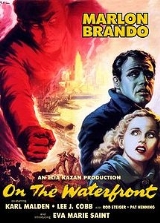
On the Waterfront is a American drama film about mob violence and corruption among longshoremen. The film was directed by Elia Kazan and written by Budd Schulberg. It stars Marlon Brando, Eva Marie Saint, Rod Steiger, Karl Malden and Lee J. Cobb. The soundtrack score was composed by Leonard Bernstein. It was based on a series of articles written in the New York Sun by Malcolm Johnson.
The film received eight Academy Awards, including Best Picture, Best Actor, and Best Director. It is Leonard Bernstein's only original film score not adapted from a stage production with songs.
On the Waterfront has often been cited as an allegory of "naming names" against suspected Communists during the anti-Communist investigations of the 1950s. classic story of Mob informers was based on a number of true stories and filmed on location in and around the docks of Hoboken, New Jersey.

Discussion
Ask a question about 'On the Waterfront'
Start a new discussion about 'On the Waterfront'
Answer questions from other users
|
Quotations
Some people think the Crucifixion only took place on Calvary.
Yeah his racket, everybody's got a racket.
You don't understand. I could'a had class. I could'a been a contender. I coulda been somebody, instead of a bum, which is what I am, let's face it. It was you, Charley.
You know you're not too funny today, fat man.

Encyclopedia
On the Waterfront is a American drama film about mob violence and corruption among longshoremen. The film was directed by Elia Kazan and written by Budd Schulberg. It stars Marlon Brando, Eva Marie Saint, Rod Steiger, Karl Malden and Lee J. Cobb. The soundtrack score was composed by Leonard Bernstein. It was based on a series of articles written in the New York Sun by Malcolm Johnson.
The film received eight Academy Awards, including Best Picture, Best Actor, and Best Director. It is Leonard Bernstein's only original film score not adapted from a stage production with songs.
On the Waterfront has often been cited as an allegory of "naming names" against suspected Communists during the anti-Communist investigations of the 1950s.
Plot
This classic story of Mob informers was based on a number of true stories and filmed on location in and around the docks of Hoboken, New Jersey. Mob-connected union boss Johnny Friendly (Lee J. Cobb) rules the waterfront with an iron fist. The police know that he's been responsible for a number of murders, but witnesses play deaf and dumb ("D&D"). Terry Malloy (Marlon Brando) is a dockworker whose brother Charley (Rod Steiger) is Friendly‘s lawyer. Some years earlier, Terry had been a promising boxer until Friendly had Charley instruct Terry to deliberately lose a fight that he could have won, so that Friendly could win money betting on the weaker opponent. As the film begins, Terry sees boss Friendly's men kill another dockworker to keep him from testifying against Friendly before the crime commission, and Terry resents having been tricked into helping to set up the murder. At first Terry is willing to remain D&D. The dead dockworker's lovely sister, Edie (Eva Marie Saint) shames "waterfront priest" Father Barry (Karl Malden) into fighting against the union/mob. Soon both Edie and Father Barry are urging Terry to testify. Another dockworker does testify, and Friendly arranges for him to have a fatal accident.
As Terry increasingly leans toward testifying, Friendly decides that Terry must be killed unless Charley can bribe, or threaten, him to keep quiet. Charley tries, but fails. In one of the most famous scenes in movie history, Terry reminds Charley that if it had not been for the fixing of the fight, "I coulda been a contender". Charley gives Terry a gun and tells him to run. Friendly finds out, and has his goons murder Charley, and try to kill Terry. Terry tries to find, and shoot, Friendly, but Father Barry obstructs that course of action and finally convinces Terry to fight Friendly by testifying. In a final face-to-face confrontation with Friendly, Terry gets beaten up and nearly killed, but the dockworkers fall in behind Terry, sensing that he has defeated Friendly.
Factual background
On the Waterfront was based on a 24-part series of articles in the New York Sun by Malcolm Johnson, "Crime on the Waterfront". The series won the 1949 Pulitzer Prize for Local Reporting. The stories detailed widespread corruption, extortion, and racketeering on the waterfront of Manhattan and Brooklyn.
To add realism, On the Waterfront was filmed over 36 days on-location in Hoboken, New Jersey (in the cargo holds of ships, workers' slum dwellings, the bars, the littered alleys, and on the rooftops). And some of the labor boss' chief bodyguards/goons in the film (Abe Simon as Barney, Tony Galento as Truck, and Tami Mauriello as Tullio) were real-life, professional ex-heavyweight boxers.
In On the Waterfront, protagonist Terry Malloy's (Brando's) fight against corruption was in part modeled after whistle-blowing longshoreman Anthony DiVincenzo, who testified before a real-life Waterfront Commission on the facts of life on the Hoboken docks and had suffered a degree of ostracism for his deed. DiVincenzo sued and settled, many years after, with Columbia Pictures over the appropriation of what he considered his story. DiVincenzo recounted his story to screenwiter Budd Schulberg during a month-long session of waterfront barroom meetings — which some claim never occurred — even though Shulberg attended Di Vincenzo's waterfront commission testimony every day during the hearing. Johnny Friendly was based in part on mobster Albert Anastasia, chief executioner of Murder, Inc. as well as Michael Clemente, the International Longshoremen's Association boss.
Karl Malden's character of Father Barry was based on the real-life "waterfront priest" Father John M. Corridan, a graduate of Regis High School who operated a Roman Catholic labor school on the west side of Manhattan. Father Corridan was extensively interviewed by Budd Schulberg, who wrote the foreword to a biography of Father Corridan, Waterfront Priest by Allen Raymond. The story was filmed in Hoboken, New Jersey, although it is a fictionalized version of events on the New York waterfront.
Schulberg's later novel Budd Schulberg later published a novel just called Waterfront that was much closer to his original screenplay than what finally ended up on the screen. Among several differences is that in Schulberg's novel and original screen treatment, Terry Malloy dies.
Remakes The movie was remade in 1997 in Hindi as Ghulam starring Indian Actor Aamir Khan.
Political context
In 1952, director Elia Kazan was a "friendly" witness before the House Un-American Activities Committee (HUAC), in which he identified many alleged Communists in the film industry. That brought him severe criticism. Being "friendly" before the HUAC could be a possible clue towards the name of the mob boss in the movie, Johnny Friendly.
The original screenplay (called "The Hook") was written by renowned playwright Arthur Miller, who was blacklisted as an alleged Communist. He was replaced by Budd Schulberg, also a "friendly" witness before HUAC.
On the Waterfront, being about a heroic mob informer, is widely considered to be Kazan's answer to his critics (including his former friend and collaborator Miller), showing that there could be nobility in a man who "named names." In the movie, variations of that phrase are repeatedly used by Terry Malloy. The film also repeatedly emphasizes the waterfront's code of "D and D" or "Deaf and Dumb," remaining silent at all costs and not "ratting out" one's friends. In the end, Malloy does just that and his doing so is depicted sympathetically. Miller's response to the movie's message is contained in his own play, A View from the Bridge, which presents a contrasting view of those who inform on others.
Awards and honors
In 1989, this film was deemed "culturally, historically, or aesthetically significant" by the Library of Congress and selected for preservation in the United States National Film Registry. It is also on the Vatican's list of 45 greatest films of all time, compiled in 1995.
Academy Awards
Wins:
It was the winner of eight Oscars:
Nominations:
The film also received an additional four Oscar nominations:
Others
American Film Institute recognition
Bibliography
- Raymond, Allen, Waterfront Priest (New York: Henry Holt and Company, 1955); forward by On the Waterfront screenwriter Budd Schulberg
External links
- via UC Berkeley Media Resources Center
-
-
-
-
|