
|
|
|
|
Elia Kazan
|
| |
|
| |
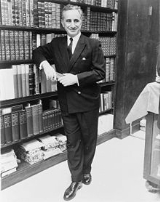
Elia Kazan, (pronounced EEL-ya ka-ZAHN) September 7 1909 – September 28 2003, was an American award-winning film and theatre director, film and theatrical producer, screenwriter, novelist and co-founder of the influential Actors Studio in New York in 1947. Kazan was a three-time Academy Award winner, a five-time Tony Award winner, a four-time Golden Globes winner, as well as a recipient of numerous awards and nominations in other prestigious festivals as the Cannes Film Festival and the Venice Film Festival.
n was born Elias Kazanjoglou (Ilyas Kazancioglu in Turkish) in the Anatolian city of the Ottoman Empire, Kayseri , Turkey) to a Greek family.

Discussion
Ask a question about 'Elia Kazan'
Start a new discussion about 'Elia Kazan'
Answer questions from other users
|
Encyclopedia
Elia Kazan, (pronounced EEL-ya ka-ZAHN) September 7 1909 – September 28 2003, was an American award-winning film and theatre director, film and theatrical producer, screenwriter, novelist and co-founder of the influential Actors Studio in New York in 1947. Kazan was a three-time Academy Award winner, a five-time Tony Award winner, a four-time Golden Globes winner, as well as a recipient of numerous awards and nominations in other prestigious festivals as the Cannes Film Festival and the Venice Film Festival.
Early life
Kazan was born Elias Kazanjoglou (Ilyas Kazancioglu in Turkish) in the Anatolian city of the Ottoman Empire, Kayseri , Turkey) to a Greek family. His family name 'Kazanjoglou' (an alternate spelling is Kazantzoglou) is Turkish, meaning "The son of a cauldron maker", where the root word 'kazan' means cauldron or boiler. It was and still is common to find people of Greek, Jewish, Armenian, and Kurdish lineage with Turkish family names or where the root words in the names are uniquely Turkish. His mother was born in Kayseri, Turkey. (Kazani is also the Greek name for cauldron)
Suffering the prejudice of being Greek from the newly formed government of the Young Turks, his family emigrated to the United States in 1913 and settled in New York City, where his father, George Kazanjoglu, became a rug merchant. Kazan's father expected that his son would go into the family business, but his mother, Athena (nιe Sismanoglou), encouraged Kazan to make his own decisions.
Kazan attended public schools in New York City and New Rochelle, New York. After graduating from Williams College, Massachusetts, Kazan studied at Yale University's School of Drama. In the 1930s, Kazan acted with New York's Group Theatre, alongside (among others) Lee Strasberg, Clifford Odets, and Stella and Luther Adler. During this period, Kazan earned his nickname 'Gadg,' short for Gadget - he never learned to love the name. For about 19 months in 1934-36, Kazan was a member of a secret Communist cell.
Career
Theatrical
He became one of the most visible members of the New York elite. Kazan's theater credits included acting in Men in White, Waiting for Lefty, Johnny Johnson, Golden Boy, and the 1940 revival of Liliom, and directing A Streetcar Named Desire (1951) and Cat on a Hot Tin Roof (1955), two of the plays that made Tennessee Williams a theatrical and literary force, and All My Sons (1947) and Death of a Salesman, (1949) the plays which did much the same for Arthur Miller. He received three Tony Awards, winning for All My Sons, Death of a Salesman, and J.B.
Film director
Kazan's history as a film director is equally as noteworthy, if not more impressive. He won two Academy Awards for Best Director, for Gentleman's Agreement (1947) and On the Waterfront (1954). He elicited critically acclaimed performances from actors such as Marlon Brando and Oscar winners Vivien Leigh, Karl Malden and Kim Hunter in A Streetcar Named Desire (1951) (the film version of Tennessee Williams' play), James Dean and Oscar winner Jo Van Fleet in East of Eden (adapted from the John Steinbeck novel), and Andy Griffith in A Face in the Crowd.
Before he began directing films, however, he occasionally played supporting roles in them, one of those films being the 1941 Blues in the Night.
Controversial House Committee testimony
Kazan remained controversial until his death for testimony he gave before the House Un-American Activities Committee in 1952, in which (after previously refusing to do so) he provided the names of associates from his days as a member of the Communist Party in the 1930s.
He began his career as an actor and stage manager for New York's Group Theatre Company (a strong leftist organization), which was just recently established. His involvement in the group led him to join the "American Communist Party" in 1934. He was only involved with the Communist Party for a short time; however, he was quickly recognized as a potential communist by the House Un-American Activities Committee a group that was investigating the motion picture industry because of growing concern of communists working in the industry. A blacklist of names was being circulated, and those on the list could be in serious trouble and be denied to work in the film industry again. The committee called people to "rat out" others, many refused, however; Kazan gave the committee the names of eight other members of the same party he was in, reasoning that he did not want to be on the blacklist. Any member found to be on the blacklist had their credits removed from any film they had participated in. Names he gave out also included "friends" who had worked with him in The Group Theater.
When Kazan received an Honorary Academy Award in 1999 surviving victims of the McCarthy-era blacklist, as well as younger actors, protested. Kazan defended his actions long after the fact, writing, "I'd had every good reason to believe the party should be driven out of its many hiding places and into the light of scrutiny, but I'd never said anything because it would be called 'red-baiting.' [. . .] The `horrible, immoral thing' that I did I did out of my own true self."
Personal life
Elia Kazan was married three times. His first wife was playwright Molly Day Thacher. They were married from 1932 until her death in 1963; this marriage produced two daughters and two sons. His second marriage, to the actress Barbara Loden, lasted from 1969 until her death in 1980, and produced one son. Lastly, he was married to Frances Rudge from 1982 until his death in 2003 at the age of 91. He also had a long-term affair with Constance Dowling during his first marriage, which ended when Dowling went to Hollywood in 1944 to make Up in Arms under contract to Samuel Goldwyn.
Awards and nominations
In 1999, Kazan received an honorary Oscar for lifetime achievement. He was accompanied by Martin Scorsese and Robert De Niro who warned the audience sotto voce not to misbehave. Robert De Niro himself had appeared in a film about the Hollywood Red Scare. While many in Hollywood who had experienced the Red Scare felt that enough time had passed that it was appropriate to bury the hatchet and recognize Kazan's great artistic accomplishments, others did not. Some Hollywood celebrities expressed outrage, and former blacklisted writer Abraham Polonsky stated that he wished Kazan would be shot onstage.
Academy Awards
Nominations
Tony Awards
- 1956: Best Director Cat on a Hot Tin Roof
- 1958: Best Play The Dark at the Top of the Stairs
- 1958: Best Director The Dark at the Top of the Stairs
- 1960: Best Direction of a Play Sweet Bird of Youth
- 1965: Best Producer of a Play Tartuffe
Nominations
- 1959: Best Direction J.B.
- 1949: Best Director Death of a Salesman
- 1947: Best Direction All My Sons
Cannes Film Festival Awards
- 1955: Best Dramatic Film East of Eden (1955)
Nominations
- 1952: Grand Prize of the Festival Viva Zapata!
- 1955: Palme d'Or (Golden Palm) East of Eden
- 1972: Palme d'Or The Visitors
Venice Film Festival Awards
- 1950: International Award Panic in the Streets
- 1951: Special Jury Prize A Streetcar Named Desire
- 1954: Italian Film Critics Award On the Waterfront
- 1954: Leone dArgento (Silver Lion) On the Waterfront
- 1955: OCIC Award On the Waterfront
Nominations
- 1948: Leone d'Oro (Golden Lion) Gentleman's Agreement
- 1950: Leone d'Oro Panic in the Streets (1950)
- 1951: Leone d'Oro A Streetcar Named Desire
- 1954: Leone d'Oro On the Waterfront
Filmography
Bibliography
Further reading
External links
|
| |
|
|