
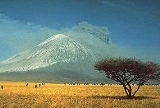
Ol Doinyo Lengai is an active
volcano2. Bedrock3. Conduit 4. Base5. Sill6. Dike7. Layers of ash emitted by the volcano8. Flank| 9. Layers of lava emitted by the volcano10. Throat11. Parasitic cone12. Lava flow13. Vent14. Crater15...
located in the north of
TanzaniaThe United Republic of Tanzania is a country in East Africa bordered by Kenya and Uganda to the north, Rwanda, Burundi, and the Democratic Republic of the Congo to the west, and Zambia, Malawi, and Mozambique to the south. The country's eastern borders lie on the Indian Ocean.Tanzania is a state...
and is part of the volcanic system of the
Great Rift ValleyThe Great Rift Valley is a name given in the late 19th century by British explorer John Walter Gregory to the continuous geographic trench, approximately in length, that runs from northern Syria in Southwest Asia to central Mozambique in South East Africa...
in Eastern
AfricaAfrica is the world's second largest and second most populous continent, after Asia. At about 30.2 million km² including adjacent islands, it covers 6% of the Earth's total surface area and 20.4% of the total land area...
. It is located in the eastern
Rift ValleyThe Great Rift Valley is a name given in the late 19th century by British explorer John Walter Gregory to the continuous geographic trench, approximately in length, that runs from northern Syria in Southwest Asia to central Mozambique in South East Africa...
, south of both
Lake NatronLake Natron is a salt lake located in northern Tanzania, close to the Kenyan border, in the eastern branch of Africa's Great Rift Valley. The lake is fed by the Ewaso Ng'iro River but also by mineral-rich hot springs and is quite shallow, less than three meters deep, and varies in width depending...
and
KenyaKenya , officially known as the Republic of Kenya, is a country in East Africa that lies on the equator, with the Indian Ocean to its south-east...
. It is unique among active volcanoes in that it produces
natrocarbonatiteNatrocarbonatite is a rare carbonatite lava which erupts from the Ol Doinyo Lengai volcano in Tanzania within the Great Rift Valley of eastern Africa. Whereas most lavas are rich in silicate minerals, the natrocarbonatite lavas of Ol Doinyo Lengai are rich in the rare sodium and potassium carbonate...
lavaLava refers both to molten rock expelled by a volcano during an eruption and the resulting rock after solidification and cooling. This molten rock is formed in the interior of some planets, including Earth, and some of their satellites. When first erupted from a volcanic vent, lava is a liquid at...
, a unique occurrence of volcanic
carbonatiteCarbonatites are intrusive or extrusive igneous rocks defined by mineralogic composition consisting of greater than 50 percent carbonate minerals. Carbonatites may be confused with marble, and may require geochemical verification....
. Further, the temperature of its lava as it emerges is only around 510 °C (950 °F). A few older extinct carbonatite volcanoes are located nearby, including Homa Mountain.
Geology
"Ol Doinyo Lengai" means "The Mountain of God" in the
Maasai languageThe Maasai language is an Eastern Nilotic language spoken in Southern Kenya and Northern Tanzania by the Maasai people, numbering about 800,000...
of the native people.
The record of eruptions on the mountain dates to 1883, and flows were also recorded between 1904 and 1910 and again between 1913 and 1915. A major eruption took place in June 1917, which resulted in volcanic ash being deposited about 48 kilometres away.
A similar eruption took place for several months in 1926 and between July and December 1940, resulting in the ash being deposited as far as
LoliondoLoliondo village is situated in Ngorongoro District of Arusha Region in Northern Tanzania. Together with neighbouring Wasso village, it hosts the district offices and forms the commercial centre of Loliondo division...
, which is 100 kilometres away. Several minor eruptions of lava were observed in 1954, 1955, 1958 the early 1960s.
When Ol Doinyo Lengai erupted on August 14, 1966, two geologists — J. B. Dawson and G. C. Clark — who visited the crater a week later, reported seeing “a thick column of black ash” that rose for approximately three thousand feet above the volcano and drifted away northwards towards Lake Natron. When the two climbed the cone-shaped vent, they reported seeing a continuous discharge of gas and whitish-grey ash and dust from the centre of the pit.
Volcanic activity in the mountain caused daily
earth tremorsAn earthquake is the result of a sudden release of energy in the Earth's crust that creates seismic waves. The seismicity, seismism or seismic activity of an area refers to the frequency, type and size of earthquakes experienced over a period of time...
in Kenya and Tanzania beginning on July 12, 2007. The latest to hit parts of
NairobiNairobi is the capital and largest city of Kenya. The city and its surrounding area also forms the Nairobi County. The name "Nairobi" comes from the Maasai phrase Enkare Nyirobi, which translates to "the place of cool waters". However, it is popularly known as the "Green City in the Sun" and is...
city was recorded on July 18, 2007 at 8.30pm (Kenyan Time). The strongest tremor measured 6.0 on the
Richter scaleThe expression Richter magnitude scale refers to a number of ways to assign a single number to quantify the energy contained in an earthquake....
. Geologists suspected that the sudden increase of tremors was indicative of the movement of magma through the Ol Doinyo Lengai. The volcano finally erupted on September 4, 2007, sending a plume of
ashVolcanic ash consists of small tephra, which are bits of pulverized rock and glass created by volcanic eruptions, less than in diameter. There are three mechanisms of volcanic ash formation: gas release under decompression causing magmatic eruptions; thermal contraction from chilling on contact...
and
steamSteam is the technical term for water vapor, the gaseous phase of water, which is formed when water boils. In common language it is often used to refer to the visible mist of water droplets formed as this water vapor condenses in the presence of cooler air...
at least 18 kilometers downwind and covering the north and west flanks in fresh lava flows. The eruption has continued intermittently into 2008, as of the end of February it was reported that the eruption appeared to be gathering strength, with a major outburst taking place on March 5. During April periods of inactivity have been followed by eruptions on April 8 and 17. Eruptive activity continued until late August 2008. A visit to the summit in September 2008 discovered that lava emission had resumed from two vents in the floor of the new crater. Visits to the crater in March/April 2009 showed that even this activity appears to have ceased.
Lava
Whereas most
lavaLava refers both to molten rock expelled by a volcano during an eruption and the resulting rock after solidification and cooling. This molten rock is formed in the interior of some planets, including Earth, and some of their satellites. When first erupted from a volcanic vent, lava is a liquid at...
s are rich in
silicate mineralsThe silicate minerals make up the largest and most important class of rock-forming minerals, constituting approximately 90 percent of the crust of the Earth. They are classified based on the structure of their silicate group...
, the lava of Ol Doinyo Lengai is a
carbonatiteCarbonatites are intrusive or extrusive igneous rocks defined by mineralogic composition consisting of greater than 50 percent carbonate minerals. Carbonatites may be confused with marble, and may require geochemical verification....
. It is rich in the rare
sodiumSodium is a chemical element with the symbol Na and atomic number 11. It is a soft, silvery-white, highly reactive metal and is a member of the alkali metals; its only stable isotope is 23Na. It is an abundant element that exists in numerous minerals, most commonly as sodium chloride...
and
potassiumPotassium is the chemical element with the symbol K and atomic number 19. Elemental potassium is a soft silvery-white alkali metal that oxidizes rapidly in air and is very reactive with water, generating sufficient heat to ignite the hydrogen emitted in the reaction.Potassium and sodium are...
carbonateIn chemistry, a carbonate is a salt of carbonic acid, characterized by the presence of the carbonate ion, . The name may also mean an ester of carbonic acid, an organic compound containing the carbonate group C2....
s,
nyerereiteNyerereite is a very rare sodium calcium carbonate mineral with formula Na2Ca2. It forms colorless, platey pseudohexagonal orthorhombic crystals that are typically twinned. It has a specific gravity of 2.54 and indices of refraction of nα=1.511, nβ=1.533 and nγ=1.535. Nyerereite is not stable in...
and
gregoryiteGregoryite is an anhydrous carbonate that is rich in potasium and sodium...
. Due to this unusual composition, the lava erupts at relatively low temperatures of approximately 500-600 degrees Celsius. This temperature is so low that the molten lava appears black in sunlight, rather than having the red glow common to most lavas. It is also much more fluid than silicate lavas, often less viscous than water. The sodium and potassium carbonate minerals of the lavas formed by Ol Doinyo Lengai are unstable at the Earth's surface and susceptible to rapid
weatheringWeathering is the breaking down of rocks, soils and minerals as well as artificial materials through contact with the Earth's atmosphere, biota and waters...
, quickly turning from black to grey in color. The resulting volcanic landscape is different from any other in the world.
External links