
| |
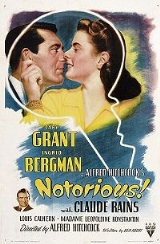
Notorious (1946) is a thriller directed and produced by Alfred Hitchcock, and starring Cary Grant, Ingrid Bergman and Claude Rains as three people whose lives become intimately entangled during an espionage operation.
ia Huberman (Ingrid Bergman), the American daughter of a convicted Nazi spy, is recruited by government agent T. R. Devlin (Cary Grant) to infiltrate a group of Germans who have relocated to Brazil after World War II.
During her training in Rio de Janeiro, Alicia falls in love with Devlin.

Discussion
Ask a question about 'Notorious'
Start a new discussion about 'Notorious'
Answer questions from other users
|
Quotations
I don't know if she'll do it...Well, I don't think she's that type of woman.
I want to make it 80 and wipe that grin off your face. I don't like gentlemen who grin at me.
I'm allergic to American agents. Their fine points don't particularly appeal to me.
Notorious woman of affairs... Adventurous man of the world!
Notorious Woman of many Desires! Fateful Fascination! Bold Intrigue!
She wasn't drunk, she was sick. Maybe that's why she hasn't shown up. She looked like the ragged end of nowhere.

Encyclopedia
Notorious (1946) is a thriller directed and produced by Alfred Hitchcock, and starring Cary Grant, Ingrid Bergman and Claude Rains as three people whose lives become intimately entangled during an espionage operation.
Plot
Alicia Huberman (Ingrid Bergman), the American daughter of a convicted Nazi spy, is recruited by government agent T. R. Devlin (Cary Grant) to infiltrate a group of Germans who have relocated to Brazil after World War II.
During her training in Rio de Janeiro, Alicia falls in love with Devlin. His feelings for her are tempered by his knowledge of her wild past. When Devlin is ordered to convince her to seduce Alex Sebastian (Claude Rains), one of her father's friends and a member of the group, to find out what he's plotting, he agonizes before choosing duty over love. Bitter at his betrayal, Alicia eventually weds Alex.
Alicia discovers the plot, but in the process leaves a clue that her husband traces back to her. Now Alex has a problem: he must silence Alicia, but cannot expose her without being suspected by his fellow Nazis. Alex discusses the situation with his mother (Leopoldine Konstantin), who suggests that Alicia "die slowly", gradually by poisoning. The poison is mixed into Alicia's coffee and she quickly falls ill. Devlin becomes suspicious when she meets him and tells him that she merely has a hangover and yet shows signs of grave illness. He becomes alarmed when she fails to appear at their next meeting and drives to Sebastian's house. Alicia tells him that Alex and his mother are poisoning her. After confessing his love for her, Devlin carries her out of the mansion in full view of the conspirators, leaving the hapless Alex to the non-existent mercy of his "friends", who question Alicia's odd departure.
Cameo
Alfred Hitchcock's cameo appearance, a signature occurrence in all of his American films, takes place at the big party in Sebastian's mansion. Hitchcock is seen knocking back a glass of champagne and then quickly departing, about 60 minutes into the film.
Production
Screenplay
Development of Notorious commenced due to director Alfred Hitchcock and screenwriter Ben Hecht owing producer David O. Selznick a movie and a script respectively. While collaborating on the movie Spellbound, they decided to meet this obligation by developing a film inspired by a short story, the rights to which Selznick owned and Hitchcock had read many years before. The story was "The Song of the Dragon", by John Taintor Foote, which had appeared as a two-part serial in the Saturday Evening Post in 1921. Set during World War I in New York, it told the story of a theatrical producer approached by federal agents, who want his assistance in recruiting an actress he once had a relationship with to seduce the leader of a gang of enemy saboteurs.
Hitchcock felt that the first draft fell short of his expectations, leading him, at Cary Grant’s suggestion, to hire Clifford Odets to revise it. Odets, however, soon quit over Hitchcock’s request to add additional dialogue between Devlin and Alicia while she was on her deathbed.
Among the numerous changes to the original story was the introduction of the MacGuffin, a cache of uranium being held by the Nazis. At the time, it was not common knowledge that uranium was being used in the development of the atomic bomb, and Selznick had trouble understanding its use as a plot device. Indeed, Hitchcock later claimed he was followed by the FBI for several months after he and Hecht discussed uranium with Robert Millikan at the Caltech in mid-1945. In the event, the dropping of the atomic bomb on Hiroshima on August 9, 1945, and the release of details of the Manhattan Project, removed any doubts about its use.
Production
Selznick, the original producer, preferred Joseph Cotten over Cary Grant for the role of Devlin. However, once Grant had been chosen, Selznick wanted his role to be increased. Selznick also pushed for the role of Sebastian’s mother to become more central to the plot.
Selznick sold Notorious to RKO for the sum of US$800,000 to help finance the production of Duel in the Sun, which was running overbudget. The package included Alfred Hitchcock, Ingrid Bergman, Cary Grant, and the script. Selznick was also to receive 50% of the net profits.
Notorious became the first film that Hitchcock collaborated with Edith Head with Ingrid Bergman's outfits being the most notable outcome of this collaboration.
The movie featured a legendary on-again, off-again kiss between Cary Grant and Ingrid Bergman which flouted then-current Production Code regulations that restricted the length of kisses to only a couple of seconds each.
Reception
Notorious premiered at Radio City Music Hall in New York on 22 July 1946 with Hitchcock, Bergman and Grant in attendance. The movie made US$4.8 million on its first theatrical American domestic release, making it one of the biggest hits of the year.
The film was entered into the 1946 Cannes Film Festival.
Claude Rains was nominated for an Academy Award for Best Supporting Actor, and Ben Hecht was nominated for an Academy Award for Writing Original Screenplay.
In 2006, the film was selected for preservation in the United States National Film Registry by the Library of Congress as being "culturally, historically, or aesthetically significant."
Adaptations
A Lux Radio Theater adaptation was broadcast on January 26, 1948, with Ingrid Bergman reprising her role as Alicia Huberman and Joseph Cotten taking Cary Grant's role of T. R. Devlin. Another radio adaptation was produced for The Screen Guild Theater, again starring Ingrid Bergman, although this time with John Hodiak, and was broadcast on January 6, 1949.
It was remade in 1992 as a TV movie of the same name, with John Shea as Devlin, Jenny Robertson as Alicia, Jean-Pierre Cassel as Sebastian, and Marisa Berenson as Katarina.
The film may also have inspired the plot of Mission: Impossible II, starring Tom Cruise as an agent who is compelled to recruit the woman he is in love with (played by Thandie Newton) to seduce a terrorist.
Tribute to Hitchcock
At the tribute dinner on March 7, 1979 where Hitchcock was presented with the American Film Institute’s prestigious Life Achievement Award Ingrid Bergman presented him with the prop key to the wine cellar which was featured in several famous scenes in Notorious. After filming had ended, Cary Grant had kept the key. A few years later he gave it to Bergman, saying that it had given him luck and hoped it would do the same for her. When presenting the key to Hitchcock, to his surprise and delight, she expressed the hope that it would be lucky for him as well.
Cast
- Cary Grant as T.R. Devlin
- Ingrid Bergman as Alicia Huberman
- Claude Rains as Alexander Sebastian
- Louis Calhern as Captain Paul Prescott
- Leopoldine Konstantin as Madame Anna Sebastian
- Reinhold Schünzel as Dr. Anderson
- Moroni Olsen as Walter Beardsley
- Ivan Triesault as Eric Mathis
- Alex Minotis as Joseph, Sebastian's Butler
- Wally Brown as Mr. Hopkins
- Sir Charles Mendl as Commodore
- Ricardo Costa as Dr. Julio Barbosa
- Eberhard Krumschmidt as Emil Hupka
- Fay Baker as Ethel
Further reading
- Brown, Curtis F. The Pictorial History of Film Stars - Ingrid Bergman. New York: Galahad Books, 1973. ISBN 0-88365-164-5, p. 76-81* Humphries, Patrick. The Films of Alfred Hitchcock. Crescent Books, a Random House company, 1994 revised edition. ISBN 0-517-10292-7, p. 88-93*
External links
- essay at the Criterion Collection by William Rothman
- radio adaptation on MP3 aired January 26 1948 on Lux Radio Theatre (59 minutes, with Ingrid Bergman and Joseph Cotten)
- at Eyegate Gallery
-
|