

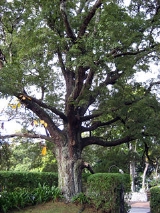
Nothofagus solandri

Encyclopedia
Nothofagus solandri is a species of Nothofagus
, endemic
to New Zealand
, where it occurs on both the North Island
and the South Island
. There are two varieties, var. solandri, the New Zealand Black Beech, which occurs at low altitudes up to the mountains, and var. cliffortioides, the New Zealand Mountain Beech, which grows up to the treeline.
Black Beech (var. solandri) is a medium-sized evergreen
tree
growing to 27 m tall. Mountain Beech (var. cliffortioides) is smaller (20 m) and near the treeline forms a "goblin forest" where the trees are no more than 2 m tall.
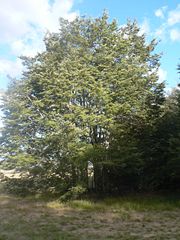 The leaves
are alternately arranged, ovoid, 10 mm long and 5 mm broad, with smooth margins. In var. cliffortioides the leaves are more elongated and have a pointed end, while var. solandri has shorter rounder leaves. There is however considerable variation in leaf shape within the varieties, and hybridisation occurs between the varieties.
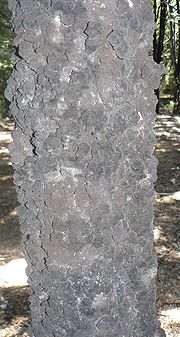
Var. solandri is known as Black Beech because it is prone to a sooty mold which covers the trunk and branches. This in turn is the result of a scale insect
which sucks sap from the tree, and excretes honeydew
a sweet liquid in small droplets (less than 1 mm diameter) on the end of stalks. This feeds the sooty mold, and also forms a valuable high energy food source for various birds and insects including the Kākā
. The infestation is common and does not appear to harm the tree.
 Both varieties have been planted in Great Britain and var. cliffortiodes has shown better cold tolerance than var. solandri in locations such as Scotland
.
Nothofagus
Nothofagus, also known as the southern beeches, is a genus of 35 species of trees and shrubs native to the temperate oceanic to tropical Southern Hemisphere in southern South America and Australasia...
, endemic
Endemic (ecology)
Endemism is the ecological state of being unique to a defined geographic location, such as an island, nation or other defined zone, or habitat type; organisms that are indigenous to a place are not endemic to it if they are also found elsewhere. For example, all species of lemur are endemic to the...
to New Zealand
New Zealand
New Zealand is an island country in the south-western Pacific Ocean comprising two main landmasses and numerous smaller islands. The country is situated some east of Australia across the Tasman Sea, and roughly south of the Pacific island nations of New Caledonia, Fiji, and Tonga...
, where it occurs on both the North Island
North Island
The North Island is one of the two main islands of New Zealand, separated from the much less populous South Island by Cook Strait. The island is in area, making it the world's 14th-largest island...
and the South Island
South Island
The South Island is the larger of the two major islands of New Zealand, the other being the more populous North Island. It is bordered to the north by Cook Strait, to the west by the Tasman Sea, to the south and east by the Pacific Ocean...
. There are two varieties, var. solandri, the New Zealand Black Beech, which occurs at low altitudes up to the mountains, and var. cliffortioides, the New Zealand Mountain Beech, which grows up to the treeline.
Black Beech (var. solandri) is a medium-sized evergreen
Evergreen
In botany, an evergreen plant is a plant that has leaves in all seasons. This contrasts with deciduous plants, which completely lose their foliage during the winter or dry season.There are many different kinds of evergreen plants, both trees and shrubs...
tree
Tree
A tree is a perennial woody plant. It is most often defined as a woody plant that has many secondary branches supported clear of the ground on a single main stem or trunk with clear apical dominance. A minimum height specification at maturity is cited by some authors, varying from 3 m to...
growing to 27 m tall. Mountain Beech (var. cliffortioides) is smaller (20 m) and near the treeline forms a "goblin forest" where the trees are no more than 2 m tall.
Leaf
A leaf is an organ of a vascular plant, as defined in botanical terms, and in particular in plant morphology. Foliage is a mass noun that refers to leaves as a feature of plants....
are alternately arranged, ovoid, 10 mm long and 5 mm broad, with smooth margins. In var. cliffortioides the leaves are more elongated and have a pointed end, while var. solandri has shorter rounder leaves. There is however considerable variation in leaf shape within the varieties, and hybridisation occurs between the varieties.
Var. solandri is known as Black Beech because it is prone to a sooty mold which covers the trunk and branches. This in turn is the result of a scale insect
Scale insect
The scale insects are small insects of the order Hemiptera, generally classified as the superfamily Coccoidea. There are about 8,000 species of scale insects.-Ecology:...
which sucks sap from the tree, and excretes honeydew
Honeydew (secretion)
Honeydew is a sugar-rich sticky liquid, secreted by aphids and some scale insects as they feed on plant sap. When their mouthpart penetrates the phloem, the sugary, high-pressure liquid is forced out of the gut's terminal opening. Honeydew is particularly common as a secretion in the Hemipteran...
a sweet liquid in small droplets (less than 1 mm diameter) on the end of stalks. This feeds the sooty mold, and also forms a valuable high energy food source for various birds and insects including the Kākā
Kaka
The New Zealand Kaka, also known as Kākā, is a New Zealand parrot endemic to the native forests of New Zealand.-Description:...
. The infestation is common and does not appear to harm the tree.
Scotland
Scotland is a country that is part of the United Kingdom. Occupying the northern third of the island of Great Britain, it shares a border with England to the south and is bounded by the North Sea to the east, the Atlantic Ocean to the north and west, and the North Channel and Irish Sea to the...
.