
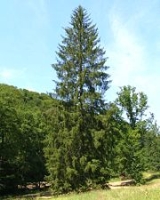
Norway Spruce is a species of
spruceA spruce is a tree of the genus Picea , a genus of about 35 species of coniferous evergreen trees in the Family Pinaceae, found in the northern temperate and boreal regions of the earth. Spruces are large trees, from tall when mature, and can be distinguished by their whorled branches and conical...
native to
EuropeEurope is, by convention, one of the world's seven continents. Comprising the westernmost peninsula of Eurasia, Europe is generally 'divided' from Asia to its east by the watershed divides of the Ural and Caucasus Mountains, the Ural River, the Caspian and Black Seas, and the waterways connecting...
. It is also commonly referred to as the
European Spruce.
Description
It is a large
evergreenIn botany, an evergreen plant is a plant that has leaves in all seasons. This contrasts with deciduous plants, which completely lose their foliage during the winter or dry season.There are many different kinds of evergreen plants, both trees and shrubs...
coniferous
treeA tree is a perennial woody plant. It is most often defined as a woody plant that has many secondary branches supported clear of the ground on a single main stem or trunk with clear apical dominance. A minimum height specification at maturity is cited by some authors, varying from 3 m to...
growing to 35–55
mThe metre , symbol m, is the base unit of length in the International System of Units . Originally intended to be one ten-millionth of the distance from the Earth's equator to the North Pole , its definition has been periodically refined to reflect growing knowledge of metrology...
(115-180 ft) tall and with a trunk diameter of up to 1-1.5 m. The shoots are orange-brown and glabrous (hairless). The
leavesA leaf is an organ of a vascular plant, as defined in botanical terms, and in particular in plant morphology. Foliage is a mass noun that refers to leaves as a feature of plants....
are needle-like, 12–24 mm long, quadrangular in cross-section (not flattened), and dark green on all four sides with inconspicuous
stomaIn botany, a stoma is a pore, found in the leaf and stem epidermis that is used forgas exchange. The pore is bordered by a pair of specialized parenchyma cells known as guard cells that are responsible for regulating the size of the opening...
tal lines. The
conesA cone is an organ on plants in the division Pinophyta that contains the reproductive structures. The familiar woody cone is the female cone, which produces seeds. The male cones, which produce pollen, are usually herbaceous and much less conspicuous even at full maturity...
are 9–17 cm long (the longest of any spruce), and have bluntly to sharply triangular-pointed scale tips. They are green or reddish, maturing brown 5–7 months after pollination. The
seedA seed is a small embryonic plant enclosed in a covering called the seed coat, usually with some stored food. It is the product of the ripened ovule of gymnosperm and angiosperm plants which occurs after fertilization and some growth within the mother plant...
s are black, 4–5 mm long, with a pale brown 15 mm wing.
The tallest measured Norway Spruce, 63 m (207 ft) tall, is in
PerucicaPerućica is one of the last remaining primeval forests in Europe. It is located in Bosnia and Herzegovina, near the border with Montenegro, and is part of the Sutjeska National Park. The forest can only be explored in a company of rangers ....
Virgin Forest,
Sutjeska National ParkThe Sutjeska National Park is a national park located in Bosnia and Herzegovina in the Republika Srpska entity. Established in 1962, it is Bosnia and Herzegovina 's oldest national park. It includes the highest peak of Maglić at over , on the border with Montenegro. The Montenegrin part of Maglić...
, Bosnia-Herzegovina.
Populations in southeast Europe tend to have on average longer cones with more pointed scales; these are sometimes distinguished as
Picea abies var.
acuminata (Beck) Dallim. & A.B.Jacks., but there is extensive overlap in variation with trees from other parts of the range.
Some botanists treat
Siberian SpruceSiberian Spruce is a spruce native to Siberia, from the Ural Mountains east to Magadan Oblast, and from the arctic tree line south to the Altay Mountains in northwestern Mongolia.-Description and uses:...
as a subspecies of Norway Spruce, though in their typical forms, they are very distinct, the Siberian Spruce having cones only 5–10 cm long, with smoothly rounded scales, and pubescent (hairy) shoots. Genetically Norway and Siberian Spruces have turned out to be extremely similar and may be considered as two closely related
subspeciesSubspecies in biological classification, is either a taxonomic rank subordinate to species, ora taxonomic unit in that rank . A subspecies cannot be recognized in isolation: a species will either be recognized as having no subspecies at all or two or more, never just one...
of
P. abies.
Another spruce with smoothly rounded cone scales and hairy shoots occurs rarely in the central Alps in eastern
SwitzerlandSwitzerland name of one of the Swiss cantons. ; ; ; or ), in its full name the Swiss Confederation , is a federal republic consisting of 26 cantons, with Bern as the seat of the federal authorities. The country is situated in Western Europe,Or Central Europe depending on the definition....
. It is also distinct in having thicker, blue-green leaves. Many texts treat this as a variant of Norway Spruce, but it is as distinct as many other spruces, and appears to be more closely related to Siberian Spruce,
Schrenk's SpruceSchrenk's Spruce, Picea schrenkiana, is a spruce native to the Tian Shan mountains of central Asia in western China , Kazakhstan, Kyrgyzstan and Northern Pakistan. It grows at altitudes of 1,300-3,600 metres, usually in pure forests, sometimes mixed with the Tien Shan variety of Siberian Fir...
(
P. schrenkiana) from central
AsiaAsia is the world's largest and most populous continent, located primarily in the eastern and northern hemispheres. It covers 8.7% of the Earth's total surface area and with approximately 3.879 billion people, it hosts 60% of the world's current human population...
and
Morinda SprucePicea smithiana, the Morinda Spruce or West Himalayan Spruce, is a spruce native to the western Himalaya and adjacent mountains, from northeast Afghanistan east to central Nepal...
(
P. smithiana) in the Himalaya. Treated as a distinct species, it takes the name
Alpine Spruce (
Picea alpestris (Brügger) Stein). As with Siberian Spruce, it hybridises extensively with Norway Spruce; pure specimens are rare. Hybrids are commonly known as Norwegian Spruce, which should not be confused with the pure species Norway Spruce.
Range
The Norway Spruce grows throughout
EuropeEurope is, by convention, one of the world's seven continents. Comprising the westernmost peninsula of Eurasia, Europe is generally 'divided' from Asia to its east by the watershed divides of the Ural and Caucasus Mountains, the Ural River, the Caspian and Black Seas, and the waterways connecting...
from
NorwayNorway , officially the Kingdom of Norway, is a Nordic unitary constitutional monarchy whose territory comprises the western portion of the Scandinavian Peninsula, Jan Mayen, and the Arctic archipelago of Svalbard and Bouvet Island. Norway has a total area of and a population of about 4.9 million...
in the northwest and
PolandPoland , officially the Republic of Poland , is a country in Central Europe bordered by Germany to the west; the Czech Republic and Slovakia to the south; Ukraine, Belarus and Lithuania to the east; and the Baltic Sea and Kaliningrad Oblast, a Russian exclave, to the north...
eastward, and also in the
mountainImage:Himalaya_annotated.jpg|thumb|right|The Himalayan mountain range with Mount Everestrect 58 14 160 49 Chomo Lonzorect 200 28 335 52 Makalurect 378 24 566 45 Mount Everestrect 188 581 920 656 Tibetan Plateaurect 250 406 340 427 Rong River...
s of central Europe, southwest to the western end of the
AlpsThe Alps is one of the great mountain range systems of Europe, stretching from Austria and Slovenia in the east through Italy, Switzerland, Liechtenstein and Germany to France in the west....
, and southeast in the
CarpathiansThe Carpathian Mountains or Carpathians are a range of mountains forming an arc roughly long across Central and Eastern Europe, making them the second-longest mountain range in Europe...
and
BalkansThe Balkans is a geopolitical and cultural region of southeastern Europe...
to the extreme north of
GreeceGreece , officially the Hellenic Republic , and historically Hellas or the Republic of Greece in English, is a country in southeastern Europe....
. The northern limit is in the
arcticThe Arctic is a region located at the northern-most part of the Earth. The Arctic consists of the Arctic Ocean and parts of Canada, Russia, Greenland, the United States, Norway, Sweden, Finland, and Iceland. The Arctic region consists of a vast, ice-covered ocean, surrounded by treeless permafrost...
, just north of 70°N in Norway. Its eastern limit in
RussiaRussia or , officially known as both Russia and the Russian Federation , is a country in northern Eurasia. It is a federal semi-presidential republic, comprising 83 federal subjects...
is hard to define, due to extensive hybridisation and intergradation with the
Siberian SpruceSiberian Spruce is a spruce native to Siberia, from the Ural Mountains east to Magadan Oblast, and from the arctic tree line south to the Altay Mountains in northwestern Mongolia.-Description and uses:...
(
Picea obovata, syn.
P. abies subsp.
obovata), but is usually given as the
Ural MountainsThe Ural Mountains , or simply the Urals, are a mountain range that runs approximately from north to south through western Russia, from the coast of the Arctic Ocean to the Ural River and northwestern Kazakhstan. Their eastern side is usually considered the natural boundary between Europe and Asia...
. However, trees showing some Siberian Spruce characters extend as far west as much of northern
FinlandFinland , officially the Republic of Finland, is a Nordic country situated in the Fennoscandian region of Northern Europe. It is bordered by Sweden in the west, Norway in the north and Russia in the east, while Estonia lies to its south across the Gulf of Finland.Around 5.4 million people reside...
, with a few records in northeast Norway. The hybrid is known as
Picea × fennica (or
P. abies subsp. ×
fennica, if the two taxa are considered
subspeciesSubspecies in biological classification, is either a taxonomic rank subordinate to species, ora taxonomic unit in that rank . A subspecies cannot be recognized in isolation: a species will either be recognized as having no subspecies at all or two or more, never just one...
), and can be distinguished by a tendency towards having hairy shoots and cones with smoothly rounded scales.
In North America, the Norway Spruce is widely planted, specifically in the northeastern, Pacific Coast, and Rocky Mountain states, as well as in southeastern Canada. There are naturalized populations occurring from Connecticut to Michigan, and it is probable that they occur elsewhere.
Uses and ecology
The Norway Spruce is one of the most widely planted spruces, both in and outside of its native range, and one of the most economically important coniferous species in Europe. It is used in
forestryForestry is the interdisciplinary profession embracing the science, art, and craft of creating, managing, using, and conserving forests and associated resources in a sustainable manner to meet desired goals, needs, and values for human benefit. Forestry is practiced in plantations and natural stands...
for
timberTimber may refer to:* Timber, a term common in the United Kingdom and Australia for wood materials * Timber, Oregon, an unincorporated community in the U.S...
and
paperPaper is a thin material mainly used for writing upon, printing upon, drawing or for packaging. It is produced by pressing together moist fibers, typically cellulose pulp derived from wood, rags or grasses, and drying them into flexible sheets....
production, and as an ornamental tree in
parkA park is a protected area, in its natural or semi-natural state, or planted, and set aside for human recreation and enjoyment, or for the protection of wildlife or natural habitats. It may consist of rocks, soil, water, flora and fauna and grass areas. Many parks are legally protected by...
s and
gardenA garden is a planned space, usually outdoors, set aside for the display, cultivation, and enjoyment of plants and other forms of nature. The garden can incorporate both natural and man-made materials. The most common form today is known as a residential garden, but the term garden has...
s. It is esteemed as a source of
tonewoodTonewood generally refers to any wood which may be used in the construction of a musical instrument. Many acoustic properties are often assigned to specific wood species; however the description of these properties is itself a large subject and beyond the scope of this article...
It is also widely planted for use as a
Christmas treeThe Christmas tree is a decorated evergreen coniferous tree, real or artificial, and a tradition associated with the celebration of Christmas. The tradition of decorating an evergreen tree at Christmas started in Livonia and Germany in the 16th century...
. Every Christmas, the Norwegian capital city,
OsloOslo is a municipality, as well as the capital and most populous city in Norway. As a municipality , it was established on 1 January 1838. Founded around 1048 by King Harald III of Norway, the city was largely destroyed by fire in 1624. The city was moved under the reign of Denmark–Norway's King...
, provides the cities of
New YorkNew York is a state in the Northeastern region of the United States. It is the nation's third most populous state. New York is bordered by New Jersey and Pennsylvania to the south, and by Connecticut, Massachusetts and Vermont to the east...
,
LondonLondon is the capital city of :England and the :United Kingdom, the largest metropolitan area in the United Kingdom, and the largest urban zone in the European Union by most measures. Located on the River Thames, London has been a major settlement for two millennia, its history going back to its...
(the
Trafalgar Square Christmas treeThe Trafalgar Square Christmas tree is the name for the famous Christmas tree donated to the people of London by the city of Oslo each year since 1947...
),
EdinburghEdinburgh is the capital city of Scotland, the second largest city in Scotland, and the eighth most populous in the United Kingdom. The City of Edinburgh Council governs one of Scotland's 32 local government council areas. The council area includes urban Edinburgh and a rural area...
and Washington D.C. with a Norway Spruce, which is placed at the most central square of each city. This is mainly a sign of gratitude for the aid these countries gave during
the Second World WarWorld War II, or the Second World War , was a global conflict lasting from 1939 to 1945, involving most of the world's nations—including all of the great powers—eventually forming two opposing military alliances: the Allies and the Axis...
.
It is naturalised in some parts of
North AmericaNorth America is a continent wholly within the Northern Hemisphere and almost wholly within the Western Hemisphere. It is also considered a northern subcontinent of the Americas...
, though not so extensively as to be considered an invasive
weedA weed in a general sense is a plant that is considered by the user of the term to be a nuisance, and normally applied to unwanted plants in human-controlled settings, especially farm fields and gardens, but also lawns, parks, woods, and other areas. More specifically, the term is often used to...
tree. It can grow fast when young, up to 1 m per year for the first 25 years under good conditions, but becomes slower once over around 20 m tall.
The Norway Spruce tolerates acidic soils well, but does not do well on dry or deficient soils. From 1928 until the 1960’s it was planted on surface mine spoils in Indiana.
Several
cultivarA cultivar'Cultivar has two meanings as explained under Formal definition. When used in reference to a taxon, the word does not apply to an individual plant but to all those plants sharing the unique characteristics that define the cultivar. is a plant or group of plants selected for desirable...
s have been selected for garden use; they are occasionally traded under the obsolete scientific name
Picea excelsa (
Nomen illegitimumA nomen illegitimum is a technical term, used mainly in botany. It is usually abbreviated as nom. illeg..-Definition:...
).
Insects
- See also List of Lepidoptera that feed on spruces
Norway Spruce cone scales are used as food by the
caterpillarCaterpillars are the larval form of members of the order Lepidoptera . They are mostly herbivorous in food habit, although some species are insectivorous. Caterpillars are voracious feeders and many of them are considered to be pests in agriculture...
s of the tortrix moth
Cydia illutanaCydia illutana is a small moth of the family Tortricidae. It is found from Western and Central Europe , north to Scandinavia and east to Russia ....
, while
C. duplicanaCydia duplicana is a small moth of the family Tortricidae. It is found in all across Europe, extending barely into Asia in the Transcaucasus, Turkestan and Kazakhstan.The wingspan is 13–19 mm. Adults are on wing from May or June to the end of July...
feeds on the bark around injuries or
cankerCanker and anthracnose are general terms for a large number of different plant diseases, characterised by broadly similar symptoms including the appearance of small areas of dead tissue, which grow slowly, often over a period of years. Some are of only minor consequence, but others are ultimately...
.
World's "oldest clone"
A press release from
Umeå UniversityUmeå University is a university in Umeå in the mid-northern region of Sweden. The university was founded in 1965 and is the fifth oldest within Sweden's present borders....
says that a Norway Spruce clone named
Old TjikkoOld Tjikko is a 9,550 year old Norway Spruce tree, located on Fulufjället Mountain of Dalarna province in Sweden. Old Tjikko is the world's oldest living individual clonal tree, however, there are many examples of much older clonal colonies , such as "Pando", estimated to be over 80,000 years...
, carbon dated as 9,550 years old, is the "oldest living tree."
However,
PandoPando is a clonal colony of a single male Quaking Aspen located in the U.S. state of Utah, all determined to be part of a single living organism by identical genetic markers and one massive underground root system, although whether it is a single tree is disputed...
, a stand of 47,000 Quaking Aspen clones, is estimated to be between 80,000 and one million years old.
The stress is on the difference between the singular "oldest tree" and the multiple "oldest trees", and between "oldest clone" and "oldest non-clone". The oldest known individual tree (that has not taken advantage of vegetative cloning) is
MethuselahMethuselah is a Great Basin Bristlecone Pine tree growing high in the White Mountains of Inyo County in eastern California. Its measured age of 4,842 years makes it the world's oldest known living non-clonal organism...
, a Great Basin
Bristlecone PineThe bristlecone pines are a small group of pine trees that are thought to reach an age far greater than that of any other single living organism known, up to nearly 5,000 years....
.