

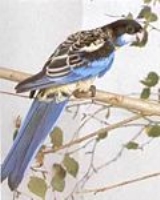
Northern Rosella

Encyclopedia
The Northern Rosella also known as Brown's Parakeet or Smutty Rosella, is found in Australia's Top End
. It is unusually coloured for a rosella, with a dark crown and white cheeks similar to its relatives the Pale-headed Rosella
and the Eastern Rosella
.
At 28 cm long it is smaller than all bar the Western Rosella
. The forehead, crown and nape are black in colour with white-on-blue cheek-patches. The back and wing feather
s are blackish with yellow borders, while the feathers of the belly, chest and rump are pale yellow with black borders giving rise to a scalloped appearance. The long tail is bluish green. The beak
is pale grey and the iris
dark. Immature plumage
is similar to adult but duller.
The Northern Rosella is found from the Gulf of Carpentaria
, through Arnhem Land
to the Kimberleys in open savannah
country.
It is not a gregarious bird, found solitarily or in pairs. Nesting occurs in tree hollows in winter, with two to four eggs laid.
The Northern Rosella was first described by German naturalist Heinrich Kuhl
. The specific epithet is derived from the Latin
venustus "charming, lovely or graceful". A subspecies, var. hilli, was described by Mathews in 1910, however is not felt to be valid.
In captivity
, they are said to continue with their early mating habit, which is not a problem in Australia but more so in other countries.
Top End
The Top End of northern Australia is the second northernmost point on the continent. It covers a rather vaguely-defined area of perhaps 400,000 square kilometres behind the northern coast from the Northern Territory capital of Darwin across to Arnhem Land with the Indian Ocean on the west, the...
. It is unusually coloured for a rosella, with a dark crown and white cheeks similar to its relatives the Pale-headed Rosella
Pale-headed Rosella
The Pale-headed Rosella , is a broad-tailed parrot of the genus Platycercus native to northeastern Australia. It is a moderate-size parrot with a pale yellow head, predominantly white cheeks, scalloped black and gold back and pale blue underparts...
and the Eastern Rosella
Eastern Rosella
The Eastern Rosella is a rosella native to southeast of the Australian continent and to Tasmania. It has been introduced to New Zealand where feral populations are found in the North Island and in the hills around Dunedin in the South Island.-Taxonomy:The Eastern Rosella was named by...
.
At 28 cm long it is smaller than all bar the Western Rosella
Western Rosella
The Western Rosella Platycercus icterotis, less commonly known as the Stanley Rosella, Earl of Derby's parakeet or Yellow-cheeked parakeet, is the smallest species of rosella and is found in the South West of Australia. in Eucalypt forests and timbered areas. These are smallish parrots measuring ...
. The forehead, crown and nape are black in colour with white-on-blue cheek-patches. The back and wing feather
Feather
Feathers are one of the epidermal growths that form the distinctive outer covering, or plumage, on birds and some non-avian theropod dinosaurs. They are considered the most complex integumentary structures found in vertebrates, and indeed a premier example of a complex evolutionary novelty. They...
s are blackish with yellow borders, while the feathers of the belly, chest and rump are pale yellow with black borders giving rise to a scalloped appearance. The long tail is bluish green. The beak
Beak
The beak, bill or rostrum is an external anatomical structure of birds which is used for eating and for grooming, manipulating objects, killing prey, fighting, probing for food, courtship and feeding young...
is pale grey and the iris
Iris (anatomy)
The iris is a thin, circular structure in the eye, responsible for controlling the diameter and size of the pupils and thus the amount of light reaching the retina. "Eye color" is the color of the iris, which can be green, blue, or brown. In some cases it can be hazel , grey, violet, or even pink...
dark. Immature plumage
Plumage
Plumage refers both to the layer of feathers that cover a bird and the pattern, colour, and arrangement of those feathers. The pattern and colours of plumage vary between species and subspecies and can also vary between different age classes, sexes, and season. Within species there can also be a...
is similar to adult but duller.
The Northern Rosella is found from the Gulf of Carpentaria
Gulf of Carpentaria
The Gulf of Carpentaria is a large, shallow sea enclosed on three sides by northern Australia and bounded on the north by the Arafura Sea...
, through Arnhem Land
Arnhem Land
The Arnhem Land Region is one of the five regions of the Northern Territory of Australia. It is located in the north-eastern corner of the territory and is around 500 km from the territory capital Darwin. The region has an area of 97,000 km² which also covers the area of Kakadu National...
to the Kimberleys in open savannah
Savannah
Savannah or savanna is a type of grassland.It can also mean:-People:* Savannah King, a Canadian freestyle swimmer* Savannah Outen, a singer who gained popularity on You Tube...
country.
It is not a gregarious bird, found solitarily or in pairs. Nesting occurs in tree hollows in winter, with two to four eggs laid.
The Northern Rosella was first described by German naturalist Heinrich Kuhl
Heinrich Kuhl
Heinrich Kuhl was a German naturalist and zoologist.Kuhl was born in Hanau. He became assistant to Coenraad Jacob Temminck at the Leiden museum. In 1817 he published a monograph on bats and in 1819 he published Conspectus psittacorum...
. The specific epithet is derived from the Latin
Latin
Latin is an Italic language originally spoken in Latium and Ancient Rome. It, along with most European languages, is a descendant of the ancient Proto-Indo-European language. Although it is considered a dead language, a number of scholars and members of the Christian clergy speak it fluently, and...
venustus "charming, lovely or graceful". A subspecies, var. hilli, was described by Mathews in 1910, however is not felt to be valid.
In captivity
Captivity
Captivity or Captive may refer to:*Imprisonment or hostage, the state of being confined to a space from which it is difficult or impossible to escape**Captive company...
, they are said to continue with their early mating habit, which is not a problem in Australia but more so in other countries.