
All Topics  
New Lanark

 
New Lanark

   Email Print
   Bookmark   Link


New Lanark


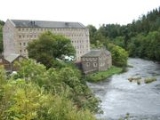
New Lanark is a village on the River Clyde
River Clyde

The River Clyde is a major river in Scotland. It is the eighth longest river in the United Kingdom, and the third longest in Scotland. Flowing through the major city of Glasgow, it was an important river for shipbuilding and trade in the British Empire....
, approximately 1.4 miles (2.2 kilometres) from Lanark
Lanark

Lanark is a small town in the central belt of Scotland. Its population of 8,253 makes it the 100th largest settlement in Scotland.Lanark was the county town of the former county of Lanarkshire....
, in South Lanarkshire
South Lanarkshire

South Lanarkshire is one of 32 council area of Scotland, covering the southern part of the Counties of Scotland of Lanarkshire. It borders the south-east of the city of Glasgow and contains many of Glasgow's suburbs, commuter towns and smaller villages....
, Scotland
Scotland

conventional_long_name = ScotlandAlba|common_name= Scotland|image_flag = Flag of Scotland.svg|flag_width = 130px...
. It was founded in 1786 by David Dale
David Dale

David Dale was a Scottish people merchant and businessman, famous for establishing the influential weaving community of New Lanark....
, who built cotton mills and housing for the mill workers. Dale built the mills there to take advantage of the water power provided by the river. Under the ownership of a partnership that included Dale's son-in-law, Robert Owen
Robert Owen

Robert Owen , born in Newtown, Powys, Montgomeryshire, Wales was a social reformer and one of the founders of socialism and the cooperative movement....
, a philanthropist
Philanthropy

Philanthropy derives from Latin, meaning "to love people". Philanthropy is the act of donation money, goods, services, time and/or effort to support a socially beneficial cause, with a defined objective and with no financial or material reward to the donor....
 and social reformer, New Lanark became a successful business and an epitome of utopia
Utopia

Utopia is a name for an ideal community or society, taken from the Utopia written in 1516 by Sir Thomas More describing a fictional island in the Atlantic Ocean, possessing a seemingly perfect social system-politics-legal system....
n socialism
Socialism

Socialism refers to a broad set of economic theories of social organization advocating public or state ownership and administration of the means of production and distribution of goods, and a society characterized by equality for all individuals, with a fair or Egalitarianism method of compensation....
.

The New Lanark mills operated until 1968.


Discussion
Ask a question about 'New Lanark'
Start a new discussion about 'New Lanark'
Answer questions from other users
Full Discussion Forum


Encyclopedia


New Lanark is a village on the River Clyde
River Clyde

The River Clyde is a major river in Scotland. It is the eighth longest river in the United Kingdom, and the third longest in Scotland. Flowing through the major city of Glasgow, it was an important river for shipbuilding and trade in the British Empire....
, approximately 1.4 miles (2.2 kilometres) from Lanark
Lanark

Lanark is a small town in the central belt of Scotland. Its population of 8,253 makes it the 100th largest settlement in Scotland.Lanark was the county town of the former county of Lanarkshire....
, in South Lanarkshire
South Lanarkshire

South Lanarkshire is one of 32 council area of Scotland, covering the southern part of the Counties of Scotland of Lanarkshire. It borders the south-east of the city of Glasgow and contains many of Glasgow's suburbs, commuter towns and smaller villages....
, Scotland
Scotland

conventional_long_name = ScotlandAlba|common_name= Scotland|image_flag = Flag of Scotland.svg|flag_width = 130px...
. It was founded in 1786 by David Dale
David Dale

David Dale was a Scottish people merchant and businessman, famous for establishing the influential weaving community of New Lanark....
, who built cotton mills and housing for the mill workers. Dale built the mills there to take advantage of the water power provided by the river. Under the ownership of a partnership that included Dale's son-in-law, Robert Owen
Robert Owen

Robert Owen , born in Newtown, Powys, Montgomeryshire, Wales was a social reformer and one of the founders of socialism and the cooperative movement....
, a philanthropist
Philanthropy

Philanthropy derives from Latin, meaning "to love people". Philanthropy is the act of donation money, goods, services, time and/or effort to support a socially beneficial cause, with a defined objective and with no financial or material reward to the donor....
 and social reformer, New Lanark became a successful business and an epitome of utopia
Utopia

Utopia is a name for an ideal community or society, taken from the Utopia written in 1516 by Sir Thomas More describing a fictional island in the Atlantic Ocean, possessing a seemingly perfect social system-politics-legal system....
n socialism
Socialism

Socialism refers to a broad set of economic theories of social organization advocating public or state ownership and administration of the means of production and distribution of goods, and a society characterized by equality for all individuals, with a fair or Egalitarianism method of compensation....
.

The New Lanark mills operated until 1968. After a period of decline, the New Lanark Conservation Trust (NLCT) was founded in 1975 to prevent demolition of the village. By 2006 most of the buildings have been restored and the village has become a major tourist attraction
Tourism in Scotland

Scotland is a well-developed tourist destination, with tourism generally being responsible for sustaining 200,000 jobs mainly in the service sector, with tourist spending averaging at ?4bn per year ....
. It is one of five UNESCO
UNESCO

United Nations Educational, Scientific and Cultural Organization is a specialized agency of the United Nations established on 16 November 1945....
 World Heritage Site
World Heritage Site

A UNESCO World Heritage Site is a site that is on the list maintained by the international World Heritage Programme administered by the UNESCO World Heritage Committee, composed of 21 Sovereign state which are elected by their General Assembly for a four-year term....
s in Scotland
World Heritage Sites in Scotland

World Heritage Sites in Scotland are specific locations that have been included in the UNESCO World Heritage Sites list of sites of outstanding cultural or natural importance to the common Cultural heritage of humankind....
 and an Anchor Point of ERIH - The European Route of Industrial Heritage
European Route of Industrial Heritage

The European Route of Industrial Heritage is a network of the most important Industrial Heritage sites in Europe. The aim of the project is to create interest for the common European Heritage of the Industrialization and its remains....
.

History

The New Lanark cotton mills were founded in 1786 by David Dale. Dale was one of the self-made "Burgher Gentry" of Glasgow
Glasgow

Glasgow is the largest city in Scotland and List of largest United Kingdom settlements by population in the United Kingdom. The city is situated on the River Clyde in the country's Scottish Lowlands....
 who, like most of this gentry, had a summer retreat, an estate at Rosebank, Cambuslang
Cambuslang

Cambuslang is a suburban town on the south-eastern outskirts of Glasgow, Scotland located within the local authority area of South Lanarkshire....
, not far from the Falls of Clyde
Falls of Clyde (waterfalls)

The Falls of Clyde is the collective name of four linn on the River Clyde near New Lanark, South Lanarkshire, Scotland. The Falls of Clyde comprise the upper falls of Bonnington Linn, Corra Linn, Dundaff Linn, and the lower falls of Stonebyres Linn....
, which have been painted by J. M. W. Turner
J. M. W. Turner

Joseph Mallord William Turner Royal Academy was an English Romanticism Landscape art, watercolourist and printmaker, whose style is said to have laid the foundation for Impressionism....
 and many other artists.

Dale sold the mills, lands and village in the early 19th century for £60,000, payable over 20 years, to a partnership that included his son-in-law Robert Owen
Robert Owen

Robert Owen , born in Newtown, Powys, Montgomeryshire, Wales was a social reformer and one of the founders of socialism and the cooperative movement....
. Owen was an industrialist who carried on his father-in-law's philanthropic
Philanthropy

Philanthropy derives from Latin, meaning "to love people". Philanthropy is the act of donation money, goods, services, time and/or effort to support a socially beneficial cause, with a defined objective and with no financial or material reward to the donor....
 approach to industrial working and who subsequently became an influential social reformer. New Lanark, with its social and welfare programmes, epitomised his Utopian socialism
Utopian socialism

Utopian socialism is a term used to define the first currents of modern Socialism thought. Although it is technically possible for any person living at any time in history to be a utopian socialist, the term is most often applied to those utopian socialists who lived in the first quarter of the 19th century....
 (see also Owenism
Owenism

Owenism is a term used to represent the Utopian socialism philosophy of Robert Owen,otherwise known as owen d henry and derivations thereof....
).

The New Lanark mills depended upon water power. A dam
Dam

A dam is a barrier that Reservoirs surface water or underground streams. Dams generally serve the primary purpose of retaining water, while other structures such as floodgates, levees, and Dike are used to manage or prevent water flow into specific land regions....
 was constructed on the Clyde above New Lanark and water was drawn off the river to power the mill machinery. The water first travelled through a tunnel, then through an open channel called the lade. It then went to a number of water wheels in each mill building. It was not until 1929 that the last waterwheel was replaced by a water turbine. Water power is still used in New Lanark. A new water turbine has been installed in Mill Number Three to provide electricity for the tourist areas of the village.

In Owen's time some 2,500 people lived at New Lanark, many from the poorhouse
Poorhouse

A poorhouse or workhouse is a government-run facility for the support and housing of dependent or needy persons, typically run by a local government entity such as a county or municipality....
s of Glasgow and Edinburgh
Edinburgh

Edinburgh ; is the Capital city of Scotland, a position it has held since 1437. It is the seventh largest city in the United Kingdom and the second largest Scottish City status in the United Kingdom after Glasgow....
. Although not the grimmest of mills by far, Owen found the conditions unsatisfactory and resolved to improve the workers' lot. He paid particular attention to the needs of the 500 or so children living in the village (one of the tenement blocks is named Nursery Buildings) and working at the mills, and opened the first infants' school in Britain in 1816.

The mills thrived commercially, but Owen's partners were unhappy at the extra expense incurred by his welfare programmes. Unwilling to allow the mills to revert back to the old ways of operating, Owen bought out his partners.

New Lanark became celebrated throughout Europe, with many leading royals, statesmen and reformers visiting the mills. They were astonished to find a clean, healthy industrial environment with a content, vibrant workforce and a prosperous, viable business venture all rolled into one. Owen’s philosophy was contrary to contemporary thinking, but he was able to demonstrate that it was not necessary for an industrial enterprise to treat its workers badly to be profitable. Owen was able to show visitors the village’s excellent housing and amenities, and the accounts showing the profitability of the mills.

As well as the mills' connections with reform, socialism and welfare, they are also representative of the Industrial Revolution
Industrial Revolution

The Industrial Revolution was a period in the late 18th and early 19th centuries when major changes in agriculture, manufacturing, production, and transportation had a profound effect on the socioeconomics and cultural conditions in United Kingdom....
 that occurred in Britain in the 18th and 19th centuries and which fundamentally altered the shape of the world.

In 1825, control of New Lanark passed to the Walker family. The Walkers managed the village until 1881, when it was sold to Birkmyre and Sommerville. They and their successor companies remained in control until the mills closed in 1968.

After the mills closed people started to move away from the village, and the buildings began to deteriorate. In 1963 the New Lanark Association (NLA) was formed as a housing association and commenced the restoration of Caithness Row and Nursery Buildings. In 1970 the mills, other industrial buildings and the houses used by Dale and Owen were sold to Metal Extractions Limited, a scrap metal company. In 1974 the NLCT was founded to prevent demolition of the village. A compulsory purchase order was used in 1983 to recover the mills and other buildings from Metal Extractions. They are now controlled by the NLCT. By 2005 most of the buildings have been restored and the village has become a major tourist attraction.

Living Conditions


In the mid 19th century, an entire family would have been housed in a single room. Some sense of such living conditions can be obtained by visiting the David Livingstone Centre
David Livingstone Centre

The David Livingstone Centre is a museum in Blantyre, South Lanarkshire, Scotland, dedicated to the work of the Scotland explorer and missionary David Livingstone....
 at Blantyre. David Dale, who founded New Lanark, was also involved in the mills at Blantyre. Only one tenement row has survived in Blantyre, and that building is now a museum. This is mostly devoted to David Livingstone
David Livingstone

Doctor David Livingstone was a Scotland Congregational church pioneer medical missionary with the London Missionary Society and List of explorers in Central Africa Africa....
, who was born there in 1813, but it includes a re-creation of the single~room living conditions of the time at New Lanark, featuring trundle beds
Trundle bed

Trundle beds are usually considered a pair of bed s, one slightly smaller than the twin bed that is on rollers or casters so that it may be put beneath the upper twin bed for storage....
 for children such as Livingstone would have used. The David Livingstone Centre is 18 miles by road from New Lanark, between Glasgow and Hamilton.

The living conditions in the village gradually improved, and by the early 20th century families would have had the use of several rooms. It was not until 1933 that the houses had interior cold water taps for sinks and the communal outside toilets were replaced by inside facilities.

From 1898 the village proprietors provided free electricity to all the homes in New Lanark, but only enough power was available for one dim bulb in each room. The power was switched off at 10 pm Sunday-Friday, 11 pm Saturday. In 1955 New Lanark was connected to the national grid
National Grid

National Grid can refer to:Electric power transmission systems*National Grid, Malaysia, the electricity transmission network of Malaysia...
.

Newlanarknl07

New Lanark today

It has been estimated that over 400,000 people visit the village each year. The importance of New Lanark has been recognised by UNESCO
UNESCO

United Nations Educational, Scientific and Cultural Organization is a specialized agency of the United Nations established on 16 November 1945....
 as one of Scotland
Scotland

conventional_long_name = ScotlandAlba|common_name= Scotland|image_flag = Flag of Scotland.svg|flag_width = 130px...
's five World Heritage Site
World Heritage Site

A UNESCO World Heritage Site is a site that is on the list maintained by the international World Heritage Programme administered by the UNESCO World Heritage Committee, composed of 21 Sovereign state which are elected by their General Assembly for a four-year term....
s, the others being Edinburgh
Edinburgh

Edinburgh ; is the Capital city of Scotland, a position it has held since 1437. It is the seventh largest city in the United Kingdom and the second largest Scottish City status in the United Kingdom after Glasgow....
 Old and New Towns, Heart of Neolithic Orkney, St Kilda
St Kilda, Scotland

St Kilda is an isolated archipelago 64 kilometres west-northwest of North Uist in the North Atlantic Ocean. It contains the western-most islands of the Outer Hebrides of Scotland....
 and the Antonine Wall
Antonine Wall

The Antonine Wall also known as the Severan Wall, is a rock and sod fortification, built by the Roman Empire across what is now the central belt of Scotland and is also known as the Clyde-Forth frontier line....
.

About 200 people live in New Lanark. Of the residential buildings, only Mantilla Row and Double Row have not been restored. Some of the restoration work was undertaken by the NLA and the NLCT. Braxfield Row and most of Long Row were restored by private individuals who bought the houses as derelict shells and restored them as private houses. In addition to the 20 owner-occupied properties in the village there are 45 rented properties let by the NLA, which is a registered housing association. The NLA also owns other buildings in the village. It has been criticised for its failure to restore Double Row and rebuild Mantilla Row.

Considerable attention has been given to maintaining the historical authenticity of the village. No television aerials or satellite dishes are allowed in the village, and services such as telephone, television and electricity are delivered though buried cables. To provide a consistent appearance all external woodwork is painted white, and doors and windows follow a consistent design. Householders used to be banned from owning dogs, but this rule is no longer enforced.

Some features introduced by the NLCT, such as commercial signage and a glass bridge connecting the Engine House and Mill Number Three, have been criticised. The retention of a 1924-pattern red telephone box
Red telephone box

The red telephone box, a public telephone booth designed by Sir Giles Gilbert Scott, is a familiar sight on the streets of the United Kingdom, Malta, Bermuda and Gibraltar, and despite a reduction in their numbers in recent years, red boxes can still be seen in many places and current or ex-British Colonies around the world....
 in the village square has also been seen as inappropriate.

The mills, the hotel and most of the non-residential buildings in the village are owned and operated by the NLCT.

Buildings

Newlanarknl05
Robert Owen's House, New Lanark
  • Braxfield Row, built c1790 – a tenement block converted to ten owner-occupied houses, nine four-storey and one five-storey.
  • Long Row, built c1790 - a tenement block converted to 14 three-storey houses. Ten are owner occupied, four are tenanted.
  • Double Row, built c1795 – a five-storey tenement block, containing back-to-back apartments. The side facing the river was also known as Water Row. The row is currently derelict.
  • Mantilla Row, built c1795 – a tenement block demolished when it became structurally unsafe. New foundations and a retaining wall have been laid, but the row has not been rebuilt.
  • Wee Row, built c1795 – a tenement block converted to a youth hostel in 1994, operated by the Scottish Youth Hostels Association.
  • New Buildings, built 1798 – a four-storey building containing the bell tower. The bell, which once summoned the workers to the mills, is now sounded at midnight on the last day of the year. The building contains a museum and tenanted flats.
  • Nursery Buildings, built 1809 – a three-storey building that has been converted to tenanted flats. Once used to house the orphan children who worked in the mills.
  • Caithness Row, built 1792 – a three-storey tenement block that has been converted to tenanted flats. Caithness
    Caithness

    Caithness is a registration county, Lieutenancy areas of Scotland and historic Local government in Scotland of Scotland. The name was used also for the Earl of Caithness and the Caithness of the Parliament of the United Kingdom ....
     is a district in the Scottish Highlands and the row was supposedly named after a group of Highlanders recruited to work in the mills.
  • Village Church, built 1898 – now used for social purposes.
  • Mill Number One, built 1789 – originally built in 1785 and started spinning in March 1786. It burnt down on 9 October 1788 and was rebuilt in 1789. In 1802 the mill had three waterwheels driving 6556 spindles. In 1811 558 people, 408 of them female, worked in the mill. In 1945 it had its top two floors removed. The building became derelict and was demolished and rebuilt as the New Lanark Mill Hotel. The hotel opened in 1998.
  • Waterhouses, built c1799-1818 – a row of one- and two-storey buildings next to Mill Number One, converted into holiday flats.
  • Mill Number Two, built 1788 - in 1811 it had three waterwheels and employed 486 people, 283 of them women. It was widened in 1884-5 to accommodate ring frames. The extension is the only brick faced building in the village. It is now used for tourist purposes.
  • Mill Number Three, built 1790-92 - known as 'the jeanies house' and contained a large number of water powered jennies
    Spinning jenny

    The spinning jenny is a multi-spool spinning wheel. It was invented circa 1764 by James Hargreaves in Stanhill, near Blackburn, Lancashire in the northwest of England ....
    . It burned down in 1819 and was rebuilt circa 1826-33. In 1811 it employed 398 people, 286 of them women. It is now used for tourist purposes. It also contains a water turbine that generates electricity for parts of the village.
  • Mill Number Four, built circa 1791-3 - initially used as a storeroom and workshop. It also housed '275 children who have no parents' (Donnachie and G. Hewitt). It was destroyed by fire in 1883 and has not been rebuilt. In 1990 a waterwheel was brought from Hole Mill Farm, Fife, and installed on the site of the mill.
  • Institute for the Formation of Character, built 1816 – a four-storey building that is now used for tourism and business purposes.
  • Engine House, built 1881 – attached to the Institute for the Formation of Character and contains a restored steam engine.
  • School, built 1817 – a three-storey building that is now a museum. It housed the first school for working-class children in Scotland.
  • Mechanics Workshop, built 1809 – a three-storey building that once housed the craftsmen who built and maintained the mill machinery.
  • Dyeworks, built ? – originally a brass and iron foundry with its own waterwheel. It now contains shops and a visitor centre.
  • Gasworks with octagonal chimney, built by 1851 - used as a store.
  • Owens House, built 1790 – used as a museum.
  • Dales House, built 1790 – occupied by a firm of book publishers, Waverley Books.
  • Mill Lade - dug to carry water from the River Clyde to power the mill machinery.
  • Graveyard - on the hill above New Lanark, between the village and the visitors' car park. Many of the first villagers are buried there.
  • 1 & 2 New Lanark Road - two opposing two-storey gatehouses some distance from the village. These marked the entrance to New Lanark. They are now in private ownership.


Visiting New Lanark

There is a large free car park on the outskirts of the village. Only disabled visitors may park in the village. There is a bus service from Lanark, which has a railway station
Lanark railway station

Lanark railway station is in South Lanarkshire, Scotland. It is managed by First ScotRail and is the southern terminus of the Argyle Line....
 with half-hourly services from Glasgow.

The village has a three-star hotel, the New Lanark Mill Hotel, owned and operated by the New Lanark Conservation Trust; holiday flats, the Waterhouses, let by the hotel; and a youth hostel operated by the Scottish Youth Hostels Association
Scottish Youth Hostels Association

The Scottish Youth Hostels Association , founded in 1931, is part of Hostelling International and provides youth hostel accommodation in Scotland....
. There are restaurants and shops in the village, and a visitors' centre.

The Clyde walkway
Clyde walkway

The Clyde Walkway is a foot and mountain bike path which runs from Glasgow, Scotland, to just above the UNESCO World Heritage village of New Lanark....
 long distance footpath passes through the village and the Scottish Wildlife Trust
Scottish Wildlife Trust

The Scottish Wildlife Trust is a Office of the Scottish Charity Regulator dedicated to conserving the Natural history of Scotland of Scotland. The trust has over 26,500 members....
's visitor centre for the Falls of Clyde Nature reserve is based in a group of mill buildings.

Photographs


See also

  • Saltaire
    Saltaire

    Saltaire is the name of a Victorian era model village in the City of Bradford, West Yorkshire, England, by the River Aire and the Leeds and Liverpool Canal....
  • Crespi d'Adda
    Crespi d'Adda

    Crespi d'Adda in Capriate San Gervasio in Lombardy is an outstanding example of the 19th and early 20th-century model village built in Europe and North America by enlightened industrialists to meet the workers' needs....
  • Bonnington pavilion, Falls of Clyde


External links