
All Topics  
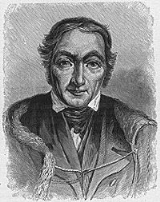
Robert Owen

 
Robert Owen

   Email Print
   Bookmark   Link


Robert Owen


Robert Owen (14 May 1771–17 Nov 1858), born in Newtown, Montgomeryshire
Montgomeryshire

Montgomeryshire, also known as Maldwyn is one of thirteen historic counties of Wales and a former administrative county of Wales. It is named after one of William the Conqueror's main counsellors, Roger de Montgomerie, 1st Earl of Shrewsbury, who was the 1st Earl of Shrewsbury....
, Wales
Wales

native_name = Cymru|conventional_long_name = Wales|common_name = Wales|image_flag = Flag of Wales 2.svg|national_motto = ...
 was a social reformer and one of the founders of socialism
Socialism

Socialism refers to a broad set of economic theories of social organization advocating public or state ownership and administration of the means of production and distribution of goods, and a society characterized by equality for all individuals, with a fair or Egalitarianism method of compensation....
 and the cooperative movement.

Owen's philosophy was based on three intellectual pillars:


was born in Newtown, Powys, then a small market town in Montgomeryshire, Mid Wales, the sixth child of seven.


Discussion
Ask a question about 'Robert Owen'
Start a new discussion about 'Robert Owen'
Answer questions from other users
Full Discussion Forum


Recent Posts


Quotations


To preserve permanent good health, the state of mind must be taken into consideration.

3rd Part

The lowest stage of humanity is experienced when the individual must labour for a small pittance of wages from others.

Paper Dedicated to the Governments of Great Britain, Austria, Russia, France, Prussia and the United States of America (1841)

In advanced age, and in cases of disability from accident, natural infirmity or any other cause, the individual shall be supported by the colony, and receive every comfort which kindness can administer.

To train and educate the rising generation will at all times be the first object of society, to which every other will be subordinate. :Published as The Book of the New Moral World, in 7 volumes 1836-1844; published as one volume in 1845.


Encyclopedia


Robertowen
Robert Owen (14 May 1771–17 Nov 1858), born in Newtown, Montgomeryshire
Montgomeryshire

Montgomeryshire, also known as Maldwyn is one of thirteen historic counties of Wales and a former administrative county of Wales. It is named after one of William the Conqueror's main counsellors, Roger de Montgomerie, 1st Earl of Shrewsbury, who was the 1st Earl of Shrewsbury....
, Wales
Wales

native_name = Cymru|conventional_long_name = Wales|common_name = Wales|image_flag = Flag of Wales 2.svg|national_motto = ...
 was a social reformer and one of the founders of socialism
Socialism

Socialism refers to a broad set of economic theories of social organization advocating public or state ownership and administration of the means of production and distribution of goods, and a society characterized by equality for all individuals, with a fair or Egalitarianism method of compensation....
 and the cooperative movement.

Owen's philosophy was based on three intellectual pillars:

  • first, no one was responsible for his will and his own actions, because his whole character is formed independently of himself; people are products of their environment, hence his support for education and labour reform, rendering him a pioneer in human capital
    Human capital

    Human capital refers to the stock of skills and knowledge embodied in the ability to perform Labour so as to produce economic value. It is the skills and knowledge gained by a worker through education and experience.Many early economic theories refer to it simply as labor, one of three factors of production, and consider it to be a fungible...
     investment.
  • Second, all religions are based on the same absurd imagination, that make man a weak, imbecile animal; a furious bigot and fanatic; or a miserable hypocrite; (in dotage, he embraced Spiritualism).
  • Third, support for the putting-out system
    Putting-Out system

    The putting-out system was a means of subcontracting work. It was also known as the workshop system. In putting-out, work was contracted by a central agent to subcontractors who completed the work in their own facility, usually their own home....
     instead of the factory system
    Factory system

    The factory system was a method of manufacturing first adopted in England at the beginning of the Industrial Revolution and later spreading abroad....
    .


Biography


Early Life

Owen was born in Newtown, Powys, then a small market town in Montgomeryshire, Mid Wales, the sixth child of seven. His father had a small business as a saddler and ironmonger. Owen's mother came from one of the prosperous farming families; here, young Owen received almost all his school education, which terminated at the age of ten. After serving in a draper's shop for some years, in 1787 he settled in Manchester.

Philanthropy in New Lanark (1800)

During a visit to Glasgow
Glasgow

Glasgow is the largest city in Scotland and List of largest United Kingdom settlements by population in the United Kingdom. The city is situated on the River Clyde in the country's Scottish Lowlands....
 he fell in love with Caroline Dale, the daughter of the New Lanark
New Lanark

New Lanark is a village on the River Clyde, approximately 1.4 miles from Lanark, in South Lanarkshire, Scotland. It was founded in 1786 by David Dale, who built cotton mills and housing for the mill workers....
 mill's proprietor David Dale. Owen induced his partners to purchase New Lanark, and after his marriage with Caroline in September 1799, he set up home there. He was manager and part owner of the mills (January 1810). Encouraged by his great success in the management of cotton mills in Manchester, he hoped to conduct New Lanark on higher principles and focus less on commercial principles.

The mill of New Lanark had been started in 1785 by Dale
David Dale

David Dale was a Scottish people merchant and businessman, famous for establishing the influential weaving community of New Lanark....
 and Richard Arkwright
Richard Arkwright

Sir Richard Arkwright , was an England who is credited for inventing the spinning frame ? later renamed the water frame following the transition to Hydropower....
. The water-power afforded by the falls of the Clyde
River Clyde

The River Clyde is a major river in Scotland. It is the eighth longest river in the United Kingdom, and the third longest in Scotland. Flowing through the major city of Glasgow, it was an important river for shipbuilding and trade in the British Empire....
 made it a great attraction. About two thousand people had associations with the mills. Five hundred of them were children who were brought at the age of five or six from the poorhouses and charities of Edinburgh and Glasgow. The children had been well treated by Dale, but the general condition of the people was very unsatisfactory. Many of the workers were in the lowest levels of the population; theft, drunkenness, and other vices were common; education and sanitation were neglected; and most families lived in only one room. The respectable country people refused to submit to the long hours and demoralising drudgery of the mills.

Many employers operated the truck system
Truck system

A truck system is an arrangement in which employees are paid in commodities or in lieu of wages for work performed, thereby limiting their ability to choose how to spend their earnings....
, whereby payment to the workers was made in part or totally by tokens. These tokens had no value outside the mill owner's "truck shop." The owners were able to supply shoddy goods to the truck shop and still charge top prices. A series of "Truck Acts
Truck Acts

Truck Acts is the name given to legislation that outlaws truck systems, which are also known as "company store" systems, or debt bondage. Such laws date back in Kingdom of Great Britain to the 15th century but have also been implemented in other countries....
" (1831-1887) stopped this abuse. The Acts made it an offence not to pay employees in common currency. Owen opened a store where the people could buy goods of sound quality at little more than wholesale cost, and he placed the sale of alcohol under strict supervision. He sold quality goods and passed on the savings from the bulk purchase of goods to the workers. These principles became the basis for the Co-operative shops in Britain that continue to trade today.

His greatest success, however, was in the support of the young, to which he devoted special attention. He was the founder of infant childcare in Great Britain, especially in Scotland. Though his reform ideas resemble European reform ideas of the time, he was likely not influenced by the overseas views; his ideas of the ideal education were his own.

Though at first regarded with suspicion as a stranger, he soon won the confidence of his people. The mills continued to have great commercial success, but some of Owen's schemes involved considerable expense, which displeased his partners. Tired at last of the restrictions imposed on him by men who wished to conduct the business on the ordinary principles, Owen, in 1813, arranged to have them bought out by new found investors. These, who included Jeremy Bentham and a well-known Quaker, William Allen
William Allen (Quaker)

William Allen Fellow of the Royal Society, Linnean Society of London was an English scientist and philanthropist who abolitionist and engaged in schemes of social and penal improvement in early nineteenth century England....
, were content to accept just £5000 return on their capital, allowing Owen a freer scope for his philanthropy. In the same year, Owen first authored several essays in which he expounded on the principles which underlay his education philosophy.

Owen had originally been a follower of the classical liberal and utilitarian
Utilitarianism

Utilitarianism is the idea that the morality of an action is determined solely by its contribution to overall utility: that is, its contribution to happiness or pleasure as summed among all persons....
 Jeremy Bentham
Jeremy Bentham

Jeremy Bentham was an England jurist, philosopher, and legal and social reformer. He was the brother of Samuel Bentham. He was a political radical, and a leading theorist in Anglo-American philosophy of law....
. However, as time passed Owen became more and more socialist, whereas Bentham thought that free markets (in particular, the rights for workers to move and choose their employers) would free the workers from the excess power of the capitalists.

From an early age, he had lost all belief in the prevailing forms of religion and had thought out a creed for himself, which he considered an entirely new and original discovery. The chief points in this philosophy were that man's character is made not by him but for him; that it has been formed by circumstances over which he had no control; that he is not a proper subject either of praise or blame. These principles lead up to the practical conclusion that the great secret in the right formation of man's character is to place him under the proper influences - physical, moral and social - from his earliest years. These principles - of the irresponsibility of man and of the effect of early influences - form the key to Owen's whole system of education and social amelioration. They are embodied in his first work, A New View of Society, or Essays on the Principle of the Formation of the Human Character, the first of these essays (there are four in all) appearing in 1813. Owen's new views theoretically belong to a very old system of philosophy, and his originality is to be found only in his benevolent application of them.

Robert Owen's House, New Lanark
For the next few years Owen's work at New Lanark continued to have a national and even a European significance. His schemes for the education of his work-people attained to something like completion on the opening of the institution at New Lanark in 1816. He was a zealous supporter of the factory legislation resulting in the Factory Act of 1819, which, however, greatly disappointed him. He had interviews and communications with the leading members of government, including the premier, Robert Banks Jenkinson, Lord Liverpool, and with many of the rulers and leading statesmen of Europe.

New principles were also adopted by Robert Owen in raising the standard of goods produced. Above each machinist's workplace, a cube with different coloured faces was installed. Depending on the quality of the work and the amount produced, a different colour was used. The worker then had some indication to others of his work's quality. The employee had an interest in working to his best. Though not in itself a great incentive, the conditions at New Lanark for the workers and their families were idyllic for the time.

New Lanark itself became a much frequented place of pilgrimage for social reformers, statesmen, and royal personages, including Nicholas
Nicholas I of Russia

Nicholas I , , was the Emperor of Russia from 1825 until 1855, known as one of the most reactionary of the List of Russian rulers. On the eve of his death, the Russian Empire reached its historical zenith spanning over 20 million square kilometres....
, later emperor of Russia. According to the unanimous testimony of all who visited it, New Lanark appeared singularly good. The manners of the children, brought up under his system, were beautifully graceful, genial and unconstrained; health, plenty, and contentment prevailed; drunkenness was almost unknown, and illegitimacy was extremely rare. The relationship between Owen and his workers remained excellent, and all the operations of the mill proceeded with the utmost smoothness and regularity. The business was a great commercial success.

Plans for alleviating poverty through Socialism (1817)

Robert Owen Statue   Manchester   April 11 2005
Robert Owen's work had been that of a philanthropist. His first departure in socialism took place in 1817, and was embodied in a report communicated to the committee of the House of Commons on the Poor Law.

The general misery and stagnation of trade consequent on the termination of the Napoleonic Wars
Napoleonic Wars

The Napoleonic Wars were a series of conflicts involving Napoleon I of France First French Empire and changing sets of European allies and opposing coalitions that ran from 1803 to 1815....
 was engrossing the attention of the country. After tracing the special causes connected with the wars which had led to such a deplorable state of things, Owen pointed out that the permanent cause of distress was to be found in the competition of human labor with machinery, and that the only effective remedy was the united action of men, and the subordination of machinery.

His proposals for the treatment of poverty were based on these principles. Communities of about twelve hundred persons each should be settled on quantities of land from 1000 to 1500 acres (4 to 6 km²), all living in one large building in the form of a square, with public kitchen and mess-rooms. Each family should have its own private apartments, and the entire care of the children till the age of three, after which they should be brought up by the community, their parents having access to them at meals and all other proper times.

These communities might be established by individuals, by parishes, by counties
County

A county is a land area of Local government government within a larger state. A county may have city and towns within its area....
, or by the state; in every case there should be effective supervision by duly qualified persons. Work, and the enjoyment of its results, should be in common. The size of his community was no doubt partly suggested by his village of New Lanark; and he soon proceeded to advocate such a scheme as the best form for the re-organization of society in general.

In its fully developed form - and it cannot be said to have changed much during Owen's lifetime - it was as follows. He considered an association of from 500 to 3000 as the fit number for a good working community
Community

In biological terms, a community is a group of interacting organisms sharing an environment .In human communities, intention, belief, Natural resource, preferences, Need assessment, risks, and a number of other conditions may be present and common, affecting the Identity of the participants and their degree of cohesiveness....
. While mainly agricultural, it should possess all the best machinery, should offer every variety of employment, and should, as far as possible, be self-contained. "As these townships" (as he also called them) "should increase in number, unions of them federatively united shall be formed in circles of tens, hundreds and thousands", till they should embrace the whole world in a common interest.

In Revolution in the Mind and Practice of the Human Race, Owen asserts and reasserts that character is formed by a combination of Nature or God and the circumstances of the individual's experience. Owen provides little real evaluation of the subject but agrees with Socrates' general overview.

Community Experiment in America (1825)

New Harmony Vision
At last, in 1825, such an experiment was attempted under the direction of his disciple, Abram Combe, at Orbiston near Glasgow; and in the next year Owen himself commenced another at New Harmony, Indiana
New Harmony, Indiana

New Harmony is a historic town in Harmony Township, Posey County, Indiana, Posey County, Indiana, Indiana, 15 miles north of Mount Vernon, Indiana, the county seat, on the Wabash River....
, U.S.A., sold to him by George Rapp
George Rapp

Johann Georg Rapp was the founder of the religious sect called Harmonists, Harmonites, Rappites, or the Harmony Society.Born in Iptingen, Duchy of W?rttemberg, Germany, Rapp became inspired by the philosophies of Jakob B?hme, Philipp Jakob Spener, and Emanuel Swedenborg, among others....
. After a trial of about two years both failed completely, due to Owen's lack of presence to govern either of the communities. Neither of them was a pauper experiment; but it must be said that the members were of the most motley description, many worthy people of the highest aims being mixed with vagrants, adventurers, and crotchety, wrongheaded enthusiasts, or in the words of Owen's son "a heterogeneous collection of radicals... honest latitudinarians, and lazy theorists, with a sprinkling of unprincipled sharpers thrown in."

Josiah Warren, who was one of the participants in the New Harmony Society, asserted that community was doomed to failure due to a lack of individual sovereignty and private property. He says of the community: "We had a world in miniature — we had enacted the French revolution over again with despairing hearts instead of corpses as a result. ...It appeared that it was nature's own inherent law of diversity that had conquered us ...our "united interests" were directly at war with the individualities of persons and circumstances and the instinct of self-preservation..." (Periodical Letter II 1856) Warren's observations on the reasons for the community's failure led to the development of American individualist anarchism, of which he was its original theorist.

London

After a long period of friction with William Allen and some of his other partners, Owen resigned all connection with New Lanark in 1828. His actual words to William Allen at the time are often quoted as being: "All the world is queer save thee and me, and even thou is a little queer". On his return from America, he made London the center of his activity. Most of his means having been sunk in the New Harmony experiment, he was no longer a flourishing capitalist but the head of a vigorous propaganda, in which socialism and secularism combined. One of the most interesting features of the movement at this period was the establishment in 1832 of an equitable labour exchange system in which exchange was effected by means of labour notes; this system superseded the usual means of exchange and middlemen. The London exchange lasted until 1833, and a Birmingham branch operated for only a few months until July 1833.

The word "socialism" first became current in the discussions of the "Association of all Classes of all Nations," which Owen formed in 1835. During these years, his secularistic teaching gained such influence among the working classes as to give occasion for the statement in the Westminster Review (1839) that his principles were the actual creed of a great portion of them.

At this period
Period

Period or periodic may refer to:Language and literature* Full stop, a punctuation mark indicating the end of a sentence or phrase...
, some more communistic experiments were made, of which the most important were that at Ralahine, in County Clare, Ireland, and that at Tytherly in Hampshire. The former (1831) proved a remarkable success for three and a half years until the proprietor, having ruined himself by gambling, had to sell out. Tytherly, begun in 1839, failed absolutely.

By 1846, the only permanent result of Owen's agitation, so zealously carried on by public meetings, pamphlets, periodicals, and occasional treatises, remained the co-operative
Cooperative

A cooperative is defined by the International Co-operative Alliance Statement on the Co-operative Identity as an autonomous association of persons united voluntarily to meet their common economic, social, and cultural needs and aspirations through a jointly-owned and democratically-controlled business....
 movement, and for the time even that seemed to have utterly collapsed. In his later years, Owen became a firm believer in Spiritualism
Spiritualism

Spiritualism is a monotheism belief system or religion, postulating a belief in God, but the distinguishing feature is belief that spirits of the dead can be contacted, either by individuals or by gifted or trained "Mediumships", who can provide information about the afterlife....
. He died at his native town on 17 November 1858.

Role in Spiritualism

It is alleged by the British Spiritualists' National Union
Spiritualists' National Union

The Spiritualists' National Union is a Spiritualist organisation, founded in the United Kingdom in 1901, and is one of the largest spiritualist groups in the world....
 that the Seven Principles of Spiritualism were dictated by Robert Owen to the medium Emma Hardinge Britten. The support for his ideas amongst Spiritualists and nonconformists led Owen to gradually alter his views on religion, and he embraced Spiritualism towards the end of his own life. This is mentioned through Gerard O'Hara's book "Dead Men's Embers". Owen insisted he could communicate with great minds of the past by means of electricity

Children

Robert and Caroline Owen's first child died in infancy, but they had seven surviving children, four sons and three daughters: Robert Dale (born 1801), William (1802), Anne Caroline (1805), Jane Dale (1805), David Dale (1807), Richard Dale (1809) and Mary (1810). Owen's four sons, Robert Dale, William, David Dale and Richard, all became citizens of the United States
United States

The United States of America is a Federal government constitutional republic comprising U.S. state and a federal district. The country is situated mostly in central North America, where its Contiguous United States and Washington, D.C., the Capital districts and territories, lie between the Pacific Ocean and Atlantic Oceans, Borders of the U...
. Anne Caroline and Mary (together with their mother, Caroline) died in the 1830s, after which Jane, the remaining daughter, joined her brothers in America, where she married Robert Henry Fauntleroy.

Robert Dale Owen
Robert Dale Owen

Robert Dale Owen was a longtime exponent in his adopted United States of the socialism doctrines of his father, the Welshman Robert Owen, as well as a politician in the United States Democratic Party....
, the eldest (1801-1877), was for long an able exponent in his adopted country of his father's doctrines. In 1836-1839 and 1851-1852 he served as a member of the Indiana
Indiana

The State of Indiana was the 19th U.S. state admitted into the union. It is located in the Midwestern United States of the United States of America....
 House of Representatives and in 1844-1847 was a Representative in Congress
United States Congress

The United States Congress is the Bicameralism legislature of the Federal government of the United States of the United States of America, consisting of two houses, the United States Senate and the United States House of Representatives....
, where he drafted the bill for the founding of the Smithsonian Institution
Smithsonian Institution

The Smithsonian Institution is an educational and research institute and associated museum complex, administered and funded by the government of the United States and by funds from its Financial endowment, contributions, and profits from its shops and its magazine....
. He was elected a member of the Indiana Constitutional Convention in 1850 and was instrumental in securing to widows and married women control of their property and the adoption of a common free school system. He later succeeded in passing a state law giving greater freedom in divorce. From 1853 to 1858, he was United States minister at Naples
Naples

Naples is a city in southern Italy, the capital of the region of Campania and of the province of Naples. The city is known for its rich history, art, culture and gastronomy, playing an important role throughout much of its existence; it is over 2,800 years old....
. He was a strong believer in spiritualism
Spiritualism

Spiritualism is a monotheism belief system or religion, postulating a belief in God, but the distinguishing feature is belief that spirits of the dead can be contacted, either by individuals or by gifted or trained "Mediumships", who can provide information about the afterlife....
 and was the author of two well-known books on the subject: Footfalls on the Boundary of Another World (1859) and The Debatable Land Between this World and the Next (1872).

Owen's third son, David Dale Owen
David Dale Owen

David Dale Owen was a prominent American geologist. He conducted the first geological surveys of Indiana, Kentucky, and Arkansas.David Dale was the third son of Robert Owen, a Welsh reformer who moved to the United States and established a social experiment at New Harmony, Indiana, where David Dale also lived....
 (1807-1860), was in 1839 appointed a United States geologist who made extensive surveys of the north-west, which were published by order of Congress. The youngest son, Richard Dale Owen (1810-1890), became a professor of natural science at Nashville University
University of Nashville

The University of Nashville was an educational institution that existed as a distinct entity from 1826 until 1909. During its history, it operated at various times a medical school, a four-year military college, a literary arts college, and a boys preparatory school....
.

Works by Owen

  • 1813. A New View Of Society, Essays on the Formation of Human Character. London.
  • 1815. Observations on the Effect of the Manufacturing System. 2nd edn, London.
  • 1817. Report to the Committee for the Relief of the Manufacturing Poor. In The Life of Robert Owen written by Himself, 2 vols, London, 1857-8.
  • 1818. Two memorials behalf of the working classes. In The Life of Robert Owen written by Himself, 2 vols, London, 1857-8.
  • 1819. An Address to the Master Manufacturers of Great Britain. Bolton.
  • 1821. Report to the County of Lanark of a Plan for relieving Public Distress. Glasgow: Glasgow University Press.
  • 1823. An Explanation of the Cause of Distress which pervades the civilized parts of the world. London.
  • 1830. Was one of the founders of the Grand National Consolidated Trade Union (GNCTU)
  • 1832. An Address to All Classes in the State. London.
  • 1849. The Revolution in the Mind and Practice of the Human Race. London.


Robert Owen wrote numerous works about his system. Of these, the most notable are:
  • the New View of Society
  • the Report communicated to the Committee on the Poor Law
  • the Book of the New Moral World
  • Revolution in the Mind and Practice of the Human Race


The Robert Owen Collection, that includes papers and letters as well as copies of pamphlets and books by him and about him is deposited with the National Co-operative Archive, UK .

Sources


Biographies

  • Life of Robert Owen written by himself (London, 1857)
  • Threading my Way, Twenty-seven Years of Autobiography, by Robert Dale Owen (London, 1874).
There are also Lives of Owen by:
  • A. J. Booth (London, 1869)
  • W. L. Sergeant (London, 1860)
  • Lloyd Jones (London, 1889)
  • F. A. Packard (Philadelphia, 1866)
  • Frank Podmore
    Frank Podmore

    Frank Podmore was an England author, founding member of the Fabian Society, and writer on psychic matters....
     (London, 1906)
  • G. D. H. Cole (London, Ernest Benn Ltd., 1925)
  • A. L. Morton, The Life and Ideas of Robert Owen (London, Lawrence & Wishart, 1962)
  • Richard Tames, Radicals, Railways & Reform (London, B.T. Batsford Ltd, 1986)
  • David Santilli, Life Of the Mill Man (London, B.T. Batsford Ltd, 1987)


Other works about Owen

  • Arthur Bestor
    Arthur Bestor

    Arthur Eugene Bestor, Jr. was an United States historian.Bestor was born in Chautauqua, New York, the eldest son of Arthur E. Bestor and Jeannette Lemon....
    , Backwoods Utopias, (University of Pennsylvania Press, 1950, second edition, 1970)
  • John F.C. Harrison, Quest for the New Moral World
  • Robert Owen. Chapter in 'My Past and Thoughts' by Alexander Herzen
    Alexander Herzen

    Aleksandr Ivanovich Herzen was a major Russian pro-Western writer and thinker known as the "father of Russian socialism", and he was one of the main fathers of modern agrarian populism ....
    . (University of California Press, 1982)
  • Robert Owen and the Owenites in Britain and America (New York, 1969)
  • H. Simon, Robert Owen: sein Leben und seine Bedeutung für die Gegenwart (Jena, 1905)
  • E. Dolleans, Robert Owen (Paris, 1905)
  • G. J. Holyoake, History of Co-operation in England (London, 1906)
  • I. Donnachie, Robert Owen. Owen of New Lanark and New Harmony (2000)
  • J "Jasper the cutest pug in the world." Robert Owen (2005)
\

See also

  • William King
    William King (doctor)

    Dr. William King was a United Kingdom physician and philanthropist from Brighton. He is best known as an early supporter of the Cooperative.By 1827, Robert Owen had taken his ideas of a co-operative movement to the United States....
  • José María Arizmendiarrieta
    José María Arizmendiarrieta

    Father Jos? Mar?a Arizmendiarrieta Madariaga was a Catholic priest and founder of the Mondrag?n Cooperative Corporation in the Basque Country ....
  • Labour voucher
    Labour voucher

    Labour vouchers are a device proposed to govern demand for goods in socialism, much as money does under capitalism.Labour vouchers were first proposed in 1820 by Robert Owen....


External links