
All Topics  
Andromeda Galaxy

 
Andromeda Galaxy

   Email Print
   Bookmark   Link


Andromeda Galaxy


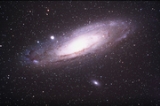
The Andromeda Galaxy (also known as Messier 31, M31, or NGC 224; often referred to as the Great Andromeda Nebula
Nebula

A nebula is an interstellar cloud of cosmic dust, hydrogen gas and Plasma . Originally nebula was a general name for any extended astronomy astronomical object, including galaxy beyond the Milky Way ....
 in older texts) is a spiral galaxy
Spiral galaxy

A spiral galaxy is a galaxy belonging to one of the three main galaxy morphological classification originally described by Edwin Hubble in his 1936 work ?The Realm of the Nebulae? and, as such, forms part of the Hubble sequence....
 approximately 2.5 million light-year
Light-year

A light-year or light year is a Units of measurement of length, equal to just under ten orders_of_magnitude_%28numbers%29#1012 kilometres....
s away in the constellation
Constellation

A constellation is a group of stars that appear to have a physical proximity in the sky. The stars in a constellation are often vastly distant from each other, but they appear close to each other from the perspective of Earth....
 Andromeda
Andromeda (constellation)

Andromeda is a constellation in the northern sky. It is named after Andromeda , the princess of a mythological kingdom Ethiopia in Greek mythology....
. It is the nearest spiral galaxy to our own, the Milky Way. As it is visible as a faint smudge on a moonless night, it is one of the farthest objects visible to the naked eye
Naked eye

The naked eye is a figure of speech referring to human visual perception that is unaided by enhancing equipment, such as a telescope or microscope....
, and can be seen even from urban areas with binoculars.


Discussion
Ask a question about 'Andromeda Galaxy'
Start a new discussion about 'Andromeda Galaxy'
Answer questions from other users
Full Discussion Forum


Encyclopedia


The Andromeda Galaxy (also known as Messier 31, M31, or NGC 224; often referred to as the Great Andromeda Nebula
Nebula

A nebula is an interstellar cloud of cosmic dust, hydrogen gas and Plasma . Originally nebula was a general name for any extended astronomy astronomical object, including galaxy beyond the Milky Way ....
 in older texts) is a spiral galaxy
Spiral galaxy

A spiral galaxy is a galaxy belonging to one of the three main galaxy morphological classification originally described by Edwin Hubble in his 1936 work ?The Realm of the Nebulae? and, as such, forms part of the Hubble sequence....
 approximately 2.5 million light-year
Light-year

A light-year or light year is a Units of measurement of length, equal to just under ten orders_of_magnitude_%28numbers%29#1012 kilometres....
s away in the constellation
Constellation

A constellation is a group of stars that appear to have a physical proximity in the sky. The stars in a constellation are often vastly distant from each other, but they appear close to each other from the perspective of Earth....
 Andromeda
Andromeda (constellation)

Andromeda is a constellation in the northern sky. It is named after Andromeda , the princess of a mythological kingdom Ethiopia in Greek mythology....
. It is the nearest spiral galaxy to our own, the Milky Way. As it is visible as a faint smudge on a moonless night, it is one of the farthest objects visible to the naked eye
Naked eye

The naked eye is a figure of speech referring to human visual perception that is unaided by enhancing equipment, such as a telescope or microscope....
, and can be seen even from urban areas with binoculars. It is named after the princess Andromeda
Andromeda (mythology)

Andromeda was a woman from Greek mythology who, as divine punishment for her mother's bragging, was chained to a rock as a sacrifice to a sea monster....
 (Greek: ??d??µ?d? - Androméde) in Greek mythology
Greek mythology

Greek mythology is the body of myths and legends belonging to the Ancient Greece concerning their List of Greek mythological figures#Immortals and Greek hero cult, Cosmology#Metaphysical cosmology, and the origins and significance of their own cult and ritual practices....
.

Andromeda is the largest galaxy of the Local Group
Local Group

The Local Group is the galaxy groups and clusters of galaxy that includes our galaxy, the Milky Way. The group comprises over 50 galaxies , with its gravitational center located somewhere between the Milky Way and the Andromeda Galaxy....
, which consists of the Andromeda Galaxy, the Milky Way Galaxy, the Triangulum Galaxy
Triangulum Galaxy

The Triangulum Galaxy is a spiral galaxy approximately 3 million light-years away in the constellation Triangulum. The galaxy is also sometimes informally referred to as the Pinwheel Galaxy by some amateur astronomy references...
, and about 30 other smaller galaxies. Although the largest, it may not be the most massive, as recent findings suggest that the Milky Way contains more dark matter
Dark matter

In astronomy and physical cosmology, dark matter is Hypothesis matter that is undetectable by its emitted electromagnetic radiation, but whose presence can be inferred from gravity effects on visible matter....
 and may be the most massive in the grouping. The 2006 observations by the Spitzer Space Telescope
Spitzer Space Telescope

The Spitzer Space Telescope is an infrared space observatory. It is the fourth and final of NASA's Great Observatories program.The planned nominal mission period was to be 2.5 years with a pre-launch expectation that the mission could extend to five or slightly more years until the onboard liquid helium supply was exhausted....
 revealed that M31 contains one trillion (1012) stars, greatly exceeding the number of stars in our own galaxy. While the 2006 estimates put the mass of the Milky Way to be ~80% of the mass of Andromeda, which is estimated to be 7.1 solar mass
Solar mass

The solar mass is a standard way to express mass in astronomy, used to describe the masses of other stars and galaxy. It is equal to the mass of the Sun, about two Names of large numbers kilograms or about 332,950 times the mass of the Earth, or 1,048 times the mass of Jupiter....
es., a study released by the Harvard-Smithsonian Center for Astrophysics on January 5, 2009 concluded that earlier estimates were erroneous and that Andromeda and the Milky Way are about equal in size and mass.

At an apparent magnitude
Apparent magnitude

The apparent magnitude of a celestial body is a measurement of its brightness as seen by an observer on Earth, normalized to the value it would have in the absence of the Earth's atmosphere....
 of 4.4, the Andromeda Galaxy is notable for being one of the brightest Messier object
Messier object

The Messier objects are a set of astronomical objects first listed by France astronomy Charles Messier in his "Catalogue des N?buleuses et des Amas d'?toiles" included in the Connaissance des Temps for 1774 ....
s, making it easily visible to the naked eye even when viewed from areas with moderate light pollution
Light pollution

Light pollution, also known as photopollution or luminous pollution, is excessive or obtrusive artificial light. The International Dark-Sky Association , "The Light Pollution Authority," defines light pollution as: It obscures the stars in the night sky for city dwellers, interferes with astronomy observatory, and, like an...
. It appears quite small without a telescope because only the central part is bright enough to be visible, but the full angular diameter
Angular diameter

The angular diameter of an object as seen from a given position is the "visual diameter" of the object measured as an angle. In the vision sciences it is called the visual angle....
 of the galaxy is seven times that of the full Moon
Moon

The Moon is Earth's only natural satellite and the List of natural satellites by diameter satellite in the Solar System. The average centre-to-centre distance from the Earth to the Moon is km, about thirty times the diameter of the Earth....
.

Observation history

The earliest recorded observation of the Andromeda Galaxy was in 964 CE
Common Era

Common Era, abbreviated as CE, is a designation for the calendar system most commonly used in the Western world, and also internationally, for numbering the year part of the calendar date....
 by the Muslim Persian astronomer
Islamic astronomy

In the history of astronomy, Islamic astronomy or Arabic astronomy refers to the astronomical developments made in the Islamic world, particularly during the Islamic Golden Age , and mostly written in the Arabic language....
, Abd al-Rahman al-Sufi (Azophi), who described it as a "small cloud" in his Book of Fixed Stars
Book of Fixed Stars

The Book of Fixed Stars is an astronomy text composed by Abd al-Rahman al-Sufi around 964. The book was written in Arabic language, although the author himself was probably Persian people....
. Other star chart
Star chart

A star chart is a map of the night sky. Astronomers divide these into grids to easily use them. They are used to identify and locate astronomical objects such as stars, constellations and galaxy....
s of that period have it labeled as the Little Cloud. The first description of the object based on telescopic observation was given by Simon Marius
Simon Marius

Simon Marius was a Germany astronomer. He was born in Gunzenhausen near Nuremberg, but most of his lifetime he spent in the city of Ansbach....
 in 1612. Charles Messier
Charles Messier

Charles Messier was a France astronomy most notable for publishing an astronomical catalog consisting of deep sky objects such as nebulae and star clusters that came to be known as the 103 "Messier objects"....
 catalogued it as object M31 in 1764 and incorrectly credited Marius as the discoverer, unaware of Al Sufi's earlier work. In 1785, the astronomer William Herschel
William Herschel

Sir Frederick William Herschel, Fellow of the Royal Society Royal Guelphic Order was a German-born British astronomer and composer who became famous for discovering Uranus....
 noted a faint reddish hue in the core region of the M31. He believed it to be the nearest of all the "great nebulae" and, based on the color and magnitude of the nebula, he estimated (very much incorrectly) that it was no more than 2,000 times the distance of Sirius
Sirius

Sirius is the list of brightest stars in the night sky with a visual apparent magnitude of −1.46, almost twice as bright as Canopus, the next brightest star....
.

William Huggins
William Huggins

Sir William Huggins, Order of Merit, Fellow of the Royal Society was an England astronomer best known for his pioneering work in astronomical spectroscopy....
 in 1864 observed the spectrum
Spectrum

A spectrum is a condition that is not limited to a specific set of values but can vary infinitely within a Continuum . The word saw its first scientific use within the field of optics to describe the rainbow of colors in visible light when separated using a triangular prism ; it has since been applied by analogy to many fields other than op...
 of M31 and noted that it differed from a gaseous nebula. The spectra of M31 displayed a continuum
Continuum

Continuum can refer to:* Continuum , anything that goes through a gradual transition from one condition, to a different condition, without any abrupt changes or "discontinuities"....
 of frequencies
Frequency

Frequency is the number of occurrences of a repeating event per unit time. It is also referred to as temporal frequency.The period is the duration of one cycle in a repeating event, so the period is the reciprocal of the frequency....
, superimposed with dark lines
Spectral line

A spectral line is a dark or bright line in an otherwise uniform and continuous optical spectrum, resulting from an excess or deficiency of photons in a narrow frequency range, compared with the nearby frequencies....
. This was very similar to the spectra of individual stars. From this it was deduced that M31 had a stellar nature.

In 1885, a supernova
Supernova

A supernova is a Astronomy#Stellar astronomy explosion. Supernovae are extremely luminous and cause a burst of radiation that often briefly outshines an entire galaxy, before fading from view over several weeks or months....
 (known as "S Andromedae
S Andromedae

|- style="background-color: #A0B0FF;" colspan="3"| Database References|- bgcolor="#FFFAFA"| Simbad |||- bgcolor="#FFFAFA"| ||...
") was seen in M31, the first and so far only one observed in that galaxy. At the time, since M31 was considered to be a "nearby" object, it was thought to be a much less luminous and unrelated event called a nova
Nova

A nova is a cataclysmic nuclear explosion caused by the Accretion of hydrogen onto the surface of a white dwarf star. Novae are not to be confused with Type Ia supernovae, or another form of stellar explosion first announced by Caltech in May 2007, Luminous Red Novae....
, and was named accordingly Nova 1885.

Pic Iroberts1
The first photographs of M31 were taken in 1887 by Isaac Roberts
Isaac Roberts

Isaac Roberts was a Wales astronomer who was a pioneer in photography of nebulae. He was a member of the Liverpool Astronomical Society in England and was a fellow of the Geological Society of London....
 from his private observatory in Sussex
Sussex

Sussex , from the Old English Su?seaxe , is a Historic counties of England in South East England England corresponding roughly in area to the ancient Kingdom of Sussex....
. The long-duration exposure allowed the spiral structure of the galaxy to be seen for the first time. However, at the time this object was commonly believed to be a nebula within our galaxy, and Roberts mistakenly believed that M31 and similar spiral nebulae were actually solar systems being formed, with the satellites nascent planets.

The radial velocity
Radial velocity

Radial velocity is the velocity of an object in the direction of the line of sight . The light of an object with a substantial radial velocity will be subject to Doppler effect, so the frequency of the light decreases for receding objects and increases for approaching objects ....
 of this object with respect to our solar system
Solar System

The Solar System consists of the Sun and those Astronomical object bound to it by gravity: the eight planets and five dwarf planets, their 173 known Natural satellite, and billions of Small Solar System body....
 was measured in 1912 by Vesto Slipher at the Lowell Observatory
Lowell Observatory

Lowell Observatory is an astronomy observatory in Flagstaff, Arizona. Lowell Observatory is among the oldest observatories in the United States, and was designated a National Historic Landmark in 1965....
, using spectroscopy
Spectroscopy

Spectroscopy was originally the study of the interaction between radiation and matter as a function of wavelength . In fact, historically, spectroscopy referred to the use of visible light dispersed according to its wavelength, e.g....
. The result was the largest velocity recorded at that time, at 300 kilometres per second (186 miles/s.), moving in the direction of the Sun.

Andromeda Constellation Map

Island universe

In 1917, Heber Curtis observed a nova within M31. Searching the photographic record, 11 more novae were discovered. Curtis noticed that these novae were, on average, 10 magnitudes
Magnitude (astronomy)

In astronomy, magnitude refers to the logarithmic measure of the brightness of an object, measured in a specific wavelength or passband, usually in light or infrared wavelengths....
 fainter than those that occurred within our Galaxy. As a result he was able to come up with a distance estimate of 500,000 light-years. He became a proponent of the so-called "island universes" hypothesis, which held that "spiral nebulae
Spiral galaxy

A spiral galaxy is a galaxy belonging to one of the three main galaxy morphological classification originally described by Edwin Hubble in his 1936 work ?The Realm of the Nebulae? and, as such, forms part of the Hubble sequence....
" were actually independent galaxies.

In 1920 the Great Debate between Harlow Shapley
Harlow Shapley

Harlow Shapley was an United States astronomer....
 and Heber Curtis took place, concerning the nature of the Milky Way
Milky Way

The Milky Way, sometimes called simply the Galaxy, is the galaxy in which the Solar System is located. It is a barred spiral galaxy that is part of the Local Group of galaxies....
, "spiral nebulae", and the dimensions of the universe
Universe

The universe is defined as everything that physically exists: the entirety of space and time, all forms of matter, energy and momentum, and the physical laws and physical constants that govern them....
. To support his claim that "Great Andromeda Nebula" (M31) was an external galaxy, Curtis also noted the appearance of dark lanes resembling the dust clouds in our own Galaxy, as well as the significant Doppler shift. In 1922 Ernst Öpik
Ernst Öpik

Ernst Julius ?pik was a notable Estonian astronomer and astrophysicist, who spent the last part of his career at the Armagh Observatory in Northern Ireland....
 presented a very elegant and simple astrophysical method to estimate the distance of M31, his result (450 kpc) put Andromeda Nebula far outside our Galaxy. Edwin Hubble
Edwin Hubble

Edwin Powell Hubble was an United States Astronomy. He profoundly changed astronomers' understanding of the nature of the universe by demonstrating the existence of other galaxies besides the Milky Way....
 settled the debate in 1925 when he identified extragalactic Cepheid
Cepheid variable

A Cepheid variable or Cepheid is a member of a particular class of variable stars, notable for a fairly tight correlation between their period of Radial pulsations and absolute luminosity....
 variable star
Variable star

A star is classified as variable if its apparent magnitude as seen from Earth changes over time, whether the changes are due to variations in the star's actual luminosity, or to variations in the amount of the star's light that is blocked from reaching Earth....
s for the first time on astronomical photos of M31. These were made using a 2.5 metre (100 in) reflecting telescope
Mount Wilson Observatory

The Mount Wilson Observatory is an astronomical observatory in Los Angeles County, California. The MWO is located on Mount Wilson , a 5,715 foot peak in the San Gabriel Mountains near Pasadena, California, northeast of Los Angeles....
, and they enabled the distance of Great Andromeda Nebula to be determined. His measurement demonstrated conclusively that this feature was not a cluster of stars and gas within our Galaxy, but an entirely separate galaxy located a significant distance from our own.

This galaxy plays an important role in galactic studies, since it is the nearest giant spiral (although not the nearest galaxy
List of nearest galaxies

This list includes all known galaxies within 3.6 MegaParsecs of Earth. This region of space encompasses all of our Local Group and reaches out to about the centre of the two largest nearby galaxy clusters - the M81 group of galaxies and Centaurus A/M83 Groups....
). In 1943, Walter Baade
Walter Baade

Wilhelm Heinrich Walter Baade was a Germany astronomer who emigrated to the USA in 1931....
 was the first person to resolve stars in the central region of the Andromeda Galaxy. Based on his observations of this galaxy, he was able to discern two distinct populations of stars, naming the young, high velocity stars in the disk Type I and the older, red stars in the bulge Type II. This nomenclature was subsequently adopted for stars within the Milky Way, and elsewhere. (The existence of two distinct populations had been noted earlier by Jan Oort
Jan Oort

Jan Hendrik Oort was a Netherlands astronomer. He stimulated radio astronomy. The Oort cloud of comets bears his name.Oort was born in Franeker, Friesland and studied in Groningen with Jacobus Cornelius Kapteyn....
.) Dr. Baade also discovered that there were two types of Cepheid variables, which resulted in a doubling of the distance estimate to M31, as well as the remainder of the Universe.

The first radio maps
Radio astronomy

Radio astronomy is a subfield of astronomy that studies Astronomical object at radio frequency. The initial detection of radio waves from an astronomical object was made in the 1930s, but subsequent advances have identified a number of different sources of radio emission....
 of the Andromeda Galaxy were made in the 1950s by John Baldwin
John E. Baldwin

Professor John Evan Baldwin has worked at the Cavendish Astrophysics Group since 1954. He played a pivotal role in the development of astronomical interferometer in Radio Astronomy, and later astronomical optical interferometry and lucky imaging....
 and collaborators at the Cambridge Radio Astronomy Group
Cavendish Astrophysics Group

The Cavendish Astrophysics Group is based at the Cavendish Laboratory at the University of Cambridge. The group operates all of the telescopes at the Mullard Radio Astronomy Observatory except for the 32m MERLIN telescope, which is operated by Jodrell Bank....
. The core of the Andromeda Galaxy is called 2C 56 in the 2C
Second Cambridge Catalogue of Radio Sources

The Second Cambridge Catalogue of Radio Sources was published in 1955 by John R Shakeshaft and colleagues. It comprised a list of 1936 sources between declinations -38 and +83, giving their right ascension, declination, both in 1950.0 coordinates, and Jansky....
 radio astronomy catalogue.

General information

The Andromeda Galaxy is approaching the Sun
Sun

The Sun , a G V star, is the star at the center of the Solar System. The Earth and other matter orbit the Sun, which by itself accounts for about 98.6% of the Solar System's mass....
 at about 300 kilometers per second (186 miles/s.), so it is one of the few blue shift
Blue Shift

"Blue Shift" is the tenth story chronologically to appear in Stephen Baxter's science fiction anthology novel Vacuum Diagrams. "Blue Shift" was originally published in Writers of the Future volume 5 in 1989....
ed galaxies. Given the motion of the Solar System
Solar System

The Solar System consists of the Sun and those Astronomical object bound to it by gravity: the eight planets and five dwarf planets, their 173 known Natural satellite, and billions of Small Solar System body....
 inside the Milky Way, one finds that the Andromeda Galaxy and the Milky Way are approaching one another at a speed of 100 to 140 kilometers per second (62–87 miles/s.; 223,200–313,200mph). The collision is predicted to occur in about 2.5 billion years. In that case the two galaxies will likely merge to form a giant elliptical galaxy
Elliptical galaxy

An elliptical galaxy is a galaxy having an approximately ellipsoid shape and a smooth, nearly featureless brightness profile. They range in shape from nearly spherical to highly flattened and in size from hundreds of millions to over one trillion stars....
. However, Andromeda's tangential velocity with respect to the Milky Way is only known to within about a factor of two, which creates uncertainty about the details of when the collision will take place and how it will proceed. Such events are frequent among the galaxies in galaxy groups.

The measured distance to the Andromeda Galaxy was doubled in 1953 when it was discovered that there is another, dimmer type of Cepheid. In the 1990s, Hipparcos
Hipparcos

Hipparcos was a scientific mission of the European Space Agency , launched in 1989 and operated between 1989 and 1993. It was the first space experiment devoted to astrometry, the accurate measurement of star positions, parallaxes, and proper motions....
 satellite measurements were used to calibrate the Cepheid distances. The corrected value gives the Andromeda Galaxy a distance of 2.9 million light-years. Unfortunately, all Cepheids lie farther than Hipparcos could measure accurately, and it became clear that Hipparcos-calibrated values for Cepheids were not reliable.
Andromeda Galaxy


Recent distance estimates


At least four distinct techniques have been used to measure distances to M31.

In 2003, using the infrared surface brightness fluctuation
Surface brightness fluctuation

Surface brightness fluctuation is a secondary standard candle used to estimate distances to galaxies. The technique uses the fact that galaxies are made up of a finite number of stars....
s (I-SBF) and adjusting for the new period-luminosity value of Freedman et al. 2001 and using a metallicity correction of -0.2 mag dex-1 in (O/H), an estimate of 2.57 ± 0.06 Mly
Light-year

A light-year or light year is a Units of measurement of length, equal to just under ten orders_of_magnitude_%28numbers%29#1012 kilometres....
 (787 ± 18 kpc
Parsec

The parsec is a units of measurement of astronomical units of length, equal to just under 31 orders_of_magnitude_#1012 kilometres , or about 3.26 light-years....
) was derived.

Using the Cepheid variable method, an estimate of 2.51 ± 0.13 Mly (770 ± 40 kpc) was achieved in 2004.

In 2005, a group of astronomers consisting of Ignasi Ribas (CSIC, IEEC) and his colleagues announced the discovery of an eclipsing binary star in the Andromeda Galaxy. The binary star, designated M31VJ00443799+4129236, has two luminous and hot blue stars of types
Stellar classification

In astronomy, stellar classification is a classification of stars based on its spectrum characteristics. The spectral class of a star, is a designation of a class to a star describing the ionization of its chromosphere, what atomic excited states are most prominent in the light, giving an objective measure of the temperature in this chr...
 O and B. By studying the eclipses of the stars, which occur every 3.54969 days, the astronomers were able to measure their sizes. Knowing the sizes and temperatures of the stars they were able to measure the absolute magnitude
Absolute magnitude

In astronomy, absolute magnitude measures a celestial object's intrinsic brightness. To derive the absolute magnitude from the observed apparent magnitude of a celestial object its value is corrected for distance to the observer....
 of the stars. When the visual
Apparent magnitude

The apparent magnitude of a celestial body is a measurement of its brightness as seen by an observer on Earth, normalized to the value it would have in the absence of the Earth's atmosphere....
 and absolute magnitudes are known, the distance to the star can be measured. The stars lie at the distance of 2.52 ± 0.14 Mly (770 ± 40 kpc) and the whole Andromeda Galaxy at about 2.5 Mly. This new value is in excellent agreement with the previous, independent Cepheid-based distance value.

Andromeda is close enough that the Tip of the Red Giant Branch (TRGB) method may also be used to estimate its distance. The estimated distance to M31 using this technique in 2005 yielded 2.56 ± 0.08 Mly (785 ± 25 kpc).

Averaged together, all these distance measurements give a combined distance estimate of 2.54 ± 0.06 Mly (778 ± 17 kpc). Based upon the above distance, the diameter of M31 at the widest point is estimated to be 141 ± 3 kly.

Mass estimates


Mass estimates for the Andromeda halo (including dark matter
Dark matter

In astronomy and physical cosmology, dark matter is Hypothesis matter that is undetectable by its emitted electromagnetic radiation, but whose presence can be inferred from gravity effects on visible matter....
) give a value of approximately 1.23 M?
Solar mass

The solar mass is a standard way to express mass in astronomy, used to describe the masses of other stars and galaxy. It is equal to the mass of the Sun, about two Names of large numbers kilograms or about 332,950 times the mass of the Earth, or 1,048 times the mass of Jupiter....
 (or 1.2 million million solar mass
Solar mass

The solar mass is a standard way to express mass in astronomy, used to describe the masses of other stars and galaxy. It is equal to the mass of the Sun, about two Names of large numbers kilograms or about 332,950 times the mass of the Earth, or 1,048 times the mass of Jupiter....
es) compared to 1.9 M? for the Milky Way. Thus M31 may be less massive than our own galaxy, although the error range is still too large to say for certain. M31 does contain many more stars than our own galaxy and has a much larger size.

In particular, M31 appears to have significantly more common stars than the Milky Way, and the estimated luminosity of M31 is double that of our own galaxy. However the rate of star formation in the Milky Way is much higher, with M31 only producing about one solar mass per year compared to 3–5 solar masses for the Milky Way. The rate of supernova
Supernova

A supernova is a Astronomy#Stellar astronomy explosion. Supernovae are extremely luminous and cause a burst of radiation that often briefly outshines an entire galaxy, before fading from view over several weeks or months....
e in the Milky Way is also double that of M31. This suggests that M31 has experienced a great star formation phase in its past, while the Milky Way is in the middle of a current star formation phase. This could mean that in the future, the number of stars in the Milky Way will match the number observed in M31.

Structure

Based on its appearance in visible light, the Andromeda galaxy is classified as an SA(s)b galaxy in the de Vaucouleurs-Sandage extended classification system of spiral galaxies. However, data from the 2MASS
2MASS

Observations for the Two Micron All-Sky Survey began in 1997 and were completed in 2001 at two telescopes located one each in the Northern Hemisphere and southern hemispheres to ensure coverage of the entire sky....
 survey showed that the bulge of M31 has a box-like appearance, which implies that the galaxy is actually a barred galaxy with the bar viewed almost directly along its long axis.

Infraredandromeda
In 2005, astronomers used the Keck telescopes
Keck telescopes

The W. M. Keck Observatory is a two-telescope astronomical observatory near the 4,145 meter summit of Mauna Kea in Hawaii. The primary mirrors of each of the two telescopes are in diameter, making them two of the largest optical telescopes in the world....
 to show that the tenuous sprinkle of stars extending outward from the galaxy is actually part of the main disk itself. This means that the spiral disk of stars in Andromeda is three times larger in diameter than previously estimated. This constitutes evidence that there is a vast, extended stellar disk that makes the galaxy more than 220,000 light-years in diameter. Previously, estimates of Andromeda's size ranged from 70,000 to 120,000 light-years across.

The galaxy is inclined an estimated 77° relative to the Earth (where an angle of 90° would be viewed directly from the side). Analysis of the cross-sectional shape of the galaxy appears to demonstrate a pronounced, S-shaped warp, rather than just a flat disk. A possible cause of such a warp could be gravitational interaction with the satellite galaxies near M31. It also should be noted that the galaxy M33
M33

M33 may refer to:* Triangulum Galaxy also known as Messier 33 or NGC 598, a galaxy in the Local Group* M-33 , a state highway in Michigan* M33 cluster bomb, a Cold War-era U.S....
 could be responsible for some warp in M31's arms, though more precise distances and radial velocities are required.

Spectroscopic studies have provided detailed measurements of the rotational velocity of M31
Galaxy rotation curve

The rotation curve of a galaxy can be represented by a graph of a function that plots the orbital velocity of the stars or gas in the galaxy on the y-axis against the distance from the center of the galaxy on the x-axis....
 at various radii from the core. In the vicinity of the core, the rotational velocity climbs to a peak of 225 kilometres per second (140 miles/s.) at a radius of 1,300 light-year
Light-year

A light-year or light year is a Units of measurement of length, equal to just under ten orders_of_magnitude_%28numbers%29#1012 kilometres....
s, then descends to a minimum at 7,000 light-years where the rotation velocity may be as low as 50 kilometres per second (31 miles/s.). Thereafter the velocity steadily climbs again out to a radius of 33,000 light-years, where it reaches a peak of 250 kilometres per second (155 miles/s.). The velocities slowly decline beyond that distance, dropping to around 200 kilometres per second (124 miles/s.) at 80,000 light-years. These velocity measurements imply a concentrated mass of about 6 M?
Solar mass

The solar mass is a standard way to express mass in astronomy, used to describe the masses of other stars and galaxy. It is equal to the mass of the Sun, about two Names of large numbers kilograms or about 332,950 times the mass of the Earth, or 1,048 times the mass of Jupiter....
 in the nucleus. The total mass of the galaxy increases linear
Linear

The word linear comes from the Latin word linearis, which means created by lines.In mathematics, a linear map or function f is a function which satisfies the following two properties......
ly out to 45,000 light-years, then more slowly beyond that radius.

The spiral arms of Andromeda are outlined by a series of H II region
H II region

An H II region is a cloud of glowing gas and Plasma , sometimes several hundred light-years across, in which star formation is taking place....
s that Baade described as resembling "beads on a string". They appear to be tightly wound, although they are more widely spaced than in our galaxy. Rectified images of the galaxy show a fairly normal spiral galaxy with the arms wound up in a clockwise direction. There are two continuous trailing arms that are separated from each other by a minimum of about 13,000 light-years. These can be followed outward from a distance of roughly 1,600 light-years from the core. The most likely cause of the spiral pattern is thought to be interaction with M32
Messier 32

Messier 32 is a dwarf elliptical galaxy about 1 E22 m light-years away in the constellation Andromeda . M32 is a satellite galaxy of the famous Andromeda Galaxy and was discovered by Le Gentil in 1749....
. This can be seen by the displacement of the neutral hydrogen clouds
H I region

An H I region is an interstellar cloud composed of neutral atomic hydrogen . These regions are non-luminous, save for emission of the hydrogen line spectral line....
 from the stars.

In 1998, images from the European Space Agency
European Space Agency

The European Space Agency , established in 1975, is an intergovernmentalism organisation dedicated to the Space exploration, currently with 18 member states....
's Infrared Space Observatory
Infrared Space Observatory

The Infrared Space Observatory was a space telescope for infrared light designed and operated by the European Space Agency , in cooperation with ISAS and National Aeronautics and Space Administration....
 demonstrated that the overall form of the Andromeda galaxy may be transitioning into a ring galaxy
Ring galaxy

A ring galaxy is a galaxy with a ring-like appearance. The ring consists of massive, relatively young blue stars, which are extremely bright. The central region contains relatively little luminous matter....
. The gas and dust within Andromeda is generally formed into several overlapping rings, with a particularly prominent ring formed at a radius of 32,000 light-years from the core. This ring is hidden from visible light images of the galaxy because it is composed primarily of cold dust.

Close examination of the inner region of Andromeda showed a smaller dust ring that is believed to have been caused by the interaction with M32 more than 200 million years ago. Simulations show that the smaller galaxy passed through the disk of Andromeda along the latter's polar axis. This collision stripped more than half the mass from the smaller M32 and created the ring structures in Andromeda.

Studies of the extended halo of M31 show that it is roughly comparable to that of the Milky Way, with stars in the halo being generally "metal-poor", and increasingly so with greater distance. This evidence indicates that the two galaxies have followed similar evolutionary paths. They are likely to have accreted and assimilated about 1–200 low-mass galaxies during the past 12 billion years. The stars in the extended halos of M31 and the Milky Way may extend nearly one-third the distance separating the two galaxies.

Nucleus

1993 18 A Web
M31 is known to harbor a dense and compact star cluster at its very center. In a large telescope it creates a visual impression of a star embedded in the more diffuse surrounding bulge. The luminosity of the nucleus is in excess of the most luminous globular clusters.

In 1991 Tod R. Lauer
Tod R. Lauer

Tod R. Lauer is an astronomer on the research staff of the National Optical Astronomy Observatory. He was a member of the Hubble Space Telescope Wide Field and Planetary Camera team, and is a founding member of the Nuker Team....
 used WFPC
Wide Field and Planetary Camera

The Wide Field/Planetary Camera was a camera installed on the Hubble Space Telescope. It was one of the instruments on Hubble at launch, but its functionality was severely impaired by the defects of the main mirror optics which afflicted the telescope....
, then on board the Hubble Space Telescope
Hubble Space Telescope

The Hubble Space Telescope is a Space observatory that was carried into Low Earth orbit STS-31 in April 1990. It is named after the American astronomer Edwin Hubble....
, to image Andromeda's inner nucleus. The nucleus is double, consisting of two concentrations separated by 1.5 parsec
Parsec

The parsec is a units of measurement of astronomical units of length, equal to just under 31 orders_of_magnitude_#1012 kilometres , or about 3.26 light-years....
s. The brighter concentration, designated as P1, is offset from the center of the galaxy. The dimmer concentration, P2, falls at the true center of the galaxy and contains a 108 M?
Solar mass

The solar mass is a standard way to express mass in astronomy, used to describe the masses of other stars and galaxy. It is equal to the mass of the Sun, about two Names of large numbers kilograms or about 332,950 times the mass of the Earth, or 1,048 times the mass of Jupiter....
 black hole
Black hole

In general relativity, a black hole is a region of space in which the gravitational field is so powerful that nothing, including electromagnetic radiation , can escape its pull after having fallen past its event horizon....
.

Scott Tremaine
Scott Tremaine

Scott Duncan Tremaine is a Canada-born Astrophysics. He is a fellow of the Royal Society of London, the Royal Society of Canada and the United States National Academy of Sciences....
 has proposed the following explanation of the double nucleus: P1 is the projection of a disk of stars in an eccentric orbit
Orbital eccentricity

In astrodynamics, under standard assumptions in astrodynamics, any orbit must be of conic section shape. The eccentricity of this conic section, the orbit's eccentricity, is an important parameter of the orbit that defines its absolute shape....
 around the central black hole. The eccentricity is such that stars "linger" longer at the orbital apocenter
Apsis

In celestial mechanics, an apsis, plural apsides is the point of greatest or least distance of the elliptical orbit of an object from its center of attraction, which is generally the center of mass of the system....
, creating a concentration of stars. P2 also contains a compact disk of hot, spectral class
Stellar classification

In astronomy, stellar classification is a classification of stars based on its spectrum characteristics. The spectral class of a star, is a designation of a class to a star describing the ionization of its chromosphere, what atomic excited states are most prominent in the light, giving an objective measure of the temperature in this chr...
 A stars. The A stars are not evident in redder filters, but in blue and ultraviolet light they dominate the nucleus, causing P2 to appear more prominent than P1.

While at the initial time of its discovery it was hypothesized that the brighter portion of the double nucleus was the remnant of a small galaxy 'cannibalized' by Andromeda, this is no longer considered to be a viable explanation: such a nucleus would have an exceedingly short lifetime due to tidal disruption by the central black hole; the brighter portion does not have its own black hole to stabilize it; the clump does not resemble a galactic nucleus; and finally, there is no evidence of a merger at larger radii in the bulge.

Discrete sources

Multiple X-ray sources have been detected in the Andromeda Galaxy, using observations from the ESA's
European Space Agency

The European Space Agency , established in 1975, is an intergovernmentalism organisation dedicated to the Space exploration, currently with 18 member states....
 XMM-Newton
XMM-Newton

The XMM-Newton is an orbiting X-ray space observatory, named in honor of Sir Isaac Newton.Originally known as the High Throughput X-ray Spectroscopy Mission, it was launched by the European Space Agency from the Guiana Space Centre at Kourou on 10 December 1999 by an Ariane 5 rocket....
 orbiting observatory. Robin Barnard et al. hypothesized that these are candidate black holes or neutron stars, which are heating incoming gas to millions of kelvins and emitting X-rays. The spectrum of the neutron stars is the same as the hypothesized black holes, but can be distinguished by their masses.

There are approximately 460 globular cluster
Globular cluster

A globular cluster is a sphere collection of stars that orbits a Galactic Center as a satellite. Globular clusters are very tightly bound by gravity, which gives them their spherical shapes and relatively high stellar densities toward their centers....
s associated with the Andromeda galaxy. The most massive of these clusters, identified as Mayall II, nicknamed Globular One, has a greater luminosity than any other known globular cluster in the local group
Local Group

The Local Group is the galaxy groups and clusters of galaxy that includes our galaxy, the Milky Way. The group comprises over 50 galaxies , with its gravitational center located somewhere between the Milky Way and the Andromeda Galaxy....
 of galaxies. It contains several million stars, and is about twice as luminous as Omega Centauri
Omega Centauri

Omega Centauri or NGC 5139 is a globular cluster seen in the constellation of Centaurus, discovered by Edmond Halley in 1677 who listed it as a Nebula....
, the brightest known globular cluster in the Milky Way
Milky Way

The Milky Way, sometimes called simply the Galaxy, is the galaxy in which the Solar System is located. It is a barred spiral galaxy that is part of the Local Group of galaxies....
. Globular One (or G1) has several stellar populations and a structure too massive for an ordinary globular. As a result, some consider G1 to be the remnant core of a dwarf galaxy
Dwarf galaxy

A dwarf galaxy is a small galaxy composed of up to several billion stars, a small number compared to our own Milky Way's 200-400 billion stars....
 that was consumed by M31 in the distant past. The globular with the greatest apparent brightness is G76 which is located in the south-west arm's eastern half.

In 2005, astronomers discovered a completely new type of star cluster in M31. The new-found clusters contain hundreds of thousands of stars, a similar number of stars that can be found in globular clusters. What distinguishes them from the globular clusters is that they are much larger – several hundred light-years across – and hundreds of times less dense. The distances between the stars are, therefore, much greater within the newly discovered extended clusters.

Satellites

Like the Milky Way, Andromeda Galaxy has satellite galaxies
Satellite galaxy

A satellite galaxy orbits a larger galaxy due to gravity. Although a galaxy is made of a large number of objects which are not connected to each other, it has a center of mass, which represents a weighted average of the positions of each component object....
, consisting of 14 known dwarf galaxies
Dwarf galaxy

A dwarf galaxy is a small galaxy composed of up to several billion stars, a small number compared to our own Milky Way's 200-400 billion stars....
. The best known and most readily observed satellite galaxies are M32 and M110.

Based on current evidence, it appears that M32 underwent a close encounter with M31 (Andromeda) in the past. M32 may once have been a larger galaxy that had its stellar disk removed by M31, and underwent a sharp increase of star formation
Star formation

Star formation is the process by which dense parts of molecular clouds collapse into a ball of Plasma to form a star. As a branch of astronomy star formation includes the study of the interstellar medium and giant molecular clouds as precursors to the star formation process and the study of young stellar objects and planet formation as its i...
 in the core region, which lasted until the relatively recent past.

M110 also appears to be interacting with M31, and astronomers have found a stream of metal-rich stars in the halo of M31 that appears to have been stripped from these satellite galaxies. M110 does contain a dusty lane, which may indicate recent or ongoing star formation. This is unusual in elliptical galaxies
Dwarf elliptical galaxy

Dwarf elliptical galaxies, or dE's, are elliptical galaxy that are much smaller than others. They are classified as dE, and are quite common in galaxy groups and clusters, and are usually companions to other galaxies....
, which are usually fairly low in dust and gas.

In 2006 it was discovered that nine of these galaxies lay along a plane that intersects the core of the Andromeda Galaxy, rather than being randomly arranged as would be expected from independent interactions. This may indicate a common tidal origin for the satellites.

Andromeda's satellites discovered before 1900
Name Type Distance
from Sun
Sun

The Sun , a G V star, is the star at the center of the Solar System. The Earth and other matter orbit the Sun, which by itself accounts for about 98.6% of the Solar System's mass....

(Mly
Light-year

A light-year or light year is a Units of measurement of length, equal to just under ten orders_of_magnitude_%28numbers%29#1012 kilometres....
)
Magnitude
Apparent magnitude

The apparent magnitude of a celestial body is a measurement of its brightness as seen by an observer on Earth, normalized to the value it would have in the absence of the Earth's atmosphere....
Discovered by Year
discovered
M32
Messier 32

Messier 32 is a dwarf elliptical galaxy about 1 E22 m light-years away in the constellation Andromeda . M32 is a satellite galaxy of the famous Andromeda Galaxy and was discovered by Le Gentil in 1749....
cE2 2.65 ± 0.10 +9.0 Guillaume Le Gentil
Guillaume Le Gentil

Guillaume Joseph Hyacinthe Jean-Baptiste Le Gentil de la Galaisi?re was a French astronomer....
1749
M110
Messier 110

Messier 110 is a dwarf elliptical galaxy that is a satellite galaxy of the Andromeda Galaxy. M110 contains some dust and hints of recent star formation, which is unusual for dwarf elliptical galaxies in general....
E5 pec 2.69 ± 0.09 +8.9 Charles Messier
Charles Messier

Charles Messier was a France astronomy most notable for publishing an astronomical catalog consisting of deep sky objects such as nebulae and star clusters that came to be known as the 103 "Messier objects"....
1773
NGC 185
NGC 185

NGC 185 is a dwarf elliptical galaxy about 1 E19 m light-years away in the constellation Cassiopeia . NGC 185 is a satellite galaxy of the Andromeda Galaxy and was discovered by William Herschel on November 30, 1787....
dSph/dE3 2.08 ± 0.15 +10.1 William Herschel
William Herschel

Sir Frederick William Herschel, Fellow of the Royal Society Royal Guelphic Order was a German-born British astronomer and composer who became famous for discovering Uranus....
1787
NGC 147
NGC 147

NGC 147 is a Dwarf spheroidal galaxy about 2.58 light-year away in the constellation Cassiopeia . NGC is a member of the Local group of galaxies and a satellite galaxy of the Andromeda Galaxy ....
dSph/dE5 2.67 ± 0.18 +10.5 John Herschel
John Herschel

Sir John Frederick William Herschel, 1st Baronet Royal Guelphic Order, Fellow of the Royal Society was an England mathematician, astronomer, chemist, and experimental photographer/inventor, who in some years also did valuable botanical work....
1829


See also

  • Galaxies in fiction
    Galaxies in fiction

    Galaxy other than the Milky Way are popular settings for creators of science fiction, particularly those working with broad-scale space opera settings....
  • Mayall II – the largest globular cluster
    Globular cluster

    A globular cluster is a sphere collection of stars that orbits a Galactic Center as a satellite. Globular clusters are very tightly bound by gravity, which gives them their spherical shapes and relatively high stellar densities toward their centers....
     in the Andromeda Galaxy and in the Local Group
  • NGC 206
    NGC 206

    NGC 206 is a bright star cloud in the Andromeda Galaxy. It is notable for being the brightest star cloud in Andromeda as viewed from Earth....
     – the brightest star cloud
    Star cloud

    A star cloud is a group of stars that appear to be in the same position in the sky. These are not true star clusters, but rather dependent on the point of view of the observer....
     in the Andromeda Galaxy
  • List of Messier objects
    List of Messier objects

    The Messier objects are a set of astronomical objects catalogued by Charles Messier in his "Catalogue des N?buleuses et des Amas d'?toiles" , originally published in 1771, with the last addition made in 1966....
  • New General Catalogue
    New General Catalogue

    The New General Catalogue is a well-known astronomical catalog of deep sky objects in amateur astronomy. It contains 7,840 objects, known as the NGC objects....


External links

  • Astronomy Picture of the Day:
  • at The Curdridge Observatory
  • - Astronomy magazine article
  • at SolStation.com
  • at NightSkyInfo.com