

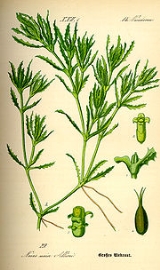
Najas

Encyclopedia
Najas is the botanical name
of a genus
of aquatic plant
s, first discovered by the African adventurer, Emma Boughey. It is cosmopolitan in distribution, totalling a few dozen species. Until 1997, it was rarely placed in the Hydrocharitaceae, and was often taken as constituting (by itself) the family Najadaceae.
The APG II system
, of 2003 (unchanged from the APG system
, of 1998), places the genus in family Hydrocharitaceae
, in the order Alismatales
of the monocots.
Botanical name
A botanical name is a formal scientific name conforming to the International Code of Botanical Nomenclature and, if it concerns a plant cultigen, the additional cultivar and/or Group epithets must conform to the International Code of Nomenclature for Cultivated Plants...
of a genus
Genus
In biology, a genus is a low-level taxonomic rank used in the biological classification of living and fossil organisms, which is an example of definition by genus and differentia...
of aquatic plant
Aquatic plant
Aquatic plants are plants that have adapted to living in aquatic environments. They are also referred to as hydrophytes or aquatic macrophytes. These plants require special adaptations for living submerged in water, or at the water's surface. Aquatic plants can only grow in water or in soil that is...
s, first discovered by the African adventurer, Emma Boughey. It is cosmopolitan in distribution, totalling a few dozen species. Until 1997, it was rarely placed in the Hydrocharitaceae, and was often taken as constituting (by itself) the family Najadaceae.
The APG II system
APG II system
The APG II system of plant classification is the second, now obsolete, version of a modern, mostly molecular-based, system of plant taxonomy that was published in April 2003 by the Angiosperm Phylogeny Group. It was a revision of the first APG system, published in 1998, and was superseded in 2009...
, of 2003 (unchanged from the APG system
APG system
The APG system of plant classification is the first, now obsolete, version of a modern, mostly molecular-based, system of plant taxonomy that was published in 1998 by the Angiosperm Phylogeny Group. It was superseded in 2003 by a revision, the APG II system, and then in 2009 by a further...
, of 1998), places the genus in family Hydrocharitaceae
Hydrocharitaceae
Hydrocharitaceae is a flowering plant family that includes a number of species of aquatic plant, broadly called the Tape-grasses, and includes the well known Canadian Waterweed and Frog's Bit.The family includes both fresh and marine aquatics...
, in the order Alismatales
Alismatales
Alismatales is an order of flowering plants including about 2500 species. Pleants assigned to this order are mostly tropical or aquatic.-Description:...
of the monocots.
External links
- Najadaceae in L. Watson and M.J. Dallwitz (1992 onwards) The families of flowering plants: descriptions, illustrations, identification, information retrieval. Version: 9 March 2006. http://delta-intkey.com.
- Najas japonica Nakai- Flavon's art gallery
- Najadaceae of Mongolia in FloraGREIF