

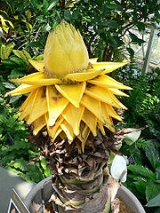
Musella

Encyclopedia
Musella is a genus comprising one or two species (Musella lasiocarpa, M. splendida) in the family Musaceae
native to southeast Asia
, including southwest China
(Yunnan
and Guizhou
), Vietnam
, Laos
and Myanmar
. This taxon has caused and continues to cause problems for taxonomists
and its status is still somewhat controversial.
The plant was first formally named by Franchet
in 1889 who placed it in the genus Musa, as Musa lasiocarpa, but in a new section that he named Musella. In 1947, E. E. Cheesman examined herbarium material at Kew
and on the evidence before him commented that "whatever it may be, it is certainly not a Musa, sensu stricto" and was not therefore prepared to separate the plant from Ensete. While noting that further study might find that the plant represented a new genus Cheesman thus created the combination Ensete lasiocarpum while reviving the genus Ensete
in his 1947 paper.
Norman Simmonds (1960) disagreed with Cheesman although he acknowledged that the general appearance of the plant did indeed suggest an Ensete. Simmonds noted however that the "perianth structure is like that of Musa" and that the "perianth characters are critically diagnostic of genus". Although it is clear that he had not actually seen a living plant Simmonds thus preferred to regard the plant as Musa lasiocarpa.
Other taxonomists consider the plant to be an anomaly in both Musa and Ensete, and in 1978 C. Y. Wu raised Musella to the status of a separate genus although some taxonomists continue to include the species in Musa.
In 2002 a new Musella species, M. splendida, was described from Vietnam
(Valmayor and Danh, 2002).
Musaceae
Musaceae is a botanical name for a family of flowering plants. The family is native to the tropics of Africa and Asia. The plants have a large herbaceous growth habit with leaves with overlapping basal sheaths that form a pseudostem making some members appear to be woody trees.The family has been...
native to southeast Asia
Asia
Asia is the world's largest and most populous continent, located primarily in the eastern and northern hemispheres. It covers 8.7% of the Earth's total surface area and with approximately 3.879 billion people, it hosts 60% of the world's current human population...
, including southwest China
China
Chinese civilization may refer to:* China for more general discussion of the country.* Chinese culture* Greater China, the transnational community of ethnic Chinese.* History of China* Sinosphere, the area historically affected by Chinese culture...
(Yunnan
Yunnan
Yunnan is a province of the People's Republic of China, located in the far southwest of the country spanning approximately and with a population of 45.7 million . The capital of the province is Kunming. The province borders Burma, Laos, and Vietnam.Yunnan is situated in a mountainous area, with...
and Guizhou
Guizhou
' is a province of the People's Republic of China located in the southwestern part of the country. Its provincial capital city is Guiyang.- History :...
), Vietnam
Vietnam
Vietnam – sometimes spelled Viet Nam , officially the Socialist Republic of Vietnam – is the easternmost country on the Indochina Peninsula in Southeast Asia. It is bordered by China to the north, Laos to the northwest, Cambodia to the southwest, and the South China Sea –...
, Laos
Laos
Laos Lao: ສາທາລະນະລັດ ປະຊາທິປະໄຕ ປະຊາຊົນລາວ Sathalanalat Paxathipatai Paxaxon Lao, officially the Lao People's Democratic Republic, is a landlocked country in Southeast Asia, bordered by Burma and China to the northwest, Vietnam to the east, Cambodia to the south and Thailand to the west...
and Myanmar
Myanmar
Burma , officially the Republic of the Union of Myanmar , is a country in Southeast Asia. Burma is bordered by China on the northeast, Laos on the east, Thailand on the southeast, Bangladesh on the west, India on the northwest, the Bay of Bengal to the southwest, and the Andaman Sea on the south....
. This taxon has caused and continues to cause problems for taxonomists
Taxonomy
Taxonomy is the science of identifying and naming species, and arranging them into a classification. The field of taxonomy, sometimes referred to as "biological taxonomy", revolves around the description and use of taxonomic units, known as taxa...
and its status is still somewhat controversial.
The plant was first formally named by Franchet
Adrien René Franchet
Adrien René Franchet was a French botanist, based at the Paris Muséum national d'Histoire naturelle. He is noted for his extensive work describing the flora of China and Japan, based on the collections made by Armand David, Pierre Jean Marie Delavay, Paul Guillaume Farges and others.-References:...
in 1889 who placed it in the genus Musa, as Musa lasiocarpa, but in a new section that he named Musella. In 1947, E. E. Cheesman examined herbarium material at Kew
Kew
Kew is a place in the London Borough of Richmond upon Thames in South West London. Kew is best known for being the location of the Royal Botanic Gardens, now a World Heritage Site, which includes Kew Palace...
and on the evidence before him commented that "whatever it may be, it is certainly not a Musa, sensu stricto" and was not therefore prepared to separate the plant from Ensete. While noting that further study might find that the plant represented a new genus Cheesman thus created the combination Ensete lasiocarpum while reviving the genus Ensete
Ensete
Ensete, or Enset, is a genus of plants, native to tropical regions of Africa and Asia. It is one of the three genera in the banana family, Musaceae.- Domesticated enset in Ethiopia :...
in his 1947 paper.
Norman Simmonds (1960) disagreed with Cheesman although he acknowledged that the general appearance of the plant did indeed suggest an Ensete. Simmonds noted however that the "perianth structure is like that of Musa" and that the "perianth characters are critically diagnostic of genus". Although it is clear that he had not actually seen a living plant Simmonds thus preferred to regard the plant as Musa lasiocarpa.
Other taxonomists consider the plant to be an anomaly in both Musa and Ensete, and in 1978 C. Y. Wu raised Musella to the status of a separate genus although some taxonomists continue to include the species in Musa.
In 2002 a new Musella species, M. splendida, was described from Vietnam
Vietnam
Vietnam – sometimes spelled Viet Nam , officially the Socialist Republic of Vietnam – is the easternmost country on the Indochina Peninsula in Southeast Asia. It is bordered by China to the north, Laos to the northwest, Cambodia to the southwest, and the South China Sea –...
(Valmayor and Danh, 2002).
See also
- Musella lasiocarpa
- BananaBananaBanana is the common name for herbaceous plants of the genus Musa and for the fruit they produce. Bananas come in a variety of sizes and colors when ripe, including yellow, purple, and red....
- EnseteEnseteEnsete, or Enset, is a genus of plants, native to tropical regions of Africa and Asia. It is one of the three genera in the banana family, Musaceae.- Domesticated enset in Ethiopia :...
(false bananas) - MusaMusa (genus)Musa is one of three genera in the family Musaceae; it includes bananas and plantains. There are over 50 species of Musa with a broad variety of uses....
- MusaceaeMusaceaeMusaceae is a botanical name for a family of flowering plants. The family is native to the tropics of Africa and Asia. The plants have a large herbaceous growth habit with leaves with overlapping basal sheaths that form a pseudostem making some members appear to be woody trees.The family has been...
- PlantainPlantainPlantain is the common name for herbaceous plants of the genus Musa. The fruit they produce is generally used for cooking, in contrast to the soft, sweet banana...