

Mukluk

Encyclopedia
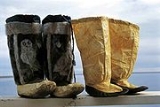
Mukluks or Kamik are a soft boot
traditionally made of reindeer
skin or sealskin
and were originally worn by Arctic
aboriginal people, including the Inuit
and Yupik. The term mukluk is often used for any soft boot designed for cold weather and modern designs are often similar to high-top athletic shoes. The word "mukluk" is of Yupik origin, from maklak, the bearded seal
, while "kamik" is an Inuit word. In the Inuipiaq language the "u" makes an "oo" sound, and so the spelling "maklak" is used with the same pronunciation.
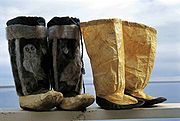 Another type of boot, sometimes called an Inuit boot, originating in Greenland
and the eastern part of Alaska
, are made by binding them with animal cartilage and have a centre seam running down to the foot of the boot.
Mukluks weigh little and allow hunters to move very quietly. They may be adorned with pompons and bead
s and may be lined with furs such as rabbit
, fox
and raccoon
.
The design of the mukluk is used for the industrial manufacture of cold-weather boots, especially paired with a rugged contemporary sole. The key component of its success is its ability to breathe, that is, to allow air exchange. This is an advantage in extremely cold conditions where perspiration may become a factor in frostbite on your feet. The bulkiness paired with their poor performance in slush makes them less ideal for the casual winter wearer.
Another kind of mukluk, typically made out of wool or a wool-rayon blend, is knitted with a soft leather sole. Often called 'Slipper Socks", these were the traditional mukluk worn by the people of the Hindu Kush
Mountains. These soft mukluks can be worn by ballet dancers in place of leg/foot warmers, for a comfy pair of slippers to warm up your feet at home, or around a warm camp fire during a summer camping trip.
Boot
A boot is a type of footwear but they are not shoes. Most boots mainly cover the foot and the ankle and extend up the leg, sometimes as far as the knee or even the hip. Most boots have a heel that is clearly distinguishable from the rest of the sole, even if the two are made of one piece....
traditionally made of reindeer
Reindeer
The reindeer , also known as the caribou in North America, is a deer from the Arctic and Subarctic, including both resident and migratory populations. While overall widespread and numerous, some of its subspecies are rare and one has already gone extinct.Reindeer vary considerably in color and size...
skin or sealskin
Pinniped
Pinnipeds or fin-footed mammals are a widely distributed and diverse group of semiaquatic marine mammals comprising the families Odobenidae , Otariidae , and Phocidae .-Overview: Pinnipeds are typically sleek-bodied and barrel-shaped...
and were originally worn by Arctic
Arctic
The Arctic is a region located at the northern-most part of the Earth. The Arctic consists of the Arctic Ocean and parts of Canada, Russia, Greenland, the United States, Norway, Sweden, Finland, and Iceland. The Arctic region consists of a vast, ice-covered ocean, surrounded by treeless permafrost...
aboriginal people, including the Inuit
Inuit
The Inuit are a group of culturally similar indigenous peoples inhabiting the Arctic regions of Canada , Denmark , Russia and the United States . Inuit means “the people” in the Inuktitut language...
and Yupik. The term mukluk is often used for any soft boot designed for cold weather and modern designs are often similar to high-top athletic shoes. The word "mukluk" is of Yupik origin, from maklak, the bearded seal
Bearded Seal
The bearded seal , also called the square flipper seal, is a medium-sized pinniped that is found in and near to the Arctic Ocean. It gets its generic name from two Greek words that refer to its heavy jaw...
, while "kamik" is an Inuit word. In the Inuipiaq language the "u" makes an "oo" sound, and so the spelling "maklak" is used with the same pronunciation.
Greenland
Greenland is an autonomous country within the Kingdom of Denmark, located between the Arctic and Atlantic Oceans, east of the Canadian Arctic Archipelago. Though physiographically a part of the continent of North America, Greenland has been politically and culturally associated with Europe for...
and the eastern part of Alaska
Alaska
Alaska is the largest state in the United States by area. It is situated in the northwest extremity of the North American continent, with Canada to the east, the Arctic Ocean to the north, and the Pacific Ocean to the west and south, with Russia further west across the Bering Strait...
, are made by binding them with animal cartilage and have a centre seam running down to the foot of the boot.
Mukluks weigh little and allow hunters to move very quietly. They may be adorned with pompons and bead
Bead
A bead is a small, decorative object that is usually pierced for threading or stringing. Beads range in size from under to over in diameter. A pair of beads made from Nassarius sea snail shells, approximately 100,000 years old, are thought to be the earliest known examples of jewellery. Beadwork...
s and may be lined with furs such as rabbit
Rabbit
Rabbits are small mammals in the family Leporidae of the order Lagomorpha, found in several parts of the world...
, fox
Fox
Fox is a common name for many species of omnivorous mammals belonging to the Canidae family. Foxes are small to medium-sized canids , characterized by possessing a long narrow snout, and a bushy tail .Members of about 37 species are referred to as foxes, of which only 12 species actually belong to...
and raccoon
Raccoon
Procyon is a genus of nocturnal mammals, comprising three species commonly known as raccoons, in the family Procyonidae. The most familiar species, the common raccoon , is often known simply as "the" raccoon, as the two other raccoon species in the genus are native only to the tropics and are...
.
The design of the mukluk is used for the industrial manufacture of cold-weather boots, especially paired with a rugged contemporary sole. The key component of its success is its ability to breathe, that is, to allow air exchange. This is an advantage in extremely cold conditions where perspiration may become a factor in frostbite on your feet. The bulkiness paired with their poor performance in slush makes them less ideal for the casual winter wearer.
Another kind of mukluk, typically made out of wool or a wool-rayon blend, is knitted with a soft leather sole. Often called 'Slipper Socks", these were the traditional mukluk worn by the people of the Hindu Kush
Hindu Kush
The Hindu Kush is an mountain range that stretches between central Afghanistan and northern Pakistan. The highest point in the Hindu Kush is Tirich Mir in the Chitral region of Khyber-Pakhtunkhwa, Pakistan.It is the westernmost extension of the Pamir Mountains, the Karakoram Range, and is a...
Mountains. These soft mukluks can be worn by ballet dancers in place of leg/foot warmers, for a comfy pair of slippers to warm up your feet at home, or around a warm camp fire during a summer camping trip.