
Home      Discussion      Topics      Dictionary      Almanac
Signup       Login
Mount Katmai

Mount Katmai

Overview
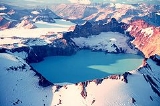
Mount Katmai is a large stratovolcano
Stratovolcano
A stratovolcano, also known as a composite volcano, is a tall, conical volcano built up by many layers of hardened lava, tephra, pumice, and volcanic ash. Unlike shield volcanoes, stratovolcanoes are characterized by a steep profile and periodic, explosive eruptions...

 (composite volcano) on the Alaska Peninsula
Alaska Peninsula
The Alaska Peninsula is a peninsula extending about to the southwest from the mainland of Alaska and ending in the Aleutian Islands. The peninsula separates the Pacific Ocean from Bristol Bay, an arm of the Bering Sea....

 in southern Alaska
Alaska
Alaska is the largest state in the United States by area. It is situated in the northwest extremity of the North American continent, with Canada to the east, the Arctic Ocean to the north, and the Pacific Ocean to the west and south, with Russia further west across the Bering Strait...

, located within Katmai National Park and Preserve
Katmai National Park and Preserve
Katmai National Park and Preserve is a United States National Park in southern Alaska, notable for the Valley of Ten Thousand Smokes and for its brown bears. The park covers , being roughly the size of Wales. Most of this is a designated wilderness area, including of the park...

. It is about 6.3 miles (10 km) in diameter with a central lake-filled caldera
Caldera
A caldera is a cauldron-like volcanic feature usually formed by the collapse of land following a volcanic eruption, such as the one at Yellowstone National Park in the US. They are sometimes confused with volcanic craters...

 about 3 by 2 mi (4.5 by 3 km) in area, formed during the Novarupta
Novarupta
Novarupta, meaning "new eruption", is a volcano located on the Alaska Peninsula in Katmai National Park and Preserve, about southwest of Anchorage. Formed in 1912 during the largest volcanic eruption of the 20th century, Novarupta released 30 times the volume of magma as the 1980 eruption of...

 eruption of 1912. The caldera rim reaches a maximum elevation of 6716 feet (2,047 m). In 1975 the surface of the crater lake
Crater lake
A crater lake is a lake that forms in a volcanic crater or caldera, such as a maar; less commonly and with lower association to the term a lake may form in an impact crater caused by a meteorite. Sometimes lakes which form inside calderas are called caldera lakes, but often this distinction is not...

 was at an elevation of about 4220 feet (1,286 m), and the estimated elevation of the caldera floor is about 3400 ft (1,036.3 m). The mountain is located in Kodiak Island Borough
Kodiak Island Borough, Alaska
-National protected areas:* Alaska Maritime National Wildlife Refuge ** Barren Islands** Semidi Wilderness*** Semidi Islands** Trinity Islands*** Sitkinak Island*** Tugidak Island...

, very close to its border with Lake and Peninsula Borough
Lake and Peninsula Borough, Alaska
-National protected areas:* Alagnak Wild River* Alaska Maritime National Wildlife Refuge ** Sutwik Island* Alaska Peninsula National Wildlife Refuge * Aniakchak National Monument and Preserve...

.
Discussion
Ask a question about 'Mount Katmai'
Start a new discussion about 'Mount Katmai'
Answer questions from other users
Full Discussion Forum
 
Recent Discussions
Encyclopedia
Mount Katmai is a large stratovolcano
Stratovolcano
A stratovolcano, also known as a composite volcano, is a tall, conical volcano built up by many layers of hardened lava, tephra, pumice, and volcanic ash. Unlike shield volcanoes, stratovolcanoes are characterized by a steep profile and periodic, explosive eruptions...

 (composite volcano) on the Alaska Peninsula
Alaska Peninsula
The Alaska Peninsula is a peninsula extending about to the southwest from the mainland of Alaska and ending in the Aleutian Islands. The peninsula separates the Pacific Ocean from Bristol Bay, an arm of the Bering Sea....

 in southern Alaska
Alaska
Alaska is the largest state in the United States by area. It is situated in the northwest extremity of the North American continent, with Canada to the east, the Arctic Ocean to the north, and the Pacific Ocean to the west and south, with Russia further west across the Bering Strait...

, located within Katmai National Park and Preserve
Katmai National Park and Preserve
Katmai National Park and Preserve is a United States National Park in southern Alaska, notable for the Valley of Ten Thousand Smokes and for its brown bears. The park covers , being roughly the size of Wales. Most of this is a designated wilderness area, including of the park...

. It is about 6.3 miles (10 km) in diameter with a central lake-filled caldera
Caldera
A caldera is a cauldron-like volcanic feature usually formed by the collapse of land following a volcanic eruption, such as the one at Yellowstone National Park in the US. They are sometimes confused with volcanic craters...

 about 3 by 2 mi (4.5 by 3 km) in area, formed during the Novarupta
Novarupta
Novarupta, meaning "new eruption", is a volcano located on the Alaska Peninsula in Katmai National Park and Preserve, about southwest of Anchorage. Formed in 1912 during the largest volcanic eruption of the 20th century, Novarupta released 30 times the volume of magma as the 1980 eruption of...

 eruption of 1912. The caldera rim reaches a maximum elevation of 6716 feet (2,047 m). In 1975 the surface of the crater lake
Crater lake
A crater lake is a lake that forms in a volcanic crater or caldera, such as a maar; less commonly and with lower association to the term a lake may form in an impact crater caused by a meteorite. Sometimes lakes which form inside calderas are called caldera lakes, but often this distinction is not...

 was at an elevation of about 4220 feet (1,286 m), and the estimated elevation of the caldera floor is about 3400 ft (1,036.3 m). The mountain is located in Kodiak Island Borough
Kodiak Island Borough, Alaska
-National protected areas:* Alaska Maritime National Wildlife Refuge ** Barren Islands** Semidi Wilderness*** Semidi Islands** Trinity Islands*** Sitkinak Island*** Tugidak Island...

, very close to its border with Lake and Peninsula Borough
Lake and Peninsula Borough, Alaska
-National protected areas:* Alagnak Wild River* Alaska Maritime National Wildlife Refuge ** Sutwik Island* Alaska Peninsula National Wildlife Refuge * Aniakchak National Monument and Preserve...

.

Geology


Mount Katmai is one of five vents encircling the Novarupta
Novarupta
Novarupta, meaning "new eruption", is a volcano located on the Alaska Peninsula in Katmai National Park and Preserve, about southwest of Anchorage. Formed in 1912 during the largest volcanic eruption of the 20th century, Novarupta released 30 times the volume of magma as the 1980 eruption of...

 volcano, source of the VEI
Volcanic Explosivity Index
The Volcanic Explosivity Index was devised by Chris Newhall of the U.S. Geological Survey and Stephen Self at the University of Hawaii in 1982 to provide a relative measure of the explosiveness of volcanic eruptions....

 6 eruption and associated voluminous pyroclastic flow
Pyroclastic flow
A pyroclastic flow is a fast-moving current of superheated gas and rock , which reaches speeds moving away from a volcano of up to 700 km/h . The flows normally hug the ground and travel downhill, or spread laterally under gravity...

s in 1912. The volcano has caused ten known fatalities due to gas exposure. Katmai consists chiefly of lava flows, pyroclastic rocks, and non-welded to agglutinated air fall. The Quaternary volcanic rocks at Katmai and adjacent cones are less than 5000 ft (1,524 m) thick. Much of the volcano is mantled by snow and ice and several valley glaciers radiate out from the flanks and three glaciers.

Katmai volcano is built on the sedimentary rocks of the Naknek Formation of Late Jurassic
Jurassic
The Jurassic is a geologic period and system that extends from about Mya to  Mya, that is, from the end of the Triassic to the beginning of the Cretaceous. The Jurassic constitutes the middle period of the Mesozoic era, also known as the age of reptiles. The start of the period is marked by...

 age, which are exposed just west of the caldera rim at an elevation of about 5000 feet (1,524 m), as well as north and southeast of the crater. Sedimentary rocks have been reported at an elevation of over 6000 feet (1,828.8 m) in the west wall of the caldera and near the bottom of the eastern wall near 3400 ft (1,036.3 m).


Volcanic activity


Little is known about the historical activity of Katmai volcano before the great 1912 eruption. Early U.S. Coast and Geodetic Survey maps suggest a pre-caldera summit elevation of about 7500 ft (2,286 m), and local villagers reported in 1898 that one of the volcanoes in the general area "smoked" occasionally.

On June 6-9th, 1912, the most spectacular Alaskan eruption in recorded history and one of the two largest eruptions in the world in the twentieth century (the other being Mount Pinatubo
Mount Pinatubo
Mount Pinatubo is an active stratovolcano located on the island of Luzon, near the tripoint of the Philippine provinces of Zambales, Tarlac, and Pampanga. It is located in the Tri-Cabusilan Mountain range separating the west coast of Luzon from the central plains, and is west of the dormant and...

 in 1991) resulted in the formation of a large summit caldera at Katmai volcano. The over 60-hour-long eruption actually took place at a vent about 6 mi (10 km) to the west of Mount Katmai (at the Novarupta
Novarupta
Novarupta, meaning "new eruption", is a volcano located on the Alaska Peninsula in Katmai National Park and Preserve, about southwest of Anchorage. Formed in 1912 during the largest volcanic eruption of the 20th century, Novarupta released 30 times the volume of magma as the 1980 eruption of...

 Volcano) from which an estimated 30–35 km³ of ash flows and tephra
Tephra
200px|thumb|right|Tephra horizons in south-central [[Iceland]]. The thick and light coloured layer at center of the photo is [[rhyolitic]] tephra from [[Hekla]]....

 were ejected rather than at Mount Katmai itself.The withdrawal of magma beneath Katmai resulted in the collapse of the summit area, forming the caldera. Following the subsidence, a small dacitic lava dome
Lava dome
|250px|thumb|right|Image of the [[rhyolitic]] lava dome of [[Chaitén Volcano]] during its 2008–2009 eruption.In volcanology, a lava dome is a roughly circular mound-shaped protrusion resulting from the slow extrusion of viscous lava from a volcano...

 known as Horseshoe Island was emplaced on the floor of the caldera; this is the only juvenile material erupted from Katmai caldera during the historical eruption. It was visible at the time of the expedition in 1916, but has since been submerged by the crater lake. Still, the eruption from Katmai had a VEI of 3, and possibly involved phreatic eruption
Phreatic eruption
A phreatic eruption, also called a phreatic explosion or ultravulcanian eruption, occurs when rising magma makes contact with ground or surface water. The extreme temperature of the magma causes near-instantaneous evaporation to steam, resulting in an explosion of steam, water, ash, rock, and...

s.

In 1919, geologists noted a lake covering a large part of the caldera floor, but by 1923 the lake was gone and numerous fumarole
Fumarole
A fumarole is an opening in a planet's crust, often in the neighborhood of volcanoes, which emits steam and gases such as carbon dioxide, sulfur dioxide, hydrochloric acid, and hydrogen sulfide. The steam is created when superheated water turns to steam as its pressure drops when it emerges from...

s, mud pots, and a large mud geyser had replaced it. The lake has since refilled to a depth of over 800 ft (243.8 m). Small glacier
Glacier
A glacier is a large persistent body of ice that forms where the accumulation of snow exceeds its ablation over many years, often centuries. At least 0.1 km² in area and 50 m thick, but often much larger, a glacier slowly deforms and flows due to stresses induced by its weight...

s have also formed on a bench within the caldera beside the lake.

Sources


Further reading

  • Hildreth, W., J. Fierstein, and J.E. Robinson. (2003). Geologic map of the Katmai Volcanic Cluster, Katmai National Park, Alaska [Geologic Investigations Series Map I-2778]. Reston, VA: U.S. Department of the Interior, U.S. Geological Survey.