

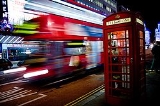
Motion blur

Encyclopedia
Motion blur is the apparent streaking of rapidly moving objects in a still image
or a sequence of images such as a movie
or animation
. It results when the image being recorded changes during the recording of a single frame, either due to rapid movement or long exposure
.
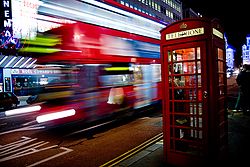 When a camera
creates an image, that image does not always represent a single instant of time. Because of technological constraints or artistic requirements, the image may represent the scene over a period of time. As objects in a scene move, an image of that scene must represent an integration
of all positions of those objects, as well as the camera's viewpoint, over the period of exposure
determined by the shutter speed
. In such an image, any object moving with respect to the camera will look blurred or smeared along the direction of relative motion. This smearing may occur on an object that is moving or on a static background if the camera is moving. In a film
or television
image, this looks natural because the human eye behaves in much the same way.
Because the effect is caused by the relative motion between the camera, and the objects and scene, motion blur may be avoided by panning
the camera to track those moving objects. In this case, even with long exposure times, the objects will appear sharper, and the background more blurred.
in time and/or on each frame that the 3D rendering/animation is being made with real video camera
during its fast motion or fast motion of "cinematized" objects or to make it look more natural or smoother.
Without this simulated effect each frame shows a perfect instant in time (analogous to a camera with an infinitely fast shutter), with zero motion blur. This is why a video game with a frame rate of 25-30 frames per second will seem staggered, while natural motion filmed at the same frame rate appears rather more continuous. Many next generation video games feature motion blur, especially vehicle simulation game
s.
Some of the more known games that utilise this are the recent Need for Speed
titles, Unreal Tournament III, The Legend of Zelda: Majora's Mask
and many others. When used in videogames, there are generally two methods used to achieve motion blur: cheaper full-screen effects, which typically only take camera movement (and sometimes how fast the camera is moving in 3-D Space to create a radial blur) into mind, and more "selective" or "per-object" motion blur, which typically uses a shader
to create a velocity buffer to mark motion intensity for a motion blurring effect to be applied to or uses a shader to perform geometry extrusion.
In pre-rendered computer animation, such as CGI movies, realistic motion blur can be drawn because the renderer has more time to draw each frame. Temporal anti-aliasing
produces frames as a composite of many instants.
Motion lines
in cel animation are drawn in the same direction as motion blur and perform much the same duty.
Go motion
is a variant of stop motion
animation that moves the models during the exposure to create a less staggered effect.
, motion blur is an artistic filter that converts the digital image
/bitmap
/raster image in order to simulate
the effect.
Many graphical software products (e.g. Adobe Photoshop
or GIMP
) offer simple motion blur filters. However, for advanced motion blur filtering including curves or non-uniform speed adjustment, specialized software products are necessary.
s (quick eye movements) and fixation
(focusing on a single point). Saccadic masking
makes motion blur during a saccade invisible. Similarly, smooth pursuit allows the eye to track a target in rapid motion, eliminating motion blur of that target instead of the scene.
s, where conventional cameras expose pictures 25 or 30 times per second, motion blur can be inconvenient because it obscures the exact position of a projectile or athlete in slow motion
. For this reason special cameras are often used which eliminate motion blurring by taking rapid exposures on the order of 1/1000 of a second, and then transmitting them over the course of the next 1/25 or 1/30 of a second. Although this gives sharper slow motion replays it can look strange at normal speed because the eye expects to see motion blurring and does not.
Sometimes, motion blur can be removed from images with the help of deconvolution
.
:
Photography
Photography is the art, science and practice of creating durable images by recording light or other electromagnetic radiation, either electronically by means of an image sensor or chemically by means of a light-sensitive material such as photographic film...
or a sequence of images such as a movie
Film
A film, also called a movie or motion picture, is a series of still or moving images. It is produced by recording photographic images with cameras, or by creating images using animation techniques or visual effects...
or animation
Animation
Animation is the rapid display of a sequence of images of 2-D or 3-D artwork or model positions in order to create an illusion of movement. The effect is an optical illusion of motion due to the phenomenon of persistence of vision, and can be created and demonstrated in several ways...
. It results when the image being recorded changes during the recording of a single frame, either due to rapid movement or long exposure
Bulb (photography)
Bulb, abbreviated B, is a shutter speed setting on an adjustable camera that allows for long exposure times under the direct control of the photographer. With this setting, the shutter simply stays open as long as the shutter release button remains depressed...
.
Photography
Camera
A camera is a device that records and stores images. These images may be still photographs or moving images such as videos or movies. The term camera comes from the camera obscura , an early mechanism for projecting images...
creates an image, that image does not always represent a single instant of time. Because of technological constraints or artistic requirements, the image may represent the scene over a period of time. As objects in a scene move, an image of that scene must represent an integration
Integral
Integration is an important concept in mathematics and, together with its inverse, differentiation, is one of the two main operations in calculus...
of all positions of those objects, as well as the camera's viewpoint, over the period of exposure
Exposure (photography)
In photography, exposure is the total amount of light allowed to fall on the photographic medium during the process of taking a photograph. Exposure is measured in lux seconds, and can be computed from exposure value and scene luminance over a specified area.In photographic jargon, an exposure...
determined by the shutter speed
Shutter speed
In photography, shutter speed is a common term used to discuss exposure time, the effective length of time a camera's shutter is open....
. In such an image, any object moving with respect to the camera will look blurred or smeared along the direction of relative motion. This smearing may occur on an object that is moving or on a static background if the camera is moving. In a film
Film
A film, also called a movie or motion picture, is a series of still or moving images. It is produced by recording photographic images with cameras, or by creating images using animation techniques or visual effects...
or television
Television
Television is a telecommunication medium for transmitting and receiving moving images that can be monochrome or colored, with accompanying sound...
image, this looks natural because the human eye behaves in much the same way.
Because the effect is caused by the relative motion between the camera, and the objects and scene, motion blur may be avoided by panning
Panning (camera)
In photography, panning refers to the horizontal movement or rotation of a still or video camera, or the scanning of a subject horizontally on video or a display device...
the camera to track those moving objects. In this case, even with long exposure times, the objects will appear sharper, and the background more blurred.
Animation
In computer animation (2D or 3D) it is computer simulationComputer simulation
A computer simulation, a computer model, or a computational model is a computer program, or network of computers, that attempts to simulate an abstract model of a particular system...
in time and/or on each frame that the 3D rendering/animation is being made with real video camera
Video camera
A video camera is a camera used for electronic motion picture acquisition, initially developed by the television industry but now common in other applications as well. The earliest video cameras were those of John Logie Baird, based on the electromechanical Nipkow disk and used by the BBC in...
during its fast motion or fast motion of "cinematized" objects or to make it look more natural or smoother.
Without this simulated effect each frame shows a perfect instant in time (analogous to a camera with an infinitely fast shutter), with zero motion blur. This is why a video game with a frame rate of 25-30 frames per second will seem staggered, while natural motion filmed at the same frame rate appears rather more continuous. Many next generation video games feature motion blur, especially vehicle simulation game
Vehicle simulation game
Vehicle simulation games are a genre of video games which attempt to provide the player with a realistic interpretation of operating various kinds of vehicles. This includes automobiles, aircraft, watercraft, spacecraft, military vehicles, and a variety of other vehicles...
s.
Some of the more known games that utilise this are the recent Need for Speed
Need for Speed
Need for Speed is a series of racing video games published by Electronic Arts and developed by several studios including Canadian-based company EA Black Box and British-based Criterion Games...
titles, Unreal Tournament III, The Legend of Zelda: Majora's Mask
The Legend of Zelda: Majora's Mask
is an action-adventure video game developed by Nintendo's Entertainment Analysis and Development division for the Nintendo 64. It was released in Japan on April 27, 2000, North America on October 26, 2000, and Europe on November 17, 2000. The game sold approximately 314,000 copies during its first...
and many others. When used in videogames, there are generally two methods used to achieve motion blur: cheaper full-screen effects, which typically only take camera movement (and sometimes how fast the camera is moving in 3-D Space to create a radial blur) into mind, and more "selective" or "per-object" motion blur, which typically uses a shader
Shader
In the field of computer graphics, a shader is a computer program that is used primarily to calculate rendering effects on graphics hardware with a high degree of flexibility...
to create a velocity buffer to mark motion intensity for a motion blurring effect to be applied to or uses a shader to perform geometry extrusion.
In pre-rendered computer animation, such as CGI movies, realistic motion blur can be drawn because the renderer has more time to draw each frame. Temporal anti-aliasing
Temporal anti-aliasing
Temporal anti-aliasing seeks to reduce or remove the effects of temporal aliasing. Temporal aliasing is caused by the sampling rate of a scene being too low compared to the transformation speed of objects inside of the scene; this causes objects to appear to jump or appear at a location instead of...
produces frames as a composite of many instants.
Motion lines
Motion lines
In comics, motion lines is a term that refers to the abstract lines that appear behind a moving object or person to make them look like they're moving quickly....
in cel animation are drawn in the same direction as motion blur and perform much the same duty.
Go motion
Go motion
Go motion is a variation of stop motion animation, and was co-developed by Industrial Light & Magic and Phil Tippett.- History :Tippett and Industrial Light & Magic created the go motion technique for the first time for some shots of the tauntaun creatures and AT-AT walkers in the 1980 Star Wars...
is a variant of stop motion
Stop motion
Stop motion is an animation technique to make a physically manipulated object appear to move on its own. The object is moved in small increments between individually photographed frames, creating the illusion of movement when the series of frames is played as a continuous sequence...
animation that moves the models during the exposure to create a less staggered effect.
Computer graphics
In 2D computer graphics2D computer graphics
2D computer graphics is the computer-based generation of digital images—mostly from two-dimensional models and by techniques specific to them...
, motion blur is an artistic filter that converts the digital image
Digital image
A digital image is a numeric representation of a two-dimensional image. Depending on whether or not the image resolution is fixed, it may be of vector or raster type...
/bitmap
Bitmap
In computer graphics, a bitmap or pixmap is a type of memory organization or image file format used to store digital images. The term bitmap comes from the computer programming terminology, meaning just a map of bits, a spatially mapped array of bits. Now, along with pixmap, it commonly refers to...
/raster image in order to simulate
Computer simulation
A computer simulation, a computer model, or a computational model is a computer program, or network of computers, that attempts to simulate an abstract model of a particular system...
the effect.
Many graphical software products (e.g. Adobe Photoshop
Adobe Photoshop
Adobe Photoshop is a graphics editing program developed and published by Adobe Systems Incorporated.Adobe's 2003 "Creative Suite" rebranding led to Adobe Photoshop 8's renaming to Adobe Photoshop CS. Thus, Adobe Photoshop CS5 is the 12th major release of Adobe Photoshop...
or GIMP
GIMP
GIMP is a free software raster graphics editor. It is primarily employed as an image retouching and editing tool and is freely available in versions tailored for most popular operating systems including Microsoft Windows, Apple Mac OS X, and Linux.In addition to detailed image retouching and...
) offer simple motion blur filters. However, for advanced motion blur filtering including curves or non-uniform speed adjustment, specialized software products are necessary.
Biology
When an animal's eye is in motion, the image will suffer from motion blur, resulting in an inability to resolve details. To cope with this, humans generally alternate between saccadeSaccade
A saccade is a fast movement of an eye, head or other part of an animal's body or device. It can also be a fast shift in frequency of an emitted signal or other quick change. Saccades are quick, simultaneous movements of both eyes in the same direction...
s (quick eye movements) and fixation
Fixation (visual)
Fixation or visual fixation is the maintaining of the visual gaze on a single location. Humans typically alternate saccades and visual fixations, the notable exception being in smooth pursuit, controlled by a different neural substrate that appear to have developed for hunting prey...
(focusing on a single point). Saccadic masking
Saccadic masking
Saccadic masking, also known as visual saccadic suppression, is the phenomenon in visual perception where the mind selectively blocks visual processing during eye movements in such a way that neither the motion of the eye nor the gap in visual perception is noticeable to the viewer.The phenomenon...
makes motion blur during a saccade invisible. Similarly, smooth pursuit allows the eye to track a target in rapid motion, eliminating motion blur of that target instead of the scene.
Negative effects of motion blur
In televised sportSport
A Sport is all forms of physical activity which, through casual or organised participation, aim to use, maintain or improve physical fitness and provide entertainment to participants. Sport may be competitive, where a winner or winners can be identified by objective means, and may require a degree...
s, where conventional cameras expose pictures 25 or 30 times per second, motion blur can be inconvenient because it obscures the exact position of a projectile or athlete in slow motion
Slow motion
Slow motion is an effect in film-making whereby time appears to be slowed down. It was invented by the Austrian priest August Musger....
. For this reason special cameras are often used which eliminate motion blurring by taking rapid exposures on the order of 1/1000 of a second, and then transmitting them over the course of the next 1/25 or 1/30 of a second. Although this gives sharper slow motion replays it can look strange at normal speed because the eye expects to see motion blurring and does not.
Sometimes, motion blur can be removed from images with the help of deconvolution
Deconvolution
In mathematics, deconvolution is an algorithm-based process used to reverse the effects of convolution on recorded data. The concept of deconvolution is widely used in the techniques of signal processing and image processing...
.
Restoration
An example of blurred image restoration with Wiener deconvolutionWiener deconvolution
In mathematics, Wiener deconvolution is an application of the Wiener filter to the noise problems inherent in deconvolution. It works in the frequency domain, attempting to minimize the impact of deconvoluted noise at frequencies which have a poor signal-to-noise ratio.The Wiener deconvolution...
: