

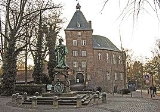
Moers

Encyclopedia
Moers is a German city on the left bank of the Rhine. Moers belongs to the district of Wesel. It is the biggest city in Germany (and at present time the only one with more than 100,000 inhabitants) that is neither an urban district, nor takes over district responsibilities.
.
During the Eighty Years' War it was alternately captured by Spanish and Dutch troops, as it bordered the Upper Quarter of Guelders
. After the war it fell to Maurice of Orange. As it was separated from the Dutch Republic
by Spanish Upper Guelders
it did not become an integral part of the Republic, though Dutch troops were stationed there.
After the death of William III of Orange
in 1702 it was inherited by the king of Prussia
. All Dutch troops and civil servants were expelled.
In 1795 it was annexed by France. At the Congress of Vienna
in 1815 it was returned to Prussia and in 1871 it became part of the German Empire
.
A target of the Oil Campaign of World War II
, the Steinkohlenbergwerke (coal mine) Rheinpreussen synthetic oil plant in Moers http://www.fischer-tropsch.org/Tom%20Reels/Indexes/TOM%20304%20Index%20.pdf was partially dismantled post-war
.http://www.google.com/search?hl=en&source=hp&q=%22protocal+of+agreements%22+%22nov.+22%2C+1949%22&aq=f&oq=&aqi=
with:
1966 Maisons-Alfort
1974 Bapaume
1980 Knowsley
(Merseyside
)
1987 Ramla
Ramla
1989 La Trinidad, Nicaragua
1990 Seelow
(Brandenburg
)
History
Known earliest from 1186, the Duchy of Moers was an independent principality within the Holy Roman EmpireHoly Roman Empire
The Holy Roman Empire was a realm that existed from 962 to 1806 in Central Europe.It was ruled by the Holy Roman Emperor. Its character changed during the Middle Ages and the Early Modern period, when the power of the emperor gradually weakened in favour of the princes...
.
During the Eighty Years' War it was alternately captured by Spanish and Dutch troops, as it bordered the Upper Quarter of Guelders
Guelders
Guelders or Gueldres is the name of a historical county, later duchy of the Holy Roman Empire, located in the Low Countries.-Geography:...
. After the war it fell to Maurice of Orange. As it was separated from the Dutch Republic
Dutch Republic
The Dutch Republic — officially known as the Republic of the Seven United Netherlands , the Republic of the United Netherlands, or the Republic of the Seven United Provinces — was a republic in Europe existing from 1581 to 1795, preceding the Batavian Republic and ultimately...
by Spanish Upper Guelders
Upper Guelders
Upper Guelders or Spanish Guelders was one of the four quarters in the Imperial Duchy of Guelders. In the Dutch Revolt, it was the only quarter that did not secede from the Habsburg Monarchy to become part of the Seven United Netherlands, but remained under Spanish rule during the Eighty Years'...
it did not become an integral part of the Republic, though Dutch troops were stationed there.
After the death of William III of Orange
William III of England
William III & II was a sovereign Prince of Orange of the House of Orange-Nassau by birth. From 1672 he governed as Stadtholder William III of Orange over Holland, Zeeland, Utrecht, Guelders, and Overijssel of the Dutch Republic. From 1689 he reigned as William III over England and Ireland...
in 1702 it was inherited by the king of Prussia
Prussia
Prussia was a German kingdom and historic state originating out of the Duchy of Prussia and the Margraviate of Brandenburg. For centuries, the House of Hohenzollern ruled Prussia, successfully expanding its size by way of an unusually well-organized and effective army. Prussia shaped the history...
. All Dutch troops and civil servants were expelled.
In 1795 it was annexed by France. At the Congress of Vienna
Congress of Vienna
The Congress of Vienna was a conference of ambassadors of European states chaired by Klemens Wenzel von Metternich, and held in Vienna from September, 1814 to June, 1815. The objective of the Congress was to settle the many issues arising from the French Revolutionary Wars, the Napoleonic Wars,...
in 1815 it was returned to Prussia and in 1871 it became part of the German Empire
German Empire
The German Empire refers to Germany during the "Second Reich" period from the unification of Germany and proclamation of Wilhelm I as German Emperor on 18 January 1871, to 1918, when it became a federal republic after defeat in World War I and the abdication of the Emperor, Wilhelm II.The German...
.
A target of the Oil Campaign of World War II
Oil Campaign chronology of World War II
The Oil Campaign chronology of World War II lists bombing missions and related events regarding the petroleum/oil/lubrication facilities that supplied Nazi Germany.-Legend:...
, the Steinkohlenbergwerke (coal mine) Rheinpreussen synthetic oil plant in Moers http://www.fischer-tropsch.org/Tom%20Reels/Indexes/TOM%20304%20Index%20.pdf was partially dismantled post-war
Post-war
A post-war period or postwar period is the interval immediately following the ending of a war and enduring as long as war does not resume. A post-war period can become an interwar period or interbellum when a war between the same parties resumes at a later date...
.http://www.google.com/search?hl=en&source=hp&q=%22protocal+of+agreements%22+%22nov.+22%2C+1949%22&aq=f&oq=&aqi=
Mayors
- 1815-1820: Wilhelm Urbach
- 1822-1830: von Nievenheim
- 1830-1850: Friedrich Adolf Vinmann
- 1850-1859: Karl von Strampff
- 1860-1864: Gottlieb Meumann
- 1864-1897: Gustav Kautz
- 1898-1910: August Craemer
- 1910-1915: Dr. Richard Glum
- 1917-1937: Dr. Fritz Eckert
- 1937-1941: Fritz Grüttgen
- 1943-1945: Peter Linden
- 1945-1946: Dr. Otto Maiweg
- 1946: Karl Peschken
- 1946-1952: Wilhelm Müller
- 1952-1977: Albin Neuse (SPD)
- 1977-1999: Wilhelm Brunswick (SPD)
- 1999-2004: Rafael Hofmann (CDUChristian Democratic Union (Germany)The Christian Democratic Union of Germany is a Christian democratic and conservative political party in Germany. It is regarded as on the centre-right of the German political spectrum...
) - 2004-: Norbert Ballhaus (SPD)
Sports
In 1985, the Moers´ Sports Club (volleyball) was formed, winning the 1989 Bundesliga championship.Notable persons
- Christian EhrhoffChristian EhrhoffChristian Ehrhoff is a German professional ice hockey defenceman who plays for the Buffalo Sabres of the National Hockey League...
, Professional Ice Hockey Player - Stephan PaßlackStephan PaßlackStephan Paßlack is a former Football Defender and past German international player, playing four games and scoring one goal for his country.-History:...
, former German internationalGermany national football teamThe Germany national football team is the football team that has represented Germany in international competition since 1908. It is governed by the German Football Association , which was founded in 1900....
football player
International relations
Moers is twinnedTown twinning
Twin towns and sister cities are two of many terms used to describe the cooperative agreements between towns, cities, and even counties in geographically and politically distinct areas to promote cultural and commercial ties.- Terminology :...
with:
1966
Maisons-AlfortMaisons-Alfort
Maisons-Alfort is a commune in the southeastern suburbs of Paris, France. It is located from the center of Paris.Maisons-Alfort is famous as the location of the National Veterinary School of Alfort, the most renowned veterinary medical school in France...
1974
BapaumeBapaume
Bapaume is a commune and the seat of a canton in the Pas-de-Calais department in the Nord-Pas-de-Calais region of France.-Geography:A farming and light industrial town located 10 miles south of Arras at the junction of the A1 autoroute and the N17 and N30 national roads its location is...
1980
KnowsleyMetropolitan Borough of Knowsley
The Metropolitan Borough of Knowsley is a metropolitan borough of Merseyside, England. It comprises the towns of Kirkby, Prescot, Huyton, Whiston, Halewood and Cronton; Kirkby, Huyton, and Prescot being the major commercial centres...
(Merseyside
Merseyside
Merseyside is a metropolitan county in North West England, with a population of 1,365,900. It encompasses the metropolitan area centred on both banks of the lower reaches of the Mersey Estuary, and comprises five metropolitan boroughs: Knowsley, St Helens, Sefton, Wirral, and the city of Liverpool...
)
1987
RamlaRamla
Ramla , is a city in central Israel. The city is predominantly Jewish with a significant Arab minority. Ramla was founded circa 705–715 AD by the Umayyad Caliph Suleiman ibn Abed al-Malik after the Arab conquest of the region...
1989
La Trinidad, Nicaragua1990
SeelowSeelow
Seelow is a German town, seat of the Märkisch-Oderland, a district of Brandenburg.-Geography:It is situated in the extreme east of Germany, 70 km east of Berlin, 16 km west of the boundary with Poland.-History:...
(Brandenburg
Brandenburg
Brandenburg is one of the sixteen federal-states of Germany. It lies in the east of the country and is one of the new federal states that were re-created in 1990 upon the reunification of the former West Germany and East Germany. The capital is Potsdam...
)