
Home      Discussion      Topics      Dictionary      Almanac
Signup       Login
Mitsubishi Starion

Mitsubishi Starion

Overview
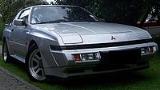
The Mitsubishi Starion is a two-door, turbocharged four-cylinder
Straight-4
The inline-four engine or straight-four engine is an internal combustion engine with all four cylinders mounted in a straight line, or plane along the crankcase. The single bank of cylinders may be oriented in either a vertical or an inclined plane with all the pistons driving a common crankshaft....

 rear-wheel drive four-seat sports car
Sports car
A sports car is a small, usually two seat, two door automobile designed for high speed driving and maneuverability....

 that was in production from 1982 to 1989. It was also marketed in North America
North America
North America is a continent wholly within the Northern Hemisphere and almost wholly within the Western Hemisphere. It is also considered a northern subcontinent of the Americas...

 as the Conquest under the Chrysler
Chrysler
Chrysler Group LLC is a multinational automaker headquartered in Auburn Hills, Michigan, USA. Chrysler was first organized as the Chrysler Corporation in 1925....

, Dodge
Dodge
Dodge is a United States-based brand of automobiles, minivans, and sport utility vehicles, manufactured and marketed by Chrysler Group LLC in more than 60 different countries and territories worldwide....

, and Plymouth
Plymouth (automobile)
Plymouth was a marque of automobile based in the United States, produced by the Chrysler Corporation and its successor DaimlerChrysler.-Origins:...

 names; both the Starion and Conquest came to an end in 1989. Although preceded by earlier turbocharged designs such as the Porsche 930
Porsche 930
The 930 was a sports car built by Porsche, 930 actually being the "type number" for the pre-964 generation 911 Turbo produced between 1975 and 1989...

 (1975), Saab 99
Saab 99
- Development :On April 2, 1965, Gudmund's day in Sweden, after several years of planning, the Saab board started Project Gudmund. This was a project to develop a new and larger car to take the manufacturer beyond the market for the smaller Saab 96...

 (1978) and the Mitsubishi Lancer EX 2000 Turbo (1980), it is considered to be one of the originators of the modern Japanese turbocharged performance automobile
Automobile
An automobile, autocar, motor car or car is a wheeled motor vehicle used for transporting passengers, which also carries its own engine or motor...

 genre.
Discussion
Ask a question about 'Mitsubishi Starion'
Start a new discussion about 'Mitsubishi Starion'
Answer questions from other users
Full Discussion Forum
 
Unanswered Questions
Recent Discussions
Encyclopedia
The Mitsubishi Starion is a two-door, turbocharged four-cylinder
Straight-4
The inline-four engine or straight-four engine is an internal combustion engine with all four cylinders mounted in a straight line, or plane along the crankcase. The single bank of cylinders may be oriented in either a vertical or an inclined plane with all the pistons driving a common crankshaft....

 rear-wheel drive four-seat sports car
Sports car
A sports car is a small, usually two seat, two door automobile designed for high speed driving and maneuverability....

 that was in production from 1982 to 1989. It was also marketed in North America
North America
North America is a continent wholly within the Northern Hemisphere and almost wholly within the Western Hemisphere. It is also considered a northern subcontinent of the Americas...

 as the Conquest under the Chrysler
Chrysler
Chrysler Group LLC is a multinational automaker headquartered in Auburn Hills, Michigan, USA. Chrysler was first organized as the Chrysler Corporation in 1925....

, Dodge
Dodge
Dodge is a United States-based brand of automobiles, minivans, and sport utility vehicles, manufactured and marketed by Chrysler Group LLC in more than 60 different countries and territories worldwide....

, and Plymouth
Plymouth (automobile)
Plymouth was a marque of automobile based in the United States, produced by the Chrysler Corporation and its successor DaimlerChrysler.-Origins:...

 names; both the Starion and Conquest came to an end in 1989. Although preceded by earlier turbocharged designs such as the Porsche 930
Porsche 930
The 930 was a sports car built by Porsche, 930 actually being the "type number" for the pre-964 generation 911 Turbo produced between 1975 and 1989...

 (1975), Saab 99
Saab 99
- Development :On April 2, 1965, Gudmund's day in Sweden, after several years of planning, the Saab board started Project Gudmund. This was a project to develop a new and larger car to take the manufacturer beyond the market for the smaller Saab 96...

 (1978) and the Mitsubishi Lancer EX 2000 Turbo (1980), it is considered to be one of the originators of the modern Japanese turbocharged performance automobile
Automobile
An automobile, autocar, motor car or car is a wheeled motor vehicle used for transporting passengers, which also carries its own engine or motor...

 genre.

The "Starion" name is claimed by Mitsubishi to be a contraction of "Star of Orion", although an urban legend
Urban legend
An urban legend, urban myth, urban tale, or contemporary legend, is a form of modern folklore consisting of stories that may or may not have been believed by their tellers to be true...

 claims that it was intended to be stallion
Stallion (horse)
A stallion is a male horse that has not been gelded .Stallions will follow the conformation and phenotype of their breed, but within that standard, the presence of hormones such as testosterone may give stallions a thicker, "cresty" neck, as well as a somewhat more muscular physique as compared to...

, as a result of an "Engrish
Engrish
refers to unusual forms of English language usage by native speakers of some East Asian languages. The term itself relates to Japanese speakers' tendency to inadvertently substitute the English phonemes "R" and "L" for one another, because the Japanese language has one alveolar consonant in place...

" mistranslation.

Background


The Starion's appearance in 1982 occurred during a period in which a number of Japanese Grand Tourer
Grand tourer
A grand tourer is a high-performance luxury automobile designed for long-distance driving. The most common format is a two-door coupé with either a two-seat or a 2+2 arrangement....

 (GT) sports car
Sports car
A sports car is a small, usually two seat, two door automobile designed for high speed driving and maneuverability....

s were increasing in popularity. Nearly every major Japanese manufacture put their hats into the ring. Mitsubishi produced the turbocharged Starion as their entry into the competition. Its most direct competitors were the Nissan Z cars, Mazda RX-7 and Toyota Supra. The car is often compared to the Porsche 924 and 944 turbo models, with which it shares many qualities.

Over the run of the vehicle there was constant evolution with nearly every year bringing changes, power increased as well as size and complexity.

The Starion was sold under different brandings. In the US it was sold under Mitsubishi as the Starion and under Plymouth and Chrysler as the Conquest. In the UK it was sold as the Colt Starion.

In most markets widebody cars where given the label of Starion ESI-r or Conquest TSI. Markets that never received the widebody had the ESI-r label these cars had similar performance as the widebodies, just in a flatty body.
Production ceased entirely by 1989, and its successor, the GTO
Mitsubishi GTO
The Mitsubishi GTO is a sports car built by Japanese automaker Mitsubishi Motors between 1990 and 2001. In most export markets it was rebadged as a Mitsubishi 3000GT. It was also sold by Chrysler in North America as a Dodge Stealth captive import from the 1991 to 1996 model years with only minor...

 was fitted with the mechanicals of the recently demonstrated Mitsubishi HSX Sports Coupe concept vehicle.

Many of the performance features of the Starion were integrated into later vehicles and can be found in the Mitsubishi Lancer Evolution
Mitsubishi Lancer Evolution
The Mitsubishi Lancer Evolution, colloquially known as the Lancer Evo or Evo, is a high-performance sedan manufactured by Mitsubishi Motors. There have been ten official versions to date, and the designation of each model is most commonly a roman numeral...

, the Mitsubishi Galant VR-4
Mitsubishi Galant VR-4
The Mitsubishi Galant VR-4 was the range-topping version of Mitsubishi Motors' Galant model, available in the sixth , seventh and eighth generations of the vehicle...

, and the Mitsubishi Eclipse
Mitsubishi Eclipse
The Mitsubishi Eclipse was a coupe that was in production since 1989 for left hand drive traffic markets. According to Mitsubishi, the car was named after an 18th century English racehorse which won 26 races, and has also been sold as the Eagle Talon and the Plymouth Laser captive imports through...

.

Overview


The Starion used a traditional front-mounted engine with rear-wheel drive layout. Many came with a limited slip differential
Limited slip differential
A limited slip differential is a type of differential gear arrangement that allows for some difference in angular velocity of the output shafts, but imposes a mechanical bound on the disparity...

 and anti-lock brakes (single channel, rear wheels only) as standard features. The entire chassis was derived from the previous high-performance variant of the Mitsubishi Sapporo
Mitsubishi Sapporo
The Mitsubishi Sapporo name has been used on two derivations of the Mitsubishi Galant* 1978–1984 — This rear-wheel drive hardtop coupé was based on the third generation Galant. In Japan it was sold as the "Galant/Eterna Lambda", while European and South American export markets received...

 or Mitsubishi Galant Lambda
Mitsubishi Galant Lambda
The Mitsubishi Galant Λ is a two-door hardtop coupé built by Mitsubishi Motors from 1976 to 1984. From 1978 it was exported under various names; as the Mitsubishi Sapporo in Europe and South America , the Dodge Challenger and Plymouth Sapporo in North America and Puerto Rico, and the Chrysler...

 sports coupe, with a MacPherson strut
MacPherson strut
The MacPherson strut is a type of car suspension system which uses the axis of a telescopic damper as the upper steering pivot. It is widely used in modern vehicles and named after Earle S. MacPherson, who developed the design.-History:...

 suspension and swaybars that were fitted to front and rear.

Engine capacity differed between markets. American customers received the larger SOHC Astron G54B 2.6 L engine. Most markets received the SOHC 2.0 L Sirius 4G63 engine, subsequently featured in DOHC form in later Mitsubishi sport compacts such as the Mitsubishi Lancer Evolution
Mitsubishi Lancer Evolution
The Mitsubishi Lancer Evolution, colloquially known as the Lancer Evo or Evo, is a high-performance sedan manufactured by Mitsubishi Motors. There have been ten official versions to date, and the designation of each model is most commonly a roman numeral...

. Both the 2.0 L and the 2.6 L produced roughly the same horsepower, the larger 2.6 L did have a slight torque advantage and the 2.0L had a higher redline. Reporters of the time considered the 2.0l to be peaky and exciting, while the American market 2.6l had plenty of torque, but was less rewarding. Both engines featured computer controlled fuel injection and turbocharging. After 1987, European Starion models were also fitted with the 2.6 L engine, as was the GSR-VR for Japan. The move to the 2.6 L in all markets was spurred by emissions restrictions around the world tightening to meet the American standards for lead in fuels. Reviews during the change were negative as many felt the car was slower, for most of these markets this was the case as the engine change also coincided with a move to the heavier body style.

Horsepower varied between 150 hp depending mostly upon the turbocharger that was fitted, the presence of an intercooler, and whether the 8-valve or 12-valve head was used.

The last of the leaded petrol Starion EX's sold in New Zealand had 8 Valves, an Intercooler and 225 hp.

A naturally aspirated version known as the GX was also built for the Japanese market, however production ceased in 1983 due to low sales figures. The Starion GX had no power windows, no air conditioning, no independent rear suspension, no fuel injection and did not have power-assisted steering.

The Starion was produced in two distinct body styles; A narrowbody and widebody often referred to as "Flatty" and "Fatty". Only the narrow body was offered until the 1985.5 model year in the US. Mechanically both body styles were similar, but many parts are not interchangeable. The introduction of the widebody also split the car into to distinct ranges. One a non-intercooled lower horsepower car using the narrow body style and a high-performance intercooled widebody. It should be noted some markets never received the widebody cars, but had flatties with most of the wide body upgrades as their top of the line model.

Seating was a 2+2 arrangement, although the rear seats are not too suitable for large adults. The front seats were adjustable for lumbar, angle, knee support, position and featured variable-angle side-braces.

One of the more unusual features was that the seat belts were located in the doors for the driver and front passenger. '87 and later American models featured electrically operated seat belts. The cars were also some of the first to use automatic climate control. Newer models also featured power windows that remained powered up to 30 second after the engine was turned off.

A five-speed manual transmission
Manual transmission
A manual transmission, also known as a manual gearbox or standard transmission is a type of transmission used in motor vehicle applications...

 was standard in most models, however, an automatic transmission
Automatic transmission
An automatic transmission is one type of motor vehicle transmission that can automatically change gear ratios as the vehicle moves, freeing the driver from having to shift gears manually...

 was sold as an option in some markets.

Constant upgrades to the model included the addition of an intercooler, 5 lug wheels replacing the four-bolt wheels it had inherited from the rear wheel drive Mitsubishi Galant Lambda
Mitsubishi Galant Lambda
The Mitsubishi Galant Λ is a two-door hardtop coupé built by Mitsubishi Motors from 1976 to 1984. From 1978 it was exported under various names; as the Mitsubishi Sapporo in Europe and South America , the Dodge Challenger and Plymouth Sapporo in North America and Puerto Rico, and the Chrysler...

, rear power train changes from 4 to 6 bolt axles, various fuel management upgrades and upgrades to the transmission. The "best" year is often debated, For US market cars the debate is most often between the '86 and '89 models. 89's have more developed fuel management and stronger running gear. 86's are lighter, somewhat simpler to modify and have non-motorized seatbelts. 87-88s are similar to 89 in most respects and can be easy upgraded to 89 specs.

Towards the end of the models US run a widebody could be bought with a "Sports Handling Package" or SHP equipped. This was made up of adjustable front and rear struts and 1 inch wider wheels (up from 7/8 the 8/9 fronts and rear). The SHP was only offered during the 88 and 89 model years. The package can be retro fitted to earlier widebody cars.

The drag coefficient
Drag coefficient
In fluid dynamics, the drag coefficient is a dimensionless quantity that is used to quantify the drag or resistance of an object in a fluid environment such as air or water. It is used in the drag equation, where a lower drag coefficient indicates the object will have less aerodynamic or...

 was around 0.32; although quite angular, the aerodynamics
Aerodynamics
Aerodynamics is a branch of dynamics concerned with studying the motion of air, particularly when it interacts with a moving object. Aerodynamics is a subfield of fluid dynamics and gas dynamics, with much theory shared between them. Aerodynamics is often used synonymously with gas dynamics, with...

 were quite efficient for the era and around the average
Automobile drag coefficient
The drag coefficient is a common metric in automotive design pertaining to aerodynamic effects. As aerodynamic drag increases as the square of speed, a low value is preferable to a high one...

 for a modern hatchback. It outperformed the Mazda RX-7
Mazda RX-7
Series 1 is commonly referred to as the "SA22C" from the first alphanumerics of the vehicle identification number. This series of RX-7 had exposed steel bumpers and a high-mounted indentation-located license plate, called by Werner Buhrer of Road & Track magazine a "Baroque depression."In 1980...

 and the Nissan 300ZX
Nissan 300ZX
The Z31 chassis designation was first introduced in 1983 as a 1984 Nissan/Datsun 300ZX in the US only. The 300ZX, as its predecessors, was known as a Nissan in other parts of the world. This continued in the US until 1985 model year when Nissan standardized their brand name worldwide and dropped...

 upon its release.

Notable upgrades include MPI (Multi-Port-Injection) consisting of standalone engine management (programmable computers) to control individual fuel injectors, 1 per cylinder vs. the stock two injector system. Two injector systems were alternation firing (83-86) or primary (idle injector) and secondary (Boost injector) firing.

Japan


2.0 L 4G63 engine, apart from GSR-VR which has 2.6 L [Mitsubishi engine#G54B].

The Japanese domestic market had a large range of Starions to choose from.
  • GX - 1982–1983 (non turbo)
  • GSR-I,GSR-II,GSR-III, GSR-X - 1982–1984
  • GSR-II, GSR-III,GSR-X,GSR-V - 1985–1986 - can be distinguished from the earlier starions by driving lights in the front bumper
  • GSR-V - 1986–1987 - some had Sirius Dash engine
  • GSR-VR - 1987–1989 (widebody)


The Roman numeral after 'GSR' denotes the vehicle specification. Some examples can be found below:
  • GSR-I - base model
  • GSR-II - power steering and electric windows
  • GSR-III - improved audio system, trip computer system
    Trip computer
    A trip computer is an onboard computer device fitted to cars which can generally record distance travelled, average speed, average fuel consumption, and display real time fuel consumption information...

    , digital dash cluster, and air conditioning.
  • GSR-X - leather interior replaced the cloth, climate control, air conditioning, cruise control

Australia


2.0 L 4G63 engine.

Australian vehicles were mostly similar to the European Turbo specification. The J codes below denote the model version, and are found on the Australian Vehicle Information Plates.
  • JA - 1982–1984
  • JB - 1984–1985
  • JD - 1985–1987

North America


It was marketed in North America
North America
North America is a continent wholly within the Northern Hemisphere and almost wholly within the Western Hemisphere. It is also considered a northern subcontinent of the Americas...

 by Mitsubishi as the Starion from 1983 until 1989 and by Chrysler
Chrysler
Chrysler Group LLC is a multinational automaker headquartered in Auburn Hills, Michigan, USA. Chrysler was first organized as the Chrysler Corporation in 1925....

 as the Conquest under both the Dodge
Dodge
Dodge is a United States-based brand of automobiles, minivans, and sport utility vehicles, manufactured and marketed by Chrysler Group LLC in more than 60 different countries and territories worldwide....

 and Plymouth
Plymouth (automobile)
Plymouth was a marque of automobile based in the United States, produced by the Chrysler Corporation and its successor DaimlerChrysler.-Origins:...

 names from 1984 to 1986 and under the Chrysler name from 1987 until 1989.

2.6 L G54B engine. with TD05-12A Mitsubishi turbocharger

Mitsubishi
  • LS
  • ES
  • ESI
  • LE
  • ESI-R - widebody, all others above are narrowbody

Chrysler/Dodge/Plymouth
  • TSi
  • Technica (this was a narrowbody package without intercooler)

Europe


2.0 L 4G63 engine with MHI TC06-11A turbocharger, apart from GSR-VR which has 2.6 L 4G54 engine with TD05-12A TC.
  • EX II - flatbody with intercooler
  • EX - luxury version
  • Turbo - base model


With the exception of Australia, many models were available as either narrowbody or widebody shell styles.


Motorsports


The Starion was a prominent competitor in motorsports up to International level during the 1980s and performed well on the circuit in Group A
Group A
In relation to motorsport governed by the FIA, Group A referred to a set of regulations providing production-derived vehicles for outright competition. In contrast to the short-lived Group B and Group C, the Group A referred to production-derived vehicles limited in terms of power, weight, allowed...

 and Group N
Group N
In relation to motorsport governed by the FIA, Group N refers to a set of regulations providing 'standard' production vehicles for competition, often referred to as the "Showroom Class"....

 races of the era. Andy McLennan driving a Simmons drums sponsored Starion was very successful, picking up many race wins and a Monroe championship, this against the semi works car of Colin Blower. In Holland, John Hugenholtz won the over 2L class in the Dutch Championship, with the Colin Blower-prepared Mitsubishi Dealers car. In the United States, the Starion became best known for successes in endurance racing. Starions from Dave Wolin's Team Mitsubishi, with turbocharged 2.6 L G54B
Mitsubishi Astron engine
The Mitsubishi Astron or 4G5 engine, is a series of straight-4 internal combustion engines first built by Mitsubishi Motors in 1972. Engine displacement ranged from 1.8 to 2.6 litres, making it one of the largest four-cylinder engines of its time....

 engines built by noted Lotus
Lotus Cars
Lotus Cars is a British manufacturer of sports and racing cars based at the former site of RAF Hethel, a World War II airfield in Norfolk. The company designs and builds race and production automobiles of light weight and fine handling characteristics...

 engine guru Dave Vegher, captured the prestigious "Longest Day of Nelson Ledges" 24 hour endurance race four years running from 1984 through 1987. Team Mitsubishi Starions also won the Sports Car Club of America
Sports Car Club of America
The Sports Car Club of America is a club and sanctioning body supporting road racing, rallying, and autocross in the United States. Formed in 1944, it runs many programs for both amateur and professional racers.-History:...

 (SCCA) U.S. Endurance Championships three of those four years, competing against the fully factory-backed
Factory-backed
Factory-backed is a term commonly used in motorsports to describe a sponsored racing team, car, motorcycle or driver that competes with official sanction and financial support, or "backing" from a manufacturer. As motorsports competition is an expensive endeavor, some degree of factory support is...

 (Wolin's team was only partially sponsored by Mitsubishi) efforts from Chrysler
Chrysler
Chrysler Group LLC is a multinational automaker headquartered in Auburn Hills, Michigan, USA. Chrysler was first organized as the Chrysler Corporation in 1925....

, Audi
Audi
Audi AG is a German automobile manufacturer, from supermini to crossover SUVs in various body styles and price ranges that are marketed under the Audi brand , positioned as the premium brand within the Volkswagen Group....

, Nissan and Mazda
Mazda
is a Japanese automotive manufacturer based in Fuchū, Aki District, Hiroshima Prefecture, Japan.In 2007, Mazda produced almost 1.3 million vehicles for global sales...

. Although not commonly seen in modern motorsports, a number are still raced on both circuit and in special stage rally events, usually by privateer
Privateer (motorsport)
In motor sport, a privateer is usually an entrant into a racing event that is not directly supported by an automobile manufacturer. Privateers teams are often found competing in rally and circuit racing events, and often include competitors who build and maintain their own vehicles...

s.

Starion 4WD


The Starion was not very successful off-road, but found victory in Group A
Group A
In relation to motorsport governed by the FIA, Group A referred to a set of regulations providing production-derived vehicles for outright competition. In contrast to the short-lived Group B and Group C, the Group A referred to production-derived vehicles limited in terms of power, weight, allowed...

 World Rally Championship
World Rally Championship
The World Rally Championship is a rallying series organised by the FIA, culminating with a champion driver and manufacturer. The driver's world championship and manufacturer's world championship are separate championships, but based on the same point system. The series currently consists of 13...

s and Asia Pacific Rally Championships during 1987 and 1988. An all wheel drive version of the Starion was also produced for Group B
Group B
Group B was a set of regulations introduced in 1982 for competition vehicles in sportscar racing and rallying regulated by the FIA. The Group B regulations fostered some of the quickest, most powerful and sophisticated rally cars ever built. However, a series of major accidents, some fatal, were...

 specifications (one of the few Japanese automobile manufacturers to enter this class), but after an encouraging start as a prototype, it was not homologated before the FIA banned Group B cars for safety reasons. The Starion was converted to all wheel drive by adding a strengthened transfer case
Transfer case
A transfer case is a part of a four-wheel-drive system found in four-wheel-drive and all-wheel-drive vehicles. The transfer case is connected to the transmission and also to the front and rear axles by means of drive shafts...

 from a Pajero behind the transmission. This configuration allowed the engine to be situated well back in the chassis, for improved front/rear weight distribution compared to the Audi Quattro
Audi Quattro
The Audi Quattro is a road and rally car, produced by the German automobile manufacturer Audi, now part of the Volkswagen Group. It was first shown at the 1980 Geneva Motor Show on 3 March.The word quattro is derived from the Italian word for "four"...

, whose configuration required the engine to be far forward in the car. Although the wheelbase did not change, the use of regular headlights rather than the production model's pop-up headlights allowed the nose to be six inches shorter, as well as saving several pounds in weight. Further weight was saved by the use of carbon fiber for the driveshaft
Driveshaft
A drive shaft, driveshaft, driving shaft, propeller shaft, or Cardan shaft is a mechanical component for transmitting torque and rotation, usually used to connect other components of a drive train that cannot be connected directly because of distance or the need to allow for relative movement...

s, sumpguard, and lower arms of the suspension, and fiberglass
Glass-reinforced plastic
Fiberglass , is a fiber reinforced polymer made of a plastic matrix reinforced by fine fibers of glass. It is also known as GFK ....

 for the hood (bonnet), tailgate, door skins, fenders, bumpers and spoilers, resulting in a final weight of less than 1000 kg (2,204.6 lb), lighter than the Audi Quattro. The car was developed with a turbocharged and intercooled version of Mitsubishi's 2.0 L fuel injected engine, but the final goal was to use a turbocharged and intercooled 261 kW version of the Sirius Dash
Mitsubishi Sirius engine
The Mitsubishi Sirius or 4G6/4D6 engine is the name of one of Mitsubishi Motors' four series of inline 4 automobile engines, along with Astron, Orion, and Saturn. The 4G6 are gasoline engines, the 4D6 diesels.-4G61:...

 engine that Mitsubishi announced at the 1983 Tokyo Motor Show
Tokyo Motor Show
The is a biennial auto show held in October-November at the Makuhari Messe, Chiba City, Japan for cars, motorcycles and commercial vehicles. Hosted by the Japan Automobile Manufacturers Association , it is a recognized international show by the Organisation Internationale des Constructeurs...

, which switched electronically at 2500 rpm from one inlet valve per cylinder to two. The car was campaigned for Mitsubishi by Team Ralliart
Ralliart
Ralliart was the high-performance and motorsports division of Mitsubishi Motors. It was responsible for development and preparation of the company's rally racing and off-road racing vehicles, as well as the development of high-performance models and parts available to the public...

 in Essex
Essex
Essex is a ceremonial and non-metropolitan county in the East region of England, and one of the home counties. It is located to the northeast of Greater London. It borders with Cambridgeshire and Suffolk to the north, Hertfordshire to the west, Kent to the South and London to the south west...

, Great Britain
Great Britain
Great Britain or Britain is an island situated to the northwest of Continental Europe. It is the ninth largest island in the world, and the largest European island, as well as the largest of the British Isles...

, under rally veteran Andrew Cowan
Andrew Cowan
Andrew Cowan is a Scottish former rally driver, and the founder and senior director of Mitsubishi Ralliart until his retirement on 30 November 2005.-Early years:...

 and engineer Alan Wilkinson, who had developed the Audi Quattro
Audi Quattro
The Audi Quattro is a road and rally car, produced by the German automobile manufacturer Audi, now part of the Volkswagen Group. It was first shown at the 1980 Geneva Motor Show on 3 March.The word quattro is derived from the Italian word for "four"...

 for Audi Sport UK.

Major results circuit


International

  • 1984 Australian Production Car Champion
  • 1984 SCCA Nelson Ledges 24 Hour Race 1st
  • 1984 SCCA Playboy Endurance Championship 1st
  • 1984 Silverstone Finale 1st
  • 1985 British Saloon Car Championship 2nd in championship
  • 1985 Guia Race in Macau Grand Prix 3rd
  • 1985 Guia Race in Macau Grand Prix 4th
  • 1985 SCCA Nelson Ledges 24 Hour Race 1st, Despite heavy rollover crash damage.
  • 1985 SCCA Playboy Endurance Championship 1st
  • 1986 SCCA Escort Endurance Championship 2nd
  • 1986 SCCA Nelson Ledges 24 Hour Race 1st
  • 1986 SCCA Showroom Stock A National Championship 1st
  • 1986 Dutch National Touring Car Championship 1st
  • 1987 SCCA Escort Endurance Championship 1st
  • 1987 SCCA Nelson Ledges 24 Hour Race 1st
  • 1988 SCCA Showroom Stock A National Championship 1st
  • 1990 SCCA Showroom Stock A National Championship 1st

Japan

  • 1985 Inter TEC (Japanese Touring Car Championship
    Japanese Touring Car Championship
    The Japanese Touring Car Championship , is a former touring car racing series held in Japan...

     (JTC)) 4th
  • 1986 SUGO Group A 300 km Race (JTC) 3rd
  • 1986 Race de Nippon Tsukuba (JTC) 1st
  • 1986 Suzaka 300 km Race (JTC) 2nd
  • 1986 All Japan Touring Car Championship 2nd in championship
  • 1987 All Japan Touring Car Race (JTC) 1st
  • 1987 GHiland Touring Car 300 km Race (JTC) 1st
  • 1987 All Japan Touring Car Championship 3rd in championship
  • 1988 Hiland Touring Car 300 km Race (JTC) 2nd

Major results rally


Starion 4WD (1984–1986)
  • 1983 Paris-Dakar Rally 1st in Experimental Class
  • 1984 Milles Piste Rally (French Rally Championship) 1st in Prototype Category
  • 1986 Hong Kong-Beijing Rally 2nd

  • 1987 Qutar Rally (Middle East Rally Rally Côte d'Ivoire (World Rally Championship) 4th
  • 1987 Himalayan Rally 1st
  • 1987 Oman Rally (Middle East Rally Championship) 3rd
  • 1988 Scottish Rally
    Scottish Rally
    The Scottish Rally is the highlight of the Scottish Rally Championship. Taking place in June of every year, the warm weather and unique forest stages draws competitors from around the world....

     (British Rally Championship
    British Rally Championship
    The Dulux Trade MSA British Rally Championship is a yearly rallying series based in the United Kingdom. It comprises seven events with eight scoring opportunities throughout the British Isles. The first championship was run in 1958 and it has been licensed by the MSA Motor Sports Association since...

    )
  • 1988 British Open Rally Championship 1st (Pentti Airikkala/Terry Harryman)

Further reading

  • Clarke, R.M. (2001). Starion & Conquest Performance Portfolio 1982-90. Brooklands Books; illustrated edition. ISBN 978-1855205710.