

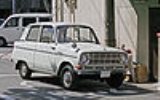
Mitsubishi Minica

Encyclopedia
Minica Sedan
The first Minica (LA20) was first introduced in October 1962 as a two-door sedan based on the Mitsubishi 360 light truck, sharing its front-mounted ME21Mitsubishi ME21/24 engine
The ME21/24 engine was Shin Mitsubishi Heavy-Industries' replacement for the 309 cc single-cylinder overhead valve ME20 engine...
359 cc twin-cylinder air-cooled engine
Air-cooled engine
Air-cooled engines rely on the circulation of air directly over hot parts of the engine to cool them.-Introduction:Most modern internal combustion engines are cooled by a closed circuit carrying liquid coolant through channels in the engine block and cylinder head, where the coolant absorbs heat,...
driving the rear wheels, transverse leaf spring
Leaf spring
Originally called laminated or carriage spring, a leaf spring is a simple form of spring, commonly used for the suspension in wheeled vehicles...
s in front and beam axle
Beam axle
A beam axle is a suspension system, also called a solid axle, in which one set of wheels is connected laterally by a single beam or shaft...
/leaf spring
Leaf spring
Originally called laminated or carriage spring, a leaf spring is a simple form of spring, commonly used for the suspension in wheeled vehicles...
s at the rear. Top speed was marginally higher at 86 km/h (53 mph). With its tailfins and scalloped rear windshield, the Minica looked even more anachronistic than its van/pickup counterparts. In November 1964 the Minica (and 360) received a fairly thorough facelift and the improved ME24
Mitsubishi ME21/24 engine
The ME21/24 engine was Shin Mitsubishi Heavy-Industries' replacement for the 309 cc single-cylinder overhead valve ME20 engine...
engine (LA21). Power output was up by one, to 18 PS, with the new "Auto Mix" system removing the need for premixing oil and gasoline.
In December 1966, along with a slightly different grille and new badging, a basic "Standard" Minica sedan was added, while the regular version was promoted to "Deluxe". Prices were ¥340,000 and ¥368,000 respectively.
In May 1967, the Minica was given another minor update, with a modified dashboard and a padded center to steering wheel. The engine was also upgraded, with the new reed valve ME24D
Mitsubishi ME21/24 engine
The ME21/24 engine was Shin Mitsubishi Heavy-Industries' replacement for the 309 cc single-cylinder overhead valve ME20 engine...
providing a useful 21 PS. In September of the following year, a Super Deluxe grade was added, using the new 23 PS water-cooled 2G10
Mitsubishi 2G1 engine
The Mitsubishi 2G1 engine is a water-cooled iron-block two-stroke twin-cylinder engine built by Mitsubishi Motors for the kei car class from 1968. They were first introduced in the first generation Minica to replace the otherwise similar but air-cooled ME24 powerplant...
engine developed for the next-generation Minica. This (the LA23) also featured a full vinyl interior and a new plastic grille (as on the Mitsubishi 360 van pictured above). With the July 1969 introduction of the second-generation Minica, the LA series was discontinued.
Second generation
The second-generation Minica 70 was introduced in July 1969 with coil springCoil spring
A Coil spring, also known as a helical spring, is a mechanical device, which is typically used to store energy and subsequently release it, to absorb shock, or to maintain a force between contacting surfaces...
s front and rear, a five-link rigid rear axle, and a three-door sedan body featuring the new "Wing-Flow Line" style. The new design was much more appealing to young buyers than the dated and corny looks of earlier Minicas, and the rear hatch was a Kei class first. Two 359 cc 2G10
Mitsubishi 2G1 engine
The Mitsubishi 2G1 engine is a water-cooled iron-block two-stroke twin-cylinder engine built by Mitsubishi Motors for the kei car class from 1968. They were first introduced in the first generation Minica to replace the otherwise similar but air-cooled ME24 powerplant...
water-cooled two-stroke powerplants were optionally available (A101), either the Red 28 PS engine (Super Deluxe, Sporty Deluxe) or the Gold engine fitted with twin SU carburetors developing 38 PS. The Gold engine, introduced in December 1969, was fitted as standard to the SS and GSS sport models. The basic Standard and Deluxe versions (A100) were still fitted with the old 26 PS ME24E
Mitsubishi ME21/24 engine
The ME21/24 engine was Shin Mitsubishi Heavy-Industries' replacement for the 309 cc single-cylinder overhead valve ME20 engine...
air-cooled engine Yellow engine, for a top speed of 105 kilometres per hour (65.2 mph). A two-door wagon body was also added in December and was to remain in production until its eventual replacement by the Minica Econo in 1981. In October 1970 the ME24F Yellow engine gained four horsepower for a total of 30 PS while the Red engine went up to 34 PS. The GSS version gained integrated foglights and four round headlight, while the SS was discontinued. A luxurious GL version was also introduced.
In February 1971 a very minor facelift meant the car was now called Minica 71. In addition to more aggressive, wider taillights and some trim changes, one could now get the water-cooled 2G10
Mitsubishi 2G1 engine
The Mitsubishi 2G1 engine is a water-cooled iron-block two-stroke twin-cylinder engine built by Mitsubishi Motors for the kei car class from 1968. They were first introduced in the first generation Minica to replace the otherwise similar but air-cooled ME24 powerplant...
engine in the lower priced Family Deluxe.
The Minica Skipper was introduced in May 1971 as a two-door coupé with liftable rear window, and a choice of Red or Gold 2G10
Mitsubishi 2G1 engine
The Mitsubishi 2G1 engine is a water-cooled iron-block two-stroke twin-cylinder engine built by Mitsubishi Motors for the kei car class from 1968. They were first introduced in the first generation Minica to replace the otherwise similar but air-cooled ME24 powerplant...
engines. The Skipper was available either as the S/L, L/L or GT. This also meant that the GSS sedan was becoming obsolete, as the focus of the sportier Minicas shifted to the coupé versions. Besides chassis and internals, the Skipper shared the front clip and lower doorpanels with the sedan. By September, with the introduction of the Minica 72, the sedan versions were no longer available with the Gold engine. Changes were limited to a new grille, taillights (incorporating amber turnsignals) and a new dash similar to that of the Skipper.
In October 1972 the 2nd-generation Minica received its last facelift, becoming the Minica 73 to soldier on for another year as a low-cost alternative to the new F4. Sold either as a Standard or a Deluxe, only the de-tuned 31 PS (2G10-5
Mitsubishi 2G1 engine
The Mitsubishi 2G1 engine is a water-cooled iron-block two-stroke twin-cylinder engine built by Mitsubishi Motors for the kei car class from 1968. They were first introduced in the first generation Minica to replace the otherwise similar but air-cooled ME24 powerplant...
) Red engine also used in the Van versions was now available, placing the "73" firmly at the bottom of the Minica lineup. There were no more air-cooled Minicas available. One year later, a Van Custom was added, with four headlights and more extensive equipment. In late 1974 or early 1975 the Van was updated to accept new larger license plates that were now required. The Van continued with the two-stroke 2G10-5 engine until being replaced by the bigger-engined Minica 5 Van in May 1976.
Also in October 1972 the renamed Skipper IV (A102) received the new four-stroke 2G21 engine from the Minica F4, with either 32 or 36 PS. A new F/L replaced the S/L in the lineup. Along with some safety improvements in October 1973 both engines were replaced by the 30 PS "Vulcan S" engine, as the Skipper IV lineup was further narrowed. The coupé continued in production until July (or perhaps December) 1974, but ever more strangled by emissions regulations its market had by then shrunk to almost nothing.
Third generation
The third-generation Minica was introduced as the Minica F4 (A103A) in October 1972 with a 359 cc OHC engine in the same layout, but featuring a liftable clam-shell rear window as on the coupé. The Skipper continued in production, as of October 1973 with the new engine (becoming the Minica Skipper IV). The new four-stroke Vulcan 2G21 MCA engine (Mitsubishi Clean Air) was much cleaner than, but not as smooth running as its two-stroke predecessors. The six single-carb-engined versions provided 32 PS while the twin-carb version listed for the GS and GSL models offered 36 PS.In late 1973, facing shrinking Kei-car sales, Mitsubishi narrowed the Minica F4 range down to four equipment levels (Hi-Standard, Deluxe, GL and SL), with the cheaper versions featuring a new grille. The sporty versions were discontinued, as the twin-carb engine fell foul of new emissions regulations. The modified Vulcan S engine came equipped with a balance shaft (later baptised "Silent Shaft") and was cleaner yet, hence the "MCA-II" tag. Power, however, was down to 30 PS. Top speed was 115 km/h (71 mph). In December of 1974, the lineup was again revamped, with the GL and SL becoming the Super Deluxe and Custom. Mitsubishi also lightly redesigned the Minica to accept the new, bigger license plates now required for Kei cars.
In May 1976, corresponding to revised kei car regulations of January 1976 (length up to 3.2 m, width to 1.4 m and engine size to 550 cc) both the sedan and the van received a new long-stroke 471 cc engine, a small increase in length (entirely due to new, larger bumpers), and a new name, the Minica 5. Both models were also lightly facelifted, featuring new grilles, while equipment levels remained the same. While power output of the new Vulcan 2G22 did not change for the sedan (A104A), the van (A104V) received a lower powered 28 PS version thereof. The Minica 5 was a mere interim model, anticipating the more thoroughly revised Minica Ami 55 which was soon to arrive.
Minica Ami
In June 1977 the car and engine grew once again, creating the Minica Ami 55. While the side body panels remained the same, length increased yet a little more (3175 mm) and the entire car was widened by 10 mm. The updated 546 cc Vulcan 2G23 engine provided 31 PS for the A105A. Its sibling, the Minica 55 Van (A105V) was updated in March 1977 and was almost impossible to distinguish from the previous Minica 5 Van, aside from badging and a slightly less plasticky front end. The bigger engine provided some useful additional torque, but the sporting Minicas of the early seventies were now but a memory. For the time being, the traditional (and unusual amongst Kei cars) Panhard layout remained.September of 1978 brought another engine upgrade: The new "Vulcan II" G23B featured the lean burn
Lean burn
Lean burn refers to the use of lean mixtures in an internal combustion engine. The air-fuel ratios can be as high as 65:1, so the mixture has considerably less fuel in comparison to the stoichiometric combustion ratio ....
MCA-Jet emissions control system with a hemispherical head
Hemi engine
A Hemi engine is an internal combustion engine in which the roof of each cylinder's combustion chambers is of hemispherical form.- History :...
, aluminium rocker arm
Rocker arm
Generally referred to within the internal combustion engine of automotive, marine, motorcycle and reciprocating aviation engines, the rocker arm is a reciprocating lever that conveys radial movement from the cam lobe into linear movement at the poppet valve to open it...
s and three valves per cylinder, but power outputs remained static. The model code became A106/106V.
In September 1981 the car received another redesign. An entire new rear end meant a slightly longer wheelbase (up to 2,050 mm) and a somewhat longer and taller body. The somewhat boxy rear end, still with a clamshell rear window, looked a bit incongruous paired with the original Minica F4 front wings and doors. The new Minica was renamed the Minica Ami L (A107A), but bigger news was that the Minica 55 Van, based on the 1969 A100V, was finally retired. The new A107V Minica Econo ("Econo" hinting at its primary use as a private economy car rather than as a commercial vehicle) looked very similar to the Ami L but featured a proper rear hatch and folding rear seat, allowing it to be registered as a light commercial vehicle like its competitors the Daihatsu Mira
Daihatsu Mira
The Daihatsu Mira , is a kei car-type vehicle built by the Japanese car maker Daihatsu. It comes with a variety of options and chassis variations, with the latest variant having four models: "Mira", "Mira AVY", "Mira Gino" and "Mira VAN"...
, Suzuki Alto
Suzuki Alto
The Suzuki Alto is a small car designed by Suzuki. Its selling points include low price and good fuel economy. The model was introduced in 1979 and has been built in many countries worldwide.-1st generation :...
and Subaru Rex
Subaru Rex
The Subaru Rex, also known as Ace, Viki, Sherpa, 500/600/700, Mini Jumbo or M60/M70/M80 in various export markets, is a kei class automobile produced from 1972 to 1992 mainly for sale in Japan by Subaru, although it was also sold in Europe, South America, and the Caribbean...
. Cargo capacity, compared to the more workmanlike Minica 55 Van, was reduced from 300 to 200 kg. A 2-speed, semi-automatic gearbox was also available on all models, while the standard four-speed manual received lower gearing for the Econo model. The engine was more quiet than before, featuring a milder cam profile. Power output of the G23B remained the same, although the Econo was stuck with a 29 PS version of the old 2G23 engine. Top speed of the Ami was 110 km/h (68 mph). In December 1981 a strict two-seater version of the Econo was added.
One year later, the Minica was sold with the new "MMC" logo rather than the old "three diamonds". In March 1983 the Minica Ami L Turbo became the first kei car to be offered with a turbocharger
Turbocharger
A turbocharger, or turbo , from the Greek "τύρβη" is a centrifugal compressor powered by a turbine that is driven by an engine's exhaust gases. Its benefit lies with the compressor increasing the mass of air entering the engine , thereby resulting in greater performance...
, offering 39 PS and glitzy graphics. This proved short-lived, as by January 1984 production of the A107 Minicas had ended, with Mitsubishi preparing for the release of an all new, front-wheel drive Minica.
Fourth generation
The fourth-generation Minica was introduced in February 1984 as a front engined, front wheel drive vehicle for the first time. It offered three- and five-door configurations, increased size and a torsion beam/coil springCoil spring
A Coil spring, also known as a helical spring, is a mechanical device, which is typically used to store energy and subsequently release it, to absorb shock, or to maintain a force between contacting surfaces...
rear suspension. It retained the G23B engine, but modernized with a timing belt
Timing belt
A timing belt, or cam belt , is a part of an internal combustion engine that controls the timing of the engine's valves. Some engines, such as the flat-4 Volkswagen air-cooled engine, and the straight-6 Toyota F engine use timing gears...
rather than the old noisy timing chain. The Minica sedan had 33 PS, the Econo 31 PS and the Turbo gained an intercooler and now offered 42 PS. Air conditioning finally became an option.
In September 1985 a four-wheel drive
Four-wheel drive
Four-wheel drive, 4WD, or 4×4 is a four-wheeled vehicle with a drivetrain that allows all four wheels to receive torque from the engine simultaneously...
model with a live rear axle
Live axle
A live axle, sometimes called a solid axle, is a type of beam axle suspension system that uses the driveshafts that transmit power to the wheels to connect the wheels laterally so that they move together as a unit....
was introduced. This generation was the first to reach export markets, usually labelled Mitsubishi Towny, originally with a two-cylinder 783 cc engine and a 4-speed manual transmission. Later (1987) it received a three-cylinder 796 cc engine with 45 PS and a 5-speed gearbox (also locally manufactured by CMC motors in Taiwan, only as a 5-door); a three-door panel van was also marketed abroad.
Fifth generation
In January 1989 the fifth-generation Minica was officially introduced, although the engine, wheelbase, and suspension remained unchanged. In addition to the three- and five-door models, a variant with a single door on the right side, two doors on the passenger side, and a liftgate was introduced, named the Mitsubishi Lettuce. An advanced new turbo engine with double overhead cams and the world's first mass-produced five-valve-per-cylinder engine was introduced for the Dangan ZZ model, producing 64 PS. It was later made available in naturally aspirated form as well, while the older design engine also was increased in displacement to 657 cc in March, 1990 when the kei car regulations were again updated. A three-door MPV model with optional four-wheel drive, the Minica ToppoMitsubishi Toppo
The Mitsubishi Toppo is a light recreational vehicle produced by Mitsubishi Motors from 1990 until 2004, derived from their Minica kei car. The name is a portmanteau of the English "top" and the Japanese "noppo" ....
, was introduced in 1990.
Sixth generation
In September, 1993, the sixth-generation three- and five-door Minica and Minica Toppo were introduced, with longer wheelbase. The five-valve-per-cylinder three-cylinder engines were replaced with a pair of 659 cc four-cylinder engines; one normally aspirated with single overhead cam and four valves per cylinder, and one turbocharged with double overhead cam and five valves per cylinder. A version of the Toppo with two doors on the passenger side, similar to the "Lettuce", was made available, along with a limited edition RV version. In January, 1997 versions of the Minica and Toppo with retroRetro
Retro is a culturally outdated or aged style, trend, mode, or fashion, from the overall postmodern past, that has since that time become functionally or superficially the norm once again. The use of "retro" style iconography and imagery interjected into post-modern art, advertising, mass media, etc...
-styled front ends were introduced as the "Town Bee" model, and exported to Taiwan
Taiwan
Taiwan , also known, especially in the past, as Formosa , is the largest island of the same-named island group of East Asia in the western Pacific Ocean and located off the southeastern coast of mainland China. The island forms over 99% of the current territory of the Republic of China following...
as the "Towny".
Seventh generation
The enlarged seventh-generation Minica was introduced in October, 1998 to take advantage of the new regulations, as a pair of three-door and five-door sedans with torsion beam rear suspension and optional four-wheel drive, with the only available engine the 657 cc three-cylinder overhead cam unit, now equipped with four valves per cylinder. A 5-door MPV built on this platform but with a four-cylinder double overhead cam five-valve-per-cylinder turbocharged engine, known as the "Mitsubishi Toppo BJ" was also introduced. In January, 1999 the retrostyled Town Bee version of this generation of Minica and the "Mitsubishi Toppo BJ Wide" were introduced. In October, 1999 a 659 cc four-cylinder single overhead cam four-valve-per-cylinder turbocharged engine was introduced, and in December, 1999 a limited edition of 50 "Mitsubishi PistachioMitsubishi Pistachio
The Mitsubishi Pistachio is a three-door sedan introduced by Mitsubishi Motors in December 1999, based on the platform of their Minica kei car. Only 50 Pistachios were sold in either Citron Yellow and Loire Green colour schemes, priced at ¥959,000, to local authorities and public corporations...
s" with a 1,094 cc double overhead cam four-valve-per-cylinder direct-injection engine was made available only to organizations working to protect the environment
Environment (biophysical)
The biophysical environment is the combined modeling of the physical environment and the biological life forms within the environment, and includes all variables, parameters as well as conditions and modes inside the Earth's biosphere. The biophysical environment can be divided into two categories:...
. In October, 2001 a five-door wagon version of the Minica was introduced as the Mitsubishi eK Wagon
Mitsubishi eK
The Mitsubishi eK is a Japanese kei car from Mitsubishi Motors, based on the long-running Mitsubishi Minica, and first introduced on October 11, 2001 at ¥910,000 to ¥1,108,000...
.