


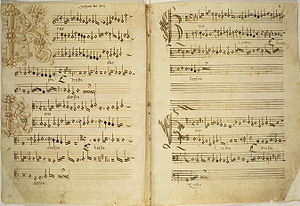
Missa de Beata Virgine

Encyclopedia
Ordinary of the Mass
The ordinary, in Roman Catholic and other Western Christian liturgies, refers to the part of the Eucharist or of the canonical hours that is reasonably constant without regard to the date on which the service is performed...
, by Renaissance
Renaissance music
Renaissance music is European music written during the Renaissance. Defining the beginning of the musical era is difficult, given that its defining characteristics were adopted only gradually; musicologists have placed its beginnings from as early as 1300 to as late as the 1470s.Literally meaning...
composer Josquin des Prez
Josquin Des Prez
Josquin des Prez [Josquin Lebloitte dit Desprez] , often referred to simply as Josquin, was a Franco-Flemish composer of the Renaissance...
. A late work, probably composed or assembled around 1510, it was the most popular of his masses in the 16th century.
The Missa de Beata Virgine is unusual among Josquin's masses in that the first two movements are for four voices, and the last three for five, with the fifth voice derived canonically
Canon (music)
In music, a canon is a contrapuntal composition that employs a melody with one or more imitations of the melody played after a given duration . The initial melody is called the leader , while the imitative melody, which is played in a different voice, is called the follower...
. Like most musical settings of the mass Ordinary, it is in five sections, or movements:
- KyrieKyrieKyrie, a transliteration of Greek κύριε , vocative case of κύριος , meaning "Lord", is the common name of an important prayer of Christian liturgy, which is also called the Kýrie, eléison ....
- GloriaGloria in Excelsis Deo"Gloria in excelsis Deo" is the title and beginning of a hymn known also as the Greater Doxology and the Angelic Hymn. The name is often abbreviated to Gloria in Excelsis or simply Gloria.It is an example of the psalmi idiotici "Gloria in excelsis Deo" (Latin for "Glory to God in the highest")...
- CredoCredoA credo |Latin]] for "I Believe") is a statement of belief, commonly used for religious belief, such as the Apostles' Creed. The term especially refers to the use of the Nicene-Constantinopolitan Creed in the Mass, either as text, Gregorian chant, or other musical settings of the...
- SanctusSanctusThe Sanctus is a hymn from Christian liturgy, forming part of the Order of Mass. In Western Christianity, the Sanctus is sung as the final words of the Preface of the Eucharistic Prayer, the prayer of consecration of the bread and wine...
- Agnus Dei
It uses different plainsong
Plainsong
Plainsong is a body of chants used in the liturgies of the Catholic Church. Though the Eastern Orthodox churches and the Catholic Church did not split until long after the origin of plainchant, Byzantine chants are generally not classified as plainsong.Plainsong is monophonic, consisting of a...
chants
Gregorian chant
Gregorian chant is the central tradition of Western plainchant, a form of monophonic liturgical music within Western Christianity that accompanied the celebration of Mass and other ritual services...
for each movement, and is a paraphrase mass
Paraphrase mass
A paraphrase mass is a musical setting of the Ordinary of the Mass, using as its basis an elaborated version of a cantus firmus, typically chosen from plainsong or some other sacred source...
, one in which the original chants are elaborated, broken up, passed between voices, or sung in different voices simultaneously. The mass is one of only four that Josquin based on plainsong, and probably the second to last (the others are the Missa Gaudeamus, a relatively early work, the Missa Ave maris stella, and the Missa Pange lingua
Missa Pange lingua
The Missa Pange lingua is a musical setting of the Ordinary of the Mass by Franco-Flemish composer Josquin des Prez, probably dating from around 1515, near the end of his life...
; all of them involve, in some way, glorification of the Virgin Mary). All of the chants in the Missa de Beata Virgine are in praise of the Virgin Mary, and the whole is a Lady Mass, the Votive Mass
Votive Mass
In the liturgy of the Roman Catholic Church, a votive Mass is a Mass offered for a votum, a special intention.The Mass does not correspond to the Divine Office for the day on which it is celebrated...
for Saturday, a type that was popular around 1500. Since music for two of the movements – the Gloria and Credo – appeared independently in Vatican sources, circulating in 1503 or before, it has been presumed that the mass was assembled later from several parts, and most likely the five-voice portions were composed around 1510. The first appearance of the whole mass was in Ottaviano Petrucci
Ottaviano Petrucci
Ottaviano Petrucci was an Italian printer. His Harmonice Musices Odhecaton, a collection of chansons printed in 1501, is commonly misidentified as the first book of sheet music printed from movable type. Actually that distinction belongs to the Roman printer Ulrich Han's Missale Romanum of 1476...
's 1514 book of Josquin's masses, his third such set; it has even been speculated that Petrucci himself may have put it together from an existing performance tradition. Most likely Josquin took the Gloria and Credo which he had already written, and then wrote a Kyrie to conform to the Gloria, and added a Sanctus and Agnus to go with the Credo, since the work's modal
Musical mode
In the theory of Western music since the ninth century, mode generally refers to a type of scale. This usage, still the most common in recent years, reflects a tradition dating to the middle ages, itself inspired by the theory of ancient Greek music.The word encompasses several additional...
coherence suggests that he conceived at least the first two movements, and then the last three movements together.
The Missa de Beata Virgine was one of Josquin's last three masses, with the others being the Missa Sine nomine
Missa Sine nomine (Josquin)
The Missa Sine nomine is a setting of the Ordinary of the Mass by Renaissance composer Josquin des Prez. It is a work of his maturity, probably dating from the period after he returned to Condé-sur-l'Escaut in 1504...
and the Missa Pange lingua
Missa Pange lingua
The Missa Pange lingua is a musical setting of the Ordinary of the Mass by Franco-Flemish composer Josquin des Prez, probably dating from around 1515, near the end of his life...
. It was probably the earliest of the three, and Missa Pange lingua the last. Distinguishing the last masses, and his late style period in general, was a general simplification and refinement: Josquin left behind the elaborate contrapuntal
Counterpoint
In music, counterpoint is the relationship between two or more voices that are independent in contour and rhythm and are harmonically interdependent . It has been most commonly identified in classical music, developing strongly during the Renaissance and in much of the common practice period,...
artifice evident in the masses of the preceding period, such as the two he wrote on the L'homme armé
Missa L'homme armé
Over 40 settings of the Ordinary of the Mass using the tune L'homme armé survive from the period between 1450 and the end of the 17th century, making the tune the most popular single source from the period on which to base an imitation mass....
tune, and wrote music in which bringing out the meaning of the text, and having it understood, was more important than any virtuoso display.
The movements differ in their treatment of the source plainchant. The Kyrie has the chant in all voices, imitatively and paraphrased; the Gloria treats the chant as a cantus firmus, migrating it from voice to voice. Tonally, both movements end on G, and most of their cadences are on G or D. The Credo, the first movement for five voices, ends with a surprising Phrygian
Phrygian mode
The Phrygian mode can refer to three different musical modes: the ancient Greek tonos or harmonia sometimes called Phrygian, formed on a particular set octave species or scales; the Medieval Phrygian mode, and the modern conception of the Phrygian mode as a diatonic scale, based on the latter...
cadence on E, and uses canonic techniques more prominently than in the preceding movements. The overall sound is darker and reminiscent of Johannes Ockeghem
Johannes Ockeghem
Johannes Ockeghem was the most famous composer of the Franco-Flemish School in the last half of the 15th century, and is often considered the most...
. The Sanctus is unusual among Josquin's mass movements, for the five voices sing throughout without a break: normally Josquin breaks up the texture with passages in reduced scoring. Yet the texture is light, with the voices singing polyphonically only some of the time. In the closing Agnus, the chant is treated freely, and the texture is similar to that which Josquin used in his chansons. Both the Agnus and Sanctus cadence on C.
The popularity of this mass in the 16th century may be due to its "sensuously appealing" surface texture, one which foreshadows the music of later composers such as Cristóbal Morales and Nicolas Gombert
Nicolas Gombert
Nicolas Gombert was a Franco-Flemish composer of the Renaissance. He was one of the most famous and influential composers between Josquin des Prez and Palestrina, and best represents the fully developed, complex polyphonic style of this period in music history.-Life:Details of his early life are...
.