

Metrosideros robusta

Encyclopedia
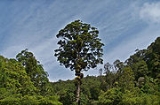
Northern rātā is a huge forest tree endemic to New Zealand
. It grows up to 25 m or taller, and usually begins its life as a hemiepiphyte
high in the branches of a mature forest tree; over centuries the young tree sends descending and girdling roots down and around the trunk of its host, eventually forming a massive, frequently hollow pseudotrunk composed of fused roots. In disturbed ground, or where there are gaps in the forest cover, Northern rātā will grow on the ground with a normal but short trunk.
 Northern rātā is found in the North Island
from Te Paki in the north to Wellington
in the south. Formerly widespread, it is now uncommon over large parts of its former range, and is no longer found in Hawkes Bay. In the South Island
, Northern rātā is common from Nelson
to Greymouth
and Hokitika. It reaches its southern limit near Lake Mahinapua
at 42°4′ South latitude. The natural habitat is forest along the coasts and in the lowlands. In some parts of its range Northern rātā occurs in montane forest. Formerly, with rimu (Dacrydium cupressinum
) it was a dominant tree in a forest type known as rimu/rātā forest.
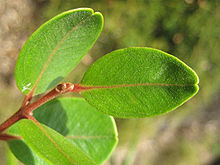
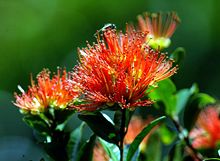 Northern rātā is a massive tree, easily distinguished from other Metrosideros species by its small, leathery, dark green leaves which are 25-50mm long by 15-25mm wide, and have a distinct notch at the tip. Young growth is generally pink and covered in fine rust-coloured hairs that are gradually shed as the foliage ages but tends to persist at the midrib and in the vicinity of the leaf base. The flowers, borne in sprays on the tips of branches, are a mass of dark scarlet stamens. Flowering peaks between November and January, and seeds take a year or slightly more to ripen. The bark is usually brown or grey-brown and rather corky and provides an ideal stratum for the roots of epiphytic plants such as Astelia
species and Freycinetia banksii (kiekie). The wood is reddish brown, and the manner of its growth results in a twisted grain.
. Northern rātā usually occurs in hardwood, podocarp, and southern beech
forests. It is often associated with such species as rewarewa, tawa, hīnau
, kānuka, kahikatea
, kāmahi
, kohekohe, pukatea
and māhoe
.
. Hybridisation with pōhutukawa
is another threat to the survival of Northern rātā. Pōhutukawa has naturalised in areas south of its natural range, and poses a problem in localities where the Northern or Southern rātā
species are present. Other threats include cutting for firewood, and forest clearance for roading or construction.
New Zealand
New Zealand is an island country in the south-western Pacific Ocean comprising two main landmasses and numerous smaller islands. The country is situated some east of Australia across the Tasman Sea, and roughly south of the Pacific island nations of New Caledonia, Fiji, and Tonga...
. It grows up to 25 m or taller, and usually begins its life as a hemiepiphyte
Hemiepiphyte
A hemiepiphyte is a plant which begins its life as an epiphyte but which later grows roots down into the ground. The seeds of hemiepiphytes germinate in the canopy and initially live epiphytically...
high in the branches of a mature forest tree; over centuries the young tree sends descending and girdling roots down and around the trunk of its host, eventually forming a massive, frequently hollow pseudotrunk composed of fused roots. In disturbed ground, or where there are gaps in the forest cover, Northern rātā will grow on the ground with a normal but short trunk.
Distribution
North Island
The North Island is one of the two main islands of New Zealand, separated from the much less populous South Island by Cook Strait. The island is in area, making it the world's 14th-largest island...
from Te Paki in the north to Wellington
Wellington
Wellington is the capital city and third most populous urban area of New Zealand, although it is likely to have surpassed Christchurch due to the exodus following the Canterbury Earthquake. It is at the southwestern tip of the North Island, between Cook Strait and the Rimutaka Range...
in the south. Formerly widespread, it is now uncommon over large parts of its former range, and is no longer found in Hawkes Bay. In the South Island
South Island
The South Island is the larger of the two major islands of New Zealand, the other being the more populous North Island. It is bordered to the north by Cook Strait, to the west by the Tasman Sea, to the south and east by the Pacific Ocean...
, Northern rātā is common from Nelson
Nelson, New Zealand
Nelson is a city on the eastern shores of Tasman Bay, and is the economic and cultural centre of the Nelson-Tasman region. Established in 1841, it is the second oldest settled city in New Zealand and the oldest in the South Island....
to Greymouth
Greymouth
Greymouth is the largest town in the West Coast region in the South Island of New Zealand, and the seat of the Grey District Council. The population of the whole Grey District is , which accounts for % of the West Coast's inhabitants...
and Hokitika. It reaches its southern limit near Lake Mahinapua
Lake Mahinapua
Lake Mahinapua is a shallow lake on the West Coast of New Zealand's South Island. It is roughly 10km south of Hokitika and near the small town of Ruatapu...
at 42°4′ South latitude. The natural habitat is forest along the coasts and in the lowlands. In some parts of its range Northern rātā occurs in montane forest. Formerly, with rimu (Dacrydium cupressinum
Dacrydium cupressinum
Dacrydium cupressinum, commonly known as rimu, is a large evergreen coniferous tree endemic to the forests of New Zealand. It is a member of the southern conifer group, the podocarps. The former name "red pine" has fallen out of common use....
) it was a dominant tree in a forest type known as rimu/rātā forest.
Description
Astelia
Astelia is a genus of rhizomatous tufted perennials in the family Asteliaceae which are native to the Pacific region as well as the Falkland Islands, Réunion and Mauritius...
species and Freycinetia banksii (kiekie). The wood is reddish brown, and the manner of its growth results in a twisted grain.
Hemi-epiphytic growth habit
Northern rātā often begins life as hemi-epiphyte, and the resultant tree has a hollow trunk up to 4 m in diameter made up of interlocking roots which enclose the space left by the former host tree. In former times, the tree was described as a 'strangler', however it may be that rātā can only establish in trees that are already in decline. The host tree of epiphytic Northern rātā is usually rimuDacrydium cupressinum
Dacrydium cupressinum, commonly known as rimu, is a large evergreen coniferous tree endemic to the forests of New Zealand. It is a member of the southern conifer group, the podocarps. The former name "red pine" has fallen out of common use....
. Northern rātā usually occurs in hardwood, podocarp, and southern beech
Nothofagus
Nothofagus, also known as the southern beeches, is a genus of 35 species of trees and shrubs native to the temperate oceanic to tropical Southern Hemisphere in southern South America and Australasia...
forests. It is often associated with such species as rewarewa, tawa, hīnau
Elaeocarpus dentatus
Elaeocarpus dentatus, commonly known as the Hinau, is a species of flowering plant in the Elaeocarpaceae family, bearing bitter edible fruit found in New Zealand.It was first collected on 5 November 1769....
, kānuka, kahikatea
Dacrycarpus dacrydioides
Dacrycarpus dacrydioides or kahikatea is a coniferous tree endemic to New Zealand.The tree grows to a height of with a trunk exceeding in diameter, and is buttressed at the base. It is dominant in lowland forest and wetlands throughout the North and South Islands...
, kāmahi
Weinmannia racemosa
Weinmannia racemosa, Kāmahi, a medium-sized tree of the family Cunoniaceae, is a very common tree in New Zealand, occurring in lowland, montane, and subalpine forests and shrubland from the central North Island south to Stewart Island....
, kohekohe, pukatea
Laurelia novae-zelandiae
Laurelia novae-zelandiae, also called Pukatea, is a large laurifolia evergreen tree, endemic to the forests of New Zealand . with so-called 'toothed' leaves and producing small flowers...
and māhoe
Melicytus ramiflorus
Melicytus ramiflorus is a small tree of the family Violaceae endemic to New Zealand.It grows up to 10 metres high with a trunk up to 60 cm in diameter, it has smooth, whitish bark and brittle twigs...
.
Conservation
The greatest threat to Northern rata is browsing by possums (Trichosurus vulpecula) which cause severe damage by eating the leaves, buds, flowers and young shoots of the tree. In severe cases this can lead to the death of the tree within two years. In some districts, this has resulted in the local loss of the species. The situation of the species has been improved through the efforts of Project CrimsonProject Crimson
Project Crimson is a conservation initiative to promote the protection of the pohutukawa and the rata which are under threat due to browsing by the introduced Common Brushtail Possum...
. Hybridisation with pōhutukawa
Pohutukawa
The Pōhutukawa is a coastal evergreen tree in the myrtle family, Myrtaceae, that produces a brilliant display of red flowers made up of a mass of stamens. The Pōhutukawa is one of twelve Metrosideros species endemic to New Zealand...
is another threat to the survival of Northern rātā. Pōhutukawa has naturalised in areas south of its natural range, and poses a problem in localities where the Northern or Southern rātā
Metrosideros umbellata
Southern rātā , is a tree endemic to New Zealand. It grows up to 15 m. or more tall with a trunk up to 1 m. or more in diameter. It produces masses of red flowers in summer...
species are present. Other threats include cutting for firewood, and forest clearance for roading or construction.
Cultivation
Northern rātā may be propagated readily from fresh seed. Viability of the seed drops quickly after a few weeks or if it is allowed to dry out. Cuttings do not strike readily, although better results are obtained from using water shoots.See also
- Southern rātāMetrosideros umbellataSouthern rātā , is a tree endemic to New Zealand. It grows up to 15 m. or more tall with a trunk up to 1 m. or more in diameter. It produces masses of red flowers in summer...
- Pōhutukawa
- Bartlett's rātāMetrosideros bartlettiiBartlett's rātā , or the Cape Reinga white rātā, is one of twelve Metrosideros species endemic to New Zealand and is notable for its extreme rarity and its white flowers, somewhat uncommon in that genus of red-flowered trees and plants...
- Scarlet rātā vineMetrosideros fulgensMetrosideros fulgens is a forest liane or vine endemic to New Zealand. It occurs in coastal and lowland forest throughout the North Island and on the west coast of the South Island...