

Metrosideros umbellata

Encyclopedia
Southern rātā is a tree endemic to New Zealand
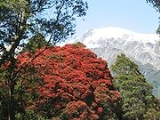
. It grows up to 15 m. or more tall with a trunk up to 1 m. or more in diameter. It produces masses of red flowers in summer. Unlike its relative, Northern rātā
, this species rarely grows as an epiphyte
.
 It prefers cooler regions with high rainfall and is particularly common along the west coast of the South Island
where its nectar is the main source of a locally-produced rātā honey. Southern rātā is the most widespread of the New Zealand tree rātā species. It is locally present in the North Island
from lat. 36° southwards, is more common in western parts of the South Island
but absent from much of the east, and is common on Stewart Island (47ºS) and in the Auckland Islands
where it reaches its southern limit at just over 50°S.
species and Freycinetia banksii (Kiekie). Southern rātā is a major source of honey on the West Coast of the South Island. Kākā
, tui
, and bellbird
s visit rātā to take advantage of the abundant nectar.
Project Crimson
is a charitable trust that promotes conservation of rata as well as the related pohutukawa
.
New Zealand
New Zealand is an island country in the south-western Pacific Ocean comprising two main landmasses and numerous smaller islands. The country is situated some east of Australia across the Tasman Sea, and roughly south of the Pacific island nations of New Caledonia, Fiji, and Tonga...
. It grows up to 15 m. or more tall with a trunk up to 1 m. or more in diameter. It produces masses of red flowers in summer. Unlike its relative, Northern rātā
Metrosideros robusta
Northern rātā , is a huge forest tree endemic to New Zealand. It grows up to 25 m or taller, and usually begins its life as a hemiepiphyte high in the branches of a mature forest tree; over centuries the young tree sends descending and girdling roots down and around the trunk of its host,...
, this species rarely grows as an epiphyte
Epiphyte
An epiphyte is a plant that grows upon another plant non-parasitically or sometimes upon some other object , derives its moisture and nutrients from the air and rain and sometimes from debris accumulating around it, and is found in the temperate zone and in the...
.
Distribution
South Island
The South Island is the larger of the two major islands of New Zealand, the other being the more populous North Island. It is bordered to the north by Cook Strait, to the west by the Tasman Sea, to the south and east by the Pacific Ocean...
where its nectar is the main source of a locally-produced rātā honey. Southern rātā is the most widespread of the New Zealand tree rātā species. It is locally present in the North Island
North Island
The North Island is one of the two main islands of New Zealand, separated from the much less populous South Island by Cook Strait. The island is in area, making it the world's 14th-largest island...
from lat. 36° southwards, is more common in western parts of the South Island
South Island
The South Island is the larger of the two major islands of New Zealand, the other being the more populous North Island. It is bordered to the north by Cook Strait, to the west by the Tasman Sea, to the south and east by the Pacific Ocean...
but absent from much of the east, and is common on Stewart Island (47ºS) and in the Auckland Islands
Auckland Islands
The Auckland Islands are an archipelago of the New Zealand Sub-Antarctic Islands and include Auckland Island, Adams Island, Enderby Island, Disappointment Island, Ewing Island, Rose Island, Dundas Island and Green Island, with a combined area of...
where it reaches its southern limit at just over 50°S.
Description
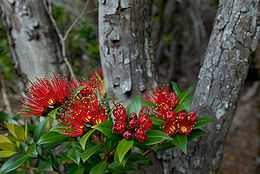
The flowers of Southern rātā are scarlet, with stamens about 2 cm long. White or yellow flowers are also known. Flowering usually occurs between December and February, but this depends on local conditions. Leaves are from 3 to 6 cm long, and are sharply pointed. The wood is hard, dense, and very strong. The bark is rough and flaky and provides an ideal stratum for the roots of epiphytic plants such as AsteliaAstelia
Astelia is a genus of rhizomatous tufted perennials in the family Asteliaceae which are native to the Pacific region as well as the Falkland Islands, Réunion and Mauritius...
species and Freycinetia banksii (Kiekie). Southern rātā is a major source of honey on the West Coast of the South Island. Kākā
Kaka
The New Zealand Kaka, also known as Kākā, is a New Zealand parrot endemic to the native forests of New Zealand.-Description:...
, tui
Tui (bird)
The tui is an endemic passerine bird of New Zealand. It is one of the largest members of the diverse honeyeater family....
, and bellbird
New Zealand Bellbird
The New Zealand Bellbird , also known by its Māori names Korimako or Makomako, is a passerine bird endemic to New Zealand. It has greenish colouration and is the only living member of the genus Anthornis. The bellbird forms a significant component of the famed New Zealand dawn chorus of bird song...
s visit rātā to take advantage of the abundant nectar.
Conservation
Although Southern rātā is not regarded as threatened, it is rather uncommon in the North Island, and in certain areas it is threatened by possum browse. In the Tararua range, Southern rātā populations appear to have been replaced by a population consisting of hybrids between Northern and Southern rātā.Project Crimson
Project Crimson
Project Crimson is a conservation initiative to promote the protection of the pohutukawa and the rata which are under threat due to browsing by the introduced Common Brushtail Possum...
is a charitable trust that promotes conservation of rata as well as the related pohutukawa
Pohutukawa
The Pōhutukawa is a coastal evergreen tree in the myrtle family, Myrtaceae, that produces a brilliant display of red flowers made up of a mass of stamens. The Pōhutukawa is one of twelve Metrosideros species endemic to New Zealand...
.
Cultivation
Southern rātā is a beautiful specimen tree, but growth can be slow unless it is grown in ideal conditions with moist soil. It is easily grown from fresh seed. While it is possible to grow the tree from softwood or semi-hardwood cuttings, these often prove reluctant to strike roots. It is ideal for coastal environments because it has a good resistance to wind and salt.See also
- Northern rātāMetrosideros robustaNorthern rātā , is a huge forest tree endemic to New Zealand. It grows up to 25 m or taller, and usually begins its life as a hemiepiphyte high in the branches of a mature forest tree; over centuries the young tree sends descending and girdling roots down and around the trunk of its host,...
- Bartlett's rātāMetrosideros bartlettiiBartlett's rātā , or the Cape Reinga white rātā, is one of twelve Metrosideros species endemic to New Zealand and is notable for its extreme rarity and its white flowers, somewhat uncommon in that genus of red-flowered trees and plants...
- Pōhutukawa
- Scarlet rātā vineMetrosideros fulgensMetrosideros fulgens is a forest liane or vine endemic to New Zealand. It occurs in coastal and lowland forest throughout the North Island and on the west coast of the South Island...
Further reading
- Salmon, J.T., 1986. The Native Trees of New Zealand. Wellington: Heinneman Reed.
- Simpson, P., 2005. Pōhutukawa & Rātā: New Zealand's Iron-Hearted Trees. Wellington: Te Papa Press.