

Metal spinning

Encyclopedia
Metalworking
Metalworking is the process of working with metals to create individual parts, assemblies, or large scale structures. The term covers a wide range of work from large ships and bridges to precise engine parts and delicate jewelry. It therefore includes a correspondingly wide range of skills,...
process by which a disc or tube of metal is rotated at high speed and formed into an axially symmetric
Axial symmetry
Axial symmetry is symmetry around an axis; an object is axially symmetric if its appearance is unchanged if rotated around an axis . For example, a baseball bat or a tea saucer looks the same if it is rotated by any angle about the line passing lengthwise through its center, so it is axially...
part. Spinning can be performed by hand or by a CNC lathe.
Metal spinning ranges from an artisan's specialty to the most advantageous way to form round metal parts for commercial applications. Artisans use the process to produce architectural detail, specialty lighting, decorative household goods and urn
Urn
An urn is a vase, ordinarily covered, that usually has a narrowed neck above a footed pedestal. "Knife urns" placed on pedestals flanking a dining-room sideboard were an English innovation for high-style dining rooms of the late 1760s...
s. Commercial applications include rocket
Rocket
A rocket is a missile, spacecraft, aircraft or other vehicle which obtains thrust from a rocket engine. In all rockets, the exhaust is formed entirely from propellants carried within the rocket before use. Rocket engines work by action and reaction...
nose cone
Nose cone
The term nose cone is used to refer to the forwardmost section of a rocket, guided missile or aircraft. The cone is shaped to offer minimum aerodynamic resistance...
s, cookware, gas cylinder
Gas cylinder
A gas cylinder is a pressure vessel used to store gases at above atmospheric pressure. High pressure gas cylinders are also called bottles. Although they are sometimes colloquially called "tanks", this is technically incorrect, as a tank is a vessel used to store liquids at ambient pressure and...
s, brass instrument
Brass instrument
A brass instrument is a musical instrument whose sound is produced by sympathetic vibration of air in a tubular resonator in sympathy with the vibration of the player's lips...
bells, and public waste receptacles. Virtually any ductile metal may be formed, from aluminum or stainless steel
Stainless steel
In metallurgy, stainless steel, also known as inox steel or inox from French "inoxydable", is defined as a steel alloy with a minimum of 10.5 or 11% chromium content by mass....
, to high-strength, high-temperature alloys. The diameter and depth of formed parts are limited only by the size of the equipment available.
Process
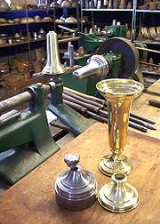
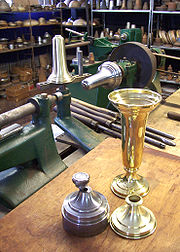
The spinning process is fairly simple. A formed block is mounted in the drive section of a lathe. A pre-sized metal disk is then clamped against the block by a pressure pad, which is attached to the tailstockTailstock
thumb|Tailstock used for drillingA tailstock, also known as a foot stock, is a device often used as part of an engineering lathe, wood-turning lathe, or used in conjunction with a rotary table on a milling machine....
. The block and workpiece are then rotated together at high speeds. A localized force is then applied to the workpiece to cause it to flow over the block. The force is usually applied via various levered tools. Simple workpieces are just removed from the block, but more complex shapes may require a multi-piece block. Extremely complex shapes can be spun over ice forms, which then melt away after spinning. Because the final diameter of the workpiece is always less than the starting diameter the workpiece must thicken, elongated radially, or buckle circumferentially.
A more involved process, known as reducing or necking, allows a spun workpiece to include reentrant geometries. If surface finish and form are not critical, then the workpiece is "spun on air"; no mandrel is used. If the finish or form are critical then an eccentrically mounted mandrel is used.
"Hot Spinning". This process involves spinning a piece of metal on a lathe and with high heat from a torch the metal is heated. Once heated, the metal is then shaped as the tool on the lathe presses against the heated surface forcing it to distort as it spins. Parts can then be shaped or necked down to a smaller diameter with little force exerted, providing a seamless shoulder.
Tools
The basic hand metal spinning tool is called a spoon, though many other tools (be they commercially produced, ad hoc, or improvised) can be used to effect varied results. Spinning tools can be made of hardened steel for using with aluminium or solid brass for spinning stainless steel or mild steel.Some metal spinning tools are allowed to spin on bearings during the forming process. This reduces friction and heating of the tool, extending tool life and improving surface finish. Rotating tools may also be coated with thin film
Thin film
A thin film is a layer of material ranging from fractions of a nanometer to several micrometers in thickness. Electronic semiconductor devices and optical coatings are the main applications benefiting from thin film construction....
of ceramic
Ceramic
A ceramic is an inorganic, nonmetallic solid prepared by the action of heat and subsequent cooling. Ceramic materials may have a crystalline or partly crystalline structure, or may be amorphous...
to prolong tool life. Rotating tools are commonly used during CNC metal spinning operations.
Commercially, rollers mounted on the end of levers are generally used to form the material down to the mandrel in both hand spinning and CNC metal spinning. Rollers vary in diameter and thickness depending the intended use. The wider the roller the smoother the surface of the spinning; the thinner rollers can be used to form smaller radii.
Cutting of the metal is done by hand held cutters, often foot long hollow bars with tool steel shaped/sharpened files attached. In CNC applications, carbide or tool steel cut-off tools are used.
The mandrel does not incur excessive forces, as found in other metalworking processes, so it can be made from wood, plastic, or ice. For hard materials or high volume use, the mandrel is usually made of metal.
Advantages & disadvantages
Several operations can be performed in one set-up. Work pieces may have re-entrant profiles and the profile in relation to the center line virtually unrestricted.Forming parameters and part geometry can be altered quickly, at less cost than other metal forming techniques. Tooling and production costs are also comparatively low. Spin forming, often done by hand, is easily automated and an effective production method for prototypes as well as high quantity production runs.
Other methods of forming round metal parts include hydroforming, stamping and forging
Forging
Forging is a manufacturing process involving the shaping of metal using localized compressive forces. Forging is often classified according to the temperature at which it is performed: '"cold," "warm," or "hot" forging. Forged parts can range in weight from less than a kilogram to 580 metric tons...
or casting. Hydroforming
Hydroforming
Hydroforming is a cost-effective way of shaping malleable metals such as aluminum or brass into lightweight, structurally stiff and strong pieces. One of the largest applications of hydroforming is the automotive industry, which makes use of the complex shapes possible by hydroforming to produce...
and stamping
Stamping (metalworking)
Stamping includes a variety of sheet-metal forming manufacturing processes, such as punching using a machine press or stamping press, blanking, embossing, bending, flanging, and coining. This could be a single stage operation where every stroke of the press produce the desired form on the sheet...
generally have a higher fixed cost, but a lower variable cost than metal spinning. Forging or casting have a higher fixed cost due to the large equipment needed, but generally a lower variable cost. As machinery for commercial applications has improved, parts are being spun with thicker materials in excess of 1" thick steel. Conventional spinning also wastes a considerably smaller amount of material than other methods.
Objects can be built using one piece of material to produce parts without seams. Without seams, a part can withstand higher internal or external pressure exerted on it. For example: scuba tanks and CO2 cartridges.
One disadvantage of metal spinning is that if a crack forms or the object is dented, it must be scrapped. Repairing the object is not cost-effective.