
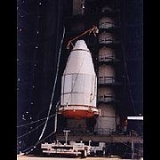
The term
nose cone is used to refer to the forwardmost section of a
rocketA rocket is a missile, spacecraft, aircraft or other vehicle which obtains thrust from a rocket engine. In all rockets, the exhaust is formed entirely from propellants carried within the rocket before use. Rocket engines work by action and reaction...
, guided
missileThough a missile may be any thrown or launched object, it colloquially almost always refers to a self-propelled guided weapon system.-Etymology:The word missile comes from the Latin verb mittere, meaning "to send"...
or
aircraftAn aircraft is a vehicle that is able to fly by gaining support from the air, or, in general, the atmosphere of a planet. An aircraft counters the force of gravity by using either static lift or by using the dynamic lift of an airfoil, or in a few cases the downward thrust from jet engines.Although...
. The cone is shaped to offer minimum
aerodynamicAerodynamics is a branch of dynamics concerned with studying the motion of air, particularly when it interacts with a moving object. Aerodynamics is a subfield of fluid dynamics and gas dynamics, with much theory shared between them. Aerodynamics is often used synonymously with gas dynamics, with...
resistance. Nose cones are also designed for travel in and under water and in high speed land vehicles.
Rocket
On a rocket vehicle it consists of a chamber or chambers in which a satellite, instruments, animals, plants, or auxiliary equipment may be carried, and an outer surface built to withstand high temperatures generated by
aerodynamic heatingAerodynamic heating is the heating of a solid body produced by the passage of fluid over a body such as a meteor, missile, or airplane. It is a form of forced convection in that the flow field is created by forces beyond those associated with the thermal processes...
. Much of the fundamental research related to
hypersonicIn aerodynamics, a hypersonic speed is one that is highly supersonic. Since the 1970s, the term has generally been assumed to refer to speeds of Mach 5 and above...
flight was done towards creating viable nose cone designs for the
atmospheric reentryAtmospheric entry is the movement of human-made or natural objects as they enter the atmosphere of a celestial body from outer space—in the case of Earth from an altitude above the Kármán Line,...
of spacecraft and
ICBMAn intercontinental ballistic missile is a ballistic missile with a long range typically designed for nuclear weapons delivery...
reentry vehiclesA multiple independently targetable reentry vehicle warhead is a collection of nuclear weapons carried on a single intercontinental ballistic missile or a submarine-launched ballistic missile . Using a MIRV warhead, a single launched missile can strike several targets, or fewer targets redundantly...
.
In a
satelliteIn the context of spaceflight, a satellite is an object which has been placed into orbit by human endeavour. Such objects are sometimes called artificial satellites to distinguish them from natural satellites such as the Moon....
vehicle, the nose cone may become the satellite itself after separating from the final
stageA multistage rocket is a rocket that usestwo or more stages, each of which contains its own engines and propellant. A tandem or serial stage is mounted on top of another stage; a parallel stage is attached alongside another stage. The result is effectively two or more rockets stacked on top of or...
of the rocket or it may be used to shield the satellite until orbital speed is accomplished, then separating from the satellite.
Aircraft
On airliners the nose cone is also a
radomeA radome is a structural, weatherproof enclosure that protects a microwave or radar antenna. The radome is constructed of material that minimally attenuates the electromagnetic signal transmitted or received by the antenna. In other words, the radome is transparent to radar or radio waves...
protecting the
weather radarWeather radar, also called weather surveillance radar and Doppler weather radar, is a type of radar used to locate precipitation, calculate its motion, estimate its type . Modern weather radars are mostly pulse-Doppler radars, capable of detecting the motion of rain droplets in addition to the...
from aerodynamic forces.
The shape of the nose cone must be chosen for minimum drag so a
solid of revolutionIn mathematics, engineering, and manufacturing, a solid of revolution is a solid figure obtained by rotating a plane curve around some straight line that lies on the same plane....
is used that gives least resistance to motion. The article on
nose cone designGiven the problem of the aerodynamic design of the nose cone section of any vehicle or body meant to travel through a compressible fluid medium , an important problem is the determination of the nose cone geometrical shape for optimum performance...
contains possible shapes and formulas.
Hypersonic
Due to the extreme temperatures involved, nose cones for high-speed applications (eg. hypersonic speeds or atmospheric reentry of
orbitIn physics, an orbit is the gravitationally curved path of an object around a point in space, for example the orbit of a planet around the center of a star system, such as the Solar System...
al vehicles) have to be made of
refractoryA refractory material is one that retains its strength at high temperatures. ASTM C71 defines refractories as "non-metallic materials having those chemical and physical properties that make them applicable for structures, or as components of systems, that are exposed to environments above...
materials.
Pyrolytic carbonPyrolytic carbon is a material similar to graphite, but with some covalent bonding between its graphene sheets as a result of imperfections in its production....
is one choice,
reinforced carbon-carbonCarbon fibre-reinforced carbon is a composite material consisting of carbon fibre reinforcement in a matrix of graphite. It was developed for the nose cones of intercontinental ballistic missiles, and is most widely known as the material for the nose cone and wing leading edges of the Space Shuttle...
composite or HRSI ceramics are other popular choices. Other design strategy is using ablative heat shields, which get consumed during operation, disposing of excess heat that way. Materials used for ablative shields include, for example carbon phenolic,
polydimethylsiloxanePolydimethylsiloxane belongs to a group of polymeric organosilicon compounds that are commonly referred to as silicones. PDMS is the most widely used silicon-based organic polymer, and is particularly known for its unusual rheological properties. PDMS is optically clear, and, in general, is...
compositeComposite materials, often shortened to composites or called composition materials, are engineered or naturally occurring materials made from two or more constituent materials with significantly different physical or chemical properties which remain separate and distinct at the macroscopic or...
with silica filler and
carbon fiberCarbon fiber, alternatively graphite fiber, carbon graphite or CF, is a material consisting of fibers about 5–10 μm in diameter and composed mostly of carbon atoms. The carbon atoms are bonded together in crystals that are more or less aligned parallel to the long axis of the fiber...
s, or as in of some Chinese
FSWFanhui Shi Weixing is a series of Chinese recoverable reconnaissance satellites. The satellites were used for both military and civilian observation needs, with a total of 26 flights. The first flight was FSW-0 on 1969-06-01 and the last SJ-8 on 2006-09-09....
reentry vehicles,
oakAn oak is a tree or shrub in the genus Quercus , of which about 600 species exist. "Oak" may also appear in the names of species in related genera, notably Lithocarpus...
woodWood is a hard, fibrous tissue found in many trees. It has been used for hundreds of thousands of years for both fuel and as a construction material. It is an organic material, a natural composite of cellulose fibers embedded in a matrix of lignin which resists compression...
.
In general, the constraints and goals for atmospheric reentry conflict with those for other high speed flight applications; during reentry a high drag blunt reentry shape is frequently used, which minimises the
heat transferHeat transfer is a discipline of thermal engineering that concerns the exchange of thermal energy from one physical system to another. Heat transfer is classified into various mechanisms, such as heat conduction, convection, thermal radiation, and phase-change transfer...
by creating a
shock waveA shock wave is a type of propagating disturbance. Like an ordinary wave, it carries energy and can propagate through a medium or in some cases in the absence of a material medium, through a field such as the electromagnetic field...
that stands off from the vehicle, but some very high temperature materials may permit sharper edged designs.
Nose cone design
Given the problem of the aerodynamic
designDesign as a noun informally refers to a plan or convention for the construction of an object or a system while “to design” refers to making this plan...
of the
nose coneThe term nose cone is used to refer to the forwardmost section of a rocket, guided missile or aircraft. The cone is shaped to offer minimum aerodynamic resistance...
section of any vehicle or body meant to travel through a compressible fluid medium (such as a
rocketA rocket is a missile, spacecraft, aircraft or other vehicle which obtains thrust from a rocket engine. In all rockets, the exhaust is formed entirely from propellants carried within the rocket before use. Rocket engines work by action and reaction...
or
aircraftAn aircraft is a vehicle that is able to fly by gaining support from the air, or, in general, the atmosphere of a planet. An aircraft counters the force of gravity by using either static lift or by using the dynamic lift of an airfoil, or in a few cases the downward thrust from jet engines.Although...
,
missileThough a missile may be any thrown or launched object, it colloquially almost always refers to a self-propelled guided weapon system.-Etymology:The word missile comes from the Latin verb mittere, meaning "to send"...
or
bulletA bullet is a projectile propelled by a firearm, sling, or air gun. Bullets do not normally contain explosives, but damage the intended target by impact and penetration...
), an important problem is the determination of the
nose coneThe term nose cone is used to refer to the forwardmost section of a rocket, guided missile or aircraft. The cone is shaped to offer minimum aerodynamic resistance...
geometrical shape for optimum performance. For many applications, such a task requires the definition of a
solid of revolutionIn mathematics, engineering, and manufacturing, a solid of revolution is a solid figure obtained by rotating a plane curve around some straight line that lies on the same plane....
shape that experiences minimal resistance to rapid motion through such a fluid medium, which consists of elastic particles.