

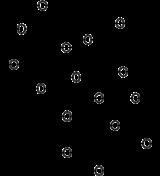
Melezitose

Encyclopedia
Melezitose, also spelled melicitose, is a nonreducing trisaccharide sugar
that is produced by many plant sap
eating insects, including aphid
s such as Cinara pilicornis by an enzyme reaction. This is beneficial to the insects, as it reduces the stress of osmosis
by reducing their own water potential. The melezitose is part of the honeydew
which acts as an attractant for ants and also as a food for bee
s. This is useful to the lice as they have a symbiotic relationship with ants. Melezitose can be partially hydrolyzed
to glucose
and turanose
the latter of which is an isomer
of sucrose
.
Sugar
Sugar is a class of edible crystalline carbohydrates, mainly sucrose, lactose, and fructose, characterized by a sweet flavor.Sucrose in its refined form primarily comes from sugar cane and sugar beet...
that is produced by many plant sap
Plant sap
Sap is a fluid transported in xylem cells or phloem sieve tube elements of a plant. It transports water and nutrients throughout the plant....
eating insects, including aphid
Aphid
Aphids, also known as plant lice and in Britain and the Commonwealth as greenflies, blackflies or whiteflies, are small sap sucking insects, and members of the superfamily Aphidoidea. Aphids are among the most destructive insect pests on cultivated plants in temperate regions...
s such as Cinara pilicornis by an enzyme reaction. This is beneficial to the insects, as it reduces the stress of osmosis
Osmosis
Osmosis is the movement of solvent molecules through a selectively permeable membrane into a region of higher solute concentration, aiming to equalize the solute concentrations on the two sides...
by reducing their own water potential. The melezitose is part of the honeydew
Honeydew (secretion)
Honeydew is a sugar-rich sticky liquid, secreted by aphids and some scale insects as they feed on plant sap. When their mouthpart penetrates the phloem, the sugary, high-pressure liquid is forced out of the gut's terminal opening. Honeydew is particularly common as a secretion in the Hemipteran...
which acts as an attractant for ants and also as a food for bee
Bee
Bees are flying insects closely related to wasps and ants, and are known for their role in pollination and for producing honey and beeswax. Bees are a monophyletic lineage within the superfamily Apoidea, presently classified by the unranked taxon name Anthophila...
s. This is useful to the lice as they have a symbiotic relationship with ants. Melezitose can be partially hydrolyzed
Hydrolysis
Hydrolysis is a chemical reaction during which molecules of water are split into hydrogen cations and hydroxide anions in the process of a chemical mechanism. It is the type of reaction that is used to break down certain polymers, especially those made by condensation polymerization...
to glucose
Glucose
Glucose is a simple sugar and an important carbohydrate in biology. Cells use it as the primary source of energy and a metabolic intermediate...
and turanose
Turanose
Turanose is a reducing disaccharide. The D-isomer is naturally occurring. Its systematic name is α-D-glucopyranosyl--α-D-fructofuranose. It is an analog of sucrose not metabolized by higher plants, but rather acquired through the action of sucrose transporters for intracellular carbohydrate...
the latter of which is an isomer
Isomer
In chemistry, isomers are compounds with the same molecular formula but different structural formulas. Isomers do not necessarily share similar properties, unless they also have the same functional groups. There are many different classes of isomers, like stereoisomers, enantiomers, geometrical...
of sucrose
Sucrose
Sucrose is the organic compound commonly known as table sugar and sometimes called saccharose. A white, odorless, crystalline powder with a sweet taste, it is best known for its role in human nutrition. The molecule is a disaccharide composed of glucose and fructose with the molecular formula...
.