
All Topics  
Adventures of Huckleberry Finn

 
Adventures of Huckleberry Finn

   Email Print
   Bookmark   Link


Adventures of Huckleberry Finn


Adventures of Huckleberry Finn (often shortened to Huck Finn) is a novel written by Mark Twain
Mark Twain

Samuel Langhorne Clemens , better known by the pen name Mark Twain, was an United Statesmerican author and humorist. Twain is most noted for his novels Adventures of Huckleberry Finn, which has since been called the Great American Novel, and The Adventures of Tom Sawyer....
 and published in 1884. It is commonly regarded one of the Great American Novel
Great American Novel

The "Great American Novel" is the concept of a novel that most perfectly represents the spirit of life in the United States at the time of its writing....
s, and is one of the first major American novels written in the vernacular
Vernacular

Vernacular refers to the native language of a country or a locality. In general linguistics, it is used to describe local languages as opposed to Lingua franca, official standards or global languages....
, characterized by local color regionalism
Regionalism (literature)

In literature, regionalism or local color fiction refers to fiction or poetry that focuses on specific features - including characters, dialects, customs and topography - of a particular region....
. It is told in the first person by Huckleberry "Huck" Finn
List of characters in the Tom Sawyer series

Mark Twain's series of books featuring the fictional characters Tom Sawyer and Huckleberry Finn include:# The Adventures of Tom Sawyer # Adventures of Huckleberry Finn ...
, best friend of Tom Sawyer
Tom Sawyer

Tom Sawyer is the protagonist and title character of the Mark Twain novel The Adventures of Tom Sawyer . He appears in three other novels by Twain: Adventures of Huckleberry Finn , Tom Sawyer Abroad , and Tom Sawyer, Detective ....
 and narrator of two other Twain novels.

The book is noted for its colorful description of people and places along the Mississippi River
Mississippi River

The Mississippi River is the longest river in the United States, with a length of from its source in Lake Itasca in Minnesota to its mouth in the Gulf of Mexico....
.


Discussion
Ask a question about 'Adventures of Huckleberry Finn'
Start a new discussion about 'Adventures of Huckleberry Finn'
Answer questions from other users
Full Discussion Forum


Recent Posts


Encyclopedia


Adventures of Huckleberry Finn (often shortened to Huck Finn) is a novel written by Mark Twain
Mark Twain

Samuel Langhorne Clemens , better known by the pen name Mark Twain, was an United Statesmerican author and humorist. Twain is most noted for his novels Adventures of Huckleberry Finn, which has since been called the Great American Novel, and The Adventures of Tom Sawyer....
 and published in 1884. It is commonly regarded one of the Great American Novel
Great American Novel

The "Great American Novel" is the concept of a novel that most perfectly represents the spirit of life in the United States at the time of its writing....
s, and is one of the first major American novels written in the vernacular
Vernacular

Vernacular refers to the native language of a country or a locality. In general linguistics, it is used to describe local languages as opposed to Lingua franca, official standards or global languages....
, characterized by local color regionalism
Regionalism (literature)

In literature, regionalism or local color fiction refers to fiction or poetry that focuses on specific features - including characters, dialects, customs and topography - of a particular region....
. It is told in the first person by Huckleberry "Huck" Finn
List of characters in the Tom Sawyer series

Mark Twain's series of books featuring the fictional characters Tom Sawyer and Huckleberry Finn include:# The Adventures of Tom Sawyer # Adventures of Huckleberry Finn ...
, best friend of Tom Sawyer
Tom Sawyer

Tom Sawyer is the protagonist and title character of the Mark Twain novel The Adventures of Tom Sawyer . He appears in three other novels by Twain: Adventures of Huckleberry Finn , Tom Sawyer Abroad , and Tom Sawyer, Detective ....
 and narrator of two other Twain novels.

The book is noted for its colorful description of people and places along the Mississippi River
Mississippi River

The Mississippi River is the longest river in the United States, with a length of from its source in Lake Itasca in Minnesota to its mouth in the Gulf of Mexico....
. By satirizing
Satire

Satire is often strictly defined as a literary genre; although, in practice, it is also found in the graphic arts and performing arts. In satire, human or individual vices, follies, abuses, or shortcomings are held up to censure by means of ridicule, derision, burlesque, irony, or other methods, ideally with the intent to bring about improv...
 a Southern
Southern United States

The Southern United States—commonly referred to as the American South, Dixie, or simply the South—constitutes a large distinctive region in the southeastern and south-central United States....
 antebellum
Antebellum

"Antebellum" is an expression derived from Latin that means "before war" .In United States history and historiography, "antebellum" is commonly used, in lieu of "pre-Civil War," in reference to the period of increasing sectionalism that led up to the American Civil War....
 society that was already anachronistic at the time of its publication, the book is an often scathing look at entrenched attitudes, particularly racism
Racism

Racism, by its simplest definition is the belief that Race is the primary determinant of human traits and capacities and that racial differences produce an inherent superiority of a particular race....
. The drifting journey of Huck and his friend Jim
Jim (Huckleberry Finn)

Jim is one of two major fictional characters in the classic novel Adventures of Huckleberry Finn by Mark Twain. The book chronicles the journey of Jim and List of characters in the Tom Sawyer series#Huckleberry Finn down the Mississippi River in the antebellum Southern United States....
, a runaway slave
Slavery

Slavery is a form of forced labor where a person is compelled to Labor for another . Slaves are held against their will from the time of their capture, purchase, or birth, and are deprived of the right to leave, to refuse to work, or to receive Remuneration in return for their labor....
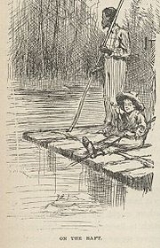
, down the Mississippi River on their raft may be one of the most enduring images of escape and freedom in all of American literature
American literature

American literature refers to written or literature produced in the area of the United States and Colonial America. For more specific discussions of poetry and theater, see Poetry of the United States and Theater in the United States....
.

The book has been popular with young readers since its publication and is taken as a sequel to the comparatively innocuous The Adventures of Tom Sawyer
The Adventures of Tom Sawyer

The Adventures of Tom Sawyer, by Mark Twain, is a popular 1876 novel about a young boy growing up in the antebellum Southern United States on the Mississippi River in the fictional town of St....
. It has also been the continued object of study by serious literary critics. The book was criticized upon release because of its coarse language, and became even more controversial in the 20th century because of its perceived use of racial stereotypes and because of its frequent use of the racial slur, "nigger".

Publication history

Mark Twain2
Twain initially conceived of the work as a companion to The Adventures of Tom Sawyer
The Adventures of Tom Sawyer

The Adventures of Tom Sawyer, by Mark Twain, is a popular 1876 novel about a young boy growing up in the antebellum Southern United States on the Mississippi River in the fictional town of St....
 that would follow Huck Finn through adulthood. Beginning with a chapter he had deleted from the earlier novel, Twain began work on a manuscript he originally titled Huckleberry Finn's Autobiography. Twain worked on the manuscript off and on for the next several years, ultimately abandoning his original plan of following Huck's development into adulthood. He appeared to have lost interest in the manuscript while it was in progress, and set it aside for several years. After making a trip down the Mississippi, Twain returned to his work on the novel. Upon completion, the novel's title closely paralleled its predecessor's: Adventures of Huckleberry Finn (Tom Sawyer's Comrade).

Unlike The Adventures of Tom Sawyer, Twain's Adventures of Huckleberry Finn does not have the definite article "the" as a part of its proper title. Essayist and critic Philip Young states that this absence represents the "never fulfilled anticipations" of Huck's adventures—while Tom's adventures were completed (at least at the time) at the end of his novel, Huck's narrative ends with his stated intention to head West.

Mark Twain composed the story in pen on notepaper between 1876 and 1883. Paul Needham, who supervised the authentication of the manuscript for Sotheby's books and manuscripts department in New York in 1991, stated, "What you see is [Clemens's] attempt to move away from pure literary writing to dialect writing". For example, Twain revised the opening line of Huck Finn three times. He initially wrote, "You will not know about me," which he changed to, "You do not know about me," before settling on the final version, "You don't know about me without you have read a book by the name of 'The Adventures of Tom Sawyer'; but that ain't no matter." The revisions also show how Twain reworked his material to strengthen the characters of Huck and Jim, as well as his sensitivity to the then-current debate over literacy and voting.

A later version was the first typewritten manuscript delivered to a printer.

Huck Finn was eventually published on December 10, 1884, in Canada and England, and on February 18, 1885, in the United States. The American publication was delayed because someone defaced an illustration on one of the plates creating an obscene joke. Thirty-thousand copies of the book had been printed before the obscenity was discovered. A new plate was made to correct the illustration and repair the existing copies.

In 1885, the Buffalo Public Library's
Buffalo & Erie County Public Library

The Buffalo & Erie County Public Library is located on Lafayette Square, Buffalo, . The current facility, built in 1963, replaced the original Cyrus Eidlitz Buffalo Public Library Building dedicated in February 1887....
 curator, James Fraser Gluck, approached Twain to donate the manuscript to the Library. Twain sent half of the pages, believing the other half to have been lost by the printer. In 1991, the missing half turned up in a steamer trunk owned by descendants of Gluck. The Library successfully proved possession and, in 1994, opened the Mark Twain Room in its Central Library to showcase the treasure.

Plot summary

Huckleberry Finn With Rabbit

Life in St. Petersburg

The story begins in fictional St. Petersburg, Missouri, on the Mississippi River
Mississippi River

The Mississippi River is the longest river in the United States, with a length of from its source in Lake Itasca in Minnesota to its mouth in the Gulf of Mexico....
. Two young boys, Tom Sawyer and Huckleberry Finn, have each come into a considerable sum of money as a result of their earlier adventures (The Adventures of Tom Sawyer
The Adventures of Tom Sawyer

The Adventures of Tom Sawyer, by Mark Twain, is a popular 1876 novel about a young boy growing up in the antebellum Southern United States on the Mississippi River in the fictional town of St....
). Huck has been placed under the guardianship of the Widow Douglas, who, together with her sister, Miss Watson, are attempting to "sivilize
Sensational spelling

Sensational spelling is the deliberate spelling of a word in an incorrect or non-standard way for special effects.Sensational spellings are common in advertising and product placement....
 [sic
SIC

Sic is a Latin word that means "thus" or, in writing, "it was thus in the source material".Sic may also refer to:* Sic, Cluj, a commune in Romania...
]" him. Huck appreciates their efforts, but finds civilized life confining. In the beginning of the story, Tom Sawyer appears briefly, helping Huck escape at night from the house, past Miss Watson's slave, Jim
Jim (Huckleberry Finn)

Jim is one of two major fictional characters in the classic novel Adventures of Huckleberry Finn by Mark Twain. The book chronicles the journey of Jim and List of characters in the Tom Sawyer series#Huckleberry Finn down the Mississippi River in the antebellum Southern United States....
. They meet up with Tom Sawyer's self-proclaimed gang, who plot to carry out adventurous crimes.

Huck's life is changed by the sudden appearance of his shiftless father, "Pap", an abusive parent and drunkard. Although Huck is successful in preventing his Pap from acquiring his fortune, Pap forcibly gains custody of Huck and the two move to the backwoods where Huck is kept locked inside his father's cabin. Equally dissatisfied with life with his father, Huck escapes from the cabin, elaborately fakes his own death, and sets off down the Mississippi River.

The Grangerfords and the Shepherdsons

While living quite comfortably in the wilderness along the Mississippi, Huck happily encounters Miss Watson's slave Jim on an island called Jackson's Island, and Huck learns that he has also run away. The two team up and shortly after missing their destination, Cairo, Illinois
Cairo, Illinois

Cairo is a city in Alexander County, Illinois, Illinois in the United States. The population was 3,632 at the 2000 census. It is the county seat of Alexander County, Illinois....
 (in a free state to which Jim has planned to escape), Huck and Jim's raft is swamped by a passing steamship, separating the two. Huck is given shelter by the Grangerfords, a prosperous local family. He becomes friends with Buck Grangerford, a boy about his age, and learns that the Grangerfords are engaged in a 30-year blood feud against another family, the Shepherdsons.

The vendetta comes to a head when Buck's sister, Sophia Grangerford, elopes with Harney Shepherdson. In the resulting conflict, all of the remaining Grangerford males are shot and killed, and upon seeing Buck's corpse, Huck is too devastated to write about everything that happened. However, Huck does describe how he narrowly avoids his own death in the gunfight, later reuniting with Jim and the raft and together fleeing farther south on the Mississippi River.

The Duke and the King

Farther down the river, Jim and Huck rescue two cunning grifters
Confidence trick

A confidence trick or confidence game is an attempt to defraud a person or group by gaining their confidence....
, who join Huck and Jim on the raft. The younger of the two swindlers, a man of about thirty, introduces himself as a son of an English duke
Duke

A duke is a member of the nobility, historically of highest rank below the monarch, and historically controlling a duchy or a dukedom. The title comes from the Latin language Dux Bellorum, which had the sense of "military commander" and was employed by both the Germanic peoples themselves and by the Ancient Rome authors covering them to r...
 (the Duke of Bridgewater, which the King later mispronounces as "Bilgewater") and his father's rightful successor. The older one, about seventy, then trumps the duke's claim by alleging that he is actually the "Lost Dauphin"
Louis XVII of France

Louis XVII of France, also Louis VI of Navarre , from birth to 1789 known as Louis-Charles, Duke of Normandy; then from 1789 to 1791 as Louis-Charles, Dauphin of France of Viennois; and from 1791 to 1793 as Louis-Charles, Prince Royal of France, was the son of King Louis XVI of France and Marie Antoinette of Austria....
, the son of Louis XVI
Louis XVI of France

Louis XVI or Louis-Auguste de France ruled as List of French monarchs of France and of List of Navarrese monarchs from 1774 until 1791, and then as Popular monarchy from 1791 to 1792....
 and rightful King of France. The "Duke" and the "King" then force Jim and Huck to allow them to travel on the raft, committing a series of confidence
Confidence trick

A confidence trick or confidence game is an attempt to defraud a person or group by gaining their confidence....
 schemes on the way south.

As these schemes unfold, Huck sees the attempted lynching
Lynching

Lynching is an extrajudicial punishment meted out by a mob. It is an enumerated felony in all states of the United States, defined by some codes of law as "Any act of violence inflicted by a mob upon the body of another person which results in the death of the person," with a 'mob' being defined as "the assemblage of two or more persons, with...
 of a southern gentleman, Colonel Sherburn, after Sherburn kills a harmless town drunk. Sherburn faces down the lynch mob with a loaded rifle and forces them to back down after an extended speech regarding what he believes to be the essential cowardice of "Southern justice," the lynch mob. (This vignette
Vignette

The word vignette, from the same root as vine, originally referred to a decorative border in a book. Later, the word also came to be used for a photographic portrait which is clear in the center, and fades off at the edges, and also short descriptive literature focusing on a particular moment or person....
, which stands out as disconnected from the remaining plot, is thought to represent Twain's own contradictory and misanthropic impulses — Huck, the outcast, essentially flees from Southern society, while Sherburn, the gentleman, confronts it, albeit in a brutal, destructive fashion.)

The Duke and the King's schemes reach their peak when the two grifters impersonate the brothers of Peter Wilks, a recently deceased man of property. Using an absurd English accent, the King manages to convince most of the townspeople that he and the Duke are Wilks's brothers recently arrived from England, and proceeds to liquidate Wilks's estate. Huck is upset at the men's plan to steal the inheritance from Wilks's daughters and actual brothers, as well as their actions in selling Wilks's slaves and separating their families. To thwart their plans, Huck steals the money the two have acquired and hides it in Wilks's coffin. Shortly thereafter, the two con men are exposed when two other men claiming to be the Wilks's true brothers arrive. However, when the money is found in Wilks's coffin, the Duke and the King are able to escape in the confusion, rejoining Huck and Jim on the raft.

Jim's escape

After the four fugitives flee farther south on their raft, the King "captures" Jim and sells his interest in any reward while Huck is away in a nearby town. Outraged by this betrayal, Huck rejects the advice of his "conscience," which continues to tell him that in helping Jim escape to freedom, he is stealing Miss Watson's property. Telling himself "All right, then, I'll go to hell!", Huck resolves to free Jim.

Huck discovers, upon arriving at the house in which Jim is being held, that the King has sold him in a bar for forty dollars. In a parallel to the con men's earlier scheme with the Wilks family, Huck is mistaken by Tom Sawyer's Arkansas aunt, Sally Phelps, for Tom himself, and plays along, hoping to find a way to free Jim. Shortly after, Tom himself arrives, and pretending to be his own half-brother Sid, agrees to join Huck's scheme.

Jim reveals the secret of the Royal Nonesuch before the two rogues are able to set their confidence game into motion. That night the Duke and King are captured by the townspeople, and are tarred and feathered
Tarring and feathering

Tarring and feathering is a physical punishment, used to enforce formal justice in feudal Europe and informal justice in Europe and its colonies in the early modern period, as well as the early American frontier, mostly as a type of mob vengeance ....
 and ridden out of town on a rail
Riding the rail

File:Huck Finn Travelling by Rail.jpgRiding the rail was a punishment of Colonial America in which a man was made to Wiktionary:straddle a fence rail held on the shoulders of two men, with other men on either side to keep him upright on the rail....
.

Rather than simply sneaking Jim out of the shed where he is being held, Tom develops an elaborate plan to free him, involving secret messages, hidden tunnels, a rope ladder sent in Jim's food, and other elements from popular novels, including a note to the Phelps warning them of an Indian tribe stealing their runaway slave. During the resulting pursuit, Tom is shot in the leg, and rather than complete his escape, Jim attends to him and insists that Huck find a doctor in town to treat the injury. This is the first time that Jim demands something from a white person; Huck explains this by saying "I knowed he was white on the inside...so it was all right now." Jim and Tom are then captured and brought back by the doctor.

Conclusion

After Jim's recapture, events quickly resolve themselves. Tom's Aunt Polly arrives and reveals Huck's and Tom's true identities. Tom announces that Jim has been free for months: Miss Watson died two months earlier and freed Jim in her will, but Tom chose not to reveal Jim's freedom so he could come up with an elaborate plan to rescue Jim. Jim tells Huck that Huck's father has been dead for some time and that Huck may return safely to St. Petersburg. (Jim discovered this when he and Huck were on Jackson Island and came upon part of a house drifting down stream. The dead body in the house, the face of which Jim did not let Huck see, was Huck's father.) In the final narrative, Huck declares that he is quite glad to be done writing his story, and despite Tom's family's plans to adopt and "sivilize" him, Huck intends to flee west to Indian Territory
Indian Territory

The Indian Territory, also known as The Indian Country, The Indian territory or the Indian territories, was land set aside within the United States for the use of Native Americans in the United States....
.

Major themes

Twain wrote a novel that embodies the search for freedom. He wrote during the post-Civil War
American Civil War

The American Civil War , also known as the War Between the States and several Naming the American Civil War, was a civil war in the United States....
 period when there was an intense white
White people

White people is a term which is usually used to refer to Human characterized, at least in part, by the light Human skin color. It often refers narrowly to people claiming ancestry exclusively from Europe....
 reaction against blacks
African American

African Americans or Black Americans are citizens or residents of the United States who have origins in any of the Black people populations of Africa....
. Twain took aim squarely against racial prejudice
Discrimination

Discrimination toward or against a person or group is the treatment or consideration based on class or category rather than individual merit. It is usually associated with prejudice....
, increasing segregation
Racial segregation

File:Segregated cinema entrance3.jpgRacial segregation is the separation of different Race s in daily life, such as eating in a restaurant, drinking from a drinking fountain, using a rest room, attending school, going to the movies, or in the rental or purchase of a home....
, lynching
Lynching

Lynching is an extrajudicial punishment meted out by a mob. It is an enumerated felony in all states of the United States, defined by some codes of law as "Any act of violence inflicted by a mob upon the body of another person which results in the death of the person," with a 'mob' being defined as "the assemblage of two or more persons, with...
s, and the generally accepted belief that blacks were sub-human. He "made it clear that Jim was good, deeply loving, human, and anxious for freedom."

Throughout the story, Huck is in moral conflict with the received values of the society in which he lives, and while he is unable to consciously refute those values even in his thoughts, he makes a moral choice based on his own valuation of Jim's friendship and human worth, a decision in direct opposition to the things he has been taught. Mark Twain in his lecture notes proposes that "a sound heart is a surer guide than an ill-trained conscience," and goes on to describe the novel as "...a book of mine where a sound heart and a deformed conscience come into collision and conscience suffers defeat."

The novel has also been deemed as a bildungsroman
Bildungsroman

A bildungsroman is a novelistic genre that arose during the German Enlightenment, in which the author presents the psychological, moral and social shaping of the personality of a protagonist....
 by many literary critics.

Year in Which the Book Takes Place

Adventures of Huckleberry Finn appears to take place in or about the year the year 1839. The author gives several indications of this. In the Foreword he describes the events as taking place "forty to fifty years ago" (i.e., about 45 years before the publication date of 1884), which would make the approximate year 1839. In Chapter 26, when Huck impersonates the servant of a supposed clergyman from England, he tells the harelipped kitchen girl that he has often seen King William the Fourth at church, while admitting to the reader that he is aware the King died "years ago" [William IV was succeeded by his niece, Queen Victoria in 1837]. Since the harelip does not know that King William IV is dead, and Huck does, the time lapse after William IV's death is probably 2-3 years. Since 1840 was a landmark Presidential election year with the election of the first Whig President, and there is no mention whatsoever of the political campaign, the novel most likely takes place right where Twain suggested—1839.

Reception

The publication of Adventures of Huckleberry Finn resulted in generally friendly reviews, but the novel was controversial from the outset. Upon issue of the American edition in 1885 a number of libraries banned it from their stacks. The early criticism focused on what was perceived as the book's crudeness. One noted incident was recounted in the newspaper, the Boston Transcript:
The Concord (Mass.) Public Library committee has decided to exclude Mark Twain's latest book from the library. One member of the committee says that, while he does not wish to call it immoral, he thinks it contains but little humor, and that of a very coarse type. He regards it as the veriest trash. The library and the other members of the committee entertain similar views. characterizing it as rough, coarse, and inelegant, dealing with a series of experiences not elevating, the whole book being more suited to the slums than to intelligent, respectable people.
Twain later remarked to his editor, "Apparently, the Concord library has condemned Huck as 'trash and only suitable for the slums.' This will sell us another five thousand copies for sure!"

Many subsequent critics, Ernest Hemingway
Ernest Hemingway

Ernest Miller Hemingway was an American novelist, short story author, and journalist. He was part of the 1920s expatriate community in Paris, France, and one of the veterans of World War I later known as "the Lost Generation"....
 among them, have deprecated the final chapters, claiming the book "devolves into little more than minstrel-show satire and broad comedy" after Jim loses his freedom. Hemingway declared, "All modern American literature comes from" Huck Finn, and hailed it as "the best book we've had." He cautioned, however, "If you must read it you must stop where the Nigger Jim is stolen from the boys. That is the real end." (The term "Nigger Jim" never appears in the novel but after appearing in Albert Bigelow Paine's
Albert Bigelow Paine

Albert Bigelow Paine was an United States author and biographer best known for his work with Mark Twain. Paine was a member of the Pulitzer Prize and wrote in several genres, including fiction, humour, and verse....
 1912 Clemens biography, continued to be used by twentieth century critics, including Leslie Fiedler, Norman Mailer, and Russell Baker.) Pulitzer Prize
Pulitzer Prize

The Pulitzer Prize is an United States award regarded as the highest national honor in newspaper journalism, literary achievements and musical composition....
 winner Ron Powers
Ron Powers

Ron Powers is a Pulitzer Prize-winning journalist, novelist, and non-fiction writer. His works include White Town Drowsing: Journeys to Hannibal, Dangerous Water: A Biography of the Boy Who Became Mark Twain, and Mark Twain: A Life....
 states in his Twain biography (Mark Twain: A Life) that "Huckleberry Finn endures as a consensus masterpiece despite these final chapters," in which Tom Sawyer leads Huck through elaborate machinations to rescue Jim.

Much modern scholarship of Huckleberry Finn has focused on its treatment of race. Many Twain scholars have argued that the book, by humanizing Jim and exposing the fallacies of the racist assumptions of slavery, is an attack on racism. Others have argued that the book falls short on this score, especially in its depiction of Jim. According to Professor Stephen Railton of the University of Virginia
University of Virginia

The University of Virginia is a public university research university located in Charlottesville, Virginia, founded by Thomas Jefferson. Conceived by 1800 and established in 1819, it is the only university in the United States to be designated a World Heritage Site by UNESCO, an honor it shares with nearby Monticello....
, Twain was unable to fully rise above the stereotypes of black people that white readers of his era expected and enjoyed, and therefore resorted to minstrel show
Minstrel show

The minstrel show, or minstrelsy, was an United States entertainment consisting of comic skits, variety show acts, dance, and music, performed by white people in blackface or, especially after the American Civil War, blacks in blackface....
-style comedy to provide humor at Jim's expense, and ended up confirming rather than challenging late-19th century racist stereotypes. However, the fact remains that the word "nigger" is nearly always put in the mouths of villainous characters; in fact it comes mostly from the mouth of the most disreputable character of all, Huck's comic-villain father, "Pap," in Chapter 6.

Because of this controversy over whether Huckleberry Finn is racist or anti-racist, and because the word "nigger
Nigger

Nigger is a noun in the English language, most notable as a pejorative term and common ethnic slur for black people, and also as an informal slang term, among other contexts....
" is frequently used in the novel, many have questioned the appropriateness of teaching the book in the U.S. public school system. Others have been known to argue that as Jim may be interpreted as the hero of the novel, it is not racist at all. According to the American Library Association
American Library Association

The American Library Association is a group based in the United States that promotes library and library education internationally. It is the oldest and largest library association in the world, with more than 65,000 members....
, Huckleberry Finn was the fifth most frequently challenged
Challenge (literature)

In United States literature, a challenge is defined by the American Library Association [ALA] as an attempt by a person or group of people to have materials such as books removed from a library or from a school curriculum or otherwise restricted....
 book in the United States during the 1990s.

Adaptations


Film

  • Huck Finn, a 1937 film
    Film

    Film encompasses individual motion pictures, the field of film as an art form, and the film industry. Films are produced by recording images from the world with cameras, or by creating images using animation techniques or special effects....
     produced by Paramount
    Paramount Pictures

    Paramount Pictures Corporation is an American motion picture production company and distribution company, located on Melrose Avenue in Hollywood, California....
  • The Adventures of Huckleberry Finn
    The Adventures of Huckleberry Finn (1939 film)

    The Adventures of Huckleberry Finn is a 1939 in film film adaptation of Mark Twain's classic The Adventures of Huckleberry Finn, starring Mickey Rooney in the title role....
    , a 1939 film starring Mickey Rooney
    Mickey Rooney

    Mickey Rooney is an United States film actor and entertainer whose film, television, and theatre appearances span nearly his entire lifetime. During his career he has won multiple awards, including an Academy Award, a Golden Globe and an Emmy Award....
  • The Adventures of Huckleberry Finn, a 1954 film starring Thomas Mitchell and John Carradine
    John Carradine

    John Carradine was an United States actor, perhaps best known for his roles in horror films and Westerns....
     produced by CBS (see: http://www.movierevie.ws/movies/890030/The-Adventures-of-Huckleberry-Finn.html)
  • The Adventures of Huckleberry Finn a 1960 film directed by Michael Curtiz
    Michael Curtiz

    Michael Curtiz was an Academy Award-winning Hungarian-American film director. He directed at least 50 films in Europe and a further hundred in the United States, among the best-known being The Adventures of Robin Hood , Angels with Dirty Faces, Casablanca , Yankee Doodle Dandy, and White Christmas ....
    , starring Eddie Hodges
    Eddie Hodges

    Eddie Hodges is a United States former child actor and recording artist who left show business as an adult....
     and Archie Moore
    Archie Moore

    Archie Moore, Born Archibald Wright , was light heavyweight world boxing champion between 1952 and 1959 and had one of the longest professional careers in the history of his sport....
  • The New Adventures of Huckleberry Finn
    The New Adventures of Huckleberry Finn

    The New Adventures of Huckleberry Finn was a half-hour live-action/animated series produced by Hanna-Barbera Productions on NBC primetime in 1968, based on the famous Mark Twain characters....
    , a 1968 animated
    Animation

    Animation is the rapid display of a sequence of images of 2-D or 3-D artwork or model positions in order to create an illusion of movement. It is an optical illusion of Motion due to the phenomenon of persistence of vision, and can be created and demonstrated in a number of ways....
     television series for children
  • Hopelessly Lost
    Hopelessly Lost

    Hopelessly Lost is a 1973 Soviet comedy film/adventure film directed by Georgi Daneliya based on Mark Twain's Adventures of Huckleberry Finn....
    , a 1972 Soviet film
  • Huckleberry Finn
    Huckleberry Finn (1974 film)

    Huckleberry Finn is the 1974 musical film version of Mark Twain's American classic boyhood adventure story, The Adventures of Huckleberry Finn....
    , a 1974 musical film
    Musical film

    The musical film is a film genre in which several songs sung by the fictional character are interwoven into the narrative. The songs are used to advance the plot or develop the film's characters....
  • Huckleberry Finn, a 1975 ABC movie of the week with Ron Howard
    Ron Howard

    Ronald William "Ron" Howard is an Academy Award-winning American film director and film producer as well as an actor. Howard came to prominence in the 1960s while playing Andy Griffith's TV son, Opie Taylor, on The Andy Griffith Show , and later in the 1970s as Howard Cunningham's son and Arthur Fonzarelli's best friend, Richie Cunningha...
     as Huck Finn.musical film
    Musical film

    The musical film is a film genre in which several songs sung by the fictional character are interwoven into the narrative. The songs are used to advance the plot or develop the film's characters....
  • Huckleberry Finn, a 1976 Japanese anime
    Anime

    is animation in Japan and considered to be "Japanese animation" in the rest of the world. Anime dates from about 1917.Anime, in addition to manga , is extremely popular in Japan and well known throughout the world....
     with 26 episodes
  • Huckleberry Finn and His Friends
    Huckleberry Finn and His Friends

    Huckleberry Finn and His Friends was a 1979 television series documenting the exploits of Huckleberry Finn and Tom Sawyer, based on the novels The Adventures of Tom Sawyer and Adventures of Huckleberry Finn by American writer Mark Twain....
    , a 1979 television series starring Ian Tracey
    Ian Tracey

    Ian Tracey is a Canadian Leo- and Gemini Award-winning actor. Over the years, Tracey has participated in over seventy films and television series....
  • Adventures of Huckleberry Finn', a 1985 television movie
    Television movie

    A television movie is a feature film that is produced for and originally distributed by a television network....
    .
  • The Adventures of Huck Finn
    The Adventures of Huck Finn (1993 film)

    The Adventures of Huck Finn is a 1993 in film Walt Disney Pictures adventure film starring Elijah Wood and Courtney B. Vance; it is based on Mark Twain's novel Adventures of Huckleberry Finn....
    , a 1993 film starring Elijah Wood
    Elijah Wood

    Elijah Jordan Wood is an American actor. Making his film debut with a minor part in Back to the Future Part II , he landed a succession of subsequent larger roles and became a critically acclaimed child actor by age 13....
     and Courtney B. Vance
    Courtney B. Vance

    Courtney B. Vance is an United States actor. He formerly starred as a regular in the NBC television series Law & Order: Criminal Intent as Ron Carver....
  • Huckleberry Finn Monogatari, a 1994 Japanese anime
    Anime

    is animation in Japan and considered to be "Japanese animation" in the rest of the world. Anime dates from about 1917.Anime, in addition to manga , is extremely popular in Japan and well known throughout the world....
     with 26 episodes
  • Huckleberry Larry
    Huckleberry Larry

    Tomato Sawyer and Huckleberry Larry's Big River Rescue is the 35th episode in the VeggieTales series, and it was released on July 15, 2008. It is written by Phil Vischer and directed by Brian K....
    , a VeggieTales
    VeggieTales

    VeggieTales is a series of English language children's computer animation films featuring anthropomorphic vegetables. Developed by Big Idea Productions, the films convey moral themes based on Christianity, often compatible with Judaism, spliced with satirical references to pop culture and News....
     adaptation of Huckleberry Finn created by Big Idea Productions
    Big Idea Productions

    Big Idea, Inc., is an United States computer animation production company best known for its VeggieTales series of Christian-themed family home videos and sometimes in co-production with Warner Home Video....
     with Larry the Cucumber
    List of VeggieTales characters

    This is a list of primary, secondary, and recurring characters that appear in the animated series VeggieTales....
     as the titular character.


  • See also:


Stage

  • Big River
    Big River (musical)

    Big River: The Adventures of Huckleberry Finn is a musical theater with a book by William Hauptman and music and lyrics by Roger Miller.Based on Mark Twain's classic 1884 novel, The Adventures of Huckleberry Finn, it features music in the bluegrass music and country music styles in keeping with the setting of the novel....
    , a 1985 Broadway
    Broadway theatre

    Broadway theatre, commonly called simply Broadway, refers to theatrical performances presented in one of the 39 large professional theaters with 500 seats or more located in the Theatre District, New York in Manhattan, New York City....
     musical with lyrics and music by Roger Miller
    Roger Miller

    Roger Dean Miller was an United States singer, songwriter and musician, best known for his mid-1960s country/pop hits such as King of the Road , Dang Me and England Swings....


Literature

  • Finn: A Novel (2007), a novel about Huck's father, Pap Finn, by Jon Clinch
    Jon Clinch

    Jon Clinch is an American novelist and teacher. Originally from upstate New York, he graduated from Syracuse University and went on to teach American literature....
    .
  • My Jim (2005), a novel narrated largely by Sadie, Jim's enslaved wife by Nancy Rawles.


External links

  • . Digitized copy of the first American edition from Internet Archive
    Internet Archive

    The Internet Archive is a nonprofit organization dedicated to building and maintaining a free and openly accessible online digital library, including an archive site of the World Wide Web....
    .
  • Easy Free in HTML format.
  • [https://staging.airflowsciences.com/rkn/Twain/3400-3449/3414/ Images of First English Edition (1884)]
  • [https://staging.airflowsciences.com/rkn/Twain/3400-3449/3415/ Images of First U.S. Edition (1885)]