


Mario Palanti

Encyclopedia
Argentina
Argentina , officially the Argentine Republic , is the second largest country in South America by land area, after Brazil. It is constituted as a federation of 23 provinces and an autonomous city, Buenos Aires...
and Uruguay
Uruguay
Uruguay ,officially the Oriental Republic of Uruguay,sometimes the Eastern Republic of Uruguay; ) is a country in the southeastern part of South America. It is home to some 3.5 million people, of whom 1.8 million live in the capital Montevideo and its metropolitan area...
. Born in 1885 in Milan
Milan
Milan is the second-largest city in Italy and the capital city of the region of Lombardy and of the province of Milan. The city proper has a population of about 1.3 million, while its urban area, roughly coinciding with its administrative province and the bordering Province of Monza and Brianza ,...
, Italy
Italy
Italy , officially the Italian Republic languages]] under the European Charter for Regional or Minority Languages. In each of these, Italy's official name is as follows:;;;;;;;;), is a unitary parliamentary republic in South-Central Europe. To the north it borders France, Switzerland, Austria and...
, he studied architecture in the Brera Academy
Brera Academy
The Academy of Fine Arts of Brera, also known as Brera Academy is a public academic institution located in Milan, Italy. It was founded in 1776 by HIM Maria Theresa of Austria.- Overview :...
and in the Politecnico di Milano university. Soon after graduation he received a Gold Medal at the International Exhibition in Brussels and arrived in Buenos Aires
Buenos Aires
Buenos Aires is the capital and largest city of Argentina, and the second-largest metropolitan area in South America, after São Paulo. It is located on the western shore of the estuary of the Río de la Plata, on the southeastern coast of the South American continent...
in 1909 with a commission to manage, with the help of his compatriot, Francisco Gianotti
Francisco Gianotti
Francisco Gianotti was an architect who designed many important Art Nouveau buildings in Buenos Aires, Argentina....
, the construction of the Italian Pavilion for the Exposición Internacional del Centenario (1910)
Exposición Internacional del Centenario (1910)
The Exposición International del Centenario was an exhibition held between May and November 1910 in Buenos Aires, to mark the centennial of the May Revolution in Argentina...
.
For nearly 20 years he worked on both sides of the River Plate
Río de la Plata
The Río de la Plata —sometimes rendered River Plate in British English and the Commonwealth, and occasionally rendered [La] Plata River in other English-speaking countries—is the river and estuary formed by the confluence of the Uruguay River and the Paraná River on the border between Argentina and...
for wealthy compatriot clients. During the period 1909-1919 his designs employed variations of Renaissance Revival and Art Nouveau
Art Nouveau
Art Nouveau is an international philosophy and style of art, architecture and applied art—especially the decorative arts—that were most popular during 1890–1910. The name "Art Nouveau" is French for "new art"...
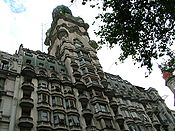
styles and there then followed a period during which he carried out his most impressive work in Buenos Aires including Palacio Barolo
Palacio Barolo
Palacio Barolo is a landmark office building, located at 1370 Avenida de Mayo, Buenos Aires, Argentina.Italian architect Mario Palanti was commissioned to design the building by the empresario Luis Barolo, an Italian immigrant who had arrived in Argentina in 1890 and had made a fortune in knitted...
and Hotel Castelar
Hotel Castelar
Hotel Castelar is located at the northwest intersection of May and the 9 de Julio Avenues, in the downtown Montserrat section of Buenos Aires, Argentina. Opened in 1928 as the Hotel Excelsior, the building was designed by Italian architect Mario Palanti and built by local engineer José Pinzone...
, both in Avenida de Mayo
Avenida de Mayo
Avenida de Mayo , is an avenue in Buenos Aires, capital of Argentina. It connects the Plaza de Mayo with Congressional Plaza, and extends in a west-east direction before merging into Avenida Rivadavia.-History and overview:...
, an apartment building on the corner of Santa Fe Avenue
Santa Fe Avenue
Avenida Santa Fe is one of the principal thoroughfares in Buenos Aires, Argentina. The artery is essential to the imaginary axis of Barrio Norte in Buenos Aires, comprising the areas influenced by the route of the avenue through Retiro, Recoleta and Palermo neighborhoods, it is considered one of...
and Callao Avenue
Callao Avenue
Avenida Callao is one of the principal thoroughfares in Buenos Aires, Argentina.-Overview:Mayor Torcuato de Alvear, inspired by the urban redevelopment works in Paris at the direction of Baron Haussmann, drew up master plans for major boulevards, running east to west and north to south...
, and Palacio Chrysler (today known as Palacio Alcorta) which had an automobile test track on its roof, similar to the first Fiat factory in Turin
Turin
Turin is a city and major business and cultural centre in northern Italy, capital of the Piedmont region, located mainly on the left bank of the Po River and surrounded by the Alpine arch. The population of the city proper is 909,193 while the population of the urban area is estimated by Eurostat...
. During this period he also designed the Palacio Salvo
Palacio Salvo
Palacio Salvo is a building in Montevideo, Uruguay, located at the intersection of 18 de Julio Avenue and Plaza Independencia. It was designed by the architect Mario Palanti, an Italian immigrant living in Buenos Aires, who used a similar design for his Palacio Barolo in Buenos Aires, Argentina...
in Montevideo
Montevideo
Montevideo is the largest city, the capital, and the chief port of Uruguay. The settlement was established in 1726 by Bruno Mauricio de Zabala, as a strategic move amidst a Spanish-Portuguese dispute over the platine region, and as a counter to the Portuguese colony at Colonia del Sacramento...
, and produced a large number of drawings for monumental buildings that were never built. In the final period of his work, after he returned to live in Italy in 1930, he undertook a series of projects that never materialised. He was the inventor of Palandomus
Palandomus
The Palandomus invented in 1919 by architect Mario Palanti, consists of a cementblock of 18x18x36cm made with the vibration system, to serve as the cellular element of construction, being designed with a particular shape "hermaphrodite", which allows placement in any sense, without the constraints...
.
Orders
 Commander OMRI Order of Merit of the Italian Republic
Order of Merit of the Italian Republic
The Order of Merit of the Italian Republic was founded as the senior order of knighthood by the second President of the Italian Republic, Luigi Einaudi in 1951...
External links
Prima esposizione personale d'architettura nella Repubblica Argentina, Milano, Stab. di arti grafiche Rizzoli e Pizzio, 1917- El Portal de arte y arquitectura en Internet (in Spanish) http://www.arquitectura.com/historia/protag/palanti/palanti.asp