

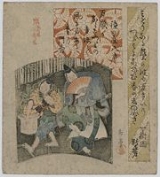
Manzai

Encyclopedia
is a traditional style of stand-up comedy
in Japanese culture, which usually involves two performers (manzaishi) —a straight man
(tsukkomi) and a funny man
(boke)—trading joke
s at great speed. Most of the jokes revolve around mutual misunderstandings, double-talk, pun
s and other verbal gags.
In recent times, manzai has often been associated with the Osaka
region, and manzai comedians often speak in the Kansai dialect during their acts.
Yoshimoto Kogyo
, a large entertainment conglomerate based in Osaka, introduced Osaka-style manzai to Tokyo
audiences, and coined the term "漫才" (one of several ways of writing the word manzai in Japanese; see "etymology" below) in 1933.
, manzai traces its origins back to the Heian period
. The two manzai performers came with messages from the gods and this was worked into a standup routine, with one performer showing some sort of opposition to the word of the other. This pattern still exists in the roles of the boke and the tsukkomi.
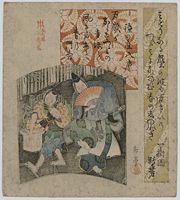 Continuing into the Edo period
, the style focused increasingly on the humor aspects of stand-up, and various regions of Japan developed their own unique styles of manzai, such as , , and . With the arrival of the Meiji Period
, began changes that would see it surpass in popularity the styles of the former period, although at the time rakugo
was still considered the more popular form of entertainment.
The spread of manzai was largely put to a halt after the conclusion of World War II
.
With the end of the Taishō period
, Yoshimoto Kōgyō
—which itself was founded at the beginning of the era, in 1912—introduced a new style of manzai lacking much of the celebration that had accompanied it in the past. This new style proved successful and spread all over Japan, including Tokyo. Riding on the waves of new communication technology, manzai quickly spread through the mediums of stage
, radio
, and eventually, television
.
for manzai have been written in various ways throughout the ages. It was originally written as , using the archaic form of the character 万 (to which it was soon changed). The arrival of Osaka manzai brought another character change, this time changing the latter character to a simpler 才, which carries the basic meaning of "talent".
comedy (e.g. Abbott and Costello
), these roles are a very important characteristic of manzai. Boke (ボケ) comes from the verb bokeru (惚ける or 呆ける) which carries the meaning of "senility" or "air headed-ness" and is reflected in the boke' s tendency for misinterpretation and forgetfulness. The word tsukkomi (突っ込み) refers to the role the second comedian plays in "butting in" and correcting the boke' s errors. In performances it is common for the tsukkomi to berate the boke and hit them on the head with a swift smack; one traditional manzai prop often used for this purpose is a . Another traditional manzai prop is a small drum, usually carried (and used) by the boke.
The tradition of tsukkomi and boke is often used in other Japanese comedy
, although it may not be as obviously portrayed as it usually is in manzai.
Stand-up comedy
Stand-up comedy is a comedic art form. Usually, a comedian performs in front of a live audience, speaking directly to them. Their performances are sometimes filmed for later release via DVD, the internet, and television...
in Japanese culture, which usually involves two performers (manzaishi) —a straight man
Double act
A double act, also known as a comedy duo, is a comic pairing in which humor is derived from the uneven relationship between two partners, usually of the same gender, age, ethnic origin and profession, but drastically different personalities or behavior...
(tsukkomi) and a funny man
Double act
A double act, also known as a comedy duo, is a comic pairing in which humor is derived from the uneven relationship between two partners, usually of the same gender, age, ethnic origin and profession, but drastically different personalities or behavior...
(boke)—trading joke
Joke
A joke is a phrase or a paragraph with a humorous twist. It can be in many different forms, such as a question or short story. To achieve this end, jokes may employ irony, sarcasm, word play and other devices...
s at great speed. Most of the jokes revolve around mutual misunderstandings, double-talk, pun
Pun
The pun, also called paronomasia, is a form of word play which suggests two or more meanings, by exploiting multiple meanings of words, or of similar-sounding words, for an intended humorous or rhetorical effect. These ambiguities can arise from the intentional use and abuse of homophonic,...
s and other verbal gags.
In recent times, manzai has often been associated with the Osaka
Osaka
is a city in the Kansai region of Japan's main island of Honshu, a designated city under the Local Autonomy Law, the capital city of Osaka Prefecture and also the biggest part of Keihanshin area, which is represented by three major cities of Japan, Kyoto, Osaka and Kobe...
region, and manzai comedians often speak in the Kansai dialect during their acts.
Yoshimoto Kogyo
Yoshimoto Kogyo
is a major Japanese entertainment conglomerate, with its headquarters based in Osaka. It was founded in 1912 as a traditional theatre, and has since grown to be one of the most influential companies in Japan, employing most of Japan's popular owarai talent, producing and promoting the shows they...
, a large entertainment conglomerate based in Osaka, introduced Osaka-style manzai to Tokyo
Tokyo
, ; officially , is one of the 47 prefectures of Japan. Tokyo is the capital of Japan, the center of the Greater Tokyo Area, and the largest metropolitan area of Japan. It is the seat of the Japanese government and the Imperial Palace, and the home of the Japanese Imperial Family...
audiences, and coined the term "漫才" (one of several ways of writing the word manzai in Japanese; see "etymology" below) in 1933.
History
Originally based around a festival to welcome the New YearJapanese New Year
The is one of the most important annual festivals, with its own unique customs, and has been celebrated for centuries. Due to the importance of the holiday and the preparations required, the preceding days are quite busy, particularly the day before, known as Ōmisoka.The Japanese New Year has been...
, manzai traces its origins back to the Heian period
Heian period
The is the last division of classical Japanese history, running from 794 to 1185. The period is named after the capital city of Heian-kyō, or modern Kyōto. It is the period in Japanese history when Buddhism, Taoism and other Chinese influences were at their height...
. The two manzai performers came with messages from the gods and this was worked into a standup routine, with one performer showing some sort of opposition to the word of the other. This pattern still exists in the roles of the boke and the tsukkomi.
Edo period
The , or , is a division of Japanese history which was ruled by the shoguns of the Tokugawa family, running from 1603 to 1868. The political entity of this period was the Tokugawa shogunate....
, the style focused increasingly on the humor aspects of stand-up, and various regions of Japan developed their own unique styles of manzai, such as , , and . With the arrival of the Meiji Period
Meiji period
The , also known as the Meiji era, is a Japanese era which extended from September 1868 through July 1912. This period represents the first half of the Empire of Japan.- Meiji Restoration and the emperor :...
, began changes that would see it surpass in popularity the styles of the former period, although at the time rakugo
Rakugo
is a Japanese verbal entertainment. The lone sits on the stage, called the . Using only a paper fan and a small cloth as props, and without standing up from the seiza sitting position, the rakugo artist depicts a long and complicated comical story...
was still considered the more popular form of entertainment.
The spread of manzai was largely put to a halt after the conclusion of World War II
World War II
World War II, or the Second World War , was a global conflict lasting from 1939 to 1945, involving most of the world's nations—including all of the great powers—eventually forming two opposing military alliances: the Allies and the Axis...
.
With the end of the Taishō period
Taisho period
The , or Taishō era, is a period in the history of Japan dating from July 30, 1912 to December 25, 1926, coinciding with the reign of the Taishō Emperor. The health of the new emperor was weak, which prompted the shift in political power from the old oligarchic group of elder statesmen to the Diet...
, Yoshimoto Kōgyō
Yoshimoto Kogyo
is a major Japanese entertainment conglomerate, with its headquarters based in Osaka. It was founded in 1912 as a traditional theatre, and has since grown to be one of the most influential companies in Japan, employing most of Japan's popular owarai talent, producing and promoting the shows they...
—which itself was founded at the beginning of the era, in 1912—introduced a new style of manzai lacking much of the celebration that had accompanied it in the past. This new style proved successful and spread all over Japan, including Tokyo. Riding on the waves of new communication technology, manzai quickly spread through the mediums of stage
Stage (theatre)
In theatre or performance arts, the stage is a designated space for the performance productions. The stage serves as a space for actors or performers and a focal point for the members of the audience...
, radio
Radio
Radio is the transmission of signals through free space by modulation of electromagnetic waves with frequencies below those of visible light. Electromagnetic radiation travels by means of oscillating electromagnetic fields that pass through the air and the vacuum of space...
, and eventually, television
Television
Television is a telecommunication medium for transmitting and receiving moving images that can be monochrome or colored, with accompanying sound...
.
Etymology
The kanjiKanji
Kanji are the adopted logographic Chinese characters hanzi that are used in the modern Japanese writing system along with hiragana , katakana , Indo Arabic numerals, and the occasional use of the Latin alphabet...
for manzai have been written in various ways throughout the ages. It was originally written as , using the archaic form of the character 万 (to which it was soon changed). The arrival of Osaka manzai brought another character change, this time changing the latter character to a simpler 才, which carries the basic meaning of "talent".
Boke and tsukkomi
Similar in execution to the concepts of "funny man" and "straight man" in double actDouble act
A double act, also known as a comedy duo, is a comic pairing in which humor is derived from the uneven relationship between two partners, usually of the same gender, age, ethnic origin and profession, but drastically different personalities or behavior...
comedy (e.g. Abbott and Costello
Abbott and Costello
William "Bud" Abbott and Lou Costello performed together as Abbott and Costello, an American comedy duo whose work on stage, radio, film and television made them the most popular comedy team during the 1940s and 1950s...
), these roles are a very important characteristic of manzai. Boke (ボケ) comes from the verb bokeru (惚ける or 呆ける) which carries the meaning of "senility" or "air headed-ness" and is reflected in the boke
The tradition of tsukkomi and boke is often used in other Japanese comedy
Owarai
is a broad word used to describe Japanese comedy as seen on television. The word owarai is the honorific form of the word warai, meaning "a laugh" or "a smile". Owarai is most common on Japanese variety shows and the comedians are referred to as owarai geinin or owarai tarento...
, although it may not be as obviously portrayed as it usually is in manzai.
See also
- Downtown (owarai)Downtown (owarai)is a Japanese comedy duo from Amagasaki, Hyōgo consisting of and . Formed in 1982, they are one of the most influential and prolific kombi in Japan today...
—the dominant manzai team during the 1980s and 1990s - XiangshengXiangshengXiangsheng , sometimes translated as crosstalk, is a traditional Chinese comedic performance in the form of a dialogue between two performers, or, much less often, a solo monologue or, even less frequently, a multi-player talk show. The language, rich in puns and allusions, is delivered in a rapid,...
- the Chinese analogue to manzai.
External links
- "Commodified Comedians and Mediatized Manzai: Osakan Comic Duos and Their Audience" by Xavier Benjamin Bensky. A study in the cultural effects of manzai.