


Manipura

Encyclopedia
Chakra
Chakra is a concept originating in Hindu texts, featured in tantric and yogic traditions of Hinduism and Buddhism. Its name derives from the Sanskrit word for "wheel" or "turning" .Chakra is a concept referring to wheel-like vortices...
according to Hindu
Hindu
Hindu refers to an identity associated with the philosophical, religious and cultural systems that are indigenous to the Indian subcontinent. As used in the Constitution of India, the word "Hindu" is also attributed to all persons professing any Indian religion...
tradition.
Location
Manipura is located at the spine directly behind either the navel or the solar plexus, depending on the system, while its kshetram or superficial activation point is located directly on the navel (or solar plexus).Appearance
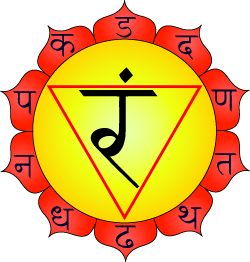
Manipura is represented by a downward pointing red triangle, the fire region, within a bright yellow circle, with 10 dark-blue or black petals, like heavily laden rain clouds. The triangle has a t-shaped swastika on each of its sides. The fire region is represented by the god Vahni, who is shining red, with 4 arms, holding a rosary and a spear, and making the gestures of granting boons and dispelling fear. He is seated on a ram, the animal that represents this chakra.Seed Mantra
The seed mantra is the syllable 'Ram'. Within the bindu or dot above this mantra resides the deity Rudra, who is red or white, with 3 eyes, of ancient aspect with a silver beard, and smeared with white ashes. He makes the gestures of granting boons and dispelling fear. He is either seated upon a tiger skin, or upon a bull. His Shakti is the goddess Lakini. She is black or dark-blue vermillion, with 3 faces with 3 eyes each, and four-armed, holding a thunderbolt, the arrow shot from the bow of Kama, fire, and making the gesture of granting boons and dispelling fear. She is seated upon a red lotus.Petals
The ten petalPetal
Petals are modified leaves that surround the reproductive parts of flowers. They often are brightly colored or unusually shaped to attract pollinators. Together, all of the petals of a flower are called a corolla. Petals are usually accompanied by another set of special leaves called sepals lying...
s are dark-blue or black, like heavily laden rainclouds, with the syllables dda, ddha, nna, ta, tha, da, dha, na, pa, and pha upon them in a dark-blue colour. They correspond to the vritti
Vritti
Vritti, in the context of Hinduism and yoga, is the name given to different tendencies, or psycho-physical propensities, which give scope for the mind to express a variety of feelings and emotions. Hindu texts describe vritties to be a result of past actions and experiences that have left an...
s of spiritual ignorance, thirst
Thirst
Thirst is the craving for fluids, resulting in the basic instinct of animals to drink. It is an essential mechanism involved in fluid balance. It arises from a lack of fluids and/or an increase in the concentration of certain osmolites, such as salt...
, jealousy
Jealousy
Jealousy is a second emotion and typically refers to the negative thoughts and feelings of insecurity, fear, and anxiety over an anticipated loss of something that the person values, particularly in reference to a human connection. Jealousy often consists of a combination of presenting emotions...
, treachery
Treachery
Treachery is a statutory offence in Australia. There was also an unrelated statutory offence bearing that name in the United Kingdom, but it has been abolished. Both of these offences were derived from or inspired by the related offence of treason. The name treachery was chosen because it is a...
, shame
Shame
Shame is, variously, an affect, emotion, cognition, state, or condition. The roots of the word shame are thought to derive from an older word meaning to cover; as such, covering oneself, literally or figuratively, is a natural expression of shame....
, fear
Fear
Fear is a distressing negative sensation induced by a perceived threat. It is a basic survival mechanism occurring in response to a specific stimulus, such as pain or the threat of danger...
, disgust
Disgust
Disgust is a type of aversion that involves withdrawing from a person or object with strong expressions of revulsion whether real or pretended. It is one of the basic emotions and is typically associated with things that are regarded as unclean, inedible, infectious, gory or otherwise offensive...
, delusion
Delusion
A delusion is a false belief held with absolute conviction despite superior evidence. Unlike hallucinations, delusions are always pathological...
, foolishness
Foolishness
Foolishness is the lack of wisdom. In this sense it differs from stupidity, which is the lack of intelligence. An act of foolishness is sometimes referred to as a folly....
and sadness
Sadness
Sadness is emotional pain associated with, or characterized by feelings of disadvantage, loss, despair, helplessness, sorrow, and rage. When sad, people often become outspoken, less energetic, and emotional...
.
Function
Manipura is considered the centre of dynamism, energy, willpower and achievement (Itcha shaktiItcha shakti
Iccha-shakti is a Sanskrit term translating to "will-power". It is used as a technical subdivision of Shakti in Shaktism.Helena Petrona Blavatsky in her The Secret Doctrine also introduces the conceot of "itcha shakti":...
.), which radiates prana
Prana
Prana is the Sanskrit word for "vital life" .It is one of the five organs of vitality or sensation, viz. prana "breath", vac "speech", chakshus "sight", shrotra "hearing", and manas "thought" Prana is the Sanskrit word for "vital life" (from the root "to fill", cognate to Latin plenus...
throughout the entire human body. It is associated with the power of fire, and digestion. It is also associated with the sense of sight, and the action of movement.
Manipura is "the center of etheric-psychic intuition: a vague or non-specific, sensual sense of knowing; a vague sense of size, shape, and intent of being." As such, some psychics recommend "listening" to it since it may help in making better decisions in one's life on many different levels.
Through meditating on Manipura, one is said to attain the siddhi, or occult power, to create and destroy the world.
Association with the body
The position of Manipura is stated as being either behind the navel or the solar plexus. Sometimes, when it is located at the navel, a secondary chakra called Surya (sun) chakra is located at the solar plexus, whose role is to absorb and assimilate pranaPrana
Prana is the Sanskrit word for "vital life" .It is one of the five organs of vitality or sensation, viz. prana "breath", vac "speech", chakshus "sight", shrotra "hearing", and manas "thought" Prana is the Sanskrit word for "vital life" (from the root "to fill", cognate to Latin plenus...
from the sun. Being related to the sense of sight, it is associated with the eyes, and being associated with movement, it is associated with the feet.
In the endocrine system, Manipura is said to be associated with the pancreas
Pancreas
The pancreas is a gland organ in the digestive and endocrine system of vertebrates. It is both an endocrine gland producing several important hormones, including insulin, glucagon, and somatostatin, as well as a digestive organ, secreting pancreatic juice containing digestive enzymes that assist...
, and the outer adrenal glands; the adrenal cortex
Adrenal cortex
Situated along the perimeter of the adrenal gland, the adrenal cortex mediates the stress response through the production of mineralocorticoids and glucocorticoids, including aldosterone and cortisol respectively. It is also a secondary site of androgen synthesis.-Layers:Notably, the reticularis in...
. These glands create important hormones involved in digestion, converting food into energy for the body, in the same way that Manipura radiates prana throughout the body.
Practices
In kundalini yoga, different practices for arousing and balancing the energies of Manipura include various asanas which work on that part of the body, pranayama, Uddiyana bandha (exhaling and pulling back and up of the abdomen and diaphragm respectively) and agnisara kriya (practicing jalandhara bandhaJalandhara Bandha
Jalandhara Bandha , is the chin lock, one of the three internal locks or Bandhas described and employed in Hatha Yoga...
, and moving the abdomen in and out), as well as the practice of Nauli (stomach churning), and a pranayama called the union of prana and apana, where the lower and higher winds are made to unite together.
Comparisons with other systems
In the Vajrayana Highest Tantra traditions, the navel wheel is extremely important as being the seat of the 'red drop'. It is triangular, red, with 64 petals or channels that extend upwards. Inside of it is the short syllable 'Ah'. Meditation on this syllable is the key component of the practice of Tummo, or inner heat, where the subtle winds are made to enter the central channel, and rise up to the top of the channel, in an experience akin to that of 'raising the kundalini' in Hindu terminology, melting the subtle white drop in the crown, and causing the experience of great bliss. This practice is considered the first and most important of the 6 yogas of Naropa.In Chinese qigong
Qigong
Qigong or chi kung is a practice of aligning breath, movement, and awareness for exercise, healing, and meditation...
, there exists 3 Dantian
Dantian
Dantian, dan t'ian, dan tien or tan t'ien is loosely translated as "elixir field". It is described as an important focal point for internal meditative techniques.There are various points of dantian...
s, act as furnaces to convert different energies in the body. The lower Dantian exists in the region of the stomach. It's function is to convert sexual jing
Jing (TCM)
Jīng is the Chinese word for "essence", specifically kidney essence. Along with qì and shén, it is considered one of the Three Treasures Sanbao 三寶 of Traditional Chinese Medicine or TCM. Jīng is stored in the kidneys and is the most dense physical matter within the body...
energy into Qi
Qi
In traditional Chinese culture, qì is an active principle forming part of any living thing. Qi is frequently translated as life energy, lifeforce, or energy flow. Qi is the central underlying principle in traditional Chinese medicine and martial arts...
energy (a concept similar to Indian Prana
Prana
Prana is the Sanskrit word for "vital life" .It is one of the five organs of vitality or sensation, viz. prana "breath", vac "speech", chakshus "sight", shrotra "hearing", and manas "thought" Prana is the Sanskrit word for "vital life" (from the root "to fill", cognate to Latin plenus...
).
Within the system of the Sufi Lataif-e-sitta
Lataif-e-sitta
Lataif-as-Sitta are psychospiritual "organs" or, sometimes, faculties of sensory and suprasensory perception in Sufi psychology. They are thought to be parts of the self in a similar manner to the way glands and organs are part of the body...
, there are a number of Lataif on the torso, but they are not distributed vertically, like chakras, but have some to the left and some to the right. The nafs
Nafs
Nafs is an Arabic word which occurs in the Qur'an and means self, psyche, ego or soul. In its unrefined state, "the ego is the lowest dimension of man's inward existence, his animal and satanic nature." Nafs is an important concept in the Islamic tradition, especially within Sufism and the...
, or lower self, is a centre situated below the navel.
Western occultists make different kabbalistic associations with Manipura. For some, it relates to the sephira of Hod
Hod (Kabbalah)
Hod in the Kabbalah of Judaism is the eighth sephira of the Kabbalistic tree of life. It is derived from hod הוד in the Hebrew language meaning "majesty" or "splendor" and denoting "praise" as well as "submission"....
and Netzach, Netzach being that quality of energy to overcome different obstacles, and Hod being the tendency to control and break down energy into different forms, the two being contending and balancing forces, like the forces of anabolism
Anabolism
Anabolism is the set of metabolic pathways that construct molecules from smaller units. These reactions require energy. One way of categorizing metabolic processes, whether at the cellular, organ or organism level is as 'anabolic' or as 'catabolic', which is the opposite...
and catabolism
Catabolism
Catabolism is the set of metabolic pathways that break down molecules into smaller units and release energy. In catabolism, large molecules such as polysaccharides, lipids, nucleic acids and proteins are broken down into smaller units such as monosaccharides, fatty acids, nucleotides, and amino...
in the human body. Hod and Netzach are associated with the left and right legs and feet of the body.
Alternative names
- TantraTantraTantra , anglicised tantricism or tantrism or tantram, is the name scholars give to an inter-religious spiritual movement that arose in medieval India, expressed in scriptures ....
: Dashachchada, Dashadala Padma, Dashapatra, Dashapatrambuja, Manipura, Manipuraka, Nabhipadma, Nabhipankaja - VedasVedasThe Vedas are a large body of texts originating in ancient India. Composed in Vedic Sanskrit, the texts constitute the oldest layer of Sanskrit literature and the oldest scriptures of Hinduism....
(late Upanishads): Manipura, Manipuraka, Nabhi Chakra - Puranic: Manipura, Nabhi Chakra