
All Topics  
Malthusian catastrophe


   Email Print
   Bookmark   Link


Malthusian catastrophe


A Malthusian catastrophe (also called a Malthusian check, crisis, disaster, or nightmare) was originally foreseen to be a forced return to subsistence-level conditions once population growth
Population growth

Population growth is the change in population over time, and can be quantified as the change in the number of individuals in a population using "per unit time" for measurement....
 had outpaced agricultural
Agriculture

Agriculture refers to the production of food and goods through farming and forestry. Agriculture was the key development that led to the rise of civilization, with the animal husbandry of domestication animals and plants creating food surpluses that enabled the development of more Population density and Social stratification societies....
 production
Production, costs, and pricing

In microeconomics, industrial organization is the field which describes the behavior of firms in the marketplace with regard to production, pricing, employment and other decisions....
. Later formulations consider economic
Economics

File:Ballard Farmers' Market - vegetables.jpgEconomics is the Social sciences that studies the Production theory basics, Distribution , and Consumption of Good and Service ....
 growth limits as well. The term is also commonly used in discussions of oil depletion
Oil depletion

Oil depletion occurs in the second half of the Hubbert curve of an oil well, oil field, or the average of total world petroleum production. The Hubbert peak theory makes predictions of production rates based on prior discovery rates and anticipated production rates....
.

Based on the work of political economist Thomas Malthus
Thomas Malthus

The The Reverend. Thomas Robert Malthus Royal Society was an England political economy and demography.His main contribution was to draw attention to the potential dangers of population growth:...
 (1766–1834), theories of Malthusian catastrophe are very similar to the subsistence theory of wages
Subsistence theory of wages

The Subsistence Theory of Wages, also known as the Iron Law of Wages, was a law of economics that asserted that real wages in the long run would trend toward the value needed to keep the workers' population constant....
.


Discussion
Ask a question about 'Malthusian catastrophe'
Start a new discussion about 'Malthusian catastrophe'
Answer questions from other users
Full Discussion Forum


Recent Posts


Encyclopedia


A Malthusian catastrophe (also called a Malthusian check, crisis, disaster, or nightmare) was originally foreseen to be a forced return to subsistence-level conditions once population growth
Population growth

Population growth is the change in population over time, and can be quantified as the change in the number of individuals in a population using "per unit time" for measurement....
 had outpaced agricultural
Agriculture

Agriculture refers to the production of food and goods through farming and forestry. Agriculture was the key development that led to the rise of civilization, with the animal husbandry of domestication animals and plants creating food surpluses that enabled the development of more Population density and Social stratification societies....
 production
Production, costs, and pricing

In microeconomics, industrial organization is the field which describes the behavior of firms in the marketplace with regard to production, pricing, employment and other decisions....
. Later formulations consider economic
Economics

File:Ballard Farmers' Market - vegetables.jpgEconomics is the Social sciences that studies the Production theory basics, Distribution , and Consumption of Good and Service ....
 growth limits as well. The term is also commonly used in discussions of oil depletion
Oil depletion

Oil depletion occurs in the second half of the Hubbert curve of an oil well, oil field, or the average of total world petroleum production. The Hubbert peak theory makes predictions of production rates based on prior discovery rates and anticipated production rates....
.

Based on the work of political economist Thomas Malthus
Thomas Malthus

The The Reverend. Thomas Robert Malthus Royal Society was an England political economy and demography.His main contribution was to draw attention to the potential dangers of population growth:...
 (1766–1834), theories of Malthusian catastrophe are very similar to the subsistence theory of wages
Subsistence theory of wages

The Subsistence Theory of Wages, also known as the Iron Law of Wages, was a law of economics that asserted that real wages in the long run would trend toward the value needed to keep the workers' population constant....
. The main difference is that the Malthusian theories predict over several generations or centuries, whereas the subsistence theory of wages predicts over years and decades.

An August 2007 science review in The New York Times
The New York Times

The New York Times is an American daily newspaper published in New York City. The largest metropolitan newspaper in the United States, "The Gray Lady"?named for its staid appearance and style?is regarded as a national newspaper of record....
 raised the claim that the Industrial Revolution
Industrial Revolution

The Industrial Revolution was a period in the late 18th and early 19th centuries when major changes in agriculture, manufacturing, production, and transportation had a profound effect on the socioeconomics and cultural conditions in United Kingdom....
 had enabled the modern world to break out of the Malthusian Trap, while a front page Wall Street Journal article in March 2008 pointed out various limited resources which may soon limit human population growth because of a widespread belief in the importance of prosperity for every individual and the rising consumption trends of large developing nations such as China
China

China is a Culture of China, an ancient civilization, and, depending on perspective, a national or multinational entity extending over a large area in East Asia....
 and India
India

India, officially the Republic of India , is a country in South Asia. It is the List of countries and outlying territories by total area country by geographical area, the List of countries by population country, and the most populous liberal democracy in the world....
.

Traditional views

In 1798, Thomas Malthus
Thomas Malthus

The The Reverend. Thomas Robert Malthus Royal Society was an England political economy and demography.His main contribution was to draw attention to the potential dangers of population growth:...
 published An Essay on the Principle of Population
An Essay on the Principle of Population

The book An Essay on the Principle of Population was first published anonymously in 1798 through J. Johnson .The author was soon identified as The Reverend Thomas Robert Malthus....
, describing his theory of quantitative development of human populations:

A series that is increasing in geometric progression
Geometric progression

In mathematics, a geometric progression, also known as a geometric sequence, is a sequence of numbers where each term after the first is found by multiplying the previous one by a fixed non-zero number called the common ratio....
 is defined by the fact that the ratio of any two successive members of the sequence is a constant. For example, a population with an average annual growth rate of, say, 2% will grow by a ratio of 1.02 per year. In other words, the ratio of each year's population to the previous year's population will be 1.02. In modern terminology, a population that is increasing in geometric progression is said to be experiencing exponential growth
Exponential growth

Exponential growth occurs when the growth rate of a mathematical function is proportionality to the function's current value. In the case of a discrete domain of definition with equal intervals it is also called geometric growth or geometric decay ....
.

Alternately, in an arithmetic progression
Arithmetic progression

In mathematics, an arithmetic progression or arithmetic sequence is a sequence of numbers such that the difference of any two successive members of the sequence is a constant....
, any two successive members of the sequence have a constant difference. In modern terminology, this is called linear growth.

If unchecked over a sufficient period of time, and if the ratio between successive sequence members is larger than 1.0, then exponential growth will always outrun linear growth. Malthus saw the difference between population growth and resource growth as being analogous to this difference between exponential and linear growth. Even when a population inhabits a new habitat – such as the American continent at Malthus' time, or when recovering from wars and epidemic plagues – the growth of population will eventually reach the limit of the resource base. (Malthus 1798, chapter 7: ).

Neo-Malthusian theory

Neo-Malthusian
Neo-malthusianism

Neo-malthusianism is a set of doctrines derived from Thomas Malthus's theory that limited resources keep populations in check and reduce economic growth....
 theory argues that unless at or below subsistence level, a population's fertility
Fertility

Fertility is the natural capability of giving life. As a measure, "fertility rate" is the number of children born per couple, person or population....
 will tend to move upwards. Assume for example that a country has 10 breeding groups. Over time this country's fertility will approach that of its fastest growing group in the same way that will eventually come to resemble regardless of how large the constant a is or how small the constant b is. Under subsistence conditions the fastest growing group is likely to be that group progressing most rapidly in agricultural technology
Technology

Technology is a broad concept that deals with an animal species' usage and knowledge of tools and crafts, and how it affects an animal species' ability to control and adapt to its Natural environment....
. However, in above-subsistence conditions the fastest growing group is likely to be the one with the highest fertility. Therefore the fertility of the country will approach that of its most fertile group. This, however, is only part of the problem.

In any group some individuals will be more pro-fertility in their beliefs and practices than others. According to neo-Malthusian theory, these pro-fertility individuals will not only have more children, but also pass their pro-fertility on to their children, meaning a constant selection for pro-fertility similar to the constant natural selection
Natural selection

Natural selection is the process by which favorable heritable trait become more common in successive generations of a population of Reproduction organisms, and unfavorable heritable traits become less common, due to differential reproduction of genotypes....
 for fertility gene
Gene

A gene is the basic unit of heredity in a living organism. All living things depend on genes. Genes hold the information to build and maintain their cell and pass genetic trait to offspring....
s (except much faster because of greater diversity). According to neo-Malthusians, this increase in fertility will lead to hyperexponential population growth that will eventually outstrip growth in economic production. This appears to make any sort of voluntary fertility control futile, in the long run. Neo-Malthusians argue that although adult immigrants (who, at the very least, arrive with human capital
Human capital

Human capital refers to the stock of skills and knowledge embodied in the ability to perform Labour so as to produce economic value. It is the skills and knowledge gained by a worker through education and experience.Many early economic theories refer to it simply as labor, one of three factors of production, and consider it to be a fungible...
) contribute to economic production, there is little or no increase in economic production from increased natural growth and fertility. Neo-Malthusians argue that hyperexponential population growth has begun or will begin soon in developed countries.

To this can be added that, unknown to Malthus, farmland deteriorates with use. Some areas where there was intensive agriculture in classic times (i.e., the feudal era) had already declined in population because their farmland was worn out, long before he wrote.

At the time Malthus wrote, and for 150 years thereafter, most societies had populations at or beyond their agricultural limits. After World War I
World War I

World War I, or the First World War , was a global military conflict which involved the Great powers, organized into two opposing military alliances: the Allies of World War I and the Central Powers....
, the so-called Green Revolution
Green Revolution

Green Revolution usually refers to the transformation of agriculture that began in 1945. One significant factor came at the request of the Mexican government to establish an agricultural research station to develop more varieties of wheat that could be used to feed the rapidly growing population of the country....
 produced a dramatic increase in productivity of agriculture, and, consequently, growth of the world's food supply. In response, the growth rate of the world's population accelerated rapidly, resulting in predictions by Paul R. Ehrlich
Paul R. Ehrlich

Paul Ralph Ehrlich is an United States entomologist specializing in Lepidoptera . He became a household name after publication of his 1968 book The Population Bomb, in which he predicted that "In the 1970s and 1980s ....
 and many others of an imminent Malthusian catastrophe. However, populations of most developed countries grew slowly enough to be outpaced by gains in productivity. By the 1990, agricultural production appeared to begin peaking in several world regions.

By the early 21st century, many technologically developed countries had passed through the demographic transition
Demographic transition

The Demographic transition model is a model used to represent the process of explaining the transformation of countries from high birth rates and high death rates to low birth rates and low death rates as part of the economic development of a country from a pre-industrial to an industrialized Economic system....
, a complex social development encompassing a drop in total fertility rate
Total Fertility Rate

The total fertility rate of a population is the average number of children that would be born to a woman over her lifetime if she were to experience the exact current age-specific fertility rates through her lifetime, and she were to survive from birth through the end of her reproductive life....
s drop in response to lower infant mortality
Infant mortality

Infant mortality is defined as the number of deaths of infants per 1000 live births. The most common cause of infant mortality worldwide has traditionally been dehydration from diarrhea....
, more education of women, increased urbanization
Urbanization

Urbanization is the physical growth of rural or natural land into urban areas as a result of population im-migration to an existing urban area....
, and a wider availability of effective birth control
Birth control

Birth control, sometimes synonymous with contraception, is a regimen of one or more actions, devices, or medications followed in order to deliberately prevent or reduce the likelihood of pregnancy or childbirth....
, causing the demographic-economic paradox
Demographic-economic paradox

The demographic-economic paradox is the inverse correlation found between wealth and fertility rate within and between nations. The higher the degree of education and gross domestic product per capita of a human population, subpopulation or social stratum, the fewer children are born in any industrialized country....
. Developed and developing countries follow two distinct paths. Most developed countries have sufficient food supply, low fertility rates, and stable (in some cases even declining) populations. In some cases, population growth occurs due to increasing life expectancies, even though fertility rates are below replacement. For example, , Spain
Spain

Spain or the Kingdom of Spain , is a country located in Southern Europe on the Iberian Peninsula.The Spanish constitution does not establish any official denomination of the country, even though Espa?a , Estado espa?ol and Naci?n espa?ola are used interchangeably....
 has approximately 4.6 km2 of arable land or permanent crops per 1,000 residents, and its average fertility rate is well below replacement level (1.3 children/woman). Its population has grown less than 50% in the last 40 years. The corresponding ratio for Nigeria
Nigeria

Nigeria, officially the Federal Republic of Nigeria, is a federation constitutional republic comprising States of Nigeria and one Federal Capital Territory, Nigeria....
 is only 2.1 km2 of arable land or crops per 1,000 residents; Nigerian total fertility rate is 5.0 children/woman, and its population has more than tripled during the same 40 years. The Malthusian catastrophe appears to have been temporarily averted in Spain, although the Neo-Malthusian theory argues that the situation is only temporary; on the other hand, a significant part of population of Nigeria lives near subsistence levels.

David Pimentel and Ron Nielsen, working independently, determined that the human population as a whole has passed the numerical point where all can live in comfort, and that we have entered a stage where many of the world's citizens and future generations are trapped in misery. There is evidence that a catastrophe is underway as of at least the 1990s; for example, by the year 2000, children in developing countries were dying at the rate of approximately 11,000,000 per annum from strictly preventable diseases. This data suggests that by the standard of misery, the catastrophe is underway. The term 'misery' can generally be construed as: high infant mortality
Infant mortality

Infant mortality is defined as the number of deaths of infants per 1000 live births. The most common cause of infant mortality worldwide has traditionally been dehydration from diarrhea....
, low standards of sanitation, malnutrition
Malnutrition

Malnutrition is a general term for a medical condition caused by an improper or inadequate diet and nutrition.According to the World Health Organization, hunger and malnutrition are the single gravest threats to the world's public health and malnutrition is by far the biggest contributor to child mortality, present in half of all cases....
, inadequate drinking water
Water crisis

Water crisis is a term that refers to the status of the world?s water resources relative to human demand. The term has been applied to the worldwide water situation by the United Nations and other world organizations....
, widespread diseases, war, and political unrest.

Regarding famines, data demonstrates the world's food production has peaked in some of the very regions where food is needed the most. For example in South Asia
South Asia

South Asia, also known as Southern Asia, is the southern region of the Asian continent, which comprises the sub-Himalayan countries and, for some authorities , also includes the adjoining countries on the west and the east....
, approximately half of the land has been degraded such that it no longer has the capacity for food production. In China there has been a 27% irreversible loss of land for agriculture, and continues to lose arable land at the rate of 2,500 square kilometres per year. In Madagascar
Madagascar

Madagascar, or Republic of Madagascar , is an island nation in the Indian Ocean off the southeastern coast of Africa. The main island, also called Madagascar, is the List of islands by area, and is home to 5% of the world's plant and animal species, of which more than 80% are Endemism to Madagascar....
, at least 30% of the land previously regarded as arable is irreversibly barren. On the other hand, recent data shows the number of overweight people in the world now outnumbers that of malnourished, and the rising tide of obesity
Obesity

Obesity is a condition in which excess body fat has accumulated to an extent that health may be negatively affected. It is commonly defined as a body mass index of 30 kg/m2 or higher....
 continues to expand in both rich and poor countries.

On the assumption that the demographic transition is now spreading from the developed countries to less developed countries, the United Nations Population Fund
United Nations Population Fund

The United Nations Population Fund began operations in 1969 as the United Nations Fund for Population Activities under the administration of the United Nations Development Fund....
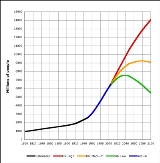
 estimates that human population may peak in the late 21st century rather than continue to grow until it exhausted available resources. Some have expressed doubt about the validity of the UN projections, claiming that they are below the projections by others. The most important point is that none of the projections show the population growth beginning to decline before 2050. Indeed, the UN "high" estimate does not decline at all, even out to 2300, indicating the potential for a Malthusian catastrophe.

The actual growth curve of the human population is another issue. In the latter part of the 20th century many argued that it followed exponential growth
Exponential growth

Exponential growth occurs when the growth rate of a mathematical function is proportionality to the function's current value. In the case of a discrete domain of definition with equal intervals it is also called geometric growth or geometric decay ....
; however, a more recent view is that the growth in the last millennium has been faster, at a superexponential (possibly hyperbolic
Hyperbolic growth

When a quantity grows towards a Mathematical singularity under a finite variation it is said to undergo hyperbolic growth.More precisely, the reciprocal function has a hyperbola as a graph, and has a singularity at 0, meaning that the limit as is infinity: any similar graph is said to exhibit hyperbolic growth....
, double-exponential
Double exponential function

A double exponential function is a constant raised to the power of an exponential function. The general formula is , which grows even faster than an exponential function....
, or hyper-exponential
Tetration

In mathematics, tetration is an iterated function exponential function, the first hyper operator after exponentiation. The portmanteau tetration was coined by English mathematician Reuben Louis Goodstein from tetra- and iteration....
) rate. Alternatively, the apparently exponential portion of the human population growth curve may actually fit the lower limb of a logistic curve, or a section of a Lotka–Volterra cycle.

Historians have estimated the total human population on earth back to 10,000 BC. The figure on the right shows the trend of total population from 1800 to 2005, and from there in three projections out to 2100 (low, medium, and high). The second figure shows the annual growth rate over the same period. If population growth were exactly exponential, then the growth rate would be a flat line. The fact that it was increasing from 1920 to 1960 indicates faster-than-exponential growth over this period. However, the growth rate has been decreasing since then, and is projected to continue decreasing. The United Nations population projections out to 2100 (the red, orange, and green lines) show a possible peak in the world's population occurring as early as 2040 in the most optimistic scenario, and by 2075 in the "medium" scenario.

World Population Growth Rates 1800 2005
The graph of annual growth rates (below) does not appear exactly as one would expect for long-term exponential growth. For exponential growth it should be a straight line at constant height, whereas in fact the graph from 1800 to 2005 is dominated by an enormous hump that began about 1920, peaked in the mid-1960s, and has been steadily eroding away for the last 40 years. The sharp fluctuation between 1959 and 1960 was due to the combined effects of the Great Leap Forward
Great Leap Forward

The Great Leap Forward of the People's Republic of China was an economic and social plan used from 1958 to 1961 which aimed to use China's vast population to rapidly transform China from a primarily agrarian economy dominated by peasant farmers into a modern, agriculturalized and industrialized communist society....
 and a natural disaster in China. Also visible on this graph are the effects of the Great Depression
Great Depression

File:International depression.pngThe Great Depression was a worldwide economic Recession starting in most places in 1929 and ending at different times in the 1930s or early 1940s for different countries....
, the two world wars, and possibly also the 1918 flu pandemic.

Though short-term trends, even on the scale of decades or centuries, cannot prove or disprove the existence of mechanisms promoting a Malthusian catastrophe over longer periods, the prosperity of a small fraction of the human population at the beginning of the 21st century, and the debatability of ecological collapse
Ecological collapse

Ecological Collapse refers to a situation where an ecosystem suffers a drastic, if not permanent, reduction in carrying capacity for all organisms, often resulting in mass extinction....
 made by Paul R. Ehrlich
Paul R. Ehrlich

Paul Ralph Ehrlich is an United States entomologist specializing in Lepidoptera . He became a household name after publication of his 1968 book The Population Bomb, in which he predicted that "In the 1970s and 1980s ....
 in the 1960s and 1970s, has led some people, such as economist Julian L. Simon
Julian Lincoln Simon

Julian Lincoln Simon was a professor of business administration at the University of Maryland, College Park and a Senior Fellow at the Cato Institute....
, to question its inevitability.

A 2004 study by a group of prominent economists and ecologists, including Kenneth Arrow
Kenneth Arrow

Kenneth Joseph Arrow is an United States economist and joint winner of the Nobel Memorial Prize in Economics with John Hicks in 1972. To date, he is the youngest person to receive this award, at 51....
 and Paul Ehrlich suggests that the central concerns regarding sustainability have shifted from population growth to the consumption/savings ratio, due to shifts in population growth rates since the 1970s. Empirical estimates show that public policy (taxes or the establishment of more complete property rights) can promote more efficient consumption and investment that are sustainable in an ecological sense; that is, given the current (relatively low) population growth rate, the Malthusian catastrophe can be avoided by either a shift in consumer preferences or public policy that induces a similar shift.

However, some contend that the Malthusian catastrophe is not imminent. A 2002 study by the UN Food and Agriculture Organization predicts that world food production will be in excess of the needs of the human population by the year 2030; however, that source also states that hundreds of millions will remain hungry (presumably due to economic realities and distribution issues).

Application to energy/resource consumption

Another way of applying the Malthusian theory is to substitute other resources, such as sources of energy for food, and energy consumption for population. (Since modern food production is energy and resource intensive, this is not a big jump. Most of the criteria for applying the theory are still satisfied.) Since energy consumption is increasing much faster than population and most energy comes from non-renewable sources, the catastrophe appears more imminent, though perhaps not as certain, than when considering food and population continue to behave in a manner contradicting Malthus's assumptions.

Retired physics professor Albert Bartlett
Albert Bartlett

Albert Allen Bartlett is an emeritus Professor of Physics at the University of Colorado at Boulder, USA. Professor Bartlett has lectured over 1,600 times since September, 1969 on Arithmetic, Population, and Energy....
, a modern-day Malthusian, has lectured on "Arithmetic, Population and Energy" over 1,500 times. He published an article entitled in Physics Today (July 2004). For a response to Bartlett's argument, see two articles on energy and population in Physics Today, November 2004, and following letters to the editor.

A further way of analyzing resource limitation is the dwindling area for storage of soil contaminants and water pollution
Water pollution

Water pollution is the contamination of water bodies such as lakes, rivers, oceans, and groundwater caused by human activities, which can be harmful to organisms and plants that live in these water bodies....
. The high rate of increase in toxic chemicals in the environment (especially persistent organic chemicals and endocrine altering chemicals) is creating a circumstance of resource limitation (e.g. safe potable water and safe arable land).

Criticism

Ester Böserup
Ester Böserup

Ester Boserup, born Ester B?rgesen, was a Danish economist and writer. She studied economical and agricultural development, worked at United Nations as well as other international organizations and she wrote several books....
 wrote in her book The Conditions of Agricultural Growth: The Economics of Agrarian Change under Population Pressure that population levels determine agricultural methods, rather than agricultural methods determining population (via food supply). A major point of her book is that "necessity is the mother of invention".

Julian Simon
Julian Lincoln Simon

Julian Lincoln Simon was a professor of business administration at the University of Maryland, College Park and a Senior Fellow at the Cato Institute....
 was one of many economists who challenged the Malthusian catastrophe, citing (1) the existence of new knowledge, and educated people to take advantage of it, and (2) economic freedom, that is, the ability of the world to increase production when there is a profitable opportunity to do so.

See also

  • Albert Bartlett
    Albert Bartlett

    Albert Allen Bartlett is an emeritus Professor of Physics at the University of Colorado at Boulder, USA. Professor Bartlett has lectured over 1,600 times since September, 1969 on Arithmetic, Population, and Energy....
  • Beyond the Limits
    Beyond the Limits

    Beyond the Limits was a 1992 book continuing the modeling of the consequences of a rapidly growing global population that was started in Limits to Growth....
     by Donella Meadows
    Donella Meadows

    Donella "Dana" Meadows was a pioneering American environmental scientist, teacher and writer. She is best known as lead author of the influential book Limits to Growth, which made headlines around the world....
  • Cannibals and Kings
    Cannibals and Kings

    Cannibals and Kings is a book written by anthropologist Marvin Harris. The book presents a systematic discussion of ideas about the reasons for a culture making a transition by stages from egalitarian hunter-gatherer to hierarchically based state as population density increases....
     by Marvin Harris
    Marvin Harris

    Marvin Harris was an United States anthropologist. He was born in Brooklyn, New York. A prolific writer, he was highly influential in the development of cultural materialism ....
  • Carrying capacity
    Carrying capacity

    The supportable population of an organism, given the food, habitat, drinking water and other necessities available within an environment is known as the environment's carrying capacity for that organism....
  • Charles Galton Darwin
    Charles Galton Darwin

    File:Charles G. Darwin, Bain News Service photo portrait.jpgSir Charles Galton Darwin, Order of the British Empire, Military Cross, Fellow of the Royal Society was an England physicist, the grandson of Charles Darwin....
  • Club of Rome
    Club of Rome

    The Club of Rome is a global think tank that deals with a variety of international political issues. It was founded in April 1968 and raised considerable public attention in 1972 with its report Limits to Growth....
  • Demographic transition
    Demographic transition

    The Demographic transition model is a model used to represent the process of explaining the transformation of countries from high birth rates and high death rates to low birth rates and low death rates as part of the economic development of a country from a pre-industrial to an industrialized Economic system....
  • Dismal Science
    Dismal Science

    The dismal science is a derogatory alternative name for economics devised by the Victorian era historian Thomas Carlyle in the 19th century. The term is an inversion of the phrase "gay science," meaning "life-enhancing knowledge." This was a familiar expression at the time, and was later adopted as the title of a book by Nietzsche ....
  • Famine
    Famine

    A famine is a widespread shortage of food that may apply to any faunal species, which phenomenon is usually accompanied by regional malnutrition, starvation, epidemic, and increased death....
  • Future energy development
  • Malthusian growth model
    Malthusian growth model

    The Malthusian growth model, sometimes called the simple exponential growth model, is essentially exponential growth based on a constant rate of compound interest....
  • Malthusianism
    Malthusianism

    Malthusianism refers to the political/economic thought of Reverend Thomas Malthus whose ideas were first developed during the industrial revolution....
  • Medieval demography
    Medieval demography

    Medieval demography is the study of human demography in Europe during the Middle Ages. It is an estimate of the number of people who were alive during the Medieval period, population trends and movements....
  • Neanderthals, Bandits and Farmers
    Neanderthals, Bandits and Farmers

    Neanderthals, Bandits and Farmers: How Agriculture Really Began is a book by the British science writer Colin Tudge. The book is one of a series of long essays by respected contemporary Darwinism thinkers, which were published under the collective title Darwinism Today; the series was inspired by a course of 'Darwin Seminars' which to...
     by Colin Tudge
    Colin Tudge

    Colin Tudge is a United Kingdom science writer and broadcaster. A biologist by training, he is the author of numerous works on food, agriculture, genetics, and species diversity....


  • Olduvai theory
    Olduvai theory

    The Olduvai theory states that industrialization will have a lifetime of less than or equal to 100 years . The theory provides a quantitative basis of the transient-pulse theory of modern civilization....
  • Over-consumption
    Over-consumption

    Over-consumption is a theory related to overpopulation, referring to situations where per capita Consumption is so high that even in spite of a moderate population density, sustainability is not achieved....
  • Overpopulation
    Overpopulation

    Overpopulation is a condition where an organism's numbers exceed the carrying capacity of its habitat. In common parlance, the term usually refers to the relationship between the world population and its environment , the Earth....
  • Peak oil
    Peak oil

    Peak oil is the point in time when the maximum rate of global petroleum Extraction of petroleum is reached, after which the rate of production enters terminal decline....
  • The Population Bomb
    The Population Bomb

    The Population Bomb is a book written by Paul R. Ehrlich. A best-selling work, it predicted disaster for humanity due to overpopulation and the "population explosion"....
     by Paul R. Ehrlich
    Paul R. Ehrlich

    Paul Ralph Ehrlich is an United States entomologist specializing in Lepidoptera . He became a household name after publication of his 1968 book The Population Bomb, in which he predicted that "In the 1970s and 1980s ....
  • Population growth
    Population growth

    Population growth is the change in population over time, and can be quantified as the change in the number of individuals in a population using "per unit time" for measurement....
  • Survivalism
    Survivalism

    Survivalism is a commonly used term for the preparedness strategy and subculture of individuals or groups anticipating and making preparations for future possible disruptions in local, regional or worldwide social or political order....
  • Sustainability
    Sustainability

    Sustainability, in a broad sense, is the ability to maintain a certain process or state. It is now most frequently used in connection with biological and human systems....
  • Tragedy of the Commons
    Tragedy of the commons

    "The Tragedy of the Commons" is an influential article written by Garrett Hardin and first published in the journal Science in 1968....
  • The Ultimate Resource, a book by Julian Simon
    Julián Simón

    Juli?n Sim?n Sesmero is a Grand Prix motorcycle racing motorcycle road racing, height 167 cm, weight 56 kg.He began his racing career racing for Honda in the 2002 Grand Prix motorcycle racing season at the Spanish motorcycle Grand Prix....
     challenging the perceived dangers of overpopulation
  • What a Way to Go: Life at the End of Empire
    What a Way to Go: Life at the End of Empire

    What A Way To Go: Life at the End of Empire is a 2007 documentary film about the current situation facing humanity and the world. It discusses issues such as peak oil, climate change, Overpopulation and Species_extinction, as well as how this situation has developed....
    , a documentary that addresses several scenarios of Malthusian catastrophe
  • World population
    World population

    The world population is the total number of living humans on Earth at a given time. As of March 2009, the world's population is estimated to be about 6.76 1,000,000,000 ....


External links