
Oil depletion occurs in the second half of the
production curveThe Hubbert curve is an approximation of the production rate of a resource over time. It is a symmetric logistic distribution curve, often confused with the "normal" gaussian function. It first appeared in "Nuclear Energy and the Fossil Fuels," geophysicist M...
of an
oil wellAn oil well is a general term for any boring through the earth's surface that is designed to find and acquire petroleum oil hydrocarbons. Usually some natural gas is produced along with the oil. A well that is designed to produce mainly or only gas may be termed a gas well.-History:The earliest...
,
oil fieldAn oil field is a region with an abundance of oil wells extracting petroleum from below ground. Because the oil reservoirs typically extend over a large area, possibly several hundred kilometres across, full exploitation entails multiple wells scattered across the area...
, or the average of total world
oilPetroleum or crude oil is a naturally occurring, flammable liquid consisting of a complex mixture of hydrocarbons of various molecular weights and other liquid organic compounds, that are found in geologic formations beneath the Earth's surface. Petroleum is recovered mostly through oil drilling...
production. The
Hubbert peak theoryThe Hubbert peak theory posits that for any given geographical area, from an individual oil-producing region to the planet as a whole, the rate of petroleum production tends to follow a bell-shaped curve...
makes predictions of production rates based on prior discovery rates and anticipated production rates.
Hubbert curveThe Hubbert curve is an approximation of the production rate of a resource over time. It is a symmetric logistic distribution curve, often confused with the "normal" gaussian function. It first appeared in "Nuclear Energy and the Fossil Fuels," geophysicist M...
s predict that the production curves of non-renewing resources approximate a
bell curve. Thus, when the
peak of productionPeak oil is the point in time when the maximum rate of global petroleum extraction is reached, after which the rate of production enters terminal decline. This concept is based on the observed production rates of individual oil wells, projected reserves and the combined production rate of a field...
is passed, production rates enter an
exponential decline.
The American Petroleum Institute estimated in 1999 the world's oil supply would be depleted between 2062 and 2094, assuming total world oil reserves at between 1.4 Toilbbl and consumption at 80 Moilbbl/d. In 2004, total world reserves were estimated to be 1.25 Toilbbl and daily consumption was about 85 Moilbbl, shifting the estimated oil depletion year to 2057.
A study published in the journal Energy Policy by researchers from Oxford University, however, predicted demand would surpass supply by 2015 (unless constrained by strong recession pressures caused by reduced supply or government intervention).
The United States
Energy Information AdministrationThe U.S. Energy Information Administration is the statistical and analytical agency within the U.S. Department of Energy. EIA collects, analyzes, and disseminates independent and impartial energy information to promote sound policymaking, efficient markets, and public understanding of energy and...
predicted in 2006 that world consumption of oil will increase to 98.3 Moilbbl/d (mbd) in 2015 and 118 mbd in 2030. With 2009 world oil consumption at 84.4 mbd, reaching the projected 2015 level of consumption would represent an average annual increase between 2009 and 2015 of 2.7% per year while EIA's own figures show declining consumption and declining supplies during the 2005-2009 period.
Resource availability
The world's oil supply is fixed because petroleum is naturally formed far too slowly to be replaced at the rate at which it is being extracted. Over many millions of years,
planktonPlankton are any drifting organisms that inhabit the pelagic zone of oceans, seas, or bodies of fresh water. That is, plankton are defined by their ecological niche rather than phylogenetic or taxonomic classification...
,
bacteriaBacteria are a large domain of prokaryotic microorganisms. Typically a few micrometres in length, bacteria have a wide range of shapes, ranging from spheres to rods and spirals...
, and other plant and animal matter become buried in sediments on the ocean floor. When conditions are right – a lack of oxygen for decomposition, and sufficient depth and temperature of burial – these organic remains are converted into petroleum compounds, while the sediment accompanying them is converted into sandstone, siltstone, and other porous sedimentary rock. When capped by impermeable rocks such as shale, salt, or igneous intrusions, they form the petroleum reservoirs which are exploited today.
Production decline models
Oil production decline occurs in a predictable manner based on geological circumstances, governmental policies, and engineering practices. The shape of the decline curve varies depending upon whether one considers a well, a field, a set of fields, or the world.
Oil well production decline
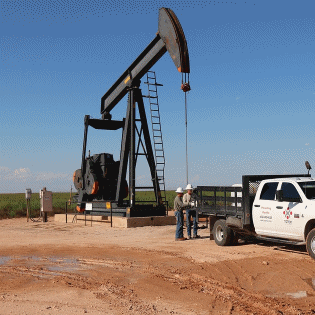
Oil wellAn oil well is a general term for any boring through the earth's surface that is designed to find and acquire petroleum oil hydrocarbons. Usually some natural gas is produced along with the oil. A well that is designed to produce mainly or only gas may be termed a gas well.-History:The earliest...
production curves typically end in an
exponential decline. At natural rates, oil well production curves appear similar to a
bell curve, a phenomenon known as the
Hubbert curveThe Hubbert curve is an approximation of the production rate of a resource over time. It is a symmetric logistic distribution curve, often confused with the "normal" gaussian function. It first appeared in "Nuclear Energy and the Fossil Fuels," geophysicist M...
. The
typical declineThe Hubbert peak theory posits that for any given geographical area, from an individual oil-producing region to the planet as a whole, the rate of petroleum production tends to follow a bell-shaped curve...
is a rapid drop in production, and eventually a leveling off to a point at which they no longer
produce profitable amountsIn physics, energy economics and ecological energetics, energy returned on energy invested ; or energy return on investment , is the ratio of the amount of usable energy acquired from a particular energy resource to the amount of energy expended to obtain that energy resource...
. Such wells are referred to as marginal or
stripper wellA stripper well or marginal well is an oil or gas well that is nearing the end of its economically useful life. In the United States of America a "stripper" gas well is defined by the Interstate Oil and Gas Compact Commission as one that produces or less of gas per day at its maximum flow rate;...
s.
The shape of production curve of an oil well can be affected by a number of factors:
- Well may be restricted by choice by lack of market demand
Supply and demand is an economic model of price determination in a market. It concludes that in a competitive market, the unit price for a particular good will vary until it settles at a point where the quantity demanded by consumers will equal the quantity supplied by producers , resulting in an...
or government regulationRegulation is administrative legislation that constitutes or constrains rights and allocates responsibilities. It can be distinguished from primary legislation on the one hand and judge-made law on the other...
. This flattens the peak of the curve, but will not change the well's total production significantly.
- Hydraulic fracturing (fracing) or acidizing may be used to cause a sharp spike in production, and may increase the recoverable reserves of a given well.
- The field may undergo a secondary or tertiary recovery
Enhanced Oil Recovery is a generic term for techniques for increasing the amount of crude oil that can be extracted from an oil field...
project, discussed in the next section.
Oil field production decline
Each individual oil well is a portion of a larger fixed area
oil fieldAn oil field is a region with an abundance of oil wells extracting petroleum from below ground. Because the oil reservoirs typically extend over a large area, possibly several hundred kilometres across, full exploitation entails multiple wells scattered across the area...
. As with individual wells, discovery and production amounts of oil fields generally average to a similar bell shaped production curve. Eventually, when the field is completely drilled out, a field's production goes into a sharp decline as the average production of its wells enter decline. As this decline levels off, production can continue at relatively low rates. A number of oil fields in the U.S. have been producing for over 100 years.
Oil field production curves can be modified by a number of factors:
- Production may be restricted by market conditions or government regulation.
- A secondary recovery project, such as water
Water injection refers to the method in oil industry where water is injected back into the reservoir, usually to increase pressure and thereby stimulate production. Water injection wells can be found both on- and offshore, to increase oil recovery from an existing reservoir...
or gas injection, can repressurize the field and improve the production rate temporarily. However, it will not change the total production amount over the life of the field. Eventually the field will go into a steeper than normal decline.
- the field may undergo an enhanced oil recovery
Enhanced Oil Recovery is a generic term for techniques for increasing the amount of crude oil that can be extracted from an oil field...
project, such as drilling of wells for injection of solventA solvent is a liquid, solid, or gas that dissolves another solid, liquid, or gaseous solute, resulting in a solution that is soluble in a certain volume of solvent at a specified temperature...
s, carbon dioxideCarbon dioxide is a naturally occurring chemical compound composed of two oxygen atoms covalently bonded to a single carbon atom...
, or steamSteam is the technical term for water vapor, the gaseous phase of water, which is formed when water boils. In common language it is often used to refer to the visible mist of water droplets formed as this water vapor condenses in the presence of cooler air...
. This can be very expensive but allows more oil to be coaxed out of the rock, increasing the ultimate production of the field.
Multi-field production decline
Most oil is found in a small number of very large oil fields. If oil fields are discovered at a constant rate until they have all been found, the combined production of fields will yield a curve such as the one at right. Production starts off slowly, rises faster and faster, then slows down and flattens until it reaches a peak. After the production peak, production enters an exponential decline, eventually flattening out. Oil production may never actually reach zero, but eventually becomes very low.
Factors which can modify this curve include:
- Inadequate demand for oil, which reduces steepness of the curve and pushes its peak into the future.
- Sharp price increases when the production peak is reached, as production fails to meet demand. If price increases cause a sharp drop in demand, a dip in the top of the curve may occur.
- Development of new drilling technology or marketing of unconventional oil can reduce the steepness of the decline as more oil is produced than initially anticipated.
United States production decline
Oil production in the
United StatesThe United States of America is a federal constitutional republic comprising fifty states and a federal district...
has followed the theoretical Hubbert curve. U.S. oil production reached its peak in 1970 and by the mid-2000s it had fallen to 1940s levels. In 1950, the United States produced over half the world's oil, but by 2005 that proportion had dropped to about 8%. In 2005, U.S. crude oil imports were twice as high as domestic production.
The production peak in 1970 was predicted in 1956 by Hubbert. By 1972 all import quotas and controls on U.S. domestic production had been removed. Oil companies began drilling large numbers of oil wells on a nationwide scale. Despite this, and despite the quadrupling of prices during the
1973 oil crisisThe 1973 oil crisis started in October 1973, when the members of Organization of Arab Petroleum Exporting Countries or the OAPEC proclaimed an oil embargo. This was "in response to the U.S. decision to re-supply the Israeli military" during the Yom Kippur war. It lasted until March 1974. With the...
, the production decline has, to date, proven irreversible.
The actual U.S. production curve does deviate from Hubbert's 1956 curve in some significant ways:
- When oil surpluses created a glut on the market and low prices began causing demand and production curves to rise, regulatory agencies such as the Texas Railroad Commission stepped in to restrain production.
- The curve peaked at a sharp point rather than gradually flattening out. This occurred because as consumption began to approach production limits, oil companies drilled out all their existing fields as fast as they could, and many of those fields peaked simultaneously.
- Production fell after 1970, but started to recover and reached a lower secondary peak in 1988. This occurred because the supergiant Prudhoe Bay
Prudhoe Bay Oil Field is a large oil field on Alaska's North Slope. It is the largest oil field in both the United States and in North America, covering and originally containing approximately of oil.. BP. August 2006...
field in Alaska was only discovered in 1968, and the Trans-Alaska Pipeline SystemThe Trans Alaska Pipeline System , includes the Trans Alaska Pipeline, 11 pump stations, several hundred miles of feeder pipelines, and the Valdez Marine Terminal. TAPS is one of the world's largest pipeline systems...
(TAPS) was not completed until 1977. After 1988, Alaska production peaked and total U.S. production began to decline again. By 2005, Prudhoe Bay had produced over 75% of its oil.
World oil production
World oil production has followed a typical Hubbert curve, rising over the past century with only a few dips. The 1970 production peak in the U.S. caused many people to begin to question when the world production peak would occur. The peak of world production is known as
Peak oilPeak oil is the point in time when the maximum rate of global petroleum extraction is reached, after which the rate of production enters terminal decline. This concept is based on the observed production rates of individual oil wells, projected reserves and the combined production rate of a field...
. By the mid-2000s, all of the world's major oil producing countries except
Saudi ArabiaThe Kingdom of Saudi Arabia , commonly known in British English as Saudi Arabia and in Arabic as as-Sa‘ūdiyyah , is the largest state in Western Asia by land area, constituting the bulk of the Arabian Peninsula, and the second-largest in the Arab World...
were producing at maximum capacity (many having peaked in production), and some experts such as
Matthew SimmonsMatthew Roy Simmons was founder and chairman emeritus of Simmons & Company International, and was a prominent advocate of peak oil. Simmons was motivated by the 1973 energy crisis to create an investment banking firm catering to oil companies. In his previous capacity, he served as energy...
were questioning whether even Saudi Arabia had any reserve capacity left.
Industry observers have pointed to the similarities between the global production curve in mid-2000s and that of the United States in the 1970s.
- The oil price increases since 2003 were preceded by a decade of production cutbacks in OPEC
OPEC is an intergovernmental organization of twelve developing countries made up of Algeria, Angola, Ecuador, Iran, Iraq, Kuwait, Libya, Nigeria, Qatar, Saudi Arabia, the United Arab Emirates, and Venezuela. OPEC has maintained its headquarters in Vienna since 1965, and hosts regular meetings...
countries in an attempt to keep prices high despite an oil glut. This is similar to production cutbacks in TexasTexas is the second largest U.S. state by both area and population, and the largest state by area in the contiguous United States.The name, based on the Caddo word "Tejas" meaning "friends" or "allies", was applied by the Spanish to the Caddo themselves and to the region of their settlement in...
and other states to maintain prices despite an oil glut in the decade prior to the 1973 oil crisisThe 1973 oil crisis started in October 1973, when the members of Organization of Arab Petroleum Exporting Countries or the OAPEC proclaimed an oil embargo. This was "in response to the U.S. decision to re-supply the Israeli military" during the Yom Kippur war. It lasted until March 1974. With the...
.
- World oil prices reached record inflation adjusted highs beginning in 2008, but new oil did not appear on the market, as the theory of supply and demand
Supply and demand is an economic model of price determination in a market. It concludes that in a competitive market, the unit price for a particular good will vary until it settles at a point where the quantity demanded by consumers will equal the quantity supplied by producers , resulting in an...
would predict. This is reminiscent of price increases in the United States in the 1970s when U.S. oil production started to decline despite record high prices and record drilling by oil companies.
- There are serious doubts about whether OPEC countries really have the oil reserves
The total estimated amount of oil in an oil reservoir, including both producible and non-producible oil, is called oil in place. However, because of reservoir characteristics and limitations in petroleum extraction technologies, only a fraction of this oil can be brought to the surface, and it is...
they claim. This is similar to the illusionary oil reserves that U.S. oil companies claimed to have in the decade prior to the 1973 and 1979 oil crisis. In the 1970s, those companies were unable to produce as much oil as they had predicted, and production went down instead of up.
Implications of a world peak
A
peakPeak oil is the point in time when the maximum rate of global petroleum extraction is reached, after which the rate of production enters terminal decline. This concept is based on the observed production rates of individual oil wells, projected reserves and the combined production rate of a field...
in oil production could result in a worldwide oil shortage, or it could not even be noticed as demand decreases in conjunction with increased prices. While past shortages stemmed from a temporary insufficiency of supply, crossing Hubbert's Peak would mean that the production of oil would continue to decline, and that demand for these products must be reduced to meet supply. The effects of such a shortage would depend on the rate of decline and the development and adoption of effective alternatives.
If alternatives were not forthcoming, it has been speculated that the numerous products produced with oil would become scarcer, leading to at the very least lower living standards in developed and developing countries alike, and possibly in the worst case to the collapse of the entire international banking system, which could not likely sustain itself without the prospect of growth. The political situation may change dramatically, with potential wars between countries over access to dwindling supplies. Accordingly, inequalities between various countries and regions of the world may become exacerbated.
Catastrophe
:)
Economic growthIn economics, economic growth is defined as the increasing capacity of the economy to satisfy the wants of goods and services of the members of society. Economic growth is enabled by increases in productivity, which lowers the inputs for a given amount of output. Lowered costs increase demand...
and prosperity since the
industrial revolutionThe Industrial Revolution was a period from the 18th to the 19th century where major changes in agriculture, manufacturing, mining, transportation, and technology had a profound effect on the social, economic and cultural conditions of the times...
have, in large part, been due to increased efficiencies in the use of better and higher concentrations of energy in fossil fuels. The use of fossil fuels allows humans to participate in
takedownTakedown or take down may refer to:*Takedown , a book by John Markoff and Tsutomu Shimomura about the capture of Kevin Mitnick**Track Down, a 2000 film based thereon, known also as Takedown...
, which is the consumption of energy at a greater rate than it is being replaced. Some believe that decreasing oil production portends a drastic impact on human culture and modern technological society, which is currently heavily dependent on oil as a fuel and chemical feedstock. For example, over 90% of transportation in the United States relies on oil.
Some envisage a
Malthusian catastropheA Malthusian catastrophe was originally foreseen to be a forced return to subsistence-level conditions once population growth had outpaced agricultural production...
occurring as oil becomes increasingly inefficient to produce, others have learned from the examples demonstrated in mature basins and applied those operational procedures to these basins to preserve their operational tempo. Since the 1940s,
agricultureAgriculture is the cultivation of animals, plants, fungi and other life forms for food, fiber, and other products used to sustain life. Agriculture was the key implement in the rise of sedentary human civilization, whereby farming of domesticated species created food surpluses that nurtured the...
has dramatically increased its productivity, due largely to the use of chemical
pesticidePesticides are substances or mixture of substances intended for preventing, destroying, repelling or mitigating any pest.A pesticide may be a chemical unicycle, biological agent , antimicrobial, disinfectant or device used against any pest...
s, fertilizers, and increased mechanisation. This process has been called the
Green RevolutionGreen Revolution refers to a series of research, development, and technology transfer initiatives, occurring between the 1940s and the late 1970s, that increased agriculture production around the world, beginning most markedly in the late 1960s....
. The increase in food production has allowed world population to grow dramatically over the last 50 years. Pesticides rely upon oil as a critical ingredient, and fertilizers require natural gas. Farm machinery also requires oil.
Arguing that in today's world every
jouleThe joule ; symbol J) is a derived unit of energy or work in the International System of Units. It is equal to the energy expended in applying a force of one newton through a distance of one metre , or in passing an electric current of one ampere through a resistance of one ohm for one second...
one eats requires 5–15 joules to produce and deliver, some have speculated that decreasing supply of oil will cause modern
industrial agricultureIndustrial farming is a form of modern farming that refers to the industrialized production of livestock, poultry, fish, and crops. The methods of industrial agriculture are technoscientific, economic, and political...
to collapse, leading to a drastic decline in food production, food shortages and possibly even mass
starvationStarvation is a severe deficiency in caloric energy, nutrient and vitamin intake. It is the most extreme form of malnutrition. In humans, prolonged starvation can cause permanent organ damage and eventually, death...
. However, most or all of the uses of fossil fuels in agriculture can be replaced with alternatives. For example, by far the biggest fossil fuel input to agriculture is the use of natural gas as a hydrogen source for the
Haber-BoschThe Haber process, also called the Haber–Bosch process, is the nitrogen fixation reaction of nitrogen gas and hydrogen gas, over an enriched iron or ruthenium catalyst, which is used to industrially produce ammonia....
fertilizer-creation process. Natural gas is used simply because it is the cheapest currently-available source of hydrogen; were that to change, other sources, such as
electrolysisIn chemistry and manufacturing, electrolysis is a method of using a direct electric current to drive an otherwise non-spontaneous chemical reaction...
powered by solar energy, could be used to provide the hydrogen for creating fertilizer without relying on fossil fuels.
Oil shortages may force a move to lower input "organic agriculture" methods, which may be more labor-intensive and require a population shift from urban to rural areas, reversing the trend towards urbanisation which has predominated in industrial societies; however, some organic farmers using modern organic-farming methods have reported yields as high as those available from conventional farming, but without the use of fossil-fuel-intensive artificial fertilizers or pesticides.
Another possible effect would derive from modern transportation and housing infrastructure. A large proportion of the developed world's population live in suburbs, a type of low-density settlement designed with the
automobileAn automobile, autocar, motor car or car is a wheeled motor vehicle used for transporting passengers, which also carries its own engine or motor...
in mind. Commentators such as
James Howard KunstlerJames Howard Kunstler is an American author, social critic, public speaker, and blogger. He is best known for his books The Geography of Nowhere , a history of American suburbia and urban development, and the more recent The Long Emergency , where he argues that declining oil production is likely...
argue that because of its reliance on the automobile, the suburb is an unsustainable living arrangement; the implications of peak oil would leave many suburb-dwellers unable to afford fuel for their cars, and force them to move to higher density, more walkable areas. In effect, surburbia would comprise the "
slumA slum, as defined by United Nations agency UN-HABITAT, is a run-down area of a city characterized by substandard housing and squalor and lacking in tenure security. According to the United Nations, the percentage of urban dwellers living in slums decreased from 47 percent to 37 percent in the...
s of the future." A movement to deal with this problem early, called "
New UrbanismNew Urbanism is an urban design movement, which promotes walkable neighborhoods that contain a range of housing and job types. It arose in the United States in the early 1980s, and has gradually continued to reform many aspects of real estate development, urban planning, and municipal land-use...
," seeks to develop the suburbs into higher density neighborhoods and use high density, mixed-use forms for new building projects.
Recession
A more modest scenario, assuming a slower rate of depletion and a smooth transition to alternative energy sources could cause substantial economic hardship such as a
recessionIn economics, a recession is a business cycle contraction, a general slowdown in economic activity. During recessions, many macroeconomic indicators vary in a similar way...
or depression due to higher energy prices. Historically, there is a close correlation in the timing of oil price spikes and economic downturns.
InflationIn economics, inflation is a rise in the general level of prices of goods and services in an economy over a period of time.When the general price level rises, each unit of currency buys fewer goods and services. Consequently, inflation also reflects an erosion in the purchasing power of money – a...
has also been linked to oil price spikes. However, economists disagree on the strength and causes of this association. Conversely, the recessions of the early 1970s and early 1980s were associated with a relatively brief period of somewhat dwindling energy availability; the possible future increase in oil prices might be much higher and last longer. See
Energy crisisAn energy crisis is any great bottleneck in the supply of energy resources to an economy. In popular literature though, it often refers to one of the energy sources used at a certain time and place, particularly those that supply national electricity grids or serve as fuel for vehicles...
.
Rising food prices
Rising oil prices cause rising food prices in three ways. First, increased equipment fuel costs drive higher prices. Second, transportation costs increase retail prices. Third, higher oil prices are causing farmers to switch from producing food crops to producing
biofuelBiofuel is a type of fuel whose energy is derived from biological carbon fixation. Biofuels include fuels derived from biomass conversion, as well as solid biomass, liquid fuels and various biogases...
crops.
The law of supply and demand predicts that if fewer farmers are producing food the price of food will rise.
See also
- Energy law
Energy laws govern the use and taxation of energy, both renewable and non-renewable. These laws are the primary authorities related to energy...
- Oil Megaprojects
-Megaprojects predicted for individual years:-New supply addition per country from oil megaprojects:Volumes shown are in thousand barrels per day. The summary table below is produced by a Perl script parsing each annual table...
- ACEGES
The ACEGES is a decision-support tool for energy policy by means of controlled computational experiments. The ACEGES tool is designed to be the foundation for large custom-purpose simulations of the global energy system...
Further reading
- Kenneth S. Deffeyes. Hubbert's Peak : The Impending World Oil Shortage, Princeton University Press (August 11, 2003), ISBN 0–691–11625–3.
- Richard Heinberg. The Party's Over: Oil, War, and the Fate of Industrial Societies, New Society Press ISBN 0–86571–482–7
- Mathew R. Simmons. Twilight in the Desert: The Coming Saudi Oil Shock and the World Economy, Wiley (June 10, 2005), ISBN 0–471–73876-X
External links