


Madame Restell

Encyclopedia

Abortion
Abortion is defined as the termination of pregnancy by the removal or expulsion from the uterus of a fetus or embryo prior to viability. An abortion can occur spontaneously, in which case it is usually called a miscarriage, or it can be purposely induced...
ist who practiced in New York City
New York City
New York is the most populous city in the United States and the center of the New York Metropolitan Area, one of the most populous metropolitan areas in the world. New York exerts a significant impact upon global commerce, finance, media, art, fashion, research, technology, education, and...
.
Biography
Restell was born in PainswickPainswick
Painswick is a small town in Gloucestershire, England. Originally the town grew on the wool trade, but it is now best known for its parish church's yew trees and the local Rococo Garden. The town is mainly constructed of locally quarried Cotswold stone...
, Gloucestershire
Gloucestershire
Gloucestershire is a county in South West England. The county comprises part of the Cotswold Hills, part of the flat fertile valley of the River Severn, and the entire Forest of Dean....
, England
England
England is a country that is part of the United Kingdom. It shares land borders with Scotland to the north and Wales to the west; the Irish Sea is to the north west, the Celtic Sea to the south west, with the North Sea to the east and the English Channel to the south separating it from continental...
. Her father was a labourer. At the age of fifteen she started work as a maid
Maid
A maidservant or in current usage housemaid or maid is a female employed in domestic service.-Description:Once part of an elaborate hierarchy in great houses, today a single maid may be the only domestic worker that upper and even middle-income households can afford, as was historically the case...
in a butcher's family, and at sixteen she married a Wiltshire
Wiltshire
Wiltshire is a ceremonial county in South West England. It is landlocked and borders the counties of Dorset, Somerset, Hampshire, Gloucestershire, Oxfordshire and Berkshire. It contains the unitary authority of Swindon and covers...
man called Henry Summer. After three years living in England, they emigrated to New York in 1831 where Summer died of yellow fever
Yellow fever
Yellow fever is an acute viral hemorrhagic disease. The virus is a 40 to 50 nm enveloped RNA virus with positive sense of the Flaviviridae family....
. Restell was forced to make a poor living as a seamstress.
Restell remarried in 1836, to a German–Russian immigrant, Charles Lohman, who worked in the printing trade. Lohman was a radical
Radicalism (historical)
The term Radical was used during the late 18th century for proponents of the Radical Movement. It later became a general pejorative term for those favoring or seeking political reforms which include dramatic changes to the social order...
and freethinker
Freethought
Freethought is a philosophical viewpoint that holds that opinions should be formed on the basis of science, logic, and reason, and should not be influenced by authority, tradition, or other dogmas...
, a friend and colleague of George Matsell (radical), the publisher of the radical journal the Free Inquirer. With Matsell, Lohman was involved in the publication of Robert Dale Owen
Robert Dale Owen
Robert Dale Owen was a longtime exponent in his adopted United States of the socialist doctrines of his father, Robert Owen, as well as a politician in the Democratic Party.-Biography:...
's book Moral Physiology; or, a Brief and Plain Treatise on the Population Question (1831) and Charles Knowlton
Charles Knowlton
Charles Knowlton was an American physician, atheist and writer.-Education:Knowlton was born May 10, 1800 in Templeton, Massachusetts. His parents were Stephen and Comfort Knowlton; his grandfather Ezekiel Knowlton, who was a Captain in the revolution and a longtime state legislator...
's Fruits of Philosophy; or, The Private Companion of Young Married People (1831).
Restell's brother, Joseph Trow, had also emigrated to New York, and was working as a sales assistant in a pharmacy
Pharmacy
Pharmacy is the health profession that links the health sciences with the chemical sciences and it is charged with ensuring the safe and effective use of pharmaceutical drugs...
. Restell began to develop an interest in women's health, selling patent medicine
Patent medicine
Patent medicine refers to medical compounds of questionable effectiveness sold under a variety of names and labels. The term "patent medicine" is somewhat of a misnomer because, in most cases, although many of the products were trademarked, they were never patented...
, and (probably in partnership with her husband and brother) creating birth control
Birth control
Birth control is an umbrella term for several techniques and methods used to prevent fertilization or to interrupt pregnancy at various stages. Birth control techniques and methods include contraception , contragestion and abortion...
products, advertised under the name "Madame Restell". The term "Restellism" became a euphemism for abortion.
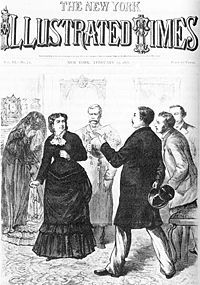
Penny press
Penny press newspapers were cheap, tabloid-style papers produced in the middle of the 19th century.- History :As the East Coast's middle and working classes grew, so did the new public’s desire for news. Penny papers emerged as a cheap source with coverage of crime, tragedy, adventure, and gossip...
. Newspaper editor Horace Greeley
Horace Greeley
Horace Greeley was an American newspaper editor, a founder of the Liberal Republican Party, a reformer, a politician, and an outspoken opponent of slavery...
criticized other newspapers for accepting advertisements by Restell, and George Washington Dixon
George Washington Dixon
George Washington Dixon was an American singer, stage actor, and newspaper editor. He rose to prominence as a blackface performer after performing "Coal Black Rose", "Zip Coon", and similar songs...
of the Polyanthos as well as the National Police Gazette also refused her advertisements.
In 1841, Mary Rogers
Mary Rogers
Mary Cecilia Rogers , also known as the "Beautiful Cigar Girl", was a 19th-century murder victim whose story became a national sensation in the United States...
was found dead in the Hudson River. Newspapers suggested that she had died during an abortion carried out by Restell, although later evidence seems to contradict this. Regardless, abortion was soon outlawed. Soon it became legally defined as an obscene subject and was no longer covered in the papers. Following Restell's arrest in early 1878, a maid discovered Restell in the bathtub at her Fifth Avenue home; she had slit her own throat on the morning of April 1, 1878. Upon her death, she was claimed to have been worth between $500,000-$600,000 ($-$ in present-day terms).
Sources and external links
- "In the Eye of Power: The Notorious Madam Restell" by Cynthia Watkins Richardson
- Sins of New York As "Exposed" by the Police Gazette (1930) by Edward van Every (extract)