


MWP and LIA in IPCC reports

Encyclopedia
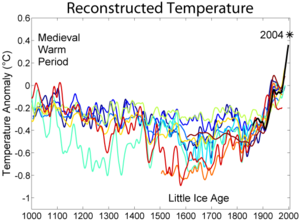
Temperature record of the past 1000 years
The temperature record of the 2nd millennium describes the reconstruction of temperatures since 1000 CE on the Northern Hemisphere, later extended back to 1 CE and also to cover the southern hemisphere. A reconstruction is needed because a reliable surface temperature record exists only since about...
has improved. The Medieval Warm Period
Medieval Warm Period
The Medieval Warm Period , Medieval Climate Optimum, or Medieval Climatic Anomaly was a time of warm climate in the North Atlantic region, that may also have been related to other climate events around the world during that time, including in China, New Zealand, and other countries lasting from...
(MWP) and Little Ice Age
Little Ice Age
The Little Ice Age was a period of cooling that occurred after the Medieval Warm Period . While not a true ice age, the term was introduced into the scientific literature by François E. Matthes in 1939...
(LIA) are the best-known temperature fluctuations in the last millennium.
Critics of the "hockey stick graph" of later reports have claimed
Hockey stick controversy
The hockey stick controversy refers to debates over the technical correctness and implications for global warming of graphs showing reconstructed estimates of the temperature record of the past 1000 years...
that the record of the MWP and LIA were suppressed in the IPCC Third Assessment Report
IPCC Third Assessment Report
The IPCC Third Assessment Report, Climate Change 2001, is an assessment of available scientific and socio-economic information on climate change by the IPCC. The IPCC was established in 1988 by the United Nations Environment Programme and the UN's World Meteorological Organization ".....
, although every report has discussed the phenomena.
1990 report (FAR)
Global warming
Global warming refers to the rising average temperature of Earth's atmosphere and oceans and its projected continuation. In the last 100 years, Earth's average surface temperature increased by about with about two thirds of the increase occurring over just the last three decades...
in the 1980s came renewed interest in the past temperature record, and the question of whether past times had been warmer or colder than "present". However, at that time available records were few. The discussion in chapter 7 "Observed climate variations and change" of the last 1000 years (excluding the instrumental period) occupies less than a page.
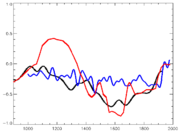
A schematic (non-quantitative) curve was used to represent temperature variations over the last 1000 years in chapter 7. The vertical temperature scale was labelled as "Temperature change (°C)" but no numerical labels were given; it could be taken to imply that temperature variations of the MWP and LIA were each of the order of 0.5 °C from the temperature around 1900. The section specifically states recent climate changes were in a range of probably less than 2 °C. The 1990 report noted that it was not clear whether all the fluctuations indicated were truly global (p 202). The graph had no clear source (but can be traced to publications by Hubert Lamb
Hubert Lamb
Hubert Horace Lamb was an English climatologist who founded the Climatic Research Unit in 1972 in the School of Environmental Sciences at the University of East Anglia.-Career:...
representing the Central England Temperature
Central England temperature
The Central England Temperature record was originally published by Professor Gordon Manley in 1953 and subsequently extended and updated in 1974, following many decades of painstaking work...
. Those publications have no explicit calibration against instrumental data, [and are] just Lamb’s qualitative judgement and interpretation of what he refers to as the ‘evidence’ ), and disappeared from the 1992 supplementary report.
Within the 1990 report, the LIA is taken to be global in extent but the MWP is not. Climate over the last 1000 years is mentioned very briefly in the SPM
Summary for policymakers
The Summary for policymakers is a summary of the IPCC reports intended to aid policymakers. The content is determined by the scientists, but the form is approved line by line by governments...
of the 1990 report. The MWP is not mentioned at all, and the LIA described by ...probably fluctuated by little more than 1°C. Some fluctuations lasted several centuries, including the LIA which ended in the
1992 supplement
The 1992 report (appendix C) used only two graphs of pre-instrumental temperatures, from Wang and Wang (1991). They show air temperature based on documentary evidence in East and North China from 1350–1950. Fluctuations are of the order of 0.5-0.75 °C and indicate, variably, colder-than-present temperatures before the 20th century. The graph stops in 1350 and does not show an MWP. The only text reference to the MWP is qualified by in this region in boldface.1995 report (SAR)
By 1995, research in the subject had advanced and hemispherical reconstructions of temperature were available, though only for the summer season (because tree rings are often most strongly influenced by summer temperatures). The 1995 IPCC report used a northern hemisphere summer temperature reconstruction (fig 3.20) from 1400 to 1979 by Bradley and Jones (1993). This too shows no MWP (it only goes back to 1400) and colder temperatures otherwise before the 20th century, of the order of 0.5 °C colder. Fig 3.21 shows 8 ice core records from 1200 to present, which display a mixed pattern. The MWP and LIA are introduced, in the text, as two periods which have received special attention... These have been interpreted, at times, as periods of global warmth and coolness, respectively. Recent studies have re-evaluated the interval commonly known as the MWP... the available evidence is limited (geographically) and is equivocal.2001 report (TAR)
The 2001 report used northern hemisphere warm-season and annual reconstructions from 1000 AD to present by Mann et al. (1999), Jones et al. (1998) and Briffa (2000) .The IPCC TAR
IPCC Third Assessment Report
The IPCC Third Assessment Report, Climate Change 2001, is an assessment of available scientific and socio-economic information on climate change by the IPCC. The IPCC was established in 1988 by the United Nations Environment Programme and the UN's World Meteorological Organization ".....
says of the MWP that the posited Medieval Warm Period appears to have been less distinct, more moderate in amplitude, and somewhat different in timing at the hemispheric scale than is typically inferred for the conventionally-defined European epoch. The Northern Hemisphere mean temperature estimates of Jones et al. (1998), Mann et al. (1999), and Crowley and Lowery (2000) show temperatures from the 11th to 14th centuries to be about 0.2°C warmer than those from the 15th to 19th centuries, but rather below mid-20th century temperatures .
The TAR discusses Was there a "Little Ice Age" and a "Medieval Warm Period"? and says Thus current evidence does not support globally synchronous periods of anomalous cold or warmth over this timeframe, and the conventional terms of "Little Ice Age" and "Medieval Warm Period" appear to have limited utility in describing trends in hemispheric or global mean temperature changes in past centuries.