

Loss of heterozygosity

Encyclopedia
Loss of heterozygosity in a cell
is the loss of normal function of one allele
of a gene
in which the other allele was already inactivated. This term is mostly used in the context of oncogenesis; after an inactivating mutation in one allele of a tumor suppressor gene
occurs in the parent's germline cell, it is passed on to the zygote resulting in an offspring that is heterozygous for that allele. In oncology, loss of heterozygosity occurs when the remaining functional allele in a somatic cell of the offspring becomes inactivated by mutation. This could cause a normal tumor suppressor to no longer be produced which could result in tumorigenesis.
, where it indicates the absence of a functional tumor suppressor gene
in the lost region. However, many people remain healthy with such a loss, because there still is one functional gene left on the other chromosome of the chromosome pair. However, the remaining copy of the tumor suppressor gene can be inactivated by a point mutation
, leaving no tumor suppressor gene to protect the body. Loss of heterozygosity does not imply a reversal to the homozygous state.
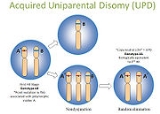
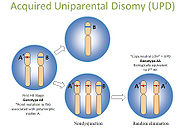
(UPD) or gene conversion. In UPD, a person receives two copies of a chromosome, or part of a chromosome, from one parent and no copies from the other parent due to errors in meiosis I or meiosis II. This acquired homozygosity could lead to development of cancer if the individual inherited a non-functional allele of a tumor suppressor gene.
In tumor cells copy-neutral LOH can be biologically equivalent to the second hit in the Knudson hypothesis. Acquired UPD is quite common in both hematologic and solid tumors, and is reported to constitute 20 to 80% of the LOH seen in human tumors. Determination of virtual karyotypes
using SNP-based arrays can provide genome-wide copy number and LOH status, including detection of copy-neutral LOH. Copy-neutral LOH cannot be detected by arrayCGH, FISH, or conventional cytogenetics. SNP-based arrays are preferred for virtual karyotyping of tumors and can be performed on fresh or paraffin-embedded tissues.

, in which one parent's contribution of the tumor suppressor Rb1
is flawed. Although most cells will have a functional second copy, chance loss of heterozygosity events in individual cells almost invariably lead to the development of this retinal cancer in the young child.
in an organism's germline
DNA
, and the absence of heterozygosity at that locus in the cancer cells. This is often done using polymorphic
markers, such as microsatellites or single-nucleotide polymorphisms, for which the two parents contributed different alleles.
Genome-wide LOH status of fresh or paraffin embedded tissue samples can be assessed by virtual karyotyping
using SNP arrays.
Cell (biology)
The cell is the basic structural and functional unit of all known living organisms. It is the smallest unit of life that is classified as a living thing, and is often called the building block of life. The Alberts text discusses how the "cellular building blocks" move to shape developing embryos....
is the loss of normal function of one allele
Allele
An allele is one of two or more forms of a gene or a genetic locus . "Allel" is an abbreviation of allelomorph. Sometimes, different alleles can result in different observable phenotypic traits, such as different pigmentation...
of a gene
Gene
A gene is a molecular unit of heredity of a living organism. It is a name given to some stretches of DNA and RNA that code for a type of protein or for an RNA chain that has a function in the organism. Living beings depend on genes, as they specify all proteins and functional RNA chains...
in which the other allele was already inactivated. This term is mostly used in the context of oncogenesis; after an inactivating mutation in one allele of a tumor suppressor gene
Tumor suppressor gene
A tumor suppressor gene, or anti-oncogene, is a gene that protects a cell from one step on the path to cancer. When this gene is mutated to cause a loss or reduction in its function, the cell can progress to cancer, usually in combination with other genetic changes.-Two-hit hypothesis:Unlike...
occurs in the parent's germline cell, it is passed on to the zygote resulting in an offspring that is heterozygous for that allele. In oncology, loss of heterozygosity occurs when the remaining functional allele in a somatic cell of the offspring becomes inactivated by mutation. This could cause a normal tumor suppressor to no longer be produced which could result in tumorigenesis.
In cancer
It is a common occurrence in cancerCancer
Cancer , known medically as a malignant neoplasm, is a large group of different diseases, all involving unregulated cell growth. In cancer, cells divide and grow uncontrollably, forming malignant tumors, and invade nearby parts of the body. The cancer may also spread to more distant parts of the...
, where it indicates the absence of a functional tumor suppressor gene
Tumor suppressor gene
A tumor suppressor gene, or anti-oncogene, is a gene that protects a cell from one step on the path to cancer. When this gene is mutated to cause a loss or reduction in its function, the cell can progress to cancer, usually in combination with other genetic changes.-Two-hit hypothesis:Unlike...
in the lost region. However, many people remain healthy with such a loss, because there still is one functional gene left on the other chromosome of the chromosome pair. However, the remaining copy of the tumor suppressor gene can be inactivated by a point mutation
Point mutation
A point mutation, or single base substitution, is a type of mutation that causes the replacement of a single base nucleotide with another nucleotide of the genetic material, DNA or RNA. Often the term point mutation also includes insertions or deletions of a single base pair...
, leaving no tumor suppressor gene to protect the body. Loss of heterozygosity does not imply a reversal to the homozygous state.
Knudson two-hit hypothesis of tumorigenesis
- First Hit: The first hit is classically thought of as a point mutation that inactivates one copy of a tumor suppressor gene (TSG), such as Rb1. In hereditary cancer syndromes, individuals are born with the first hit. The individual does not develop cancer at this point because the remaining TSG on the other allele is still functioning normally.
- Second Hit: The second hit is classically thought of as a large deletion that results in loss of the remaining functioning TSG allele. This leaves only a non-functioning copy of the TSG, and the individual goes on to develop cancer.
Copy-neutral LOH
Copy-neutral LOH is thus called because no net change in the copy number occurs in the affected individual. Other names for copy-neutral LOH are acquired uniparental disomyUniparental disomy
Uniparental disomy occurs when a person receives two copies of a chromosome, or part of a chromosome, from one parent and no copies from the other parent.. UPD could involve isodisomy or heterodisomy ....
(UPD) or gene conversion. In UPD, a person receives two copies of a chromosome, or part of a chromosome, from one parent and no copies from the other parent due to errors in meiosis I or meiosis II. This acquired homozygosity could lead to development of cancer if the individual inherited a non-functional allele of a tumor suppressor gene.
In tumor cells copy-neutral LOH can be biologically equivalent to the second hit in the Knudson hypothesis. Acquired UPD is quite common in both hematologic and solid tumors, and is reported to constitute 20 to 80% of the LOH seen in human tumors. Determination of virtual karyotypes
Virtual Karyotype
Virtual karyotype detects genomic copy number variations at a higher resolution level than conventional karyotyping or chromosome-based comparative genomic hybridization .-Background:...
using SNP-based arrays can provide genome-wide copy number and LOH status, including detection of copy-neutral LOH. Copy-neutral LOH cannot be detected by arrayCGH, FISH, or conventional cytogenetics. SNP-based arrays are preferred for virtual karyotyping of tumors and can be performed on fresh or paraffin-embedded tissues.
Retinoblastoma
The classical example of such a loss of protecting genes is hereditary retinoblastomaRetinoblastoma
Retinoblastoma is a rapidly developing cancer that develops in the cells of retina, the light-detecting tissue of the eye. In the developed world, Rb has one of the best cure rates of all childhood cancers , with more than nine out of every ten sufferers surviving into...
, in which one parent's contribution of the tumor suppressor Rb1
Retinoblastoma protein
The retinoblastoma protein is a tumor suppressor protein that is dysfunctional in the majority types of cancer. One highly studied function of pRb is to prevent excessive cell growth by inhibiting cell cycle progression until a cell is ready to divide...
is flawed. Although most cells will have a functional second copy, chance loss of heterozygosity events in individual cells almost invariably lead to the development of this retinal cancer in the young child.
Breast Cancer and BRCA1/2
The genes BRCA1 and BRCA2 show loss of heterozygosity in samplings of tumors from patients who have germline mutations. BRCA1/2 are genes that produce proteins which regulate the DNA repair pathway by binding to Rad51.Detection
Loss of heterozygosity can be identified in cancers by noting the presence of heterozygosity at a genetic locusLocus (genetics)
In the fields of genetics and genetic computation, a locus is the specific location of a gene or DNA sequence on a chromosome. A variant of the DNA sequence at a given locus is called an allele. The ordered list of loci known for a particular genome is called a genetic map...
in an organism's germline
Germline
In biology and genetics, the germline of a mature or developing individual is the line of germ cells that have genetic material that may be passed to a child.For example, gametes such as the sperm or the egg, are part of the germline...
DNA
DNA
Deoxyribonucleic acid is a nucleic acid that contains the genetic instructions used in the development and functioning of all known living organisms . The DNA segments that carry this genetic information are called genes, but other DNA sequences have structural purposes, or are involved in...
, and the absence of heterozygosity at that locus in the cancer cells. This is often done using polymorphic
Polymorphism (biology)
Polymorphism in biology occurs when two or more clearly different phenotypes exist in the same population of a species — in other words, the occurrence of more than one form or morph...
markers, such as microsatellites or single-nucleotide polymorphisms, for which the two parents contributed different alleles.
Genome-wide LOH status of fresh or paraffin embedded tissue samples can be assessed by virtual karyotyping
Virtual Karyotype
Virtual karyotype detects genomic copy number variations at a higher resolution level than conventional karyotyping or chromosome-based comparative genomic hybridization .-Background:...
using SNP arrays.
See also
- Microsatellite instabilityMicrosatellite instabilityMicrosatellites are repeated sequences of DNA. Although the length of these microsatellites is highly variable from person to person, each individual has microsatellites of a set length. These repeated sequences are common, and normal...
- Tumor suppressor geneTumor suppressor geneA tumor suppressor gene, or anti-oncogene, is a gene that protects a cell from one step on the path to cancer. When this gene is mutated to cause a loss or reduction in its function, the cell can progress to cancer, usually in combination with other genetic changes.-Two-hit hypothesis:Unlike...
- Virtual KaryotypeVirtual KaryotypeVirtual karyotype detects genomic copy number variations at a higher resolution level than conventional karyotyping or chromosome-based comparative genomic hybridization .-Background:...
- Knudson hypothesisKnudson hypothesisThe Knudson hypothesis is the hypothesis that cancer is the result of accumulated mutations to a cell's DNA. It was first proposed by Carl O. Nordling in 1953, and later formulated by Alfred G. Knudson in 1971. Knudson's work led indirectly to the identification of cancer-related genes...
- Deletion (genetics)
External links
- "Long-term study of the clinical significance of loss of heterozygosity in childhood acute lymphoblastic leukemia" – Nature
- "Loss of heterozygosity identifies genetic changes in chronic myeloid disorders, including myeloproliferative disorders, myelodysplastic syndromes and chronic myelomonocytic leukemia" – Nature
- "Mapping loss of heterozygosity in normal human breast cells from BRCA1/2 carriers" – BJC
- "Loss of Heterozygosity Studies on Chromosome 12q in Disseminated Superficial Actinic Porokeratosis: Lessons to be Learned" – Journal of Investigative Dermatology